


Ditch the Drag-and-Drop: Build Complex Systems through Conversation
For decades, creating visual models was a labor-intensive process that required manual drag-and-drop actions, wrestling with rigid templates, and specialized knowledge of complex notations. Professionals often faced the grueling task of translating messy or vague requirements into structured visuals, a process that could take hours of drafting and multiple meetings. The Visual Paradigm AI Chatbot represents a significant paradigm shift, allowing users to transform intent into insight instantly through natural language, effectively ditching the manual “pencil and paper” approach for a conversational co-pilot.
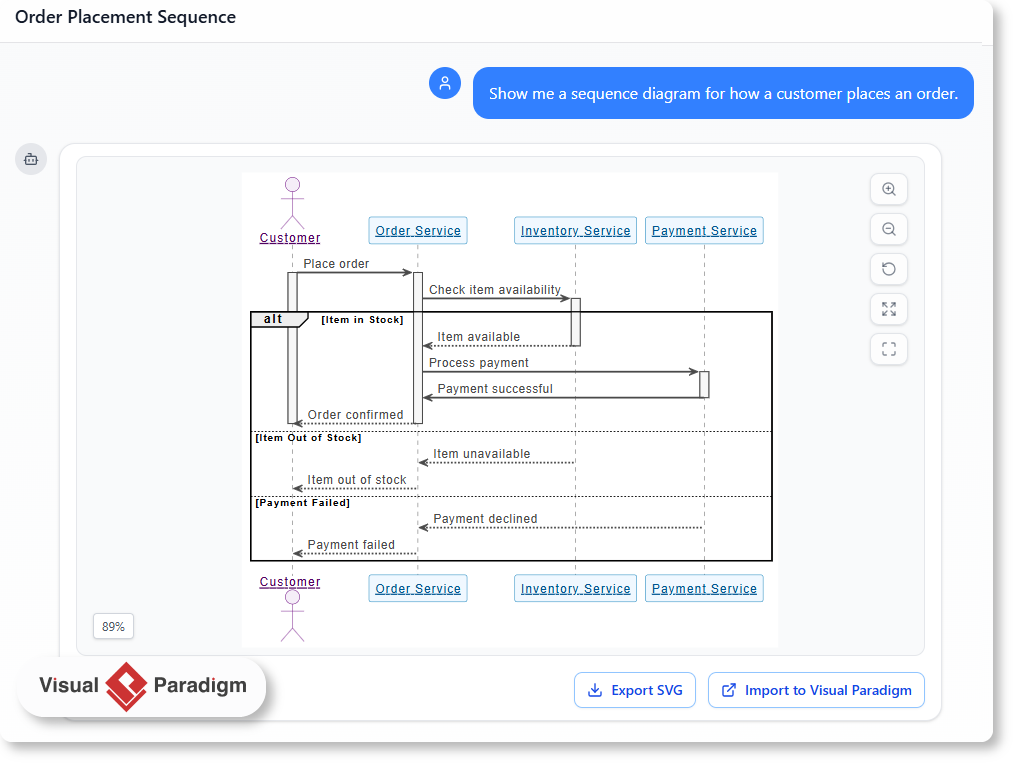
From Prompt to Production-Ready Diagrams
The core of this new workflow is natural language diagram generation. Instead of manually connecting shapes, you simply describe your system, process, or strategy in plain English. For example, you can prompt the AI to “Draw a C4 Container diagram for an e-commerce platform” or “Create a SysML Internal Block Diagram for an autonomous drone,” and a high-fidelity, standards-compliant diagram materializes in seconds.
This tool is not a generic “text-to-image” generator; it is a domain-specialized assistant that “thinks in diagrams”. It supports over 20 diagram types, including:
- Software Engineering: UML (Class, Sequence, Use Case), SysML, and C4 models.
- Enterprise Architecture: Over 20 standardized ArchiMate viewpoints.
- Business Strategy: SWOT, PESTLE, Porter’s Five Forces, and the Ansoff Matrix.
The Power of Semantic Rigor
Generic AI tools often produce diagrams that are “syntactically plausible but semantically flawed”—such as misplaced lifelines in a sequence diagram or invalid ArchiMate associations. The Visual Paradigm AI Chatbot avoids these pitfalls through a custom hybrid architecture and a semantic constraint engine. This engine enforces metamodel compliance at the moment of generation, ensuring every diagram adheres strictly to professional standards like OMG UML 2.5.1 and ISO specifications. The result is an accurate, production-ready model rather than a mere visual sketch.
Refining Through Dialogue
Modeling is rarely a one-off task; it is an iterative journey. Because the chatbot is context-aware, it maintains the state of your diagram throughout the conversation. You can evolve your designs live using simple, plain-English commands:
- “Add a new use case ‘Export Report’ linked to the Admin.”
- “Rename ‘User’ to ‘Customer’ everywhere.”
- “Make the activity loop tighter.”
- “Include branches for invalid promo codes.”
This conversational approach allows users to perform “diagram touch-ups” and refactorings without ever touching a mouse, saving up to 90% of traditional design time.
Intelligent Analysis and Documentation
The chatbot treats your diagram as a knowledge artifact, not just pixels. You can ask the AI to reason over the model to identify design smells or compliance gaps. Powerful queries include asking for “potential single points of failure” or checking if a class diagram violates the “Law of Demeter”.
Furthermore, you can command the AI to generate on-demand documentation, such as stakeholder-friendly architecture overviews, traceability matrices, or step-by-step explanations of complex logic like “alt fragments”. This ensures that documentation and design evolve in lockstep, keeping all stakeholders aligned.
Bridging the Gap to Professional Modeling
While the AI handles rapid prototyping, it is deeply integrated with the Visual Paradigm Desktop environment. Diagrams generated in the chat can be imported as “first-class modeling objects,” meaning they remain fully editable, traceable, and analyzable. Once in the desktop suite, teams can leverage “heavy machinery” features like simulating timings or managing complex traceability across large-scale projects.
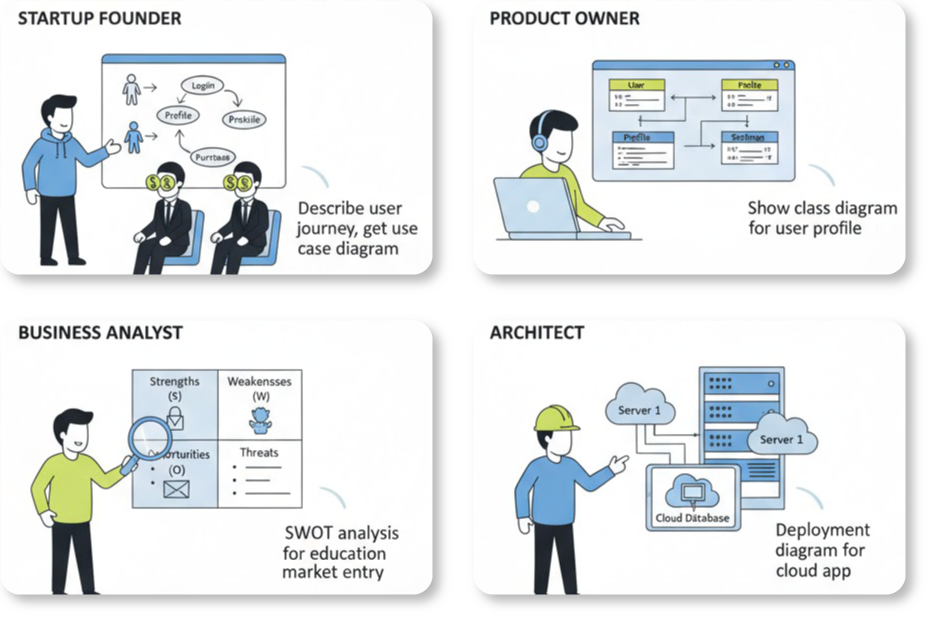
Analogy for Understanding: Refining a diagram with the AI chatbot is like directing a master sketch artist. Instead of grabbing the pencil yourself to erase and redraw lines, you simply give instructions like “add a garage on the left” or “make the windows larger,” and the artist instantly updates the drawing while ensuring the entire house remains structurally sound and follows professional building codes.
- AI Chatbot Feature – Intelligent Assistance for Visual Paradigm Users: Leverage AI-powered chatbot functionality to get instant guidance, automate tasks, and enhance productivity within Visual Paradigm.
- Visual Paradigm AI Chatbot Enhances Multi-Language Support : Discover the latest updates to Visual Paradigm ‘s AI -Powered visual modeling software, including multi-language UI and improved chat content localization.
- AI Chatbot for Diagramming: How It Works with Visual Paradigm: The Visual Paradigm AI chatbot is an AI -powered modeling assistant that turns natural language into diagrams. It doesn’t require users to learn specific modeling standards or syntax.
- Case Study: Enhancing System Modeling Efficiency with Visual Paradigm’s AI-Powered Chatbot: This case study demonstrates how Visual Paradigm’s AI chatbot improves productivity and accuracy in system modeling.
- Visual Paradigm AI Chatbot: The World’s First Purpose-Built AI Assistant for Visual Modeling: Visual Paradigm launches its groundbreaking AI chatbot, designed specifically to assist users in visual modeling tasks with natural language interactions and intelligent guidance.
- Introducing Visual Paradigm AI Chatbot: Intelligent Design Assistance: Discover how Visual Paradigm’s AI chatbot enhances design workflows by offering real-time suggestions and automating repetitive tasks.
- Mastering Sequence Diagrams with Visual Paradigm: AI Chatbot Tutorial: A beginner-friendly tutorial using Visual Paradigm to create sequence diagrams, illustrated through a real-world e-commerce chatbot use case.
- Integrating AI Activity Diagrams into Your Visual Paradigm …: Sep 12, 2025 · Learn how to use AI -powered modeling software to generate and refine activity diagrams with natural language. Discover the benefits of AI chatbot diagram generation in UML workflows.
- Beginner’s Tutorial: Create Your First Professional Sequence Diagram in Minutes: A beginner-friendly guide to generating professional sequence diagrams quickly using Visual Paradigm’s AI chatbot feature.
- Comprehensive Tutorial: Generating and Modifying C4 Component : This tutorial is based on the official Visual Paradigm product demo video, demonstrating how to use the AI-powered Chatbot to create and iteratively refine a C4 Component Diagram for a car park booking system.
- SWOT Analysis via AI Chat in Visual Paradigm: This interactive page allows users to generate SWOT analyses through an AI-powered chat interface within the Visual Paradigm environment.
- Meet the AI SWOT Assistant: How Visual Paradigm’s Chatbot : Discover how the visual paradigm chatbot provides natural language diagram generation for business frameworks like SWOT , PEST, and more—turning ideas into clear strategic models with AI -powered analysis .