
Visual Paradigm AI Chatbot: Mastering System Architecture & Strategy Modeling
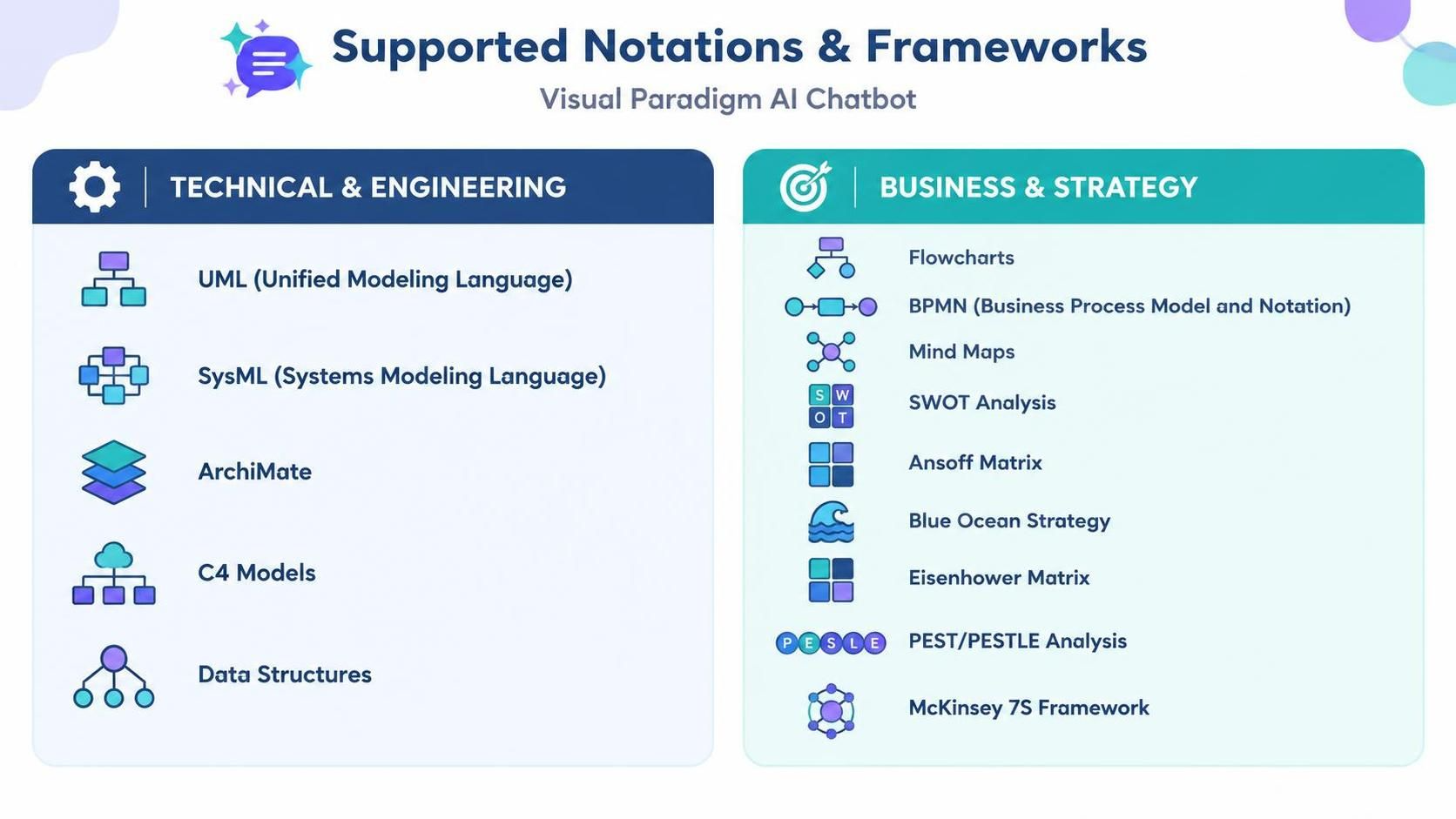
In the rapidly evolving landscape of software engineering and strategic business planning, the ability to visualize complex systems is paramount. Visual Paradigm’s AI Chatbot has emerged as a versatile tool, bridging the gap between abstract concepts and concrete architectural diagrams. By leveraging an extensive ecosystem of supported notations, this platform empowers users to model everything from intricate data structures to high-level corporate strategies without the friction of manual drawing.
This tutorial explores the dual pillars of the Visual Paradigm AI ecosystem: Technical & Engineering and Business & Strategy. We will walk through the core concepts of these frameworks and demonstrate how to structure your thoughts for effective system design.
The Dual Pillars of Modern Modeling
Visual Paradigm categorizes its capabilities into two distinct but interconnected domains. Understanding the distinction between these domains is the first step in choosing the right tool for your specific problem.
1. Technical & Engineering Domains
This domain focuses on the structural, behavioral, and physical aspects of a system. It is primarily utilized by software architects, systems engineers, and data scientists to define the “how” of a solution.
- UML (Unified Modeling Language): The industry standard for object-oriented software design. It uses diagrams like Class, Sequence, and Use Case to map out the logic and interactions within an application.
- SysML (Systems Modeling Language): A general-purpose modeling language for systems engineering applications. Unlike UML, which is software-centric, SysML supports hardware, software, people, and processes.
- ArchiMate: A modeling language for enterprise architecture. It provides a structured approach to describing, analyzing, and visualizing the relationships between business, application, and technology layers.
- C4 Models: A hierarchy of diagrams (Context, Container, Component, Code) that helps developers and architects communicate the architecture of software systems at different levels of abstraction.
- Data Structures: Fundamental concepts representing the way data is organized and stored, often visualized using tree or graph structures to show relationships and hierarchy.
2. Business & Strategy Domains
While engineering focuses on the build, this domain focuses on the “why” and “what.” These frameworks are essential for business analysts, consultants, and strategists to align IT capabilities with business goals.
- Flowcharts & BPMN: Flowcharts provide a general view of a process, while BPMN (Business Process Model and Notation) is a standardized notation that uses specific symbols to define the flow of activities, decisions, and events within an organization.
- SWOT Analysis: A strategic planning technique used to identify Strengths, Weaknesses, Opportunities, and Threats involved in a project or business venture.
- Strategic Matrices: Frameworks such as the Ansoff Matrix (market growth), Blue Ocean Strategy (market creation), Eisenhower Matrix (prioritization), and McKinsey 7S Framework (organizational effectiveness) help visualize complex strategic decisions.
- PEST/PESTLE Analysis: A macro-environmental framework used to analyze Political, Economic, Social, Technological, Legal, and Environmental factors affecting an organization.
Step-by-Step: Constructing a System Architecture
When using the Visual Paradigm AI Chatbot, the modeling process is conversational. You do not need to manually place shapes or draw lines. Instead, you provide the context, and the AI generates the appropriate diagram based on the selected framework.
Let’s walk through a hypothetical scenario: You are designing a new E-Commerce platform. Here is how you would approach it using the supported notations.
Step 1: Define the Scope (Context Diagram)
Before diving into code or logic, you need to understand the system’s boundaries. Using the C4 Model (Context Level), you would ask the AI to define the system in relation to its users.
AI Input Example: “Create a C4 Context diagram for an online bookstore, showing users, external payment systems, and the main application.”
Step 2: Map the Business Logic (BPMN)
Once the system is defined, you must understand the business processes it supports. If the goal is to optimize the checkout experience, BPMN is the ideal tool. It allows you to visualize the “Happy Path” (successful transaction) and “Exception Paths” (payment failure, out of stock).
Step 3: Analyze the Strategy (SWOT & PESTLE)
Before the technical build begins, a strategic review is crucial. You might ask the AI to generate a SWOT Analysis to see if the new platform is stronger than competitors, or a PESTLE analysis to ensure compliance with new data privacy laws.
Step 4: Design the Data (Data Structures)
Finally, the AI can assist in visualizing the underlying data. Whether it is a simple Tree structure for a product category or a Graph for a recommendation engine, the AI can generate the structural representation to guide database design.
The flexibility of the Visual Paradigm AI Chatbot lies in its ability to switch between these modes seamlessly. You can discuss the Blue Ocean Strategy of entering a new market one moment, and the UML Sequence Diagram of the API integration the next, all within the same ecosystem.
Why AI-Driven Modeling Matters
The integration of AI into modeling tools like Visual Paradigm shifts the focus from “how to draw” to “what to design.” By automating the syntax and layout rules of complex notations like SysML or ArchiMate, the AI allows technical and non-technical stakeholders to collaborate more effectively. It ensures that the diagram accurately reflects the system’s reality, reducing the risk of miscommunication between business leaders and engineering teams.