
Mastering System Modeling: 6 UML Perspectives with Visual Paradigm
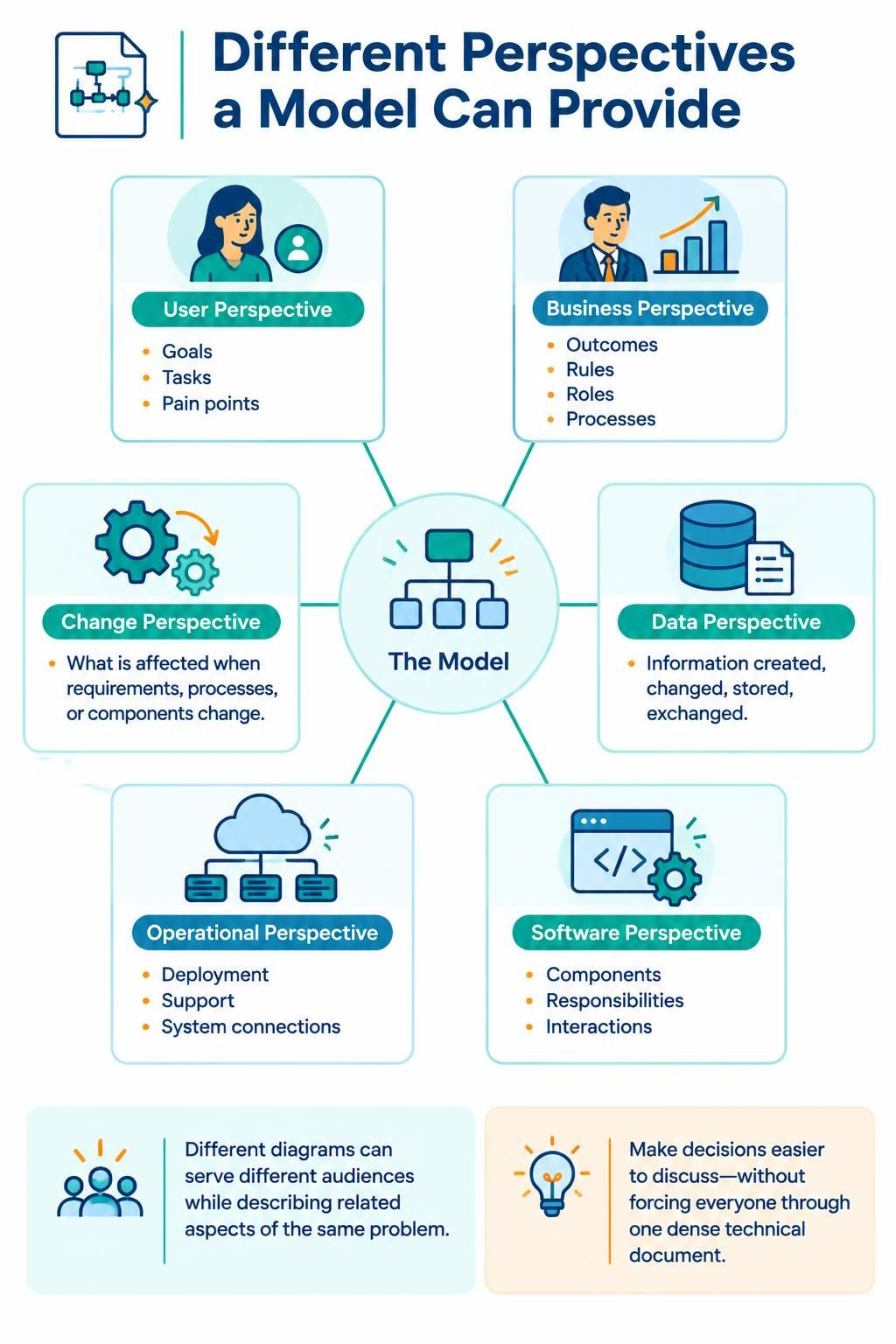
In the world of software architecture and business analysis, a common pitfall is creating a single, monolithic document that attempts to describe everything to everyone. This approach often leads to confusion, where developers get bogged down in user goals, and business stakeholders get lost in technical database schemas. To build truly effective models, we must adopt a multi-perspective approach.
This tutorial explores the concept of Contextual Modeling, demonstrating how a single system can be viewed through six distinct lenses. By separating these concerns, we allow different teams to focus on their specific responsibilities while maintaining a unified understanding of the whole system.
1. The User Perspective: Solving Human Problems
Every software project begins with a human need. The User Perspective focuses on the “Who” and “Why” of the system. It is the foundation of User Experience (UX) and User Interface (UI) design.
- Goals: What does the user want to achieve? (e.g., “Process a refund quickly.”)
- Tasks: What specific steps must they take to reach that goal?
- Pain Points: What obstacles exist in their current workflow that the new system must solve?
When modeling from this perspective, diagrams typically take the form of Use Case Diagrams or User Journey Maps. They abstract away the technology to focus purely on value delivery.
2. The Business Perspective: Defining the Rules of Engagement
While users focus on tasks, the Business Perspective focuses on outcomes. This view is critical for stakeholders who need to ensure the system aligns with organizational strategy.
- Outcomes: The measurable success of a process (e.g., “Increase conversion by 5%”).
- Rules: The logic and constraints that govern the system (e.g., “Users over 18 only”).
- Roles: Who is authorized to perform specific actions?
- Processes: The end-to-end workflows that generate value.
Business Process Model and Notation (BPMN) is often used here to visualize how the business operates, independent of the software that supports it.
3. The Data Perspective: The Backbone of Information
Systems are built to manage information. The Data Perspective looks at the lifecycle of information within the system. This is often the most critical view for database architects and backend engineers.
- Created: What data is generated by users or sensors?
- Changed: How does data evolve over time (e.g., status updates)?
- Stored: Where is the data persisted?
- Exchanged: How does data move between different systems?
Entity Relationship Diagrams (ERD) are the standard tool for this perspective, ensuring that data integrity is maintained across the application.
4. The Software Perspective: Engineering the Solution
Once we understand the user needs and data requirements, we must define the technical structure. The Software Perspective breaks the system down into its constituent parts.
- Components: The modules, services, or libraries that make up the codebase.
- Responsibilities: What specific function does each component perform?
- Interactions: How do components talk to one another (APIs, internal method calls)?
Architecture diagrams, Component Diagrams, and Class Diagrams are essential here to visualize the technical boundaries and interfaces.
5. The Operational Perspective: Deployment and Support
A system is useless if it cannot be deployed or maintained. The Operational Perspective (often associated with DevOps) looks at the system in its runtime environment.
- Deployment: Where does the software run? (e.g., Kubernetes clusters, serverless functions).
- Support: How is the system monitored, logged, and patched?
- System Connections: How does this system connect to external infrastructure, networks, or third-party services?
Deployment diagrams are the primary artifact for this view, ensuring that the infrastructure can support the software.
6. The Change Perspective: Managing Impact
Perhaps the most overlooked perspective is the Change Perspective. In agile development, requirements change constantly. This view asks: “If we change X, what breaks?”
- Requirements Impact: How does a change in user requirements ripple through the system?
- Process Impact: Does a change in business logic require new workflows?
- Component Impact: Which specific code modules are affected by a change?
Traceability matrices and impact analysis diagrams are used to map these dependencies, minimizing regression bugs during updates.
Bringing the Perspectives Together
The goal of modeling is not to create six separate silos of information, but to connect them. A model becomes powerful when the Software Perspective (the code) directly reflects the Data Perspective (the storage) to satisfy the Business Perspective (the rules) for the User Perspective (the goals), all while being deployable via the Operational Perspective.
By utilizing different diagrams for different audiences, a team can discuss complex decisions without forcing a business stakeholder to decipher a dense technical document. This clarity is the key to successful system architecture.