


In the rapidly evolving landscape of software architecture and system design, the ability to visualize complex logic is paramount. This comprehensive guide details how to utilize the Visual Paradigm AI platform to create, refine, and implement UML state machine diagrams through natural language and intelligent automation. By leveraging generative AI, developers and system architects can now bridge the gap between unstructured problem descriptions and structured behavioral models with unprecedented efficiency.
Introduction to AI-Enhanced State Diagramming
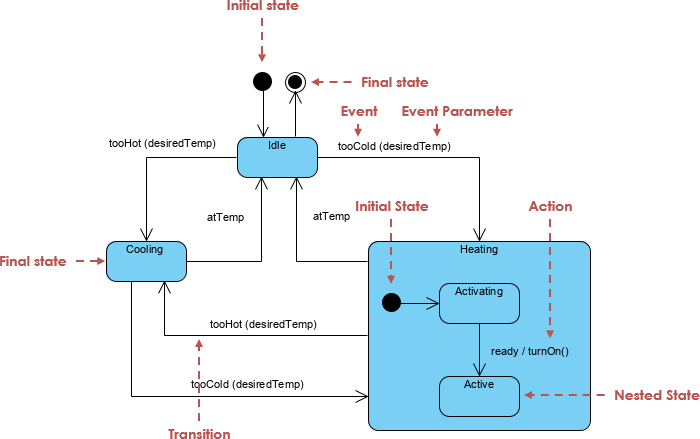
Visual Paradigm offers a unified platform that integrates generative AI directly into the visual modeling process. This integration allows users to transform text-based requirements into rigorous diagrams seamlessly. The AI-enhanced state machine tools are specifically designed to visualize object behavior and model the complex transitions of a system in response to internal or external events. Unlike traditional manual drafting, this approach ensures that the resulting models are not only visually accurate but also logically consistent with the input specifications.
Core AI Features for State Diagrams
The platform utilizes a suite of intelligent tools designed to streamline the modeling workflow. Understanding these features is key to maximizing the potential of AI-assisted design.
AI Chatbot Assistant
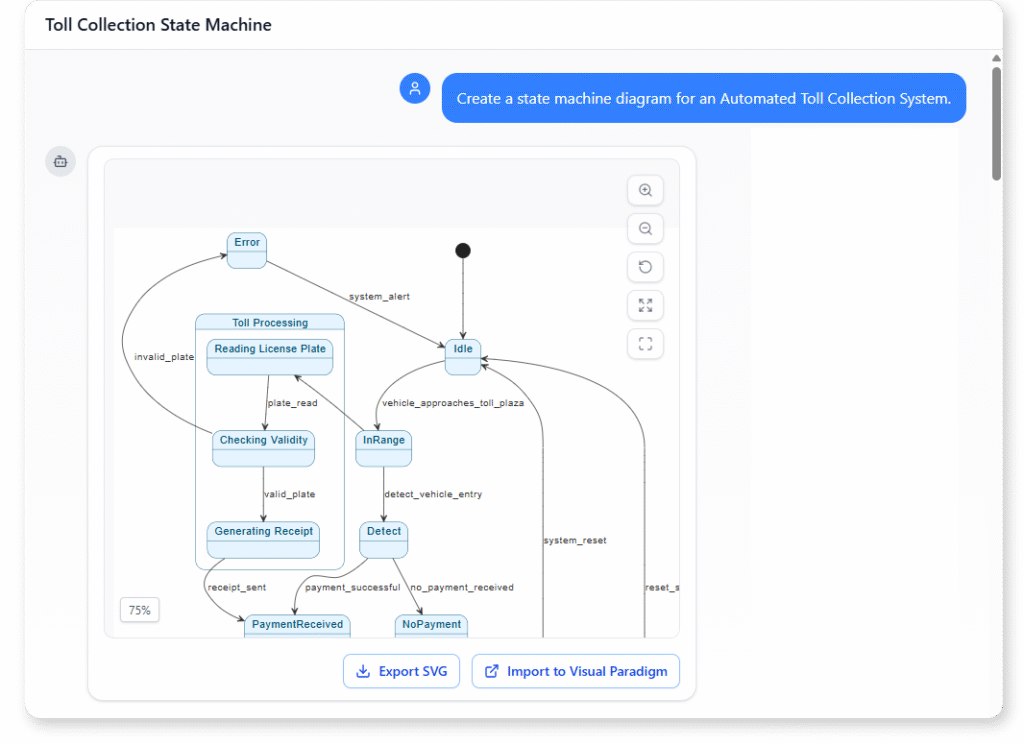
The primary interface for state diagramming is a purpose-built AI chatbot. This assistant converts natural language input into complete, presentation-ready diagrams. This feature eliminates the tedious task of manual sketching, allowing users to evolve a simple text description into a full system design instantly. Whether you are brainstorming early concepts or documenting finalized requirements, the chatbot acts as a bridge between thought and visualization.
Interactive Design Interface
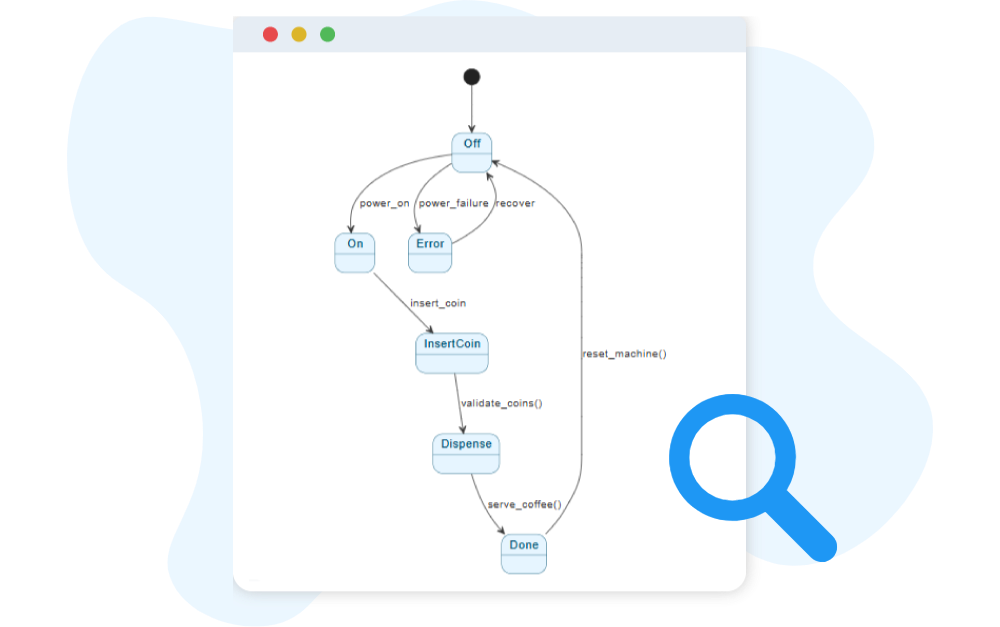
Beyond simple generation, the platform provides a web-based Interactive State Machine Diagram Tool. This environment allows teams to create and edit models in real time with continuous generative AI support. Users can interact with the diagram elements directly, making adjustments that the AI helps to validate against standard UML notation.
Context-Aware Editing
One of the most powerful features is context awareness. The AI chatbot can interpret instructions within the context of the current model, updating existing diagrams with accurate changes while preserving naming conventions, structural integrity, and visual consistency. This ensures that iterative updates do not break the logical flow of the diagram.
Step-by-Step Guide to Creating State Diagrams
Creating a state machine diagram with Visual Paradigm AI is a structured process that moves from abstract requirements to concrete models. Follow these steps to generate high-quality diagrams:
- Describe the System Behavior: Begin by entering a natural language description of the system’s logic into the AI Chatbot or AI Toolbox. For example, you might describe the varying states of a 3D printer or the logic flow of an automated toll system.
- Instant Model Generation: The AI processes the provided logic and instantly generates a diagram featuring the necessary states and transitions. This initial draft serves as a solid foundation for further refinement.
- Define Activities: Enhance the generated states by defining specific actions. This includes specifying Entry, Exit, and Do activities to clarify what happens when a system enters a state, remains in it, or leaves it.
- Refine Transitions: Use the interactive tools to drag transitions between source and target states. It is crucial to name these transitions to reflect specific system events or triggers accurately.
- Collaborative Refinement: Leverage the Visual Paradigm Circle platform to share the generated model via a URL. This facilitates real-time feedback and co-designing capabilities, allowing your team to refine the logic collaboratively.
Advanced Technical Capabilities
Visual Paradigm AI extends beyond visual representation, offering advanced features that integrate the modeling phase with the development lifecycle.
Automated Code Generation
Once the behavioral logic is modeled, the platform can generate source code directly from the state machine diagrams. This feature is critical for developers, as it allows for the implementation of complex, state-driven logic efficiently while maintaining synchronization between the design artifacts and the actual codebase. This reduces the risk of implementation errors and ensures the code reflects the agreed-upon architecture.
Robustness Analysis and Diagram Continuity
Users can perform robustness analysis alongside state modeling to define system boundaries and identify critical components before moving to the implementation phase. Furthermore, the AI service ensures modeling continuity, helping users maintain a consistent design thread as they move from high-level requirements to detailed state transitions. This continuity is essential for large-scale projects where maintaining context across different diagrams is challenging.
Practical Application: Automated Toll System
A common use case demonstrating the power of these tools is modeling an Automated Toll System. By using AI-enhanced state diagrams, designers can automate complex system behaviors, such as detecting a vehicle, calculating fees based on vehicle type, and managing gate transitions based on payment status. The AI helps ensure that all edge cases and exceptions—such as payment failures or sensor errors—are visualized and accounted for early in the development lifecycle, resulting in a more robust and reliable system.