
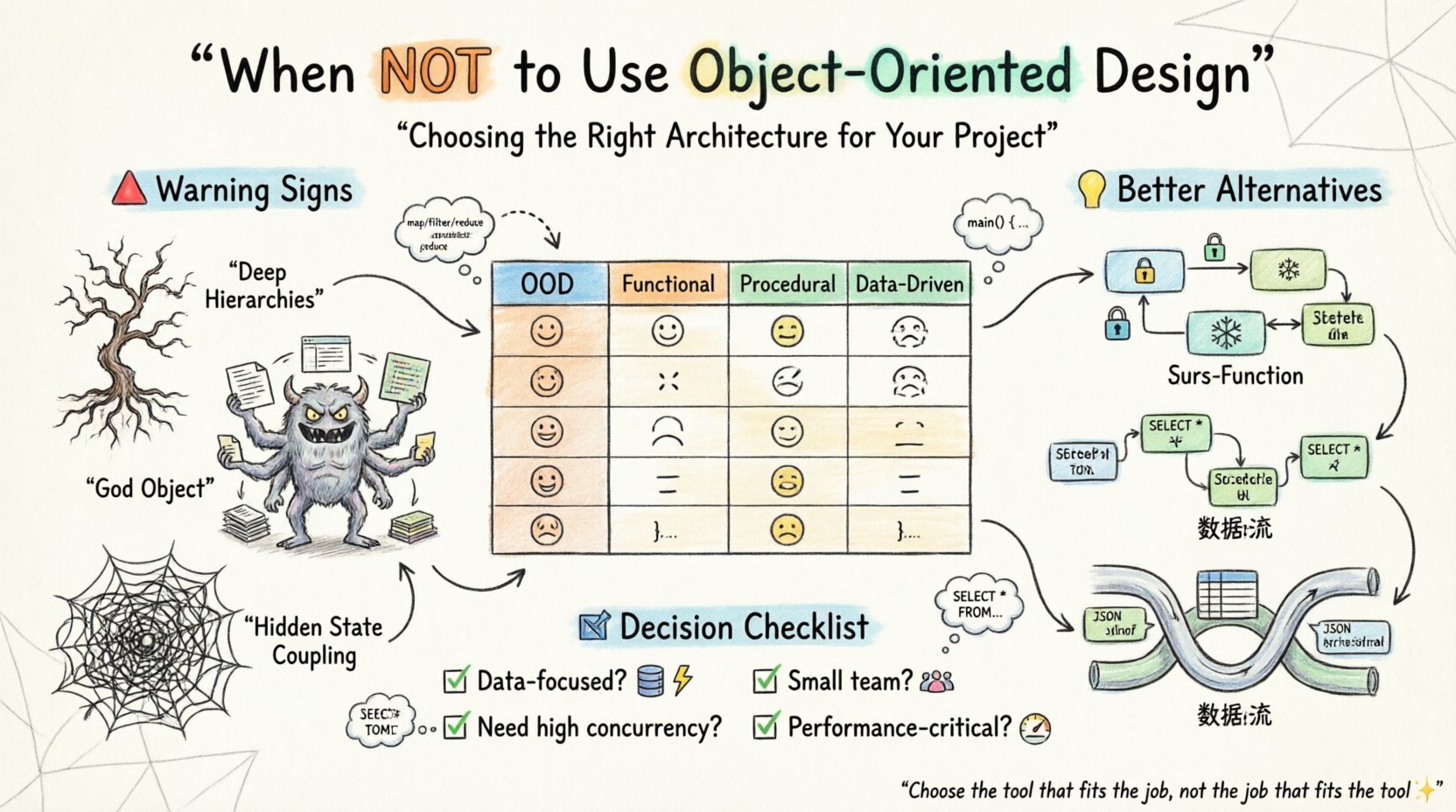
Object-Oriented Design (OOD) has been the dominant paradigm in software development for decades. It promises structure, modularity, and a natural mapping between real-world entities and code. For many teams, it is the default setting. However, treating every problem as a collection of interacting objects can lead to unnecessary complexity, performance bottlenecks, and maintenance nightmares. 🧐
This guide explores the limitations of OOD. We examine scenarios where other architectural styles serve the project better. By understanding the tradeoffs, you can select the tool that fits the job, rather than forcing the job to fit the tool. 💡
The Allure of Object-Oriented Design 🧠
It is easy to understand why OOD became the industry standard. The core principles—encapsulation, inheritance, and polymorphism—provide a powerful way to manage complexity. When designed correctly, these features allow for:
- Modularity: Isolating changes to specific classes without breaking the entire system.
- Reusability: Creating base classes that multiple specific implementations can inherit from.
- Abstraction: Hiding implementation details behind clean interfaces.
These benefits are real and valuable. However, the marketing of OOD often suggests it is the universal solution. When applied indiscriminately, the same features that provide structure can become sources of rigidity. The very mechanisms intended to reduce complexity often introduce hidden dependencies that are difficult to trace. 🕸️
Signs Your Architecture Is Fighting You 🚩
Before deciding to abandon the object model, you must recognize the warning signs. Sometimes, the problem is not the paradigm itself, but its misapplication. If you observe the following symptoms, it may be time to reconsider your approach.
1. Deep Inheritance Hierarchies
Inheritance is meant to share behavior, not manage state. When you find yourself creating classes that are only slightly different from their parents, you are likely abusing inheritance. This leads to:
- Brittle Base Classes: Changing a method in a parent class can break dozens of child classes unexpectedly.
- The Fragile Base Class Problem: A change in the superclass forces changes in subclasses even if the subclass logic remains unchanged.
- Complexity Explosion: A deep hierarchy makes it hard to understand where a method actually resides or executes.
If you spend more time navigating the class tree than writing logic, your design is too deep. Composition over inheritance is a better strategy, but sometimes neither is the right fit.
2. The God Object Anti-Pattern
When a single class or module grows to manage too many responsibilities, it becomes a “God Object.” This often happens because developers try to force all related data into one cohesive unit. The result is a class that knows too much and does too much. 🔥
Characteristics of a God Object include:
- Methods that accept complex parameters but return void.
- Access to nearly every other class in the application.
- Difficulty in unit testing because of excessive dependencies.
- A file size that exceeds thousands of lines of code.
This violates the Single Responsibility Principle. It creates a tight coupling that makes refactoring painful and dangerous.
3. Excessive Coupling Through State
Objects often manage state. When state is mutable and shared across many objects, it creates hidden dependencies. If Object A changes a variable that Object B reads, they are coupled. This coupling is often invisible until a bug appears in production. 🐞
In systems where data flows through pipelines, mutable state is a liability. Every object becoming a source of truth for its own state increases the cognitive load required to understand the system’s behavior at any given moment.
Functional Alternatives for State Management 🔄
Functional programming offers a different perspective. Instead of focusing on objects and their state, it focuses on the evaluation of expressions and the avoidance of state and mutable data. This is not about writing a functional language, but adopting functional principles within your architecture.
Pure Functions and Immutability
In many scenarios, data processing is the primary goal. Pure functions take input and return output without side effects. This makes testing straightforward and reasoning about code simpler. If you are building a data transformation pipeline, a functional approach often reduces the number of classes required.
- Predictability: Given the same input, a pure function always returns the same output.
- Concurrency: Immutable data structures allow multiple threads to access data without locking mechanisms.
- Composability: Small functions can be combined to create complex logic without introducing shared state.
When to Switch Paradigms
You should consider a functional style when:
- Data transformations are the core business logic.
- High concurrency is required for performance.
- The data model is flat and does not require complex inheritance relationships.
- You need to minimize memory overhead associated with object headers.
This does not mean abandoning objects entirely. It means recognizing that objects are a representation of state and behavior. If behavior is transient and data is static, objects add unnecessary overhead.
Procedural Simplicity for Small Scale ⚙️
There is a misconception that every application requires a complex object model. For small scripts, command-line tools, or simple automation tasks, procedural programming is often superior. Introducing classes and interfaces for a script that runs once and exits adds friction without value. 🛠️
Reducing Boilerplate
Every class requires a constructor, a destructor, and potentially interface definitions. In a small context, this boilerplate consumes developer time that could be spent solving the actual problem. Procedural code allows you to write a function, pass arguments, and execute logic immediately.
Consider the following scenarios where procedural code shines:
- One-off Scripts: Data migration or cleanup tasks that run infrequently.
- Configuration Parsers: Reading a file and returning a simple data structure.
- Utility Libraries: Math operations or string manipulations that do not require state.
Maintainability in Small Teams
In small teams or short-term projects, the cognitive overhead of understanding class relationships can slow down development. Procedural code is often more linear and easier to follow for developers who are not deeply familiar with design patterns. The learning curve is significantly lower.
Data-Driven Approaches for Pipelines 📊
Modern data engineering often relies on pipelines where data moves from one stage to another. In these systems, the data itself is the center of attention, not the objects manipulating it. Treating data as a flow rather than a collection of objects can simplify the architecture.
Event Sourcing and CQRS
Event Sourcing records every change to an application state as a sequence of events. This approach decouples the writing of data from the reading of data. It fits poorly with traditional object models that try to maintain consistency in memory at all times. In this context, a command-driven approach is often more robust.
Schema-First Design
When the data structure is defined by an external schema (like a database or API contract), forcing that data into object classes can create a mismatch. This is known as impedance mismatch. If the data is hierarchical and complex, keeping it in a format close to the source (like JSON or XML) until processing is necessary can reduce transformation errors.
Performance Costs of Abstraction 🏎️
Abstraction comes at a cost. Object-oriented languages often require dynamic memory allocation for each instance. They also rely on virtual method dispatch, which can be slower than direct function calls. In high-performance computing, these costs are non-trivial.
Memory Overhead
Every object instance carries metadata. In languages that support this, this includes type information, reference counts, and synchronization locks. If you are creating millions of temporary objects during a calculation, the garbage collector will struggle. This leads to latency spikes.
Virtual Dispatch Latency
Polymorphism allows you to call a method on an interface without knowing the specific implementation. However, the computer must look up the correct function address at runtime. In tight loops, this lookup can slow down execution. In scenarios where speed is critical, such as financial trading systems, static binding or direct function calls are preferred.
Team Dynamics and Cognitive Load 👥
Architecture is not just about code; it is about people. A design that is theoretically sound but too complex for the team to maintain is a failure. Object-Oriented Design requires a specific mindset. If the team is not trained in these patterns, they will implement them incorrectly.
The Learning Curve
Junior developers often struggle with OOD concepts like dependency injection, interfaces, and abstract base classes. If the team is small or rotating frequently, a simpler architecture reduces the risk of introducing bugs. Procedural or functional styles often have a lower barrier to entry.
Documentation and Onboarding
Complex inheritance trees are difficult to document. A developer joining the team needs to understand the hierarchy to make changes. In contrast, a flat structure of functions is easier to map. This reduces the time required to onboard new engineers and allows for faster iteration.
Comparing Architectural Styles 📝
To help visualize the tradeoffs, consider the following comparison table. This outlines where each style excels and where it struggles.
| Style | Best Use Case | Key Limitation | Complexity |
|---|---|---|---|
| Object-Oriented | Complex business logic with stateful entities | Over-engineering, deep inheritance | High |
| Functional | Data processing, math-heavy logic, concurrency | Learning curve for state management | Medium |
| Procedural | Scripts, tools, small utilities | Scalability issues in large systems | Low |
| Data-Driven | Pipelines, ETL processes, analytics | Requires strict schema management | Medium |
Notice that no single style is superior. The choice depends on the specific constraints of your project. A hybrid approach is often the most practical, using the right tool for the specific module.
Making the Right Decision 🧭
How do you decide if OOD is the right choice for your next project? Start by asking specific questions about the domain and the requirements.
- What is the primary value of the system? Is it data manipulation or entity management?
- What is the expected lifespan? Short-lived scripts do not need long-term architectural investment.
- What is the team’s expertise? Does the team understand design patterns deeply?
- What are the performance constraints? Does the system require low latency or high throughput?
- How complex is the state? Does the state change frequently across many parts of the system?
If the answer to most of these questions points towards simplicity, data flow, or speed, you may want to reconsider the object model. It is not about rejecting OOD, but about applying it where it adds value.
Final Considerations on Architectural Flexibility 🌐
Software architecture is a series of tradeoffs. Every decision to use one pattern over another involves sacrificing something. Object-Oriented Design offers structure and safety, but it demands discipline and effort. When that effort outweighs the benefits, the system suffers.
Successful engineers are those who know when to stop designing. They recognize that a simple solution is often better than a complex one that solves the same problem. By remaining flexible and open to alternative paradigms, you build systems that are resilient, maintainable, and fit for purpose. 🛡️
Remember, the goal is not to follow a specific methodology. The goal is to deliver value. If objects help you do that, use them. If they hinder you, put them down and pick up a different tool. The code serves the business, not the other way around. 🚀