
In the rapidly evolving landscape of software-as-a-service, longevity is often more critical than initial growth. A company might launch with explosive momentum, yet fail to maintain profitability over time. To understand why some business models endure while others falter, leaders must look beyond revenue numbers and examine the structural forces shaping the market. Porter’s Five Forces provides a robust framework for this analysis, specifically when applied to the nuances of recurring revenue models.
This guide details how to leverage this strategic tool to evaluate SaaS business model sustainability. We will dissect each force, explaining its impact on margins, customer retention, and competitive positioning. By understanding these dynamics, you can make informed decisions about product development, pricing strategies, and resource allocation.
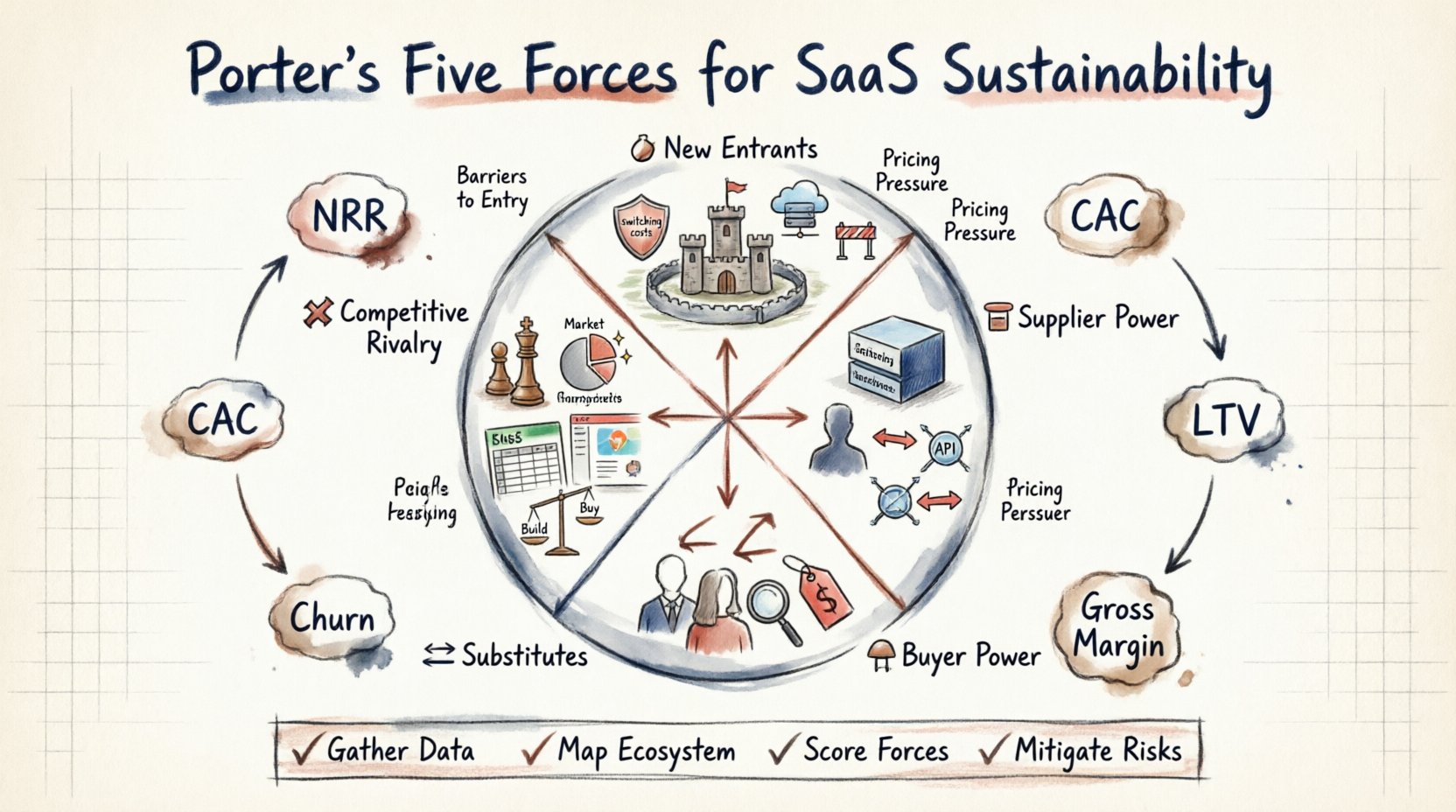
🔍 Why Framework Analysis Matters for SaaS
Traditional businesses often rely on asset-heavy models. SaaS companies operate on a different paradigm: low marginal costs, high upfront customer acquisition expenses, and a heavy reliance on recurring revenue. This structure creates unique vulnerabilities. A drop in churn rate might look like a win, but if the threat of new entrants increases simultaneously, the market share could erode quickly.
Applying a strategic framework allows you to see the invisible currents. It moves the conversation from “how do we sell more?” to “how do we protect our position?” Sustainability is not just about cash flow; it is about maintaining a defensible moat against market pressures.
1️⃣ The Threat of New Entrants 🔓
One of the most significant risks for any software company is the ease with which competitors can enter the market. In the past, building a software product required massive capital investment in infrastructure and talent. Today, cloud computing and open-source tools have lowered these barriers significantly.
📉 Factors Influencing Entry Barriers
To assess this force, consider the following elements:
- Capital Requirements: While hosting costs are low, customer acquisition costs (CAC) can be prohibitive. A new player needs significant funding to outbid incumbents for ad space.
- Technology Stack: Modern frameworks allow rapid prototyping. If your technology is not proprietary or difficult to replicate, entry is easier.
- Regulatory Compliance: In sectors like healthcare or finance, compliance acts as a natural barrier. If you hold certifications that take years to obtain, new entrants face a steep climb.
- Customer Switching Costs: This is the most critical factor. If migrating data is easy, the threat increases. If data is siloed within complex workflows, the threat decreases.
🛡️ Building a Defensive Moat
Sustainability requires raising the cost for a customer to leave. You can achieve this through:
- Data Integration: Become the central hub where data lives. When a user’s entire workflow depends on your platform, leaving becomes operationally painful.
- Ecosystem Partnerships: Integrate with other tools that are essential to the client. If you connect with their CRM, billing, and project management, you become indispensable.
- Brand Reputation: Trust is a currency. Established players with a track record of security and uptime command higher loyalty.
When the threat of new entrants is high, you must focus on differentiation. Generic features are easily copied. Unique value propositions rooted in specific industry knowledge are harder to replicate.
2️⃣ Bargaining Power of Suppliers 📦
In the SaaS context, “suppliers” are not just vendors of raw materials. They include cloud infrastructure providers, talent pools, data sources, and API partners. The power these entities hold can directly impact your gross margins.
🔎 Identifying Key Supplier Leverage
Analyze your supply chain for vulnerabilities:
- Infrastructure Dependence: If you rely heavily on a single cloud provider, a price hike or outage affects your entire operation. Diversifying across multiple providers can mitigate this risk.
- Talent Scarcity: Skilled engineers are a finite resource. If the market for developers is tight, labor costs rise, squeezing profitability. This is a hidden supplier cost.
- Third-Party APIs: Many SaaS products rely on external data or services. If a partner changes their pricing model or terms of service, your cost structure shifts unexpectedly.
📊 Managing Supplier Relationships
To reduce supplier power, consider the following strategies:
- Standardization: Adopt open standards where possible. This prevents vendor lock-in and gives you the flexibility to switch providers if prices become unfavorable.
- Vertical Integration: In some cases, bringing a function in-house reduces reliance on external suppliers. This might involve hiring more staff or building internal tools.
- Long-Term Contracts: Lock in pricing for critical infrastructure or talent services to protect against market volatility.
High supplier power can erode the margin advantage that SaaS models typically enjoy. Keeping a close watch on these inputs is essential for long-term financial health.
3️⃣ Bargaining Power of Buyers 🛒
This force is often the most intense pressure point for SaaS companies. Buyers are increasingly savvy, informed, and willing to switch. The market is flooded with alternatives, making price sensitivity a constant factor.
⚖️ Drivers of Buyer Power
Buyers exert power when:
- Switching Costs are Low: If a competitor offers a similar product at a lower price with easy data migration, customers will move.
- Volume Purchasing: Enterprise clients buying in bulk can demand significant discounts. They often have dedicated procurement teams negotiating every feature.
- Transparency: Review sites and comparison tools make it easy for buyers to benchmark pricing and features across the industry.
- Standardization: If your product is a commodity, buyers focus primarily on price. If it is differentiated, they focus on value.
📈 Strategies to Mitigate Buyer Power
Reducing buyer leverage involves increasing the perceived value of your offering:
- Customization: Allow clients to tailor the experience. A solution that fits their specific workflow is harder to replace than a generic one.
- Customer Success: Invest in onboarding and support. When a client feels supported, they are less likely to churn due to minor price increases.
- Value-Based Pricing: Shift pricing models from per-seat to value-based. Align your revenue with the outcomes you deliver for the client.
Understanding buyer power helps in setting pricing tiers. If buyers have high power, you may need to offer more flexibility or bundle features to increase stickiness.
4️⃣ Threat of Substitutes 🔄
Substitutes are not just direct competitors; they are alternative ways of solving the same problem. A customer might not buy your software because they choose to build a solution in-house, use spreadsheets, or hire contractors.
🧩 Common SaaS Substitutes
Identify the alternatives your customers consider:
- Manual Processes: For many SMBs, a well-organized spreadsheet is the default substitute. You must prove that automation saves more money than the time spent building the tool.
- Build vs. Buy: Large enterprises often prefer building custom solutions to avoid vendor lock-in. You must demonstrate that your roadmap is faster and cheaper than their internal dev team.
- Competitor Alternatives: Direct rivals offering similar features at a different price point.
🚀 Reducing Substitution Risk
To protect against substitutes, focus on efficiency and depth:
- Integration Depth: The more you integrate into the daily workflow, the harder it is to substitute with a manual process.
- Continuous Innovation: If you stop updating, the “build in-house” argument becomes stronger. Stay ahead of the curve.
- Education: Show customers the hidden costs of the substitute. For example, calculate the time saved by using your tool versus managing data manually.
Sustainability depends on staying ahead of the substitute. If the “do it yourself” option becomes too expensive or difficult, your business becomes more viable.
5️⃣ Competitive Rivalry ⚔️
This force encompasses the intensity of competition within the industry. In crowded SaaS markets, rivalry can lead to price wars, feature bloat, and high marketing spend.
🔥 Indicators of Intense Rivalry
Rivalry is fierce when:
- Number of Competitors: Many players fighting for the same market share.
- Industry Growth Rate: In slow-growth markets, companies fight for existing customers. In high-growth markets, they fight for new ones.
- Product Homogeneity: If products look the same, competition becomes a race to the bottom on price.
- Exit Barriers: If it is hard to exit the market (e.g., sunk costs in talent), companies stay and fight even when profitability is low.
🛡️ Navigating the Competitive Landscape
Strategies to manage rivalry include:
- Niche Focus: Target a specific vertical or segment where you have deep expertise. Generalists often struggle against specialists.
- Brand Differentiation: Build a brand that stands for quality, not just features.
- Strategic Alliances: Partner with complementary tools to expand your reach without direct competition.
High rivalry requires constant vigilance. You must monitor competitor moves and adjust your strategy accordingly to maintain market position.
📊 Comparative Analysis Table
Use the following table to quickly assess the strength of each force in your specific market context.
| Force | High Threat (Red) | Moderate Threat (Yellow) | Low Threat (Green) |
|---|---|---|---|
| New Entrants | Low switching costs, low capital needs | Some regulatory barriers, moderate CAC | High switching costs, proprietary tech |
| Supplier Power | Single cloud provider, talent shortage | Multiple providers, stable talent market | Open standards, in-house capability |
| Buyer Power | High churn, commoditized product | Mixed churn, some differentiation | Low churn, high customization |
| Substitutes | Easy to build in-house, manual options | Moderate complexity to replace | Complex integration, high efficiency |
| Rivalry | Price wars, many competitors | Stable market, few major players | Niche dominance, high barriers |
📈 Integrating Metrics with Strategic Analysis
Strategic analysis must be grounded in data. The Five Forces framework provides the context, but metrics provide the proof. To evaluate sustainability, you must correlate qualitative force assessments with quantitative performance indicators.
🔑 Key Metrics to Track
- Net Revenue Retention (NRR): High NRR indicates low buyer power and strong product stickiness.
- Customer Acquisition Cost (CAC): Rising CAC suggests high competitive rivalry or high threat of new entrants.
- Gross Margin: Declining margins may indicate increasing supplier power or pricing pressure.
- Churn Rate: High churn points to low switching costs or strong substitute threats.
- Customer Lifetime Value (LTV): A high LTV:CAC ratio suggests a sustainable model despite competitive pressures.
✅ Actionable Steps for Implementation
Now that you understand the forces, how do you apply them? Follow this structured approach to conduct your own analysis.
- Gather Data: Collect internal metrics and external market research. Talk to sales teams about why deals are won or lost.
- Interview Stakeholders: Speak with customers to understand their pain points and switching triggers. Ask about their alternative solutions.
- Map the Ecosystem: Identify all players, suppliers, and substitutes. Draw the relationships between them.
- Score the Forces: Rate each force as High, Medium, or Low based on your evidence.
- Develop Strategies: For each High threat force, create a mitigation plan. For Low threat forces, identify opportunities to expand.
- Review Regularly: Market dynamics change. Re-evaluate the analysis quarterly or annually.
⚠️ Common Pitfalls to Avoid
When applying this framework, be aware of common mistakes that can lead to flawed conclusions.
- Static Analysis: Treating the forces as fixed. They change over time. A low threat today might be high tomorrow.
- Ignoring the Customer: Focusing too much on competitors and not enough on the buyer’s actual needs.
- Overlooking Complements: Sometimes products that complement you (like integrations) are more important than direct rivals.
- One-Size-Fits-All: Applying the same logic to every product line. Enterprise and SMB segments face different force dynamics.
🏁 Final Thoughts on Long-Term Viability
Evaluating a SaaS business model for sustainability is an ongoing process. It requires a deep understanding of the market forces at play and the willingness to adapt when those forces shift. By systematically analyzing the threat of new entrants, supplier power, buyer power, substitutes, and competitive rivalry, you gain clarity on where your vulnerabilities lie.
This clarity allows for proactive decision-making. Instead of reacting to churn or price wars, you can build structures that prevent them. Whether it is increasing switching costs, diversifying suppliers, or differentiating your product, each action contributes to a stronger, more resilient organization.
Sustainability is not a destination; it is a continuous state of alignment between your business model and the market environment. Use this framework as a compass to navigate the complexities of the software industry and secure your place in the market for the long haul.