
Strategic planning is the backbone of any successful startup. Without a clear roadmap, resources dissipate, momentum stalls, and opportunities slip away. Entrepreneurs often face a paradox of choice: too many frameworks, too little time. Among the most cited tools is the SWOT analysis. However, treating every strategic challenge with the same lens can lead to oversimplified conclusions. Understanding when to deploy SWOT versus other models like PESTLE, the Business Model Canvas, or Porter’s Five Forces is critical for founders and product leaders.
This guide explores the mechanics of SWOT analysis, contrasts it with alternative frameworks, and outlines specific scenarios where it shines or falls short. By the end, you will have a clear understanding of how to select the right strategic tool for your startup’s current phase and objectives.
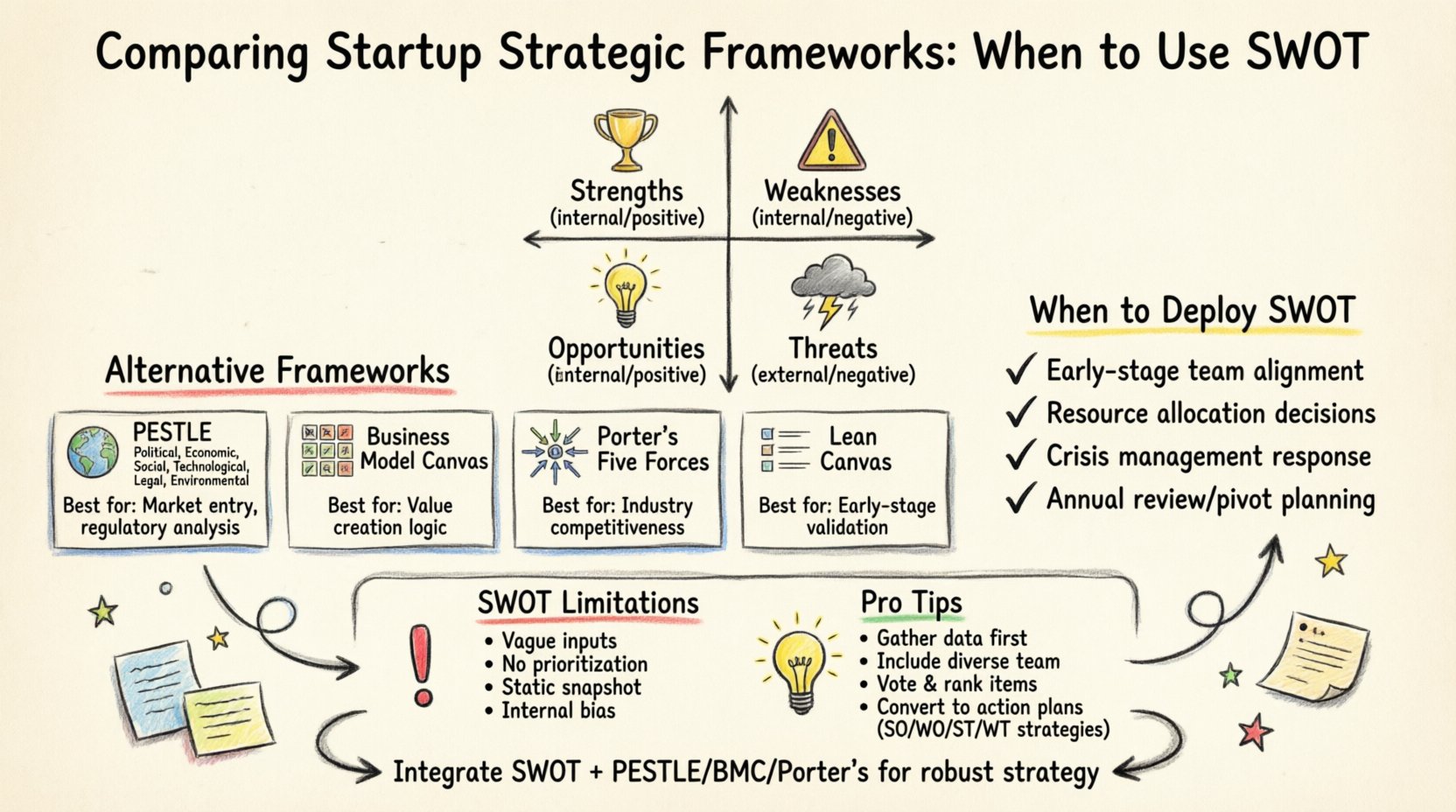
🔍 Understanding the SWOT Analysis Framework
SWOT stands for Strengths, Weaknesses, Opportunities, and Threats. It is a foundational tool used to evaluate the internal and external factors affecting an organization. The structure is simple, which is often why it is the first framework founders encounter.
The Four Pillars of SWOT
- Strengths (Internal): What does your team do better than anyone else? This includes proprietary technology, specialized talent, or strong brand loyalty.
- Weaknesses (Internal): Where are you lacking? Consider limited funding, a small team, or technological debt.
- Opportunities (External): What market trends can you leverage? Look for regulatory changes, emerging customer needs, or gaps in the competitor landscape.
- Threats (External): What external factors could cause trouble? Think about new competitors, economic downturns, or shifting consumer preferences.
The power of SWOT lies in its binary nature: Internal vs. External and Positive vs. Negative. This dichotomy helps teams organize thoughts quickly without requiring deep financial modeling or complex data sets.
🧩 The Landscape of Strategic Frameworks
While SWOT is versatile, it is not a panacea. Other frameworks exist to solve specific problems that SWOT cannot address effectively. To make an informed decision, we must understand the alternatives.
1. PESTLE Analysis
PESTLE stands for Political, Economic, Social, Technological, Legal, and Environmental. It is a macro-environmental scanning tool. Unlike SWOT, which is often broad, PESTLE dives deep into external forces.
- Best For: Market entry strategies, long-term policy impact, and regulatory compliance.
- Limitation: It ignores internal capabilities entirely. You cannot determine if you have the strength to capitalize on a trend without internal data.
2. Business Model Canvas (BMC)
The BMC breaks down a business into nine building blocks: Value Proposition, Customer Segments, Channels, Customer Relationships, Revenue Streams, Key Resources, Key Activities, Key Partnerships, and Cost Structure.
- Best For: Visualizing the logic of how an organization creates, delivers, and captures value.
- Limitation: It is less focused on external threats and more on internal operational logic. It does not explicitly account for competitor aggression.
3. Porter’s Five Forces
Michael Porter’s model analyzes industry attractiveness through five lenses: Competitive Rivalry, Threat of New Entrants, Threat of Substitutes, Bargaining Power of Suppliers, and Bargaining Power of Buyers.
- Best For: Industry analysis, pricing strategy, and understanding competitive pressure.
- Limitation: It is static. It describes the industry at a point in time but does not account for the specific internal strengths of the startup.
4. Lean Canvas
Adapted from the BMC, the Lean Canvas focuses on problem-solution fit. It prioritizes problems, solutions, and unfair advantages.
- Best For: Early-stage startups validating a hypothesis and iterating quickly.
- Limitation: It is too narrow for mature companies or complex ecosystem plays.
⚖️ Framework Comparison Table
The following table summarizes the primary use cases and limitations of each model.
| Framework | Primary Focus | Internal vs External | Best Use Case |
|---|---|---|---|
| SWOT | General Strategic Position | Both | General planning, team alignment, high-level review |
| PESTLE | Macro Environment | External | Market entry, regulatory compliance, long-term forecasting |
| Business Model Canvas | Operational Logic | Internal | Product definition, revenue modeling, partnership mapping |
| Porter’s Five Forces | Industry Competitiveness | External | Competitive analysis, pricing strategy, industry assessment |
| Lean Canvas | Problem/Solution Fit | Internal | Pitching to investors, early validation, pivot planning |
🎯 When to Deploy SWOT Analysis
Given the variety of tools, when is SWOT the right choice? It is most effective in specific contexts where clarity and speed are required.
1. Early-Stage Strategic Alignment
When a team is small and scattered, a SWOT session can quickly align everyone on the reality of the situation. It forces founders to confront weaknesses rather than hiding behind vision.
- Scenario: A seed-stage startup preparing for Series A.
- Goal: Identify gaps in the team or technology that need to be filled before fundraising.
2. Resource Allocation Decisions
When budget is tight, leaders must decide where to invest. SWOT helps prioritize based on what is an internal strength versus an external opportunity.
- Scenario: Choosing between building a new feature or improving customer support.
- Goal: Leverage existing strengths to capture new market opportunities.
3. Crisis Management
When a startup faces a sudden threat, such as a competitor launching a similar product, SWOT provides a rapid assessment of the threat level and internal capacity to respond.
- Scenario: A competitor drops prices significantly.
- Goal: Assess if price matching is a weakness (cost structure) or if differentiation (strength) is the better path.
4. Annual Review or Pivot Planning
Once a year, or before a major pivot, SWOT serves as a reset button. It allows the team to look back at what was achieved and look forward at what has changed in the market.
- Scenario: End-of-year strategic planning.
- Goal: Update the roadmap based on current strengths and new market opportunities.
🚫 Limitations and Blind Spots
SWOT is not without flaws. Relying on it exclusively can lead to strategic errors.
1. Vague Inputs
Without data, SWOT becomes a brainstorming session full of opinions. “We have a strong brand” is less useful than “We have a 40% retention rate compared to the industry average.”
- Risk: Overconfidence or unfounded fear.
- Mitigation: Require evidence for every point listed.
2. Lack of Prioritization
SWOT generates a list, not a plan. A list of 20 strengths and 20 threats does not tell you which one to act on first.
- Risk: Analysis paralysis.
- Mitigation: Follow the SWOT with a prioritization matrix or impact-effort analysis.
3. Static Snapshot
SWOT captures a moment in time. Markets move fast. A SWOT done in January may be obsolete by June in a high-growth sector.
- Risk: Acting on outdated information.
- Mitigation: Treat SWOT as a living document updated quarterly.
4. Internal Bias
Teams often focus heavily on internal factors, neglecting the external environment. This can lead to ignoring industry shifts that render internal strengths obsolete.
- Risk: Building a better mousetrap in a world that wants cats.
- Mitigation: Dedicate equal time to Opportunities and Threats.
🛠 Executing a SWOT Session Effectively
To get value from SWOT, the process matters as much as the output. Follow these steps for a productive session.
Step 1: Preparation and Data Gathering
Do not walk into the room empty-handed. Collect metrics, customer feedback, and competitor data beforehand.
- Gather churn rates and acquisition costs.
- Review competitor pricing and feature sets.
- Survey customer satisfaction scores.
Step 2: Diverse Participation
Include people from different departments. A salesperson sees threats differently than an engineer. A customer support lead sees weaknesses that product managers miss.
- Include cross-functional representation.
- Encourage honest feedback without fear of retribution.
Step 3: Brainstorming and Categorization
Write ideas on sticky notes or a whiteboard. Sort them into the four quadrants. Do not judge ideas immediately; quantity comes before quality in the brainstorming phase.
- Use a timer to keep the session moving.
- Ensure all quadrants receive equal attention.
Step 4: Validation and Ranking
Once the list is populated, vote on the importance of each item. Use a dot-voting system to highlight the top three Strengths, Weaknesses, Opportunities, and Threats.
- Focus resources on the top-ranked items.
- Discard items that are no longer relevant.
Step 5: Action Planning
Convert the top items into actionable strategies. This is where SWOT becomes a plan.
- SO Strategies: Use Strengths to maximize Opportunities.
- WO Strategies: Overcome Weaknesses by taking advantage of Opportunities.
- ST Strategies: Use Strengths to minimize Threats.
- WT Strategies: Minimize Weaknesses to avoid Threats.
🔗 Integrating SWOT with Other Models
The most robust strategy often comes from combining frameworks. SWOT acts as the summary layer that synthesizes findings from deeper analysis.
SWOT + PESTLE
Use PESTLE to generate the external data points (Opportunities and Threats). This ensures the external analysis is comprehensive and not just based on recent news.
- Run a PESTLE analysis first.
- Feed the results into the O and T quadrants of the SWOT.
SWOT + Business Model Canvas
Use the BMC to define the internal Strengths and Weaknesses. The nine blocks of the BMC provide specific categories for internal factors, preventing vague statements.
- Fill out the BMC to identify internal capabilities.
- Translate Key Resources and Activities into SWOT Strengths.
- Translate Cost Structure and Revenue Streams into SWOT Weaknesses.
SWOT + Porter’s Five Forces
Use Porter’s to validate the Threats quadrant. If the industry is highly competitive, the Threats will be severe. This adds weight to the SWOT assessment.
- Analyze industry rivalry and supplier power.
- Ensure the Threats section reflects industry reality, not just anecdotal evidence.
📈 Measuring the Impact of Strategic Decisions
Once you have executed a strategy derived from SWOT, you must measure if it worked. Strategy is not a one-time event.
Define Key Performance Indicators (KPIs)
Link every strategic goal to a measurable metric. If the goal was to “Improve Customer Retention” (addressing a Weakness), the KPI is the retention rate.
Set Review Cadences
Schedule quarterly reviews of the SWOT. Ask the following questions:
- Are the identified Strengths still relevant?
- Have the Threats materialized or changed?
- Did our actions close the identified Weaknesses?
Adaptability
If the data shows the strategy is failing, be prepared to pivot. The SWOT is a tool for adaptation, not a rigid contract.
🌟 Final Thoughts
Selecting the right strategic framework depends on the specific problem you are trying to solve. SWOT is a powerful, accessible tool for general alignment and high-level planning. However, it is not a substitute for deep industry analysis or operational modeling.
By understanding the strengths and limitations of SWOT relative to tools like PESTLE, Porter’s Five Forces, and the Business Model Canvas, founders can build a more resilient strategy. The key is not to rely on a single model but to use the right tool for the specific phase of the startup lifecycle.
Start with clarity. Gather data. Involve your team. And remember that strategy is a continuous process of learning and adjustment.