
In today’s volatile business environment, relying on static strategic models is insufficient. Markets evolve rapidly, driven by technological disruption, regulatory changes, and shifting consumer behaviors. To maintain a competitive edge, organizations must move beyond traditional industry analysis and adopt a forward-looking approach. This guide explores integrating risk assessment into Michael Porter’s Five Forces framework. By anticipating shifts in competitive dynamics, leaders can build resilience and navigate uncertainty with precision.
📊 Why Traditional Analysis Falls Short
Standard industry analysis often captures the status quo. It answers the question: “What is the structure of this industry today?” However, strategic planning requires answering: “How will this structure change tomorrow?” Static models fail to account for emerging threats that sit outside traditional boundaries.
- Historical Bias: Past data does not guarantee future stability.
- Blind Spots: Disruptive technologies often originate from outside the industry.
- Static Assumptions: Bargaining power and entry barriers shift faster than quarterly reports reflect.
Integrating risk assessment transforms the Five Forces model from a snapshot into a dynamic radar system. It forces analysts to question the durability of current advantages and identify vulnerabilities before they impact the bottom line.
🔄 Integrating Risk into the Five Forces Framework
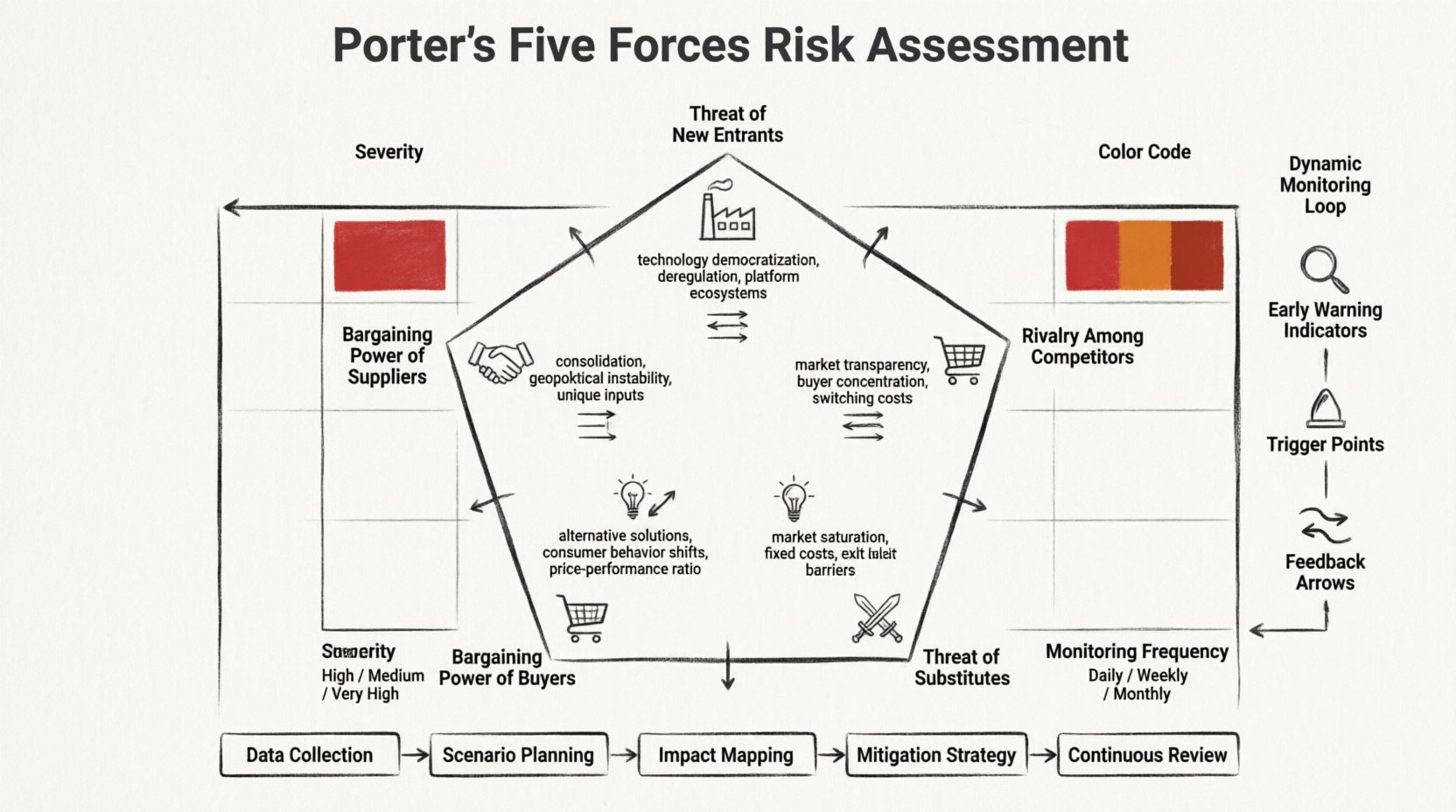
The core of this approach lies in treating each force not just as a structural element, but as a vector for potential disruption. Risk assessment adds a layer of probability and impact analysis to the qualitative assessment of each force.
Key Risk Indicators for Each Force
When applying risk assessment, look for specific signals that indicate a change in force intensity. These indicators vary by industry but generally fall into categories such as regulatory shifts, technological breakthroughs, or supply chain fragility.
- Probability: How likely is the force to increase or decrease?
- Impact: What is the financial or operational consequence of that change?
- Velocity: How quickly will the shift occur?
🚨 Deep Dive: Analyzing the Five Forces for Risk
1. Threat of New Entrants 🏭
Barriers to entry protect incumbents. However, these barriers are increasingly porous. Risk assessment here focuses on the erosion of these barriers over time.
Risk Factors to Monitor
- Technology Democratization: Cloud computing and open-source tools lower capital requirements for competitors.
- Regulatory Deregulation: Policy changes may open markets previously closed to new players.
- Platform Ecosystems: Large platforms can bypass traditional distribution channels.
Strategic Implications
If barriers are lowering, the risk of margin compression increases. Organizations must consider how to increase switching costs or create proprietary networks that are harder for new entrants to replicate.
2. Bargaining Power of Suppliers 🤝
Supplier power dictates cost structures. Risk arises when supplier concentration increases or when alternatives dwindle.
Risk Factors to Monitor
- Consolidation: Mergers among suppliers reduce the number of available sources.
- Geopolitical Instability: Trade wars or sanctions can restrict supply flows.
- Unique Inputs: Specialized materials or intellectual property owned by a few vendors.
Strategic Implications
High supplier power creates cost volatility. Risk mitigation involves diversifying the supply base, vertical integration, or designing products that allow for component substitution.
3. Bargaining Power of Buyers 🛒
Buyer power drives price sensitivity. Risk emerges when buyers gain better information or access to alternatives.
Risk Factors to Monitor
- Market Transparency: Price comparison tools make differentiation harder.
- Buyer Concentration: A few large customers can dictate terms.
- Switching Costs: If technology makes switching easier, loyalty decreases.
Strategic Implications
When buyers are powerful, pricing power diminishes. Organizations must focus on value-added services, brand loyalty, or unique customization to reduce buyer leverage.
4. Threat of Substitutes 🧠
Substitutes often come from unexpected industries. This force represents the highest level of strategic uncertainty.
Risk Factors to Monitor
- Alternative Solutions: New technologies solving the same problem differently (e.g., streaming vs. cable).
- Consumer Behavior: Shifts in preference towards sustainability or digital convenience.
- Price-Performance Ratio: If substitutes offer better value, demand shifts.
Strategic Implications
Ignoring substitutes is a common strategic failure. Risk assessment requires scanning adjacent industries to identify products that could render the core offering obsolete.
5. Rivalry Among Existing Competitors ⚔️
Competitive intensity drives marketing spend and price wars. Risk increases when growth slows and competitors fight for market share.
Risk Factors to Monitor
- Market Saturation: When growth stalls, competition becomes zero-sum.
- Fixed Costs: High overheads force aggressive pricing to maintain volume.
- Exit Barriers: Difficulties leaving the market force competitors to stay and fight.
Strategic Implications
High rivalry erodes profitability. Differentiation and niche targeting are essential to reduce direct conflict. Monitoring competitor financial health can also signal aggressive moves.
📊 Comparative Risk Matrix
The following table summarizes the primary risk vectors associated with each force and suggests focus areas for monitoring.
| Force | Primary Risk Trigger | Impact Severity | Monitoring Frequency |
|---|---|---|---|
| New Entrants | Lowered entry barriers | High | Quarterly |
| Suppliers | Supply chain disruption | High | Monthly |
| Buyers | Increased price sensitivity | Medium | Quarterly |
| Substitutes | Technological disruption | Very High | Continuous |
| Rivalry | Market saturation | Medium | Quarterly |
🛠️ Implementation Steps for Risk Assessment
Executing this analysis requires a structured process. Ad-hoc reviews often miss critical data points. A systematic approach ensures consistency and depth.
- Data Collection: Gather internal performance data and external market intelligence. This includes pricing trends, supplier contracts, and competitor announcements.
- Scenario Planning: Develop “what-if” scenarios for each force. For example, “What happens if a major supplier exits the market?”
- Impact Mapping: Map risks to specific business units, revenue streams, or operational capabilities.
- Mitigation Strategy: Define actions to reduce probability or impact. This could involve diversification, innovation, or partnership.
- Continuous Review: Schedule regular updates to the assessment. Static documents become obsolete quickly.
📉 Common Pitfalls to Avoid
Even with a robust framework, execution errors can undermine the analysis. Awareness of these common mistakes helps maintain integrity in the process.
- Over-reliance on Historical Data: Past performance does not predict future structural shifts.
- Ignoring Weak Signals: Small changes in technology or regulation often precede major shifts.
- Cognitive Bias: Confirmation bias leads leaders to ignore data that contradicts their strategic assumptions.
- Siloed Analysis: Risk assessment should involve cross-functional teams, not just strategy departments.
🌐 The Role of Technology in Risk Analysis
While no specific software is required, leveraging data analytics enhances the quality of the assessment. Modern organizations use automated monitoring tools to track market sentiment, pricing changes, and news events in real-time.
Data Sources for Insight
- Market Reports: Industry publications provide context on structural trends.
- Financial Filings: Competitor earnings calls reveal strategic priorities and risks.
- Social Listening: Customer sentiment analysis highlights shifting preferences.
- Patent Databases: Tracking R&D activity signals future product directions.
🔄 Dynamic Monitoring Systems
Static analysis is a point-in-time exercise. Effective risk management requires a dynamic system that updates as conditions change.
- Early Warning Indicators: Define specific metrics that signal a shift in a force. For example, a sudden drop in supplier lead times might indicate a shift in bargaining power.
- Trigger Points: Establish thresholds that automatically prompt a review. If raw material costs rise by 10%, trigger a supplier risk reassessment.
- Feedback Loops: Ensure that post-event analysis feeds back into the risk model. Learning from actual events improves future predictions.
🧠 Strategic Decision Making Under Uncertainty
The goal of this assessment is not to predict the future with certainty, but to prepare for multiple possibilities. Decision-makers use the output to build flexible strategies.
Building Resilience
Resilience is the ability to absorb shocks and recover quickly. This involves:
- Financial Buffers: Maintaining liquidity to weather price wars or supply shocks.
- Operational Flexibility: Designing supply chains that can reroute quickly.
- Talent Agility: Having a workforce capable of adapting to new market demands.
Investment Allocation
Risk assessment informs where to invest capital. Resources should flow toward areas that mitigate the highest risks or capture the most significant opportunities.
- Invest in R&D to counter substitute threats.
- Invest in supplier relationships to mitigate supply risk.
- Invest in branding to reduce buyer power.
🔮 Future Trends in Competitive Analysis
The landscape of strategic analysis is evolving. Several trends are shaping how organizations assess competitive risks.
- Interconnected Markets: Industries are converging. A tech company may become a competitor to a traditional retailer.
- ESG Factors: Environmental, social, and governance criteria are becoming competitive differentiators and risk factors.
- Speed of Change: The pace of innovation requires faster assessment cycles than annual planning allows.
- Global Complexity: Geopolitical shifts impact local markets more than ever before.
📝 Summary of Key Takeaways
Applying risk assessment to Porter’s Five Forces provides a robust method for anticipating competitive shifts. It moves the organization from a reactive stance to a proactive one.
- Structure: The Five Forces provide a logical structure for analysis.
- Risk Lens: Viewing each force through a risk lens highlights vulnerabilities.
- Continuous Process: Monitoring must be ongoing, not a one-time event.
- Actionable Insights: The output must lead to strategic decisions and resource allocation.
By embedding this analysis into regular strategic planning, organizations can navigate industry shifts with confidence. The goal is not to eliminate risk, but to understand it well enough to manage it effectively. This approach ensures long-term viability in an ever-changing marketplace.
🔍 Final Considerations for Leaders
Leaders must remain vigilant. The competitive landscape is rarely static. Regularly challenging assumptions is crucial. If the data suggests a force is changing, the strategy must adapt accordingly. Ignoring signals of change is the most significant risk of all.
Success depends on the quality of the analysis and the willingness to act on the findings. A perfect assessment that leads to no action is useless. Conversely, action without analysis is reckless. Balancing data-driven insight with decisive execution defines successful strategic management.