
Manufacturing stands at the intersection of raw materials, complex logistics, and final consumer demand. In this high-stakes environment, understanding competitive dynamics is not merely academic—it is a survival necessity. The Porter’s Five Forces framework offers a structured method to evaluate the profitability and intensity of competition within an industry. For manufacturing leaders, this model provides clarity on where leverage exists and where vulnerability lies.
Applying this analysis specifically to the manufacturing sector requires a deep dive into supply chain dependencies, buyer negotiation capabilities, and the structural barriers that define production economics. This guide explores how to assess these forces to inform strategic decisions without relying on hype or generic advice. We will examine each force, highlight manufacturing-specific nuances, and provide actionable insights for long-term planning.
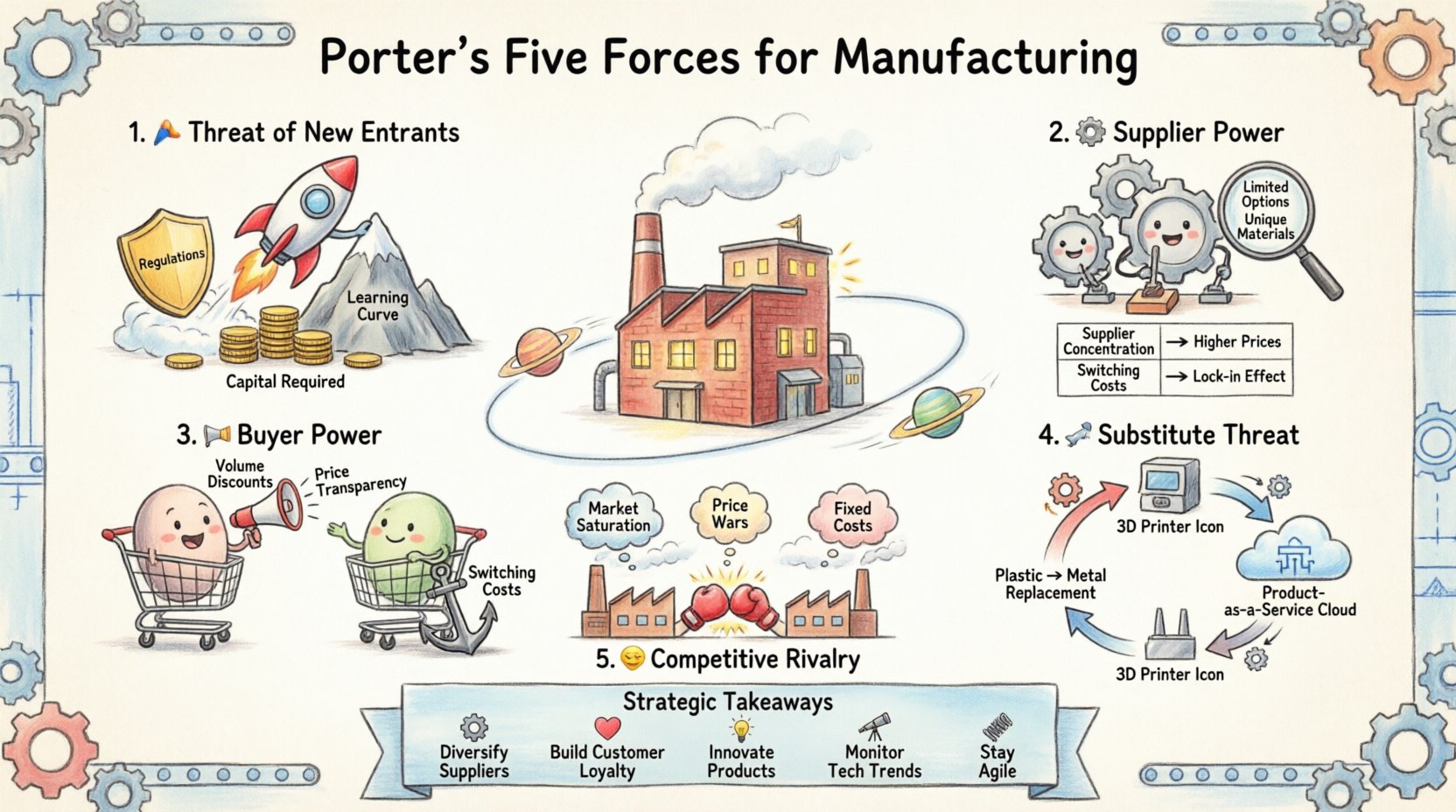
1. The Threat of New Entrants 🚀
Barriers to entry determine how easily a new competitor can disrupt the market. In manufacturing, these barriers are often substantial, yet they are not impenetrable. Understanding these hurdles helps established players defend their market share and identify potential vulnerabilities.
Capital Intensity and Economies of Scale
Manufacturing typically requires significant upfront investment in machinery, facilities, and technology. Large-scale production lowers the per-unit cost, creating a barrier for smaller players who cannot achieve similar efficiency.
- Heavy Asset Requirements: Setting up a production line for automotive parts or electronics demands millions in capital.
- Cost Advantages: Incumbents often benefit from lower costs due to volume, making it hard for newcomers to compete on price.
- Learning Curve: Experienced manufacturers optimize processes over years, reducing waste and improving quality faster than new entrants.
Regulatory and Technical Hurdles
Beyond money, compliance and expertise act as filters. Safety standards, environmental regulations, and proprietary technology can slow down or prevent new competition.
- Compliance Costs: Environmental and safety regulations vary by region, adding layers of complexity for new operations.
- Patents and IP: Proprietary processes or materials can legally restrict market access.
- Supply Chain Access: Securing reliable sources of raw materials can be difficult for new firms without established relationships.
Key Question for Manufacturers
What makes it difficult for a competitor to start producing the same goods today? If the answer involves specialized machinery, strict regulatory permits, or exclusive vendor contracts, the threat of new entrants is low.
2. Bargaining Power of Suppliers ⚙️
Supply chain stability is the backbone of manufacturing. When suppliers hold leverage, they can dictate pricing, delivery terms, and quality standards. This force directly impacts margins and operational continuity.
Supplier Concentration
When few suppliers dominate the market for a critical input, their power increases. Manufacturers have limited alternatives, forcing them to accept higher prices or lower quality.
- Limited Options: If only three companies produce a specific semiconductor or specialty steel, they hold significant sway.
- Switching Costs: Changing suppliers often requires retooling machinery or requalifying products, which is expensive and time-consuming.
- Dependency: Reliance on a single source for critical components creates risk.
Input Differentiation
Suppliers gain power when their materials are unique or specialized. Standard commodities like steel or plastic offer less leverage than proprietary chemicals or rare earth metals.
- Unique Materials: Custom alloys or specialized polymers cannot be easily sourced elsewhere.
- Quality Impact: If a supplier’s material directly affects the final product’s performance, their input is harder to replace.
- Innovation: Suppliers driving R&D can become indispensable partners.
Table: Factors Increasing Supplier Power
| Factor | Impact on Manufacturer |
|---|---|
| Supplier Concentration | Higher prices, reduced negotiation leverage |
| Switching Costs | Lock-in effect, slower response to market changes |
| Forward Integration | Suppliers may start making the final product themselves |
| Input Uniqueness | High dependency, limited alternatives |
3. Bargaining Power of Buyers 👥
In manufacturing, buyers range from individual consumers to large corporate procurement teams. The power of the buyer dictates price sensitivity and the demand for customization.
Volume and Concentration
When a few large customers purchase a significant portion of output, they can demand lower prices or better terms. This is common in B2B manufacturing sectors.
- Large Procurement Orders: Major retailers or automotive OEMs can dictate terms due to order volume.
- Concentration: If a manufacturer relies on three clients for 80% of revenue, those clients hold power.
- Price Sensitivity: Buyers comparing prices across multiple manufacturers increase competition.
Availability of Information
Digital transparency allows buyers to compare costs and specifications easily. This reduces the information asymmetry that manufacturers once relied on.
- Market Comparisons: Buyers can quickly find alternative suppliers online.
- Cost Transparency: Understanding the cost structure of competitors gives buyers leverage in negotiations.
- Quality Standards: Clear specifications allow buyers to shop based on technical compliance rather than brand loyalty.
Switching Costs for Buyers
High switching costs protect manufacturers. If a buyer faces significant friction to change vendors, they are less likely to switch based on minor price differences.
- Integration: Custom software or machinery integration creates lock-in.
- Contractual Obligations: Long-term agreements reduce buyer flexibility.
- Reliability: Buyers prioritize consistent supply over marginal savings.
4. Threat of Substitute Products 🔄
Substitutes are not just direct competitors; they are alternative solutions that solve the same problem in a different way. In manufacturing, technological shifts often create substitution threats.
Performance and Price Trade-offs
Substitutes often enter the market with better performance at a lower cost. Manufacturers must watch for innovations that disrupt traditional production methods.
- Material Substitution: Plastic replacing metal, or composites replacing traditional alloys.
- Process Changes: Additive manufacturing (3D printing) reducing the need for traditional molds.
- Service Models: Product-as-a-service models reducing the need for ownership.
Buyer Propensity to Substitute
Some industries face higher substitution risks due to low switching barriers or high innovation rates.
- Technology Sector: Rapid obsolescence increases the threat of new solutions.
- Consumer Goods: Trends shift quickly, making brand loyalty less stable.
- Industrial Equipment: Upgrades in efficiency can make older machinery obsolete.
5. Rivalry Among Existing Competitors 🥊
Intense competition drives down prices and margins. Understanding the nature of rivalry helps manufacturers position themselves effectively within the market.
Number and Balance of Competitors
When many competitors of similar size exist, rivalry intensifies. Fragmented markets often lead to price wars.
- Market Saturation: Too many players chasing the same demand reduces profitability.
- Similar Offerings: Lack of differentiation leads to price-based competition.
- Exit Barriers: High fixed costs make it difficult for struggling firms to leave the market, keeping supply high.
Industry Growth Rate
Slow growth forces competitors to fight for market share rather than expanding the pie together.
- Zero-Sum Game: In stagnant markets, gaining a customer means losing one elsewhere.
- Capacity Expansion: Adding capacity in a slow market increases supply pressure.
- Strategic Focus: Companies may focus on cost leadership rather than innovation.
Fixed Costs and Inventory
High fixed costs encourage manufacturers to fill capacity, even at lower margins, to cover overhead.
- Overhead Coverage: Running machinery at full capacity reduces per-unit costs.
- Inventory Pressure: High inventory levels necessitate sales to free up capital.
- Price Wars: Competition to move stock can erode profitability.
Strategic Application for Manufacturing Leaders 📊
Conducting the analysis is only the first step. Integrating these insights into operational strategy determines success.
Identifying Leverage Points
Look for areas where the forces are weakest. These are opportunities to invest and grow.
- Supplier Relations: Diversify the supply base to reduce dependency.
- Customer Engagement: Build relationships that increase switching costs.
- Product Differentiation: Focus on features competitors cannot easily replicate.
Monitoring Industry Shifts
Forces are not static. Technological advancements and economic shifts can alter the balance overnight.
- Technology Trends: Monitor automation and AI impacts on production costs.
- Economic Cycles: Adjust strategy based on inflation and raw material costs.
- Regulatory Changes: Prepare for new environmental or trade policies.
Building Resilience
Resilience involves preparing for the worst-case scenarios identified in the analysis.
- Supply Chain Redundancy: Maintain multiple sources for critical inputs.
- Financial Buffers: Keep cash reserves to weather price wars.
- Agile Production: Design facilities that can adapt to new product lines.
Common Pitfalls in Analysis ⚠️
Even experienced strategists can misinterpret data. Avoiding these mistakes ensures the analysis remains useful.
Overlooking Indirect Forces
Focusing only on direct competitors ignores substitutes or regulatory shifts that could disrupt the market.
- Look Beyond: Consider technologies that replace the need for the product entirely.
- External Factors: Include labor laws and trade tariffs in the assessment.
Static Assumptions
Treating the analysis as a one-time event leads to outdated strategies.
- Regular Reviews: Revisit the assessment annually or when major market shifts occur.
- Dynamic Data: Use real-time data rather than historical averages.
Neglecting the Customer
Manufacturers often focus on production efficiency while ignoring buyer needs.
- Feedback Loops: Maintain direct communication with end-users.
- Value Proposition: Ensure the product solves a real problem better than alternatives.
Future Outlook: Industry 4.0 and Beyond 🔮
The manufacturing landscape is evolving rapidly. Digital transformation influences all five forces.
Impact on Supplier Power
Digital platforms increase transparency, potentially reducing supplier leverage.
- Marketplaces: Online sourcing makes finding alternatives easier.
- Data Analytics: Better visibility into supplier performance allows for smarter selection.
Impact on Buyer Power
Customers expect faster delivery and customization.
- On-Demand: Just-in-time manufacturing becomes a standard expectation.
- Personalization: Mass customization requires flexible production lines.
Impact on Rivalry
Technology lowers barriers to entry in some areas while raising them in others.
- Automation: High efficiency lowers variable costs, increasing pressure on margins.
- Innovation: Speed to market becomes a key competitive advantage.
Summary of Key Takeaways 📝
A comprehensive assessment of Porter’s Five Forces in manufacturing provides a clear picture of industry profitability and risk. It moves decision-making from intuition to evidence.
- New Entrants: High capital and regulatory barriers protect incumbents.
- Suppliers: Concentration and uniqueness drive power up.
- Buyers: Volume and information transparency increase leverage.
- Substitutes: Technological innovation creates new competitive threats.
- Rivalry: Market saturation and fixed costs intensify competition.
By applying these principles, manufacturing leaders can navigate complex market dynamics with confidence. The goal is not just to survive, but to position the organization where it holds the most influence. Strategic planning based on these forces ensures resources are allocated to areas that yield the highest return. Continuous monitoring keeps the organization agile in a changing world.
The manufacturing sector rewards those who understand the structural forces at play. Using this framework allows for a disciplined approach to strategy, avoiding the noise of short-term market fluctuations. Focus on the long-term structural realities to build a resilient and profitable operation.