
Expanding a business beyond domestic borders introduces a complex layer of variables that standard strategic models often overlook. When applying Michael Porter’s Five Forces framework to international markets, the dynamics shift significantly due to regulatory differences, currency fluctuations, and cultural nuances. This guide provides a rigorous examination of how to adapt this analytical tool for cross-border environments.
Strategic planning for global operations requires a deeper understanding of competitive intensity. It is not enough to replicate domestic analysis. The threat of new entrants in a foreign market may be lower due to licensing, yet higher due to local competitors with established networks. Similarly, supplier power is influenced by trade agreements and logistics infrastructure. Understanding these nuances allows organizations to position themselves effectively against multinational rivals and local champions alike.
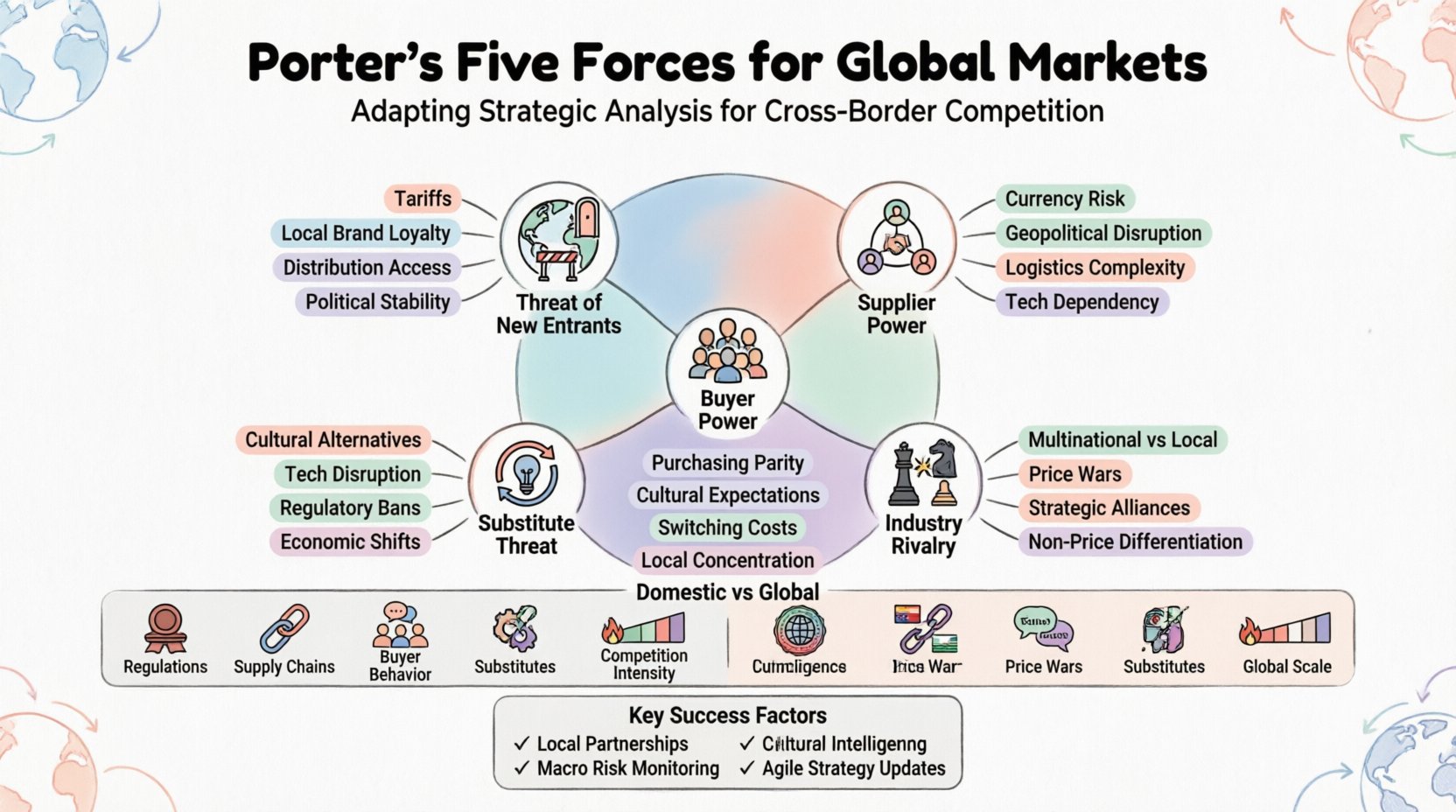
📉 Why Domestic Models Fall Short Globally
A strategy that works in one country often fails in another due to structural differences. A domestic analysis assumes a relatively stable regulatory environment and a homogenous customer base. In contrast, global markets involve multiple jurisdictions, each with its own legal framework and economic conditions.
- Regulatory Variance: Antitrust laws, labor regulations, and environmental standards vary widely. What is permissible in one region may be illegal in another, altering the competitive landscape.
- Market Fragmentation: Global markets are rarely monolithic. They are fragmented by language, culture, and economic development levels. A single strategy rarely addresses all segments effectively.
- Supply Chain Complexity: Cross-border logistics introduce lead times and costs that domestic models do not account for. This affects pricing power and inventory management significantly.
Organizations must recognize that the forces shaping competition are not static. They evolve with geopolitical shifts and economic cycles. A thorough analysis requires looking at the macroeconomic environment as a driving force behind the five competitive pressures.
🔄 The Five Forces Framework Revisited
To analyze global competition effectively, each force must be examined through the lens of international operations. The following sections detail how each force manifests differently when crossing borders.
1. Threat of New Entrants in International Markets
The barrier to entry is a critical factor in determining long-term profitability. In global markets, these barriers are a mix of structural, financial, and political elements.
- Capital Requirements: Establishing a presence in a foreign country often requires significant upfront investment in infrastructure, compliance, and marketing. This can deter smaller players.
- Government Policy: Foreign ownership restrictions, joint venture requirements, and protectionist tariffs create artificial barriers. These policies are designed to protect local industries from external competition.
- Brand Loyalty: Local consumers often prefer domestic brands due to cultural affinity or trust. Breaking this loyalty requires substantial marketing spend and time.
- Distribution Channels: Accessing established local distribution networks is difficult for new entrants. Incumbents often have exclusive contracts with key retailers or logistics providers.
When evaluating entry barriers, consider the stability of the political environment. A country with frequent policy changes presents a higher risk, potentially discouraging entrants but also destabilizing incumbents.
2. Bargaining Power of Global Suppliers
Supplier power is amplified in cross-border scenarios due to the reliance on complex supply chains. A disruption in one region can impact production in another.
- Geopolitical Risks: Trade wars, sanctions, or diplomatic tensions can sever supply lines. Companies must assess the concentration of suppliers in specific regions.
- Currency Fluctuations: Purchasing power changes with exchange rates. A strong domestic currency can give buyers leverage, but a weak currency can increase costs for imported inputs.
- Logistics Costs: Shipping, insurance, and customs duties add layers to the cost of goods. Suppliers with integrated logistics networks may hold more power than those relying on third-party freight.
- Technology Transfer: In high-tech sectors, access to proprietary technology or specialized components creates dependency. Localizing production can reduce this dependency but increases capital expenditure.
Organizations should diversify their supplier base to mitigate risk. Relying on a single source in a volatile region creates vulnerability that competitors can exploit.
3. Buyer Power Across Cultures
Buyer power is not uniform across regions. Economic development levels and consumer behavior dictate how much leverage customers hold.
- Purchasing Parity: In developed markets, buyers have more information and alternatives. In emerging markets, price sensitivity often dominates, reducing the power of brand differentiation.
- Concentration of Buyers: If a market is dominated by a few large retailers or government entities, they hold significant negotiating power. This is common in regulated industries like healthcare or infrastructure.
- Cultural Expectations: Service standards and product expectations vary. Meeting these expectations requires customization, which can limit economies of scale.
- Switching Costs: High switching costs protect incumbents. However, digital platforms often lower these costs globally, increasing buyer power.
Understanding local purchasing habits is essential. A strategy based on volume sales in one region may fail in another where premium pricing or service is preferred.
4. Threat of Substitutes and Cultural Shifts
Substitutes are not just direct competitors but also alternative ways to solve a problem. In global markets, cultural context defines what constitutes a substitute.
- Technological Disruption: Innovations may emerge in one region and spread globally. Companies must monitor tech trends in all markets they serve.
- Cultural Substitution: A product acceptable in one culture may be replaced by a traditional alternative in another. For example, local food traditions can substitute for imported processed goods.
- Regulatory Bans: Governments may ban certain products or technologies, effectively creating substitutes through legislation. Compliance is a form of competitive defense.
- Economic Conditions: Inflation can drive consumers toward cheaper alternatives. This pressure varies by region depending on local inflation rates.
Continuous monitoring of local trends is necessary to identify emerging substitutes before they erode market share.
5. Intensity of Global Industry Rivalry
Competition is fiercest in industries with many players and low differentiation. In global markets, this rivalry involves multinational corporations and local champions.
- Price Wars: Global price competition can be destructive. Companies must balance global pricing strategies with local market realities.
- Capacity Expansion: Overcapacity in one region can lead to dumping in another. This aggressive pricing strategy aims to capture market share at the expense of profitability.
- Strategic Alliances: Partnerships between local and international firms can alter the balance of power. These alliances often combine local knowledge with global resources.
- Non-Price Competition: Differentiation through innovation, brand, or service becomes crucial when price competition becomes unsustainable.
📊 Comparative Analysis: Domestic vs. Global Forces
The table below highlights the key differences in how the five forces operate in domestic versus global contexts.
| Force | Domestic Context | Global Context |
|---|---|---|
| Threat of New Entrants | Barriers based on local capital and regulations. | Barriers include tariffs, foreign ownership laws, and cultural distance. |
| Supplier Power | Relies on local logistics and relationships. | Complicated by exchange rates, trade routes, and geopolitical stability. |
| Buyer Power | Driven by local income and preferences. | Influenced by purchasing power parity and cross-border shopping habits. |
| Substitute Threat | Similar products or technologies. | Includes cultural alternatives and regional regulatory bans. |
| Industry Rivalry | Local competitors and price sensitivity. | Includes multinational giants and local champions with government backing. |
🌐 External Macro Factors Influencing the Forces
Beyond the five forces, macroeconomic and political factors act as background conditions that modify competitive dynamics. These are often outside the control of the firm but must be managed.
- Exchange Rates: Volatility affects cost structures and pricing power. Companies may need to hedge currency risk to maintain margins.
- Inflation Rates: High inflation erodes purchasing power and increases input costs. This forces price adjustments that can affect demand.
- Political Stability: Unstable governments increase operational risk. This can lead to supply chain disruptions or asset expropriation.
- Trade Agreements: Free trade zones or blocs can reduce barriers, increasing competition from within the region.
Organizations must maintain a risk register for these factors. Regular scenario planning helps prepare for potential shifts in the macroeconomic environment.
🛠️ Implementation Strategy for Multinational Teams
Executing a global Five Forces analysis requires coordination across different departments and regions. A centralized approach ensures consistency, while local input ensures accuracy.
- Centralized Data Collection: Gather market data from regional offices to create a unified view of the competitive landscape.
- Local Expert Consultation: Engage local strategists who understand the nuances of the market. They can identify threats that external data misses.
- Regular Updates: Global markets change rapidly. The analysis should be reviewed quarterly or when major geopolitical events occur.
- Integration with Strategy: The findings must inform investment decisions, pricing models, and market entry strategies.
Communication is key. Ensure that insights from the analysis are translated into actionable plans for regional managers.
⚠️ Common Analytical Pitfalls
Avoiding common mistakes ensures the analysis remains relevant and accurate. Many organizations fail by applying domestic assumptions to global markets.
- Ignoring Cultural Context: Assuming that consumer behavior is the same across borders leads to flawed predictions.
- Overlooking Informal Markets: In some regions, a significant portion of trade is informal. This affects competitor analysis and market size estimates.
- Static Analysis: Treating the forces as static leads to outdated strategies. Competition evolves with technology and regulation.
- National Bias: Evaluating foreign markets through the lens of the home country creates blind spots regarding local strengths and weaknesses.
🚀 Future-Proofing the Analysis
The global landscape is shifting towards digitalization and sustainability. These trends will reshape the five forces in the coming years.
- Digital Platforms: E-commerce reduces barriers to entry for some industries while increasing concentration for others. Digital ecosystems create new competitive boundaries.
- Sustainability Regulations: Environmental standards are becoming stricter globally. Compliance costs will act as a barrier to entry for some firms.
- Supply Chain Resilience: The focus is shifting from efficiency to resilience. This changes supplier relationships and inventory strategies.
- Data Privacy: Regulations like GDPR affect how companies compete on data-driven services. This creates a new dimension of competitive advantage.
Organizations must remain agile. The ability to adapt to these emerging trends will define success in global markets. Continuous learning and adaptation are essential for long-term viability.
🔍 Final Considerations for Strategic Planning
Applying Porter’s Five Forces to global markets demands a nuanced approach. It is not a checklist but a framework for thinking about competition. The goal is to identify where value can be created and protected.
- Focus on Differentiation: In global markets, differentiation is harder but more valuable. Unique value propositions can justify premium pricing.
- Build Local Relationships: Strong ties with local partners can mitigate entry barriers and supplier risks.
- Monitor Competitor Moves: Keep a close watch on how rivals adapt to local conditions. Their success can reveal market opportunities.
- Assess Long-Term Viability: Ensure that the strategy aligns with long-term geopolitical and economic trends, not just short-term gains.
By systematically analyzing these dynamics, organizations can navigate the complexities of international competition. The Five Forces framework remains a vital tool when adapted correctly for cross-border contexts.