
Strategic planning is often treated as a ritual rather than a discipline. Many small business owners and founders sit down once a quarter to fill out a template. They check boxes. They feel productive. Yet, when the year ends, the strategy remains on paper while the market moves forward. The culprit is rarely the SWOT analysis framework itself. The problem lies in the quality of the data entered into it, specifically within the "Strengths" quadrant.
When you write "Experienced Team" or "Good Reputation" as a strength, you are not stating a fact; you are stating a hope. These generic statements offer no direction. They do not tell you where to allocate capital, where to hire, or what to stop doing. This guide explores why vague strengths undermine your small business plan and how to replace them with actionable intelligence that drives growth.
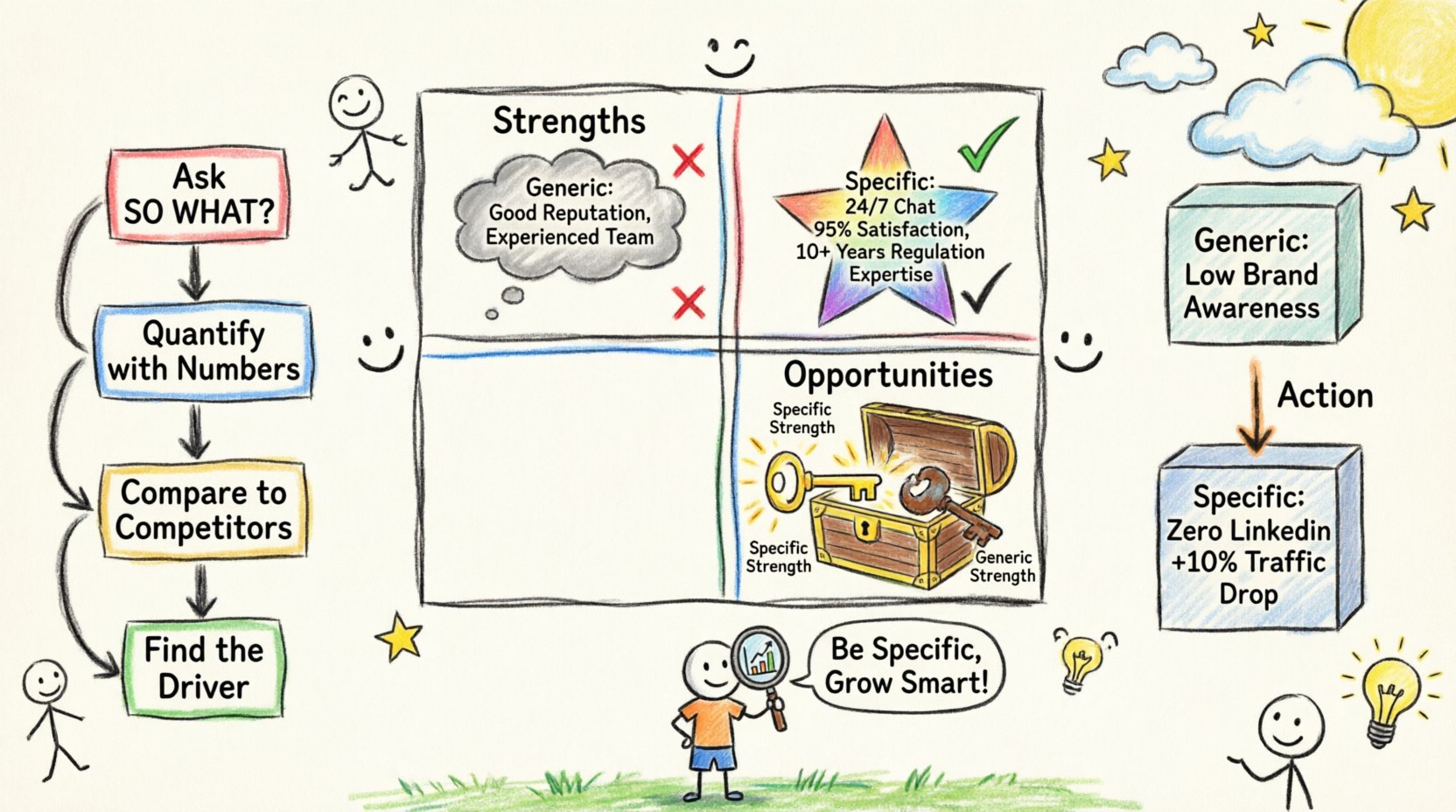
Understanding the SWOT Landscape 🗺️
SWOT stands for Strengths, Weaknesses, Opportunities, and Threats. It is a framework used to evaluate the internal and external factors affecting an organization. It is not a magic spell. It is a diagnostic tool. To use it effectively, you must understand the distinction between internal and external factors.
- Internal Factors: These are elements within your control. Strengths and Weaknesses fall here. They include your cash flow, your staff, your proprietary technology, your brand voice, and your operational processes.
- External Factors: These are elements outside your control. Opportunities and Threats fall here. They include market trends, competitor actions, regulatory changes, and economic shifts.
Most businesses get the external factors right because the market shouts at you. You see the competitor lowering prices. You see the new regulation. The internal factors are harder to see because you are inside the house. You normalize your strengths. You accept your weaknesses as just "how it is." This normalization is where the strategic failure begins.
The Trap of Generic Strengths ❌
A strength is a capability that gives you an advantage over the competition. However, "advantage" is relative. If every competitor in your industry has a "dedicated team," then having a team is not a strength. It is a baseline requirement.
Generic strengths create a false sense of security. When you write "High Quality Products", you are assuming quality is the deciding factor for your customer. Often, it is not. Price, speed, convenience, or customer service might be the deciding factor. If you focus on quality without quantifying what "high" means, you risk optimizing for a metric that does not drive revenue.
Here are the common generic strengths found in small business plans and why they fail:
- "Good Reputation": Reputation is a lagging indicator. It is the result of past actions. It does not predict future success. You need to know why people trust you. Is it speed? Is it transparency? Is it a specific guarantee?
- "Experienced Team": Tenure does not equal performance. A team that has been there for ten years might be resistant to change. You need to define the specific skills that drive current results. Are they experts in sales? Experts in logistics? Experts in a specific software stack?
- "Low Overhead": Low costs allow for lower prices or higher margins, but only if the market demands low prices. If the market demands premium service, low overhead might mean you cannot afford the staff to deliver that service. This is a strength only in specific contexts.
- "Strong Leadership": Leadership is subjective. If the leadership is strong in vision but weak in execution, the business will struggle. You need to identify the specific leadership trait that matters, such as rapid decision-making or crisis management.
When you rely on these vague terms, your strategy becomes reactive. You react to market pressures because you do not have a clear internal anchor. You do not know what to leverage when an opportunity arises.
Specificity as a Competitive Edge 🎯
Specificity turns data into strategy. A specific strength allows you to make a bet. It tells you where to push. It tells you what to protect. To move from generic to specific, you must ask the "So What?" question repeatedly.
Consider the statement: "We have a large inventory." So what? Does it allow you to fulfill orders faster than a drop-shipping competitor? Does it allow you to bundle products? Does it allow you to absorb price fluctuations? If it allows you to fulfill orders in 24 hours while competitors take 5 days, then the strength is "Rapid Fulfillment Capability via Local Stock."
This distinction changes the strategy. If the strength is "Rapid Fulfillment," you market speed. You prioritize logistics partners who can handle volume spikes. You invest in warehouse management systems. If the strength is "Large Inventory," you might just hoard stock and tie up cash flow.
Here is a breakdown of how to refine your strengths using a structured approach:
- Quantify: Replace adjectives with numbers. Instead of "Fast Service," use "90% of orders shipped within 2 hours."
- Contextualize: Compare your strength to the industry standard. "Our response time is 2 hours, while the industry average is 48 hours."
- Identify the Driver: What asset creates this strength? Is it a proprietary algorithm? Is it a long-term lease on a prime location? Is it a loyal customer database?
- Validate: Can the customer articulate this value? If you cannot explain it simply, it is not a clear strength.
Connecting the Dots: The S-O Matrix 🔗
The true power of SWOT lies in the intersection of quadrants. Specifically, linking Strengths to Opportunities. This is where growth happens. A generic strength cannot effectively link to an opportunity because the connection is too abstract.
Let's look at a practical scenario. You are a boutique software consultancy.
- Generic Approach: Strength: "Skilled Developers." Opportunity: "Growing demand for AI." Strategy: "Hire more developers." Result: You burn cash and hope for the best.
- Specific Approach: Strength: "Proprietary code base for legacy data migration." Opportunity: "Large enterprises migrating from on-premise servers." Strategy: "Package migration as a service and target CTOs of mid-sized firms." Result: You have a clear product and a clear customer.
The specific strength acts as a key. The opportunity is the lock. If the key does not fit the lock, you cannot open the door. Generic strengths look like they might fit many locks, but they often don't fit any of them securely.
To build this connection, map your specific strengths against external trends. Ask:
- How does this specific capability reduce customer acquisition costs?
- How does this specific capability increase customer lifetime value?
- How does this specific capability create a barrier to entry for competitors?
Common Mistakes in Weaknesses & Threats ⚖️
While this guide focuses on strengths, ignoring weaknesses and threats often invalidates the strengths. A strength is only valuable if the weakness does not undermine it. Similarly, a threat can negate a strength if you are unprepared.
Many businesses hide their weaknesses. They write "We need to improve marketing" as a weakness. This is not a weakness; this is an action item. A weakness is a current deficiency. "Lack of internal marketing team" is a weakness. "Limited budget for paid ads" is a weakness.
Threats are often dismissed as "competitors." That is too broad. A threat is a specific risk. "A competitor launching a lower-priced subscription model next quarter" is a threat. "Supply chain disruptions in Asia" is a threat.
When you are honest about weaknesses, you protect your strengths. If your strength is "Premium Support," your weakness might be "High cost of support staff." You must decide if the strength justifies the cost of the weakness. If the weakness is too high, the strength becomes a liability.
Actionable Framework for Better SWOT 🏃♂️
To move forward, you need a process. Analysis paralysis is a real risk. You must gather data, interpret it, and then discard the analysis to focus on execution. Here is a framework to ensure your SWOT is not just a document, but a plan.
- Gather Evidence: Do not rely on memory. Pull data from your CRM, sales reports, and customer feedback. What does the data say about your performance compared to the market?
- Interview Stakeholders: Talk to your sales team. They know why customers buy. Talk to your operations team. They know where bottlenecks are. Synthesize these insights.
- Challenge Assumptions: For every strength, ask "What if this disappears tomorrow?" If the answer is "We fail," that is a critical dependency, not just a strength.
- Prioritize: You cannot fix everything. Pick the top three strengths that matter most to your current growth goals. Ignore the rest for now.
- Assign Owners: Every specific strength should have an owner. Who is responsible for maintaining this advantage? Who is responsible for exploiting it?
By assigning ownership, you move from planning to management. The SWOT becomes a living document that is reviewed when the owner reports on the status of that strength.
Real-World Examples: Generic vs. Specific 📊
To make this concrete, let's look at a comparison table. This illustrates the shift from vague planning to strategic precision.
| Quadrant | Generic Entry (Weak) | Specific Entry (Strong) | Strategic Implication |
|---|---|---|---|
| Strength | Good Customer Service | 24/7 live chat support with 95% satisfaction rate | Strategy: Market support availability as a differentiator against competitors with ticket-only support. |
| Strength | Experienced Staff | Team has 10+ years average tenure in industry regulations | Strategy: Position as trusted advisors for compliance-heavy clients. |
| Weakness | Low Brand Awareness | Zero presence on LinkedIn; organic search traffic down 10% | Strategy: Invest in LinkedIn advertising and SEO audit immediately. |
| Opportunity | New Market Trends | 30% of competitors are moving to subscription models | Strategy: Pilot a subscription tier for our top 100 clients. |
| Threat | Competitors | Competitor X secured a major distribution deal with Retail Giant Y | Strategy: Secure exclusive contracts with key regional partners to block similar deals. |
Notice the difference in the "Strategic Implication" column. The generic entries lead to vague ideas like "Market more" or "Improve brand." The specific entries lead to concrete actions like "Secure contracts" or "Pilot subscription." This is the difference between a plan and a roadmap.
The Psychology of Strategic Planning 🧠
Why do businesses stick to generic strengths? It is often psychological comfort. Admitting that a strength is only useful in a narrow context feels like a limitation. It feels like a weakness. However, acknowledging limitations is the first step to managing them.
There is also the bias of familiarity. You know your business best. You know the effort it takes to deliver a result. You assume the customer sees the same effort. They do not. The customer sees the outcome. If your strength is "Complex Customization," the customer sees "Products made for us." You must translate your internal strength into external value.
This translation requires empathy. You must step outside the company and view your operations as a customer would. What friction do they feel? What value do they feel? Your strengths should be the things that reduce friction or increase value for the customer.
Reviewing and Updating the Plan 🔄
A SWOT analysis is not a one-time event. The business environment changes. A strength today might be a weakness tomorrow if the technology shifts. A threat today might become an opportunity if you adapt.
Set a quarterly review cycle. Do not wait for the annual planning session. Every quarter, ask:
- Has a competitor changed their pricing or offering?
- Have we lost a key employee who held a specific strength?
- Has a new regulation changed the landscape?
- Are the specific metrics we tracked still relevant?
If your strengths are specific, updating the plan is easier. You know exactly which metric changed. If your strengths are generic, you cannot measure change. You only feel it vaguely.
Final Thoughts on Strategic Clarity 🌟
Small business planning requires courage. It requires admitting that "good reputation" is not enough. It requires digging into the data to find the specific levers that move the needle. When you replace generic strengths with specific capabilities, you stop guessing and start directing.
Your plan becomes a tool for decision-making. When a new project comes up, you check your specific strengths. Does this project leverage our proprietary code? Does it utilize our 24/7 support? If not, you might not pursue it. This discipline conserves resources and focuses your energy on what actually works.
Strategic planning is not about predicting the future. It is about preparing for it. By grounding your SWOT analysis in specific, measurable, and actionable internal capabilities, you build a foundation that can withstand market shifts. You stop being reactive and start being proactive. That is how small businesses scale.