
The Business Motivation Model (BMM) provides a structured framework for understanding the drivers, goals, and tactics within an enterprise. However, defining objectives is only the first step. The critical challenge lies in measuring performance against Business Motivation Model objectives to ensure strategic intent translates into tangible results. Without rigorous measurement, strategic plans remain theoretical constructs that fail to influence daily operations.
This guide explores the mechanics of performance measurement within the BMM context. We will examine how to align metrics with strategic intent, establish robust data collection methods, and interpret variances without relying on external hype or generic advice. The focus remains on the structural integrity of the measurement process.
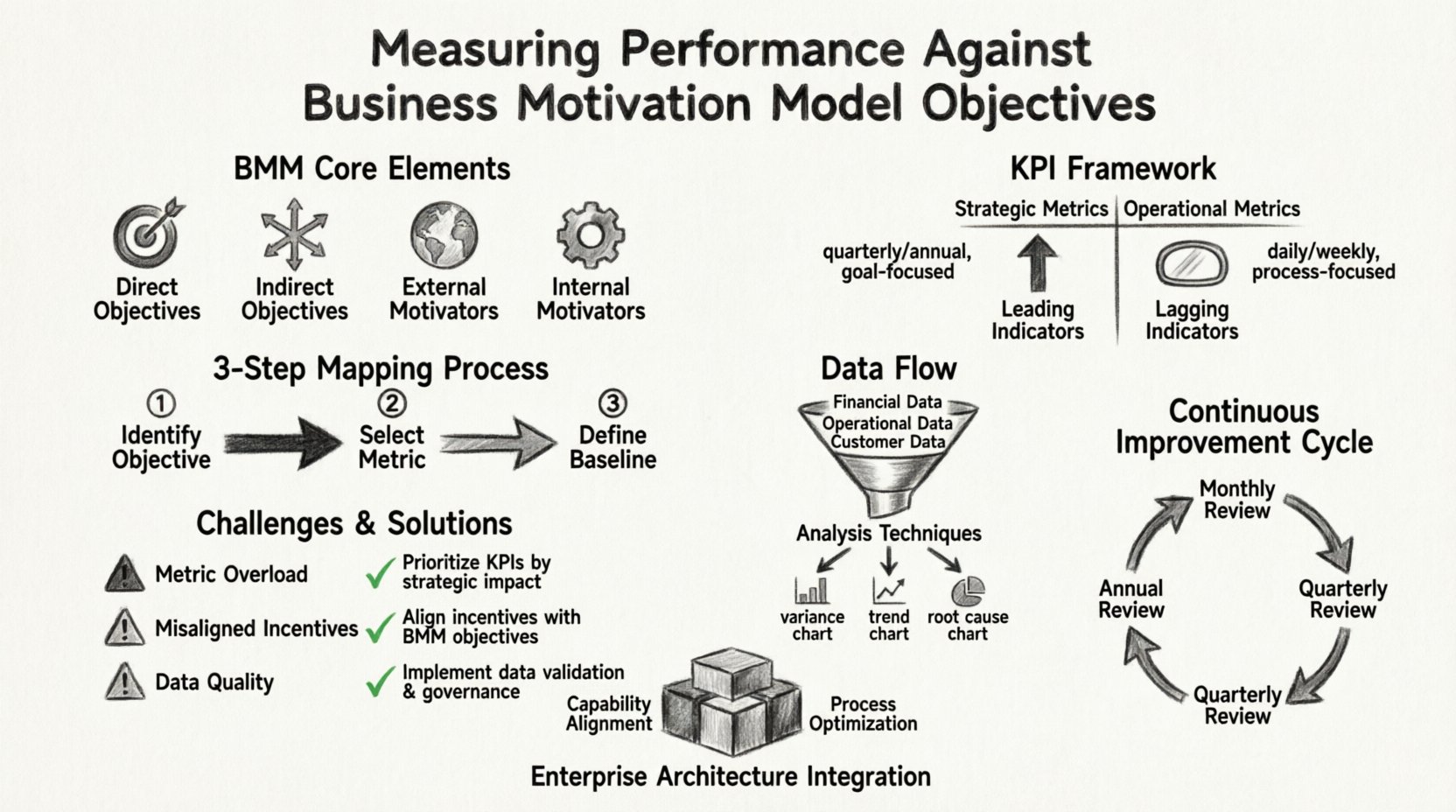
🧩 Understanding the Components of BMM Performance
Before measuring, one must understand what is being measured. The BMM distinguishes between several core elements, each requiring a different measurement approach. Confusing these elements leads to noise rather than insight.
1. Direct vs. Indirect Objectives
Objectives in the BMM are categorized based on their relationship to the business outcome. Measurement strategies differ significantly between these categories.
- Direct Objectives: These are specific outcomes the organization explicitly aims to achieve. Examples include revenue targets, market share growth, or customer satisfaction scores. Measurement here is straightforward and quantitative.
- Indirect Objectives: These support Direct Objectives but are not the final outcome themselves. An example might be improving employee retention to support a goal of operational stability. These require proxy metrics.
When tracking performance, it is vital to distinguish between the goal and the tactic used to achieve it. A tactic that succeeds does not always mean the goal was met if the underlying assumption was flawed.
2. Motivators as Measurement Triggers
Motivators are the forces that drive the achievement of objectives. They can be external (market trends, regulatory changes) or internal (culture, capability). Measuring performance often involves monitoring the status of these motivators. If a key motivator shifts, the relevance of the current performance metrics may change.
- External Motivators: Economic indicators, competitor actions.
- Internal Motivators: Budget availability, workforce skill levels.
📏 Defining Key Performance Indicators for BMM
Establishing Key Performance Indicators (KPIs) requires a deliberate mapping process. Randomly selected metrics do not constitute a measurement system. Each metric must trace back to a specific objective within the model.
Strategic vs. Operational Metrics
Performance measurement operates at different levels of the organization. Strategic metrics look at the long-term horizon, while operational metrics focus on immediate execution.
| Dimension | Strategic Metrics | Operational Metrics |
|---|---|---|
| Time Horizon | Quarterly or Annual | Daily, Weekly, or Monthly |
| Focus | Goal Achievement | Process Efficiency |
| BMM Element | Goals, Objectives | Tactics, Plan |
| Example | Market Share Growth | Number of Sales Calls |
Leading vs. Lagging Indicators
A robust measurement system utilizes both types of indicators to provide a complete picture of performance.
- Lagging Indicators: These confirm past performance. They are the result of actions already taken. Examples include financial reports or completed project milestones. While necessary, they offer limited ability to correct course in real-time.
- Leading Indicators: These predict future performance. They measure activities that drive results. Examples include customer engagement rates or pipeline velocity. These allow for proactive adjustments to tactics.
When aligning with BMM objectives, a balance is essential. Relying solely on lagging indicators means reacting to problems after they occur. Relying solely on leading indicators risks measuring activity without verifying actual impact.
🔗 Mapping Metrics to Objectives
The core of measuring performance is the linkage between the metric and the objective. This mapping ensures that effort is not wasted on data that does not inform strategic decisions.
Step 1: Identify the Objective
Begin by selecting the specific Objective from the Business Motivation Model. Is it a Goal, a Direction, or a Plan? Each has a different measurement granularity.
- Goals: Broad, qualitative, or quantitative targets. Measurement is often high-level.
- Plans: Specific sets of actions. Measurement focuses on completion rates and adherence.
Step 2: Select the Metric
Choose a metric that directly reflects progress toward the identified Objective. Avoid vanity metrics that look good but do not correlate with business value.
- Relevance: Does this number change when the Objective moves?
- Accuracy: Can the data be trusted?
- Timeliness: Is the data available when needed for decision-making?
Step 3: Define the Baseline
Performance cannot be measured without a reference point. Establish a baseline that represents the current state of the Objective. This allows for the calculation of variance and progress over time.
Baseline data should be historical and verified. Using incorrect baseline data creates a false sense of achievement or failure.
📡 Data Collection and Analysis Methods
Once metrics are defined, the mechanism for gathering data must be established. This process must be systematic to ensure consistency.
Data Sources
Performance data often comes from disparate systems. Integrating these sources is critical for a holistic view.
- Financial Systems: Provide data on cost, revenue, and budget variance.
- Operational Systems: Provide data on throughput, quality, and speed.
- Customer Feedback: Provide qualitative data on satisfaction and loyalty.
Analysis Techniques
Raw data does not equal insight. Analysis techniques transform data into actionable information.
- Variance Analysis: Compare actual performance against the plan. Identify where the deviation occurred.
- Trend Analysis: Look at performance over time to identify patterns or seasonal effects.
- Root Cause Analysis: If a metric is off-target, determine why. Is it the tactic, the objective, or the external environment?
⚠️ Common Challenges in BMM Measurement
Implementing a measurement system introduces complexity. Several common pitfalls can undermine the effectiveness of the process.
1. Metric Overload
Tracking too many metrics dilutes focus. When every KPI is important, none are. Select only the metrics that directly influence the success of the primary Objectives.
- Audit the dashboard regularly.
- Remove metrics that no longer provide value.
- Focus on the vital few rather than the trivial many.
2. Misaligned Incentives
Measurement systems influence behavior. If the metrics do not align with the true goals of the organization, employees may optimize for the wrong outcome.
- Ensure performance reviews reflect the BMM Objectives.
- Check that tactical success does not undermine strategic intent.
3. Data Quality Issues
Inaccurate data leads to incorrect conclusions. Garbage in, garbage out is a fundamental rule of performance management.
- Implement validation rules at the point of entry.
- Regularly audit data integrity.
- Ensure stakeholders understand the definition of each metric.
🔄 Continuous Improvement and Adaptation
The Business Motivation Model is not static. The business environment changes, and objectives may evolve. The measurement system must adapt accordingly.
Review Cycles
Establish regular intervals for reviewing performance data. These cycles allow for the assessment of whether the current strategy remains valid.
- Monthly Reviews: Focus on operational tactics and immediate variances.
- Quarterly Reviews: Focus on goal progress and strategic alignment.
- Annual Reviews: Focus on the relevance of the Objectives themselves and the need for new goals.
Feedback Loops
Measurement is useless if it does not lead to action. Create feedback loops where performance data triggers specific responses.
- Positive Variance: If performance exceeds targets, analyze if the target was too conservative. Consider raising the objective.
- Negative Variance: If performance falls short, analyze if the tactic was ineffective. Adjust the plan or resource allocation.
🏗️ Integrating with Enterprise Architecture
Performance measurement does not exist in a vacuum. It must integrate with the broader Enterprise Architecture to ensure technical capabilities support strategic goals.
Capability Alignment
Business capabilities must be measured to ensure they can deliver the required outcomes. If a business objective relies on a specific capability, that capability must be assessed for readiness and performance.
- Identify the capabilities required to achieve the Objective.
- Measure the performance of these capabilities.
- Invest in improvement where gaps exist.
Process Optimization
Processes are the mechanisms that execute tactics. Measuring process performance helps identify bottlenecks that hinder the achievement of objectives.
- Map processes to the relevant BMM Tactic.
- Identify delays or errors in the workflow.
- Optimize for speed and quality.
🎯 Final Considerations for Implementation
Implementing a measurement framework against Business Motivation Model objectives requires discipline and clarity. It is not a one-time project but an ongoing management practice.
- Clarity of Definition: Ensure all stakeholders agree on what each Objective means.
- Consistency of Data: Use standardized definitions for all metrics.
- Transparency of Reporting: Share results openly to foster accountability.
- Flexibility of Structure: Allow the measurement system to evolve as the business evolves.
By adhering to these principles, organizations can ensure that their performance measurement efforts directly support their strategic ambitions. The goal is not just to count numbers, but to understand the drivers of business success and steer the organization effectively toward its desired future state.
The integration of rigorous measurement into the Business Motivation Model transforms abstract strategy into concrete action. It provides the visibility needed to manage risk, allocate resources, and validate the value of initiatives. In this way, measurement becomes a strategic asset rather than a compliance burden.