
Michael Porter’s Five Forces framework has stood as a cornerstone of business strategy for decades. Introduced in 1979, it provided a structured way to analyze the competitive intensity and attractiveness of an industry. However, the business landscape has shifted dramatically since the late 20th century. Markets move faster, technology disrupts traditional value chains, and ecosystems replace linear supply chains.
While the model remains valuable for understanding industry structure, relying on it exclusively creates blind spots. Strategic leaders must recognize where this framework falls short and when to integrate additional analytical tools. This guide explores the specific limitations of the Five Forces and identifies the complementary methods necessary for a robust strategic analysis.
📊 Understanding the Core Framework
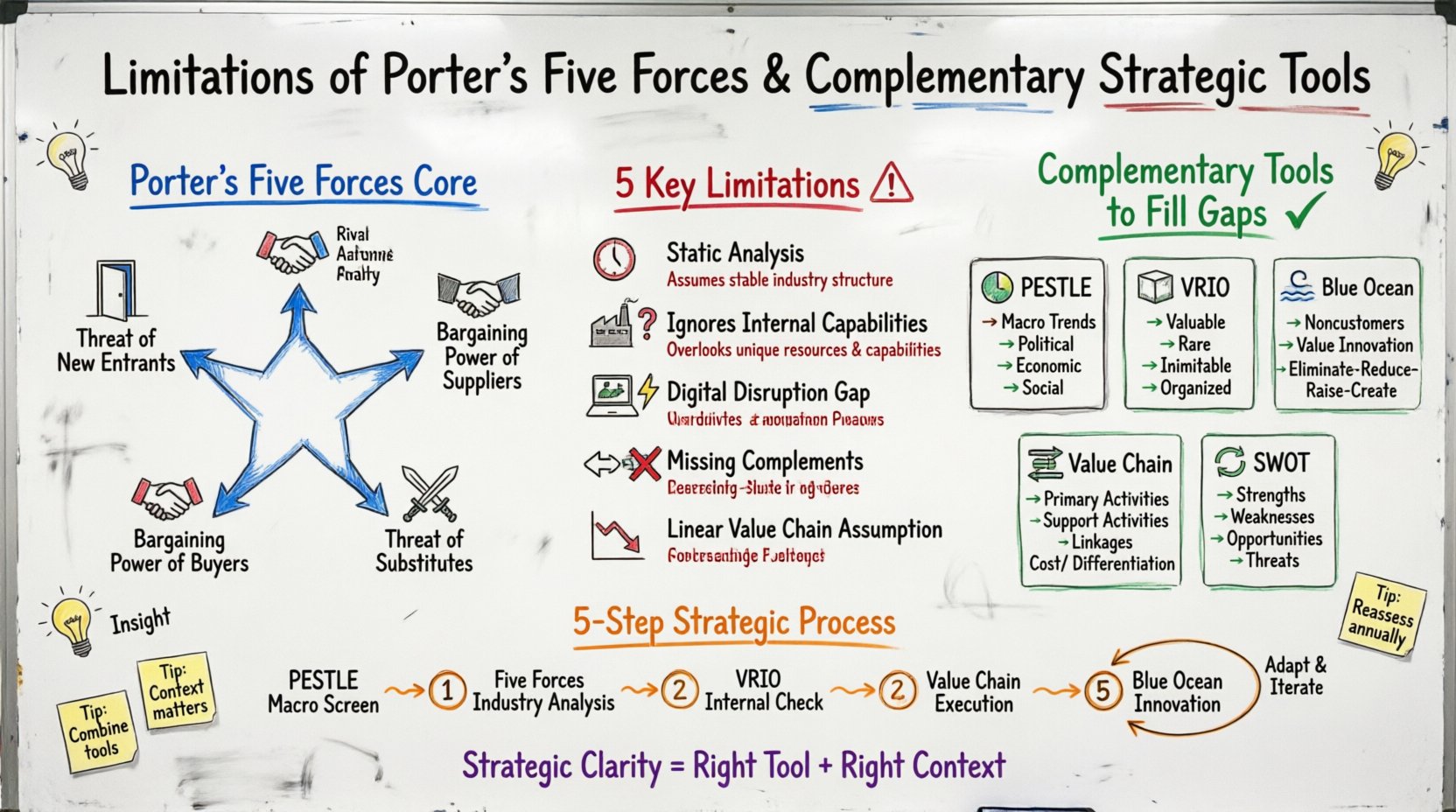
Before addressing the shortcomings, it is essential to recall what the Five Forces actually measure. The model assesses the competitive environment based on five distinct pressures:
- Threat of New Entrants: How easy is it for new competitors to enter the market?
- Bargaining Power of Suppliers: Can suppliers drive up prices or reduce quality?
- Bargaining Power of Buyers: Can customers drive down prices or demand more value?
- Threat of Substitute Products or Services: Are there alternatives outside the immediate industry?
- Rivalry Among Existing Competitors: How intense is the competition between current players?
This structure focuses heavily on the external industry environment. It assumes a relatively stable industry structure where profit potential is determined by the balance of these five forces. While this logic holds for many traditional manufacturing or utility sectors, it struggles to capture the dynamics of modern knowledge economies.
🧩 Key Limitations of the Five Forces Model
Recognizing the constraints of any strategic tool is the first step toward effective application. The following sections detail why the Five Forces alone may lead to incomplete or inaccurate strategic planning.
1. The Static Nature of the Analysis ⏳
The Five Forces provide a snapshot of the industry at a specific point in time. They are inherently static. They do not account for rapid changes in technology, consumer behavior, or regulatory environments. In fast-moving sectors like software or telecommunications, the competitive landscape can shift significantly within a single fiscal year.
When a strategy is built on a static model, it risks becoming obsolete before it is fully implemented. A company might analyze supplier power today, only for a new technology to render those suppliers irrelevant tomorrow. This lack of temporal depth is a significant drawback for companies operating in volatile markets.
2. Neglect of Internal Capabilities 🏭
The framework is almost exclusively external. It looks outward at the industry but looks inward only through the lens of competitive position. It does not evaluate what the company actually possesses that allows it to succeed. A firm might operate in a highly attractive industry (low rivalry, low entry barriers) but still fail because it lacks the internal resources to execute.
For example, a startup might find a gap in the market with low competition, but if it lacks the technical expertise or capital to scale, the opportunity is illusory. The Five Forces do not measure organizational strength, culture, or operational efficiency.
3. The Digital Disruption Gap 💻
The original model was designed for an industrial economy. It assumes clear industry boundaries. In the digital age, these boundaries are porous. Technology companies often enter traditional industries, and traditional industries often become tech companies. This convergence blurs the lines of who the competitors are.
Consider the ride-sharing industry. Traditional Five Forces analysis might focus on taxi medallion holders. However, the real competition came from app-based platforms that did not own vehicles. The model struggles to account for business models that create value through network effects rather than traditional asset ownership.
4. Ignoring Complementary Products 🔗
Porter originally excluded a sixth force: the threat of complementary products. However, in many modern industries, complements are more critical than substitutes. A product often needs a complementary service to function effectively. If the complementary industry is weak, the primary industry suffers.
For instance, the gaming console industry depends heavily on the availability of high-quality software titles. If software developers leave the platform, the hardware becomes less valuable. The original model does not explicitly weigh the power of these complementary forces, which can be a decisive factor in success.
5. Assumption of a Linear Value Chain 📉
The framework assumes a linear flow: suppliers make inputs, the firm processes them, and buyers consume the output. Modern value creation is often non-linear. It involves platforms, networks, and ecosystems where value is co-created with users. The model does not easily accommodate collaborative value creation where the customer is also a producer of value.
🛠️ Complementary Strategic Tools to Consider
To overcome these limitations, strategists should supplement the Five Forces with other established frameworks. Each tool brings a different perspective, filling the gaps left by the industry analysis.
1. PESTLE Analysis for Macro Context 🌍
When the Five Forces fail to account for external macroeconomic shifts, the PESTLE framework steps in. This tool analyzes Political, Economic, Social, Technological, Legal, and Environmental factors.
- Political: Trade policies, tax regimes, and stability.
- Economic: Growth rates, exchange rates, and inflation.
- Social: Demographics, lifestyle trends, and cultural attitudes.
- Technological: R&D activity, automation, and tech incentives.
- Legal: Employment laws, health and safety, and consumer protection.
- Environmental: Sustainability issues, carbon footprint, and climate change.
Using PESTLE alongside Five Forces ensures that the analysis covers both the immediate industry forces and the broader environment that shapes them.
2. VRIO Framework for Internal Strengths 🧱
If the Five Forces look outward, the VRIO framework looks inward. It assesses whether a company’s resources provide a sustained competitive advantage. VRIO stands for Value, Rarity, Imitability, and Organization.
- Value: Does the resource exploit an opportunity or neutralize a threat?
- Rarity: Is the resource controlled by only a few firms?
- Imitability: Is it costly for others to imitate this resource?
- Organization: Is the firm organized to capture value from the resource?
This tool corrects the Five Forces’ blindness to internal capabilities. A strategy is only viable if the company has the specific resources to execute it.
3. Blue Ocean Strategy for Market Creation 🌊
Porter’s model focuses on beating the competition within existing market boundaries. The Blue Ocean Strategy challenges this by suggesting that companies should stop fighting for a share of a known market and instead create uncontested market space.
This approach utilizes the Four Actions Framework:
- Eliminate: Which factors that the industry takes for granted should be eliminated?
- Reduce: Which factors should be reduced well below the industry standard?
- Raise: Which factors should be raised well above the industry standard?
- Create: Which factors should be created that the industry has never offered?
This is particularly useful when the Five Forces indicate an industry is too saturated to profitably compete in.
4. Value Chain Analysis for Operational Detail 🔗
The Five Forces view the firm as a black box. The Value Chain breaks the firm down into primary and support activities to identify where value is actually created. It looks at inbound logistics, operations, outbound logistics, marketing, service, and support functions.
This granular view helps identify cost advantages or differentiation points that the broader Five Forces model misses. It connects the external industry pressures to internal operational realities.
5. SWOT Analysis for Holistic View 🔄
SWOT (Strengths, Weaknesses, Opportunities, Threats) is a broad-brush tool that combines internal and external factors. While often criticized for being generic, it serves as an excellent summary tool when used after deeper analysis.
- Strengths & Weaknesses: Derived from the VRIO and Value Chain.
- Opportunities & Threats: Derived from the Five Forces and PESTLE.
Using SWOT as a synthesis tool helps align the findings from the Five Forces with the company’s internal reality.
📋 Comparison of Strategic Frameworks
To make informed decisions about which tools to apply, it helps to compare them side-by-side. The table below outlines the focus, time horizon, and best use case for each method.
| Framework | Primary Focus | Time Horizon | Best Use Case |
|---|---|---|---|
| Porter’s Five Forces | Industry Structure | Static / Short-Term | Evaluating entry into a specific sector. |
| PESTLE | Macro Environment | Medium to Long-Term | Assessing risk from external societal shifts. |
| VRIO | Internal Resources | Long-Term | Identifying core competencies and sustained advantage. |
| Blue Ocean | Market Space | Medium-Term | Innovation and avoiding direct competition. |
| Value Chain | Operational Activities | Short to Medium-Term | Cost reduction and process optimization. |
🚀 Implementing a Multi-Tool Strategy
Knowing the tools is one thing; knowing when to deploy them is another. A robust strategic planning process integrates these frameworks sequentially rather than in isolation.
Step 1: Macro Screening with PESTLE
Begin by understanding the broad environment. If regulatory changes or technological shifts are imminent, the Five Forces analysis may need to be adjusted immediately. For example, if a new data privacy law is pending (Political/Legal), the cost of data acquisition changes, affecting the bargaining power of buyers and suppliers.
Step 2: Industry Analysis with Five Forces
Once the macro context is clear, analyze the specific industry. Determine the profit potential. If the analysis shows high rivalry and low barriers to entry, the market may be unattractive unless there is a way to differentiate.
Step 3: Internal Reality Check with VRIO
Even if the industry is attractive, does the company have the resources to win? If the answer is no, the strategy must involve building resources or partnering. If the answer is yes, the strategy can focus on exploitation.
Step 4: Operational Execution with Value Chain
Finally, map out how the company will deliver value. Where can costs be cut? Where can quality be improved? This ensures the strategy is grounded in operational reality.
Step 5: Innovation Check with Blue Ocean
Before finalizing, ask if there is a way to make the competition irrelevant. If the Five Forces show a red ocean of bloody competition, consider if a Blue Ocean move is possible. This step prevents getting stuck in a price war.
🔄 Adapting to Dynamic Environments
The modern business environment requires agility. Relying on a single framework creates rigidity. Strategic leaders must treat these tools as a toolkit rather than a rigid recipe. The combination of tools should change based on the specific challenge at hand.
For example, in a stable utility market, the Five Forces might be sufficient. In a disruptive tech startup, the Five Forces are almost useless without the addition of Network Effect analysis and Blue Ocean thinking. Recognizing the context is as important as knowing the analysis.
🔍 Critical Considerations for Leaders
When integrating these tools, keep the following principles in mind to maintain analytical rigor.
- Avoid Analysis Paralysis: Gathering data is not the same as making decisions. Use the tools to inform, not to replace judgment.
- Update Regularly: Strategic analysis should not be an annual event. In fast-moving industries, update the Five Forces quarterly.
- Involve Cross-Functional Teams: Different departments see different forces. Sales sees buyer power; R&D sees technological threats. Bring diverse perspectives together.
- Focus on Causality: Understand why a force exists. Is it structural, or is it temporary? Address the root cause.
- Validate Assumptions: Every framework relies on assumptions. Test them against real-world data before committing resources.
🏁 Moving Forward with Strategic Clarity
The Five Forces framework remains a powerful instrument for understanding industry structure. However, its static nature and external focus limit its utility in isolation. By supplementing it with PESTLE, VRIO, Value Chain, and Blue Ocean strategies, organizations gain a multidimensional view of their strategic position.
Strategic success comes from recognizing where traditional models fall short and adapting the toolkit accordingly. Leaders who integrate these diverse perspectives create strategies that are resilient, resource-aligned, and capable of navigating the complexities of the modern economy. The goal is not to find a single perfect model, but to build a flexible analytical process that evolves with the market.