
In the landscape of modern software engineering, the intersection between structured design methodologies and adaptive development frameworks remains a critical area of focus. Object-Oriented Analysis and Design (OOA/D) has historically been associated with upfront planning and comprehensive documentation. Agile methodology, conversely, prioritizes responsiveness to change and iterative delivery. Understanding how these two paradigms interact is essential for teams aiming to build robust, scalable systems without sacrificing speed.
This guide explores the mechanics of integrating OOA/D principles into Agile workflows. It examines the benefits of structured thinking, the challenges of documentation overhead, and the practical strategies for maintaining architectural integrity while delivering value continuously. We will look at real-world applications, communication patterns, and the long-term effects on code quality.
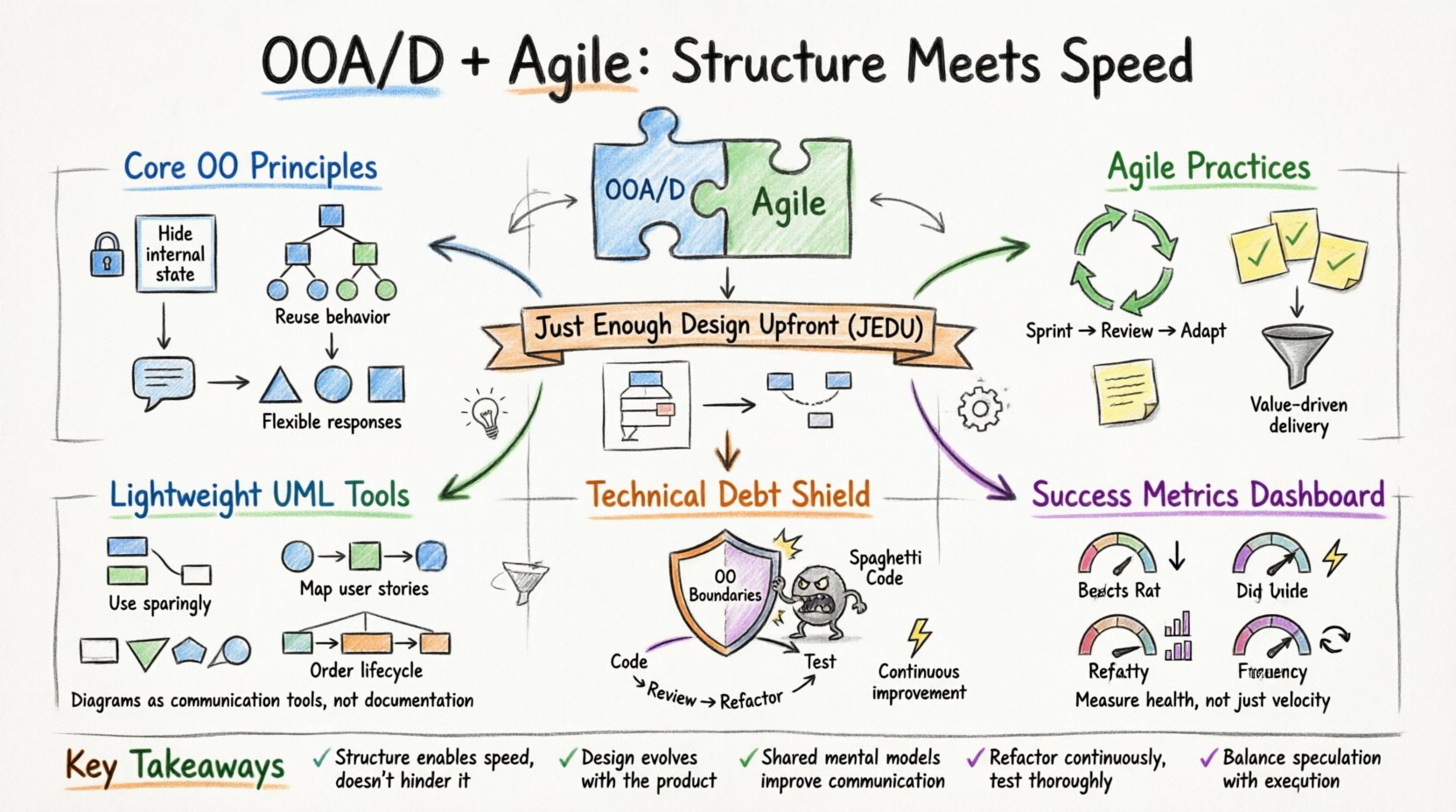
Defining the Intersection 🧩
Object-Oriented Analysis and Design focuses on modeling real-world entities as objects that contain both data and behavior. This approach emphasizes encapsulation, inheritance, and polymorphism. Agile software development focuses on breaking work into small, manageable increments that can be reviewed and adapted frequently.
When these two approaches converge, the result is a development process that balances the need for structure with the need for flexibility. Teams do not need to choose one over the other; rather, they must find the equilibrium where design supports agility rather than hindering it.
- OOA/D: Provides a blueprint for how components interact.
- Agile: Provides a framework for how work is prioritized and delivered.
- Integration: Ensures the blueprint evolves alongside the product.
The Historical Context of Design and Speed ⏱️
Traditionally, software projects followed a linear path where analysis and design were completed before coding began. This Waterfall approach often led to significant delays if requirements changed mid-project. Object-Oriented methods were adopted to manage complexity, but they were frequently misused to create massive design documents that became obsolete upon completion.
Agile emerged to address the rigidity of these models. However, a common misconception is that Agile implies “no design.” In reality, Agile requires design, but the nature of that design shifts from static documentation to active, living code structures.
Consider the following comparison of approaches:
| Aspect | Traditional OOA/D | Agile-Integrated OOA/D |
|---|---|---|
| Timing | Before coding starts | Just-in-time during sprints |
| Documentation | Heavy, static diagrams | Lightweight, code-centric |
| Change Response | High cost to modify | Low cost, iterative refinement |
| Goal | Perfection of initial model | Adaptability and value delivery |
Integrating OO Principles into Iterative Cycles 🔄
The core of Object-Oriented Analysis and Design lies in how objects are defined and how they communicate. In an Agile environment, these definitions cannot be fixed at the start of a project. They must evolve as the team learns more about the business domain.
Encapsulation becomes a vital tool for managing complexity. By hiding internal state within an object, teams can change implementation details without affecting other parts of the system. This aligns perfectly with Agile’s goal of minimizing coupling.
Inheritance allows teams to create reusable structures. However, overuse can lead to fragile hierarchies. In Agile, inheritance is used judiciously to share behavior across similar objects without creating deep dependency trees.
Polymorphism enables flexibility. Different objects can respond to the same message in different ways. This supports the Agile principle of welcoming change, as new behaviors can be introduced without rewriting the core logic.
Practical Application Steps
- Identify Core Entities: During sprint planning, identify the key objects required for the feature.
- Define Interfaces: Specify how these objects interact, focusing on the “what” rather than the “how”.
- Implement Incrementally: Write code that fulfills the immediate requirement.
- Refactor: After implementation, improve the structure based on new insights.
The Role of UML in Modern Sprints 📐
Unified Modeling Language (UML) is a standard for visualizing system design. In the past, teams spent weeks creating detailed class diagrams. In an Agile context, the utility of these diagrams changes.
Diagrams are no longer meant to be exhaustive blueprints. Instead, they serve as communication tools to align the team on a specific problem. They are created when the team encounters ambiguity and are discarded or updated as soon as the understanding is codified into software.
- Class Diagrams: Used sparingly to clarify complex relationships between objects.
- Sequence Diagrams: Effective for mapping out the flow of data during a specific user story.
- State Diagrams: Helpful for managing complex object lifecycles, such as order processing.
The key is to keep these artifacts lightweight. If a diagram takes longer to update than the code it represents, it becomes a burden. The code itself is the ultimate source of truth.
Managing Technical Debt through Design 🛡️
Technical debt accumulates when short-term decisions compromise long-term maintainability. Poor OOA/D is a primary driver of this debt. In Agile, speed can encourage shortcuts that lead to messy codebases.
Applying OOA/D principles helps mitigate this risk. By enforcing clear boundaries between objects, teams prevent the “spaghetti code” scenario where every component depends on every other component. This makes refactoring safer and easier.
Strategies to Reduce Debt
- Continuous Refactoring: Dedicate time in every sprint to improve code structure.
- Code Reviews: Focus on architectural consistency, not just syntax.
- Design Patterns: Use established patterns to solve common problems, reducing the need for custom solutions.
- Test Coverage: Ensure automated tests exist before refactoring, providing safety nets for structural changes.
Communication and Collaboration Patterns 🗣️
Object-Oriented Analysis and Design is not just about code; it is about shared mental models. When a team agrees on how objects behave, communication becomes more efficient. Developers can discuss features by referring to specific objects and their responsibilities.
This shared vocabulary reduces the friction often found in large teams. Instead of explaining the entire system, a developer can say, “Update the Order object to handle the discount logic.” This specificity speeds up problem-solving.
However, this requires discipline. If every developer has a different mental model of the Order object, the system will fragment. Regular design discussions help align these models.
Facilitating Design Discussions
- Pair Programming: Two developers working together to design a class in real-time.
- Architecture Decision Records: Brief documents capturing why a specific design choice was made.
- Domain-Driven Design (DDD): Aligning the object model with the business language.
Refactoring as a Continuous Practice 🔧
Refactoring is the act of changing the internal structure of software to improve it without changing its external behavior. In Agile, refactoring is not a phase; it is a daily activity. It relies heavily on the principles of Object-Oriented Analysis and Design.
Without good OO design, refactoring is dangerous. If classes are tightly coupled, changing one will break another. If responsibilities are unclear, changes will be unpredictable. Good design makes refactoring a low-risk activity.
Teams should view refactoring as an investment. The time spent improving the structure pays dividends in the speed of future development. Features are delivered faster when the underlying code is clean and modular.
When to Refactor
- When adding new features that are difficult to implement.
- When code duplication is observed across multiple files.
- When a variable or method name no longer accurately reflects its purpose.
- When test coverage is low in critical areas.
Balancing Speculation and Execution ⚖️
One of the biggest challenges in OOA/D within Agile is knowing when to design too much. This is known as “gold plating” or over-engineering. Teams often try to anticipate every possible future requirement, creating complex systems that are never fully utilized.
Agile advises against this. Design only what is needed for the current iteration. If a feature requires more complexity later, the team can extend the design then. This approach is known as “Just Enough Design Upfront” (JEDU).
This balance requires trust in the team’s ability to recognize when the design is insufficient. If the code becomes too hard to modify, it is a signal to stop and invest in design. If the design feels rigid, it is a signal to loosen the constraints.
Signs of Over-Design
- Interfaces that are rarely implemented.
- Classes with methods that are never called.
- Complex inheritance hierarchies that are hard to traverse.
- Documentation that exceeds the complexity of the code.
Team Maturity and Skill Requirements 📈
Implementing OOA/D effectively in an Agile team requires a certain level of maturity. Junior developers may struggle to identify appropriate boundaries for objects. Senior developers must mentor the team to ensure consistency.
Skills required include:
- Abstraction: The ability to see the big picture and hide unnecessary details.
- Modularity: Understanding how to split a system into independent parts.
- Testing: Writing unit tests that validate object behavior.
- Collaboration: Discussing design trade-offs openly.
Training and pair programming are effective ways to build these skills. The goal is to raise the collective intelligence of the team so that design decisions are made collectively and consistently.
Measuring Success Beyond Velocity 📊
Velocity measures how much work a team completes in a sprint. However, it does not measure code quality. A team can have high velocity but degrade their architecture rapidly.
To truly measure the impact of OOA/D, teams should track metrics related to stability and maintainability. These include:
- Defect Rate: Are bugs decreasing over time?
- Lead Time for Changes: How long does it take to deploy a fix?
- Cyclomatic Complexity: Is the code becoming too difficult to understand?
- Refactoring Frequency: Is the team actively improving the code?
These metrics provide a clearer picture of the health of the software than velocity alone. They highlight whether the design is supporting the team or hindering them.
Summary of Key Takeaways 📝
The integration of Object-Oriented Analysis and Design into Agile teams is not about choosing between structure and speed. It is about using structure to enable speed. When objects are well-defined, changes are contained. When interfaces are clear, communication is efficient.
Teams must remain vigilant against the temptation to over-design or under-design. The sweet spot lies in creating just enough structure to support the current requirements while remaining flexible enough to accommodate future changes. Refactoring, continuous testing, and shared mental models are the pillars that support this balance.
By adopting these practices, teams can build systems that are both robust and adaptable. The result is software that evolves with the business, rather than becoming a barrier to its growth.