


From Plain Text to Presentation-Ready Diagrams in Seconds
For decades, creating visual models was a labor-intensive process that required manual drag-and-drop actions, rigid templates, and specialized knowledge of complex notations. The Visual Paradigm AI Chatbot represents a significant paradigm shift by allowing professionals to transform their intent into presentation-ready diagrams instantly using natural language. Unlike generic AI tools that may produce visually plausible but semantically flawed sketches, this chatbot is a domain-specialized co-pilot that “thinks in diagrams” and adheres strictly to formal industry standards.
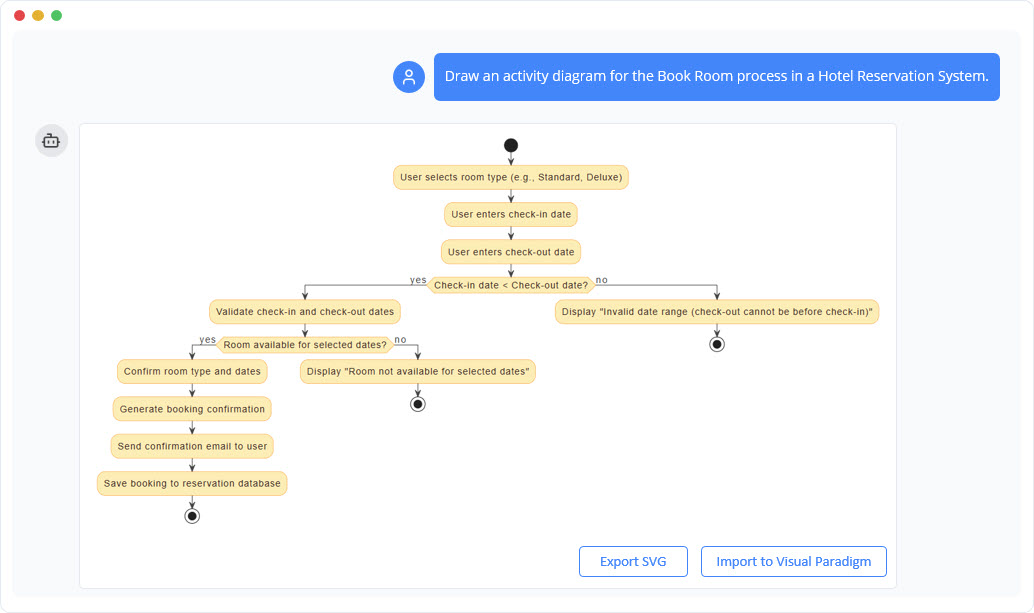
Turning Descriptions into Structure
The process begins with a simple description of a system, process, or strategy in plain English. Users do not need to be experts in modeling syntax or learn specific standards because the AI understands the context of the requirements—whether they describe a software interaction, a business strategy, or a cloud deployment. By typing a prompt such as “Create a use case diagram for an online shopping system,” the tool instantly processes the intent and generates a complete, structured visual. This natural language diagram generation bridges the gap between a technical or business idea and its visual representation in a matter of seconds.
Modeling with Intelligence and Rigor
What sets this tool apart from broad-spectrum AI assistants is its foundation in formal modeling standards. The chatbot is pre-trained on official specifications from organizations like the Object Management Group (OMG) and the IEEE, supporting a wide array of frameworks including:
- Software Engineering: UML (Class, Sequence, Use Case, Activity), SysML, and the C4 Model.
- Enterprise Architecture: Over 20 standardized ArchiMate viewpoints across business, application, and technology layers.
- Strategic Planning: SWOT, PESTLE, Porter’s Five Forces, and the Ansoff Matrix.
Because it employs a semantic constraint engine, every generated diagram is conceptually valid and production-ready. It recognizes the logical difference between a process and a sub-process, or a class and an attribute, ensuring the resulting model reflects real-world behavior rather than a generic checklist.
Conversational Refinement and Analysis
Modeling is rarely a one-off task; it requires constant iteration. The chatbot supports context-aware dialogue, meaning it maintains the state of the diagram throughout a conversation. Instead of manually adjusting shapes, users can issue simple commands to add, remove, or rename elements. For example, a user might say, “Add a two-factor authentication step,” and the AI will instantly update the sequence diagram, inserting new actors and messages while maintaining logical coherence.
Beyond generation, the AI can reason over the model. Users can query the chatbot to identify “single points of failure” in an architecture or explain complex elements like “alt fragments” in simple terms. It can also generate on-demand documentation, such as polished reports and technical specifications, ensuring that stakeholders remain aligned with the latest version of the design.
Seamless Integration for Professional Workflows
While the AI provides rapid prototyping, the system is deeply integrated with the Visual Paradigm Desktop environment for high-precision needs. Generated diagrams are not static images but first-class modeling objects that can be imported directly into professional software. This allows teams to perform advanced tasks such as simulating timings, managing complex traceability, or conducting enterprise-level collaboration in a unified workspace. By combining AI speed with desktop precision, users report up to 90% time savings in their modeling workflows.
Analogy for Understanding: Using the Visual Paradigm AI Chatbot is like working with a master architect who sits beside you, sketching your thoughts as fast as you can speak them. While a generic AI might draw a “sketch” that looks like a house but lacks structural integrity, this co-pilot ensures that every “blueprint” it generates follows strict building codes and professional engineering standards, making it ready for a construction crew to build immediately.
- AI Chatbot Feature – Intelligent Assistance for Visual Paradigm Users: Leverage AI-powered chatbot functionality to get instant guidance, automate tasks, and enhance productivity within Visual Paradigm.
- Visual Paradigm AI Chatbot Enhances Multi-Language Support …: 7 hours ago · Discover the latest updates to Visual Paradigm ‘s AI -Powered visual modeling software, including multi-language UI and improved chat content localization. Experience seamless AI diagram generation in languages like Spanish, French, Chinese, and more with our AI chatbot for UML and other diagrams.
- AI Chatbot for Diagramming: How It Works with Visual Paradigm: The Visual Paradigm AI chatbot is an AI -powered modeling assistant that turns natural language into diagrams. It doesn’t require users to learn specific modeling standards or syntax.
- Case Study: Enhancing System Modeling Efficiency with Visual Paradigm’s AI-Powered Chatbot: This case study demonstrates how Visual Paradigm’s AI chatbot improves productivity and accuracy in system modeling by enabling conversational diagram creation.
- Visual Paradigm AI Chatbot: The World’s First Purpose-Built AI Assistant for Visual Modeling: Visual Paradigm launches its groundbreaking AI chatbot, designed specifically to assist users in visual modeling tasks with natural language interactions and intelligent guidance.
- Introducing Visual Paradigm AI Chatbot: Intelligent Design Assistance: Discover how Visual Paradigm’s AI chatbot enhances design workflows by offering real-time suggestions and automating repetitive tasks.
- Mastering Sequence Diagrams with Visual Paradigm: AI Chatbot Tutorial: A beginner-friendly tutorial using Visual Paradigm to create sequence diagrams, illustrated through a real-world e-commerce chatbot use case.
- Integrating AI Activity Diagrams into Your Visual Paradigm …: Sep 12, 2025 · Learn how to use AI -powered modeling software to generate and refine activity diagrams with natural language. Discover the benefits of AI chatbot diagram generation in UML workflows.
- Beginner’s Tutorial: Create Your First Professional Sequence Diagram in Minutes: A beginner-friendly guide to generating professional sequence diagrams quickly using Visual Paradigm’s AI chatbot feature.
- Comprehensive Tutorial: Generating and Modifying C4 Component …: Dec 16, 2025 · This tutorial is based on the official Visual Paradigm product demo video, demonstrating how to use the AI-powered Chatbot to create and iteratively refine a C4 Component Diagram for a car park booking system. The C4 model (Context, Containers, Components, and Code) is a popular approach for visualizing software architecture, and the Component level focuses on the internal structure of a …
- SWOT Analysis via AI Chat in Visual Paradigm: This interactive page allows users to generate SWOT analyses through an AI-powered chat interface within the Visual Paradigm environment.
- Meet the AI SWOT Assistant: How Visual Paradigm’s Chatbot …: Sep 11, 2025 · Discover how the visual paradigm chatbot provides natural language diagram generation for business frameworks like SWOT , PEST, and more—turning ideas into clear strategic models with AI -powered analysis .