
Understanding the architecture of organizational intent is critical for effective enterprise alignment. Within the Business Motivation Model (BMM), the distinction between strategy and tactics forms the backbone of how an enterprise defines its path forward. Confusing these two concepts often leads to misaligned resources, unclear metrics, and a disconnect between high-level vision and day-to-day execution.
This guide provides a comprehensive examination of how to differentiate tactics and strategies within the BMM framework. By clarifying these roles, organizations can ensure that their motivations are translated into actionable plans that drive measurable value.
Understanding the Business Motivation Model Context 🏗️
The Business Motivation Model serves as a standard for representing the motivations that drive business activities. It provides a structured way to describe why an organization exists and what it intends to achieve. At the core of this model lies the concept of motivational elements, which include strategies, tactics, goals, and objectives.
When modeling business architecture, it is essential to maintain a clear hierarchy. The model moves from abstract intentions to concrete actions. This hierarchy ensures that every task performed by an actor or resource can be traced back to a primary motivation.
Key components of the BMM include:
- Strategic Intent: The broad direction and long-term aspirations of the enterprise.
- Tactical Intent: The specific means chosen to achieve the strategic intent.
- Goals: Desired outcomes that are measurable and time-bound.
- Objectives: Specific milestones that support the achievement of goals.
- Business Rules: Constraints or requirements that guide behavior.
- Stakeholders: Individuals or groups with an interest in the outcomes.
Getting the relationship between Strategy and Tactics right ensures that the means align with the ends. Without this distinction, an organization may execute perfectly on the wrong things.
Defining Strategic Intent 🎯
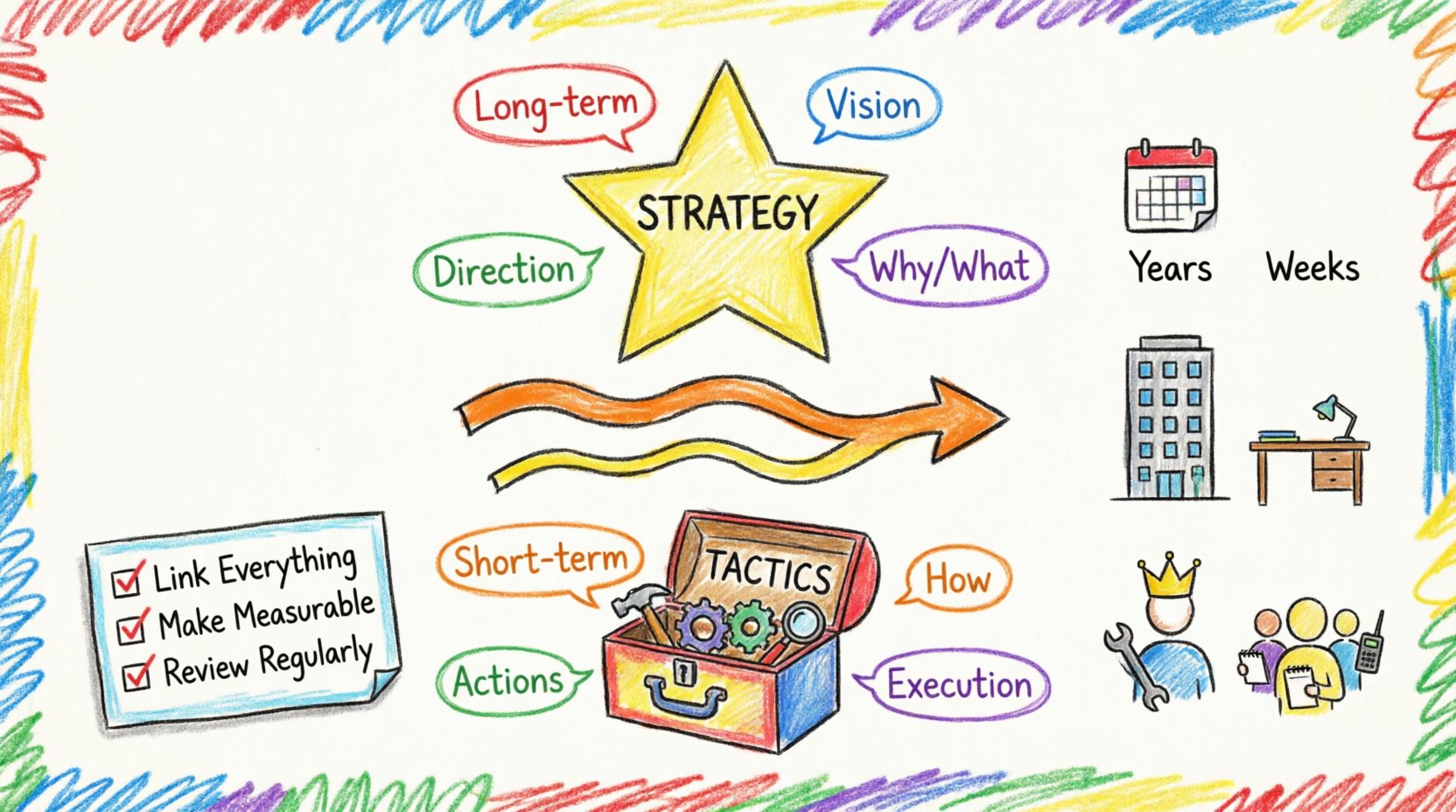
Strategy in the context of the Business Motivation Model represents the high-level plan to achieve a long-term goal. It is the what and the why at a macro level. Strategic intent is often characterized by its longevity and its broad scope. It does not describe specific actions but rather the desired state of the future.
When formulating a strategy, leaders focus on positioning and competitive advantage. The strategy dictates the direction in which resources should flow. It is stable over time but may evolve as the external environment shifts.
Characteristics of Strategic Intent include:
- Long-term Horizon: Strategies are typically planned for years rather than months.
- High-level Abstraction: They describe broad outcomes rather than specific tasks.
- Resource Allocation: They determine where capital and talent are invested.
- Market Orientation: They consider external factors like competitors and market trends.
In the BMM, a strategy is often linked to a Goal. The Goal represents the measurable result the strategy aims to produce. For example, a strategy might be to “Become the market leader in regional distribution”. This is not an action itself, but a direction that guides all subsequent tactical decisions.
Defining Tactical Intent 🛠️
Tactics are the specific actions, methods, or plans used to achieve the strategic intent. While strategy is about direction, tactics are about execution. In the Business Motivation Model, tactics are the means by which goals are realized. They are more concrete and measurable than strategies.
Tactical intent answers the question: “How do we get there?”. It involves selecting specific approaches to solve problems or capture opportunities identified by the strategy. Tactics are often more flexible than strategies and can be adjusted more frequently based on immediate feedback.
Characteristics of Tactical Intent include:
- Short-term Horizon: Tactics are often implemented over weeks, months, or a single fiscal quarter.
- Specific Actions: They describe concrete steps, such as launching a campaign or hiring a team.
- Resource Specificity: They define which specific assets are used for execution.
- Operational Focus: They focus on internal processes and immediate performance.
Using the previous example, if the strategy is to “Become the market leader in regional distribution”, a tactical intent might be to “Open five new warehouses in the northern region” or “Partner with two logistics firms”. These are actionable items that directly support the broader goal.
Key Differences Between Strategy and Tactics 📊
While strategies and tactics are interconnected, they serve distinct functions. Confusing them can lead to a situation where an organization is efficient at doing the wrong things. The table below outlines the fundamental differences between the two within the BMM context.
| Feature | Strategic Intent | Tactical Intent |
|---|---|---|
| Focus | Direction and Vision | Execution and Action |
| Timeframe | Long-term (Years) | Short-term (Months/Quarters) |
| Scope | Enterprise-wide | Department or Project-level |
| Flexibility | Stable, changes slowly | Adaptable, changes frequently |
| Measurement | Goals and KPIs | Milestones and Metrics |
| Ownership | Executive Leadership | Managers and Team Leads |
Understanding these distinctions helps in modeling the relationships correctly. In BMM, a Strategy is linked to a Goal, which is then supported by Tactics. This flow ensures traceability from the boardroom to the shop floor.
The Relationship and Flow of Motivation 🔄
In the Business Motivation Model, the flow of motivation is critical. It is not enough to have a strategy and a tactic in isolation; they must be linked. This linkage creates a chain of justification. If a task is performed, there must be a reason for it that traces back to the strategic intent.
The typical flow follows this pattern:
- Strategic Intent: The organization decides on a direction.
- Goal: A measurable outcome is defined to validate the strategy.
- Tactical Intent: Specific plans are created to achieve the goal.
- Business Rules: Constraints are applied to ensure compliance.
- Actor/Resource: The entity that performs the work.
For example, consider a retail organization.
- Strategy: Improve customer loyalty.
- Goal: Increase repeat purchase rate by 20% within 12 months.
- Tactic: Implement a points-based rewards program.
- Actor: Marketing Department.
This structure allows for clear accountability. If the repeat purchase rate does not increase, the organization can analyze the tactic (the rewards program) rather than questioning the strategy (loyalty).
Common Modeling Errors and Pitfalls ⚠️
When constructing a Business Motivation Model, practitioners often encounter specific challenges. Recognizing these pitfalls early can save significant time and effort during the modeling process.
1. Confusing Goals with Strategies
A common error is labeling a goal as a strategy. A strategy is a plan of action; a goal is a target. For instance, “Increase revenue” is a goal, not a strategy. The strategy would be “Expand into the Asian market” to achieve that revenue increase.
2. Vague Tactical Descriptions
Tactics must be actionable. Descriptions like “Improve efficiency” are too vague. A proper tactic would be “Automate the invoice processing workflow”. Specificity allows for better tracking and measurement.
3. Missing the Linkage
Sometimes, a tactic exists without a clear link to a strategic goal. This results in “shadow projects” that consume resources without contributing to the primary mission. Every tactical intent should trace back to at least one strategic intent.
4. Overloading Tactics
A tactic should not try to achieve everything. If a tactic is too broad, it loses its focus. It is better to have multiple specific tactics supporting one goal than one massive tactic that covers multiple goals.
Aligning with Business Rules 📜
Business rules act as the guardrails for both strategies and tactics. They define the constraints within which the motivation must operate. In the BMM, business rules are linked to the elements they constrain.
Strategies are often constrained by external rules, such as regulations or market conditions. Tactics are often constrained by internal rules, such as budget limits or process standards.
For example:
- Strategic Rule: “All expansion must comply with local labor laws.”
- This constrains the strategy of entering new regions.
- Tactical Rule: “All software purchases must be approved by the IT Director.”
- This constrains the tactic of procuring new tools.
By modeling these rules explicitly, the organization ensures that its motivations are viable and compliant. It prevents the creation of strategies that are legally or operationally impossible.
Ensuring Measurability and Tracking 📏
A strategy or tactic that cannot be measured is difficult to manage. The Business Motivation Model emphasizes the importance of Goals as the bridge between intent and measurement. Without a goal, there is no way to know if a tactic was successful.
To ensure measurability:
- Define Clear Metrics: Every goal should have associated Key Performance Indicators (KPIs).
- Set Baselines: Know the starting point to measure improvement.
- Establish Timeframes: Goals must be time-bound to create urgency.
- Assign Responsibility: Someone must own the metric.
When a tactic fails to move the metric, it signals a need to adjust the tactic, not necessarily the strategy. This separation of concerns allows for agile adjustments without losing sight of the long-term vision.
The Role of Actors and Stakeholders 👥
Who drives the strategy and who executes the tactics? In the BMM, Actors represent the roles or resources that perform activities. Stakeholders represent those who have an interest in the outcomes.
Strategies are usually owned by high-level stakeholders, such as the Board of Directors or C-suite executives. Tactics are owned by managers and operational actors.
It is vital to map these relationships clearly:
- Strategic Stakeholders: Provide the vision and approve the strategy.
- Tactical Stakeholders: Provide the execution and report on progress.
- Beneficiaries: The customers or users who receive the value.
If a tactic is assigned to an actor without the necessary skills or authority, the motivation will fail. The model should reflect the capability of the actors involved.
Iterative Review and Adaptation 🔄
Business environments are dynamic. A strategy that worked last year may not work today. The Business Motivation Model supports an iterative approach to motivation management.
Regular reviews should occur to assess:
- Is the strategy still relevant?
- Are the tactics effective?
- Do the business rules still apply?
- Have stakeholder needs changed?
This does not mean changing the strategy frequently. Stability is key to strategy. However, the tactics must be adaptable. If a tactic is not yielding results, it should be replaced or refined quickly.
Benefits of Clear Distinction ✅
Investing time in correctly distinguishing tactics and strategies yields significant returns. Organizations that maintain this clarity experience:
- Better Resource Allocation: Funds and people go to the right places.
- Improved Communication: Everyone understands their role in the bigger picture.
- Faster Decision Making: Decisions can be made at the appropriate level (strategic vs. tactical).
- Clear Accountability: It is easy to identify who is responsible for what.
- Reduced Waste: Efforts are not spent on activities that do not support the goals.
By adhering to the BMM principles, organizations create a living map of their motivation. This map guides the enterprise through uncertainty and change.
Summary of Best Practices 📝
To conclude this examination, here are the essential takeaways for modeling Business Motivation effectively:
- Keep them separate: Do not mix strategic intent with tactical intent.
- Link everything: Ensure every tactic traces back to a strategy.
- Make it measurable: Define clear goals for every strategic intent.
- Review regularly: Update the model as the business environment changes.
- Focus on actors: Ensure the right people are assigned to the right motivations.
By following these practices, the Business Motivation Model becomes a powerful tool for alignment and performance. It transforms abstract ideas into concrete plans that drive real results.
Final Thoughts on Implementation 💡
Implementing this distinction requires discipline. It is easy to fall back on vague language when describing plans. However, precision is the hallmark of effective business architecture. When you can clearly articulate the difference between what you intend to achieve (Strategy) and how you will achieve it (Tactics), you create a foundation for sustainable success.
The Business Motivation Model provides the vocabulary and structure to do this. Use it to clarify your intentions, align your teams, and measure your progress. In doing so, you ensure that every action taken contributes to the overarching mission of the organization.