
Building a robust business architecture requires more than just identifying goals. It demands a clear understanding of the logical connections between what an organization wants to achieve and the specific actions required to get there. This guide explores the mechanics of constructing Ends to Means chains within the Business Motivation Model (BMM). By linking strategic intentions with operational realities, organizations can ensure alignment, traceability, and effective execution. 🏗️
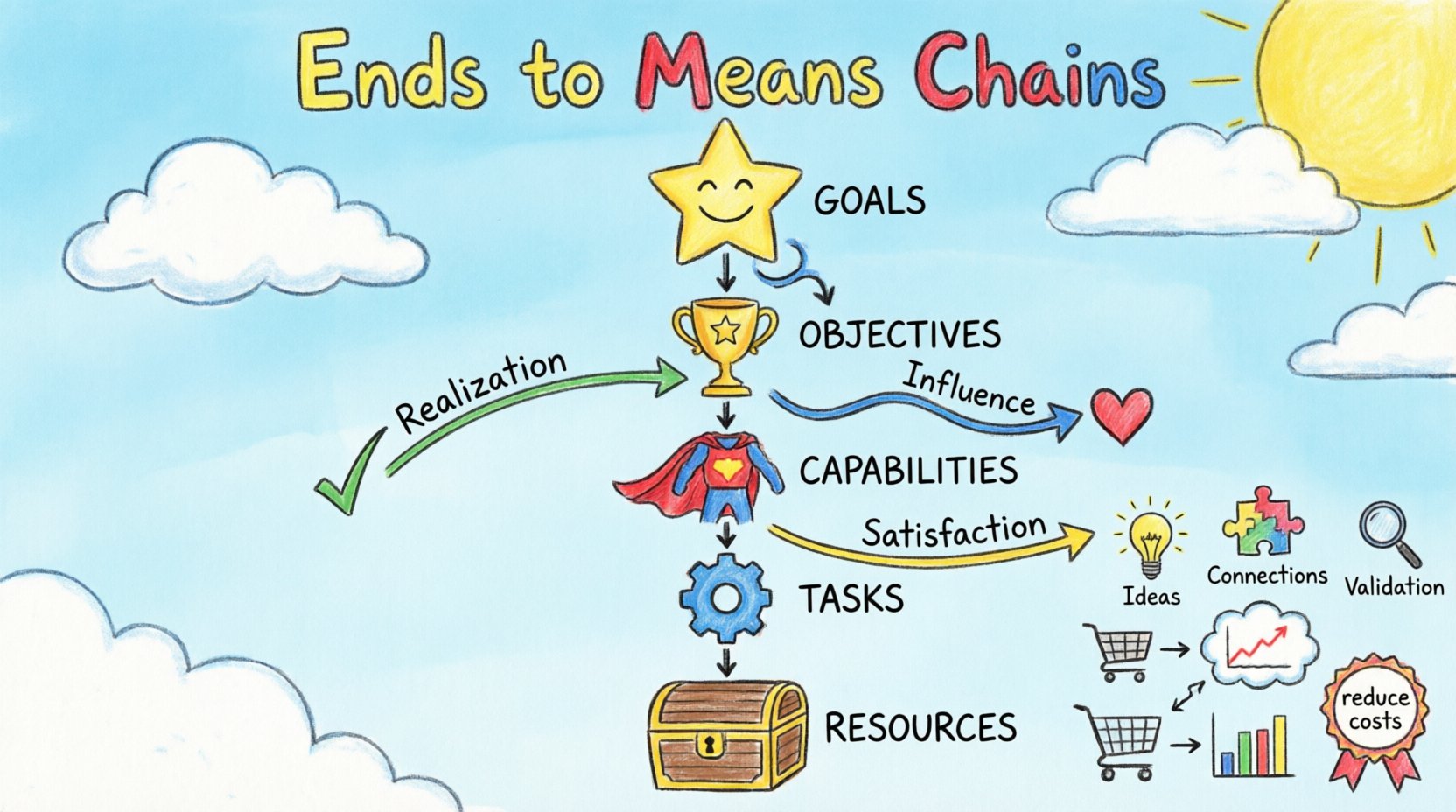
Understanding the Core Concepts 🧠
The Business Motivation Model provides a structured way to represent business motivation. At its heart lies the distinction between Ends and Means. Understanding these terms is the first step toward building effective chains.
- Ends: These represent the desired outcomes. They are the “what” of the business strategy.
- Means: These represent the methods used to achieve the Ends. They are the “how” of the business operations.
Without a clear chain connecting the two, strategies often remain abstract documents that do not influence daily operations. A Means-Ends chain bridges this gap.
The Hierarchy of Ends 📉
Ends are not monolithic. They exist at various levels of abstraction. Recognizing this hierarchy helps in mapping the flow of motivation.
- Goals: Broad, high-level aspirations. These are often qualitative and long-term. Example: Increase market presence.
- Objectives: Specific, measurable targets derived from Goals. These are quantitative and time-bound. Example: Achieve 15% growth in Q4.
The Spectrum of Means 🛠️
Means are the vehicles that drive progress toward Ends. They are categorized based on their nature and function.
- Tasks: Specific actions performed by actors. These are the discrete units of work.
- Capabilities: The ability of an actor to perform tasks. This includes skills, processes, and competencies.
- Resources: The assets required to execute tasks. This includes money, technology, data, and physical assets.
Mapping Relationships in BMM 🔗
The strength of the Business Motivation Model lies in its relationship types. These relationships define how Means influence Ends and how Ends drive the selection of Means. There are three primary relationship types used to construct these chains.
1. Realization Relationship 🛤️
This is the most direct link. It answers the question: “How does this mean help achieve this end?” A Means realizes an End when it directly contributes to its fulfillment.
- Direction: From Means to End.
- Logic: If the Means is performed, the End is supported.
- Example: A Task “Process Order” realizes the Objective “Reduce Order Fulfillment Time”.
2. Influence Relationship ⚖️
Not all relationships are direct. Some means affect Ends indirectly or conditionally. This relationship captures dependencies, constraints, or enablers.
- Direction: From Means to End (or End to End).
- Logic: The Means affects the likelihood or quality of the End, but does not guarantee it.
- Example: A Resource “High-Speed Internet” influences the capability to “Remote Collaboration”.
3. Satisfaction Relationship ✅
This relationship is often used to describe the state of an End. It indicates whether an End has been met based on the performance of specific Means.
- Direction: From Means to End.
- Logic: The satisfaction of the Means leads to the satisfaction of the End.
- Example: Completing a Training Course satisfies the Objective “Employee Competency Level”.
Constructing the Chain: A Step-by-Step Approach 📝
Creating a complete chain requires a systematic approach. Rushing this process often leads to gaps where strategy fails to translate into action. Follow these steps to build reliable structures.
Step 1: Define the Strategic Ends 🎯
Start at the top. Identify the high-level Goals. Be specific about the desired state of the organization.
- Ensure Goals are aligned with the vision.
- Break down Goals into measurable Objectives.
- Document the success criteria for each Objective.
Step 2: Identify Required Capabilities 🦸
Once the Ends are clear, determine what abilities are needed to achieve them. This focuses on the human and process elements.
- What skills must the workforce possess?
- What processes must be standardized?
- Which actors are responsible for these capabilities?
Step 3: Select Necessary Resources 💰
Capabilities need support. Identify the tangible assets required to enable the capabilities.
- What budget is allocated?
- What technology stack is required?
- Are there physical locations or tools needed?
Step 4: Define Specific Tasks ⚙️
Break down capabilities into actionable items. This is where the work becomes visible.
- List the discrete activities.
- Assign actors to each Task.
- Estimate the time and effort required.
Step 5: Link Means to Ends 🔗
Draw the lines. Connect the Tasks, Capabilities, and Resources to the Objectives and Goals using the appropriate relationship types.
- Use Realization for direct contributions.
- Use Influence for dependencies.
- Use Satisfaction for completion states.
Visualizing the Structure 📊
While text descriptions are useful, a visual representation often clarifies complex chains. Below is a table illustrating the typical flow of an End to Means chain.
| Level | Element Type | Example | Relationship to Next Level |
|---|---|---|---|
| Strategic | Goal | Maximize Customer Retention | Decomposed into Objectives |
| Tactical | Objective | Reduce Churn Rate by 10% | Realized by Capabilities |
| Operational | Capability | Implement Feedback Loop | Realized by Tasks |
| Execution | Task | Survey Customers Monthly | Supported by Resources |
| Foundation | Resource | Survey Software License | Enables Tasks |
Practical Example: Retail Operations 🛍️
Consider a hypothetical retail organization aiming to improve its supply chain efficiency. The following scenario demonstrates how to apply these concepts in a real-world context.
1. The End: Strategic Goal 🏁
Goal: Optimize Supply Chain Efficiency.
This is a broad statement. It sets the direction but does not specify how to measure success.
2. The End: Tactical Objective 🎯
Objective: Reduce Inventory Holding Costs by 20% within 12 months.
This is specific. It provides a target that can be measured against actual performance data.
3. The Means: Capability 🦸
Capability: Predictive Demand Forecasting.
To reduce inventory costs, the organization needs the ability to predict what customers want before they order it. This capability sits between the Objective and the Tasks.
4. The Means: Task ⚙️
Task: Analyze Historical Sales Data Quarterly.
This is the specific action taken by the supply chain team. It is the work that builds the capability.
5. The Means: Resource 💰
Resource: Analytics Platform Subscription.
This is the tool required to perform the Task. Without the software, the Task cannot be completed effectively.
6. The Connections 🔗
- The Task (Analyze Data) Realizes the Capability (Forecasting).
- The Capability (Forecasting) Realizes the Objective (Reduce Costs).
- The Resource (Platform) Influences the Task (Enables the analysis).
In this chain, every element has a purpose. If the Resource is removed, the Task fails, the Capability degrades, and the Objective is missed. This traceability is the value of the chain.
Common Pitfalls and How to Avoid Them ⚠️
Even with a clear methodology, errors can occur during the modeling process. Awareness of these common issues helps maintain model integrity.
1. Orphaned Means 🚫
This occurs when a Task or Resource exists without a link to any End. These elements consume resources without contributing to strategy.
- Solution: Review all Means. Ensure every Task connects to at least one Objective.
2. Broken Chains 🔗
A broken chain happens when a link is missing between levels. For example, an Objective exists, but no Capability is defined to achieve it.
- Solution: Perform a gap analysis. Identify missing links between Ends and Means.
3. Circular Dependencies 🔁
Occasionally, a Means might depend on an End that depends on the Means. This creates a logical loop that cannot be resolved.
- Solution: Check the direction of relationships. Ensure the flow moves from Means to Ends.
4. Vague Relationships 🌫️
Using the Influence relationship too broadly can obscure actual responsibility. If everything influences everything, nothing is specific.
- Solution: Reserve Influence for conditional dependencies. Use Realization for direct contributions.
Validation and Governance 🛡️
Once the chains are built, they must be maintained. A static model becomes obsolete quickly in a dynamic business environment.
Regular Audits 🔍
Schedule periodic reviews of the model. Check if the Ends are still relevant. Are the Means still effective? Has the business context changed?
Change Management 🔄
When a change is proposed, trace its impact through the chain. If a Task is removed, which Objective is affected? If a Resource is cut, which Capability is at risk?
Stakeholder Alignment 🤝
Ensure that all stakeholders understand the chain. Managers should see the link between their team’s Tasks and the company’s Goals. This fosters ownership and accountability.
Integration with Other Models 🧩
The Business Motivation Model does not exist in a vacuum. It often works alongside other architectural frameworks.
Business Process Management (BPM) 📈
Process models define the flow of work. BMM defines the motivation for that work. Combining them ensures processes are not just efficient, but also aligned with strategic goals.
Enterprise Architecture (EA) 🏛️
EA covers the broader IT and organizational structure. BMM provides the “Why” within the EA, explaining why certain capabilities or systems are prioritized over others.
Risk Management 🛑
Risk models identify threats. BMM identifies dependencies. By linking risks to specific Means, organizations can see which strategic Ends are most vulnerable to failure.
Benefits of a Robust Chain Structure 🌟
Investing time in creating detailed End to Means chains yields significant returns. These benefits extend beyond simple documentation.
- Clarity: Everyone understands how their work contributes to the bigger picture.
- Agility: When changes occur, the impact is visible immediately.
- Efficiency: Resources are not wasted on activities that do not support strategic Ends.
- Communication: The model serves as a common language between strategy and operations teams.
Conclusion 🏁
Constructing End to Means chains is a foundational activity for effective business architecture. It transforms abstract strategy into actionable plans. By rigorously defining Ends, identifying appropriate Means, and establishing clear relationships, organizations can navigate complexity with confidence. This approach ensures that every task performed is a deliberate step toward the desired future state.
Remember that this is a living process. As the business evolves, the chains must evolve with it. Regular review and adjustment keep the model relevant and useful. With a solid chain in place, the organization moves from reacting to events to proactively shaping outcomes.
Key Takeaways 📝
- Ends represent Goals and Objectives; Means represent Tasks, Capabilities, and Resources.
- Use Realization, Influence, and Satisfaction relationships to connect Ends and Means.
- Ensure every Means is linked to an End to prevent waste.
- Validate the model regularly to maintain accuracy.
- Integrate with other frameworks for a holistic view of the enterprise.