
Understanding the drivers behind organizational change is critical for any business analyst or architect. The Business Motivation Model (BMM) provides a structured framework to capture the intentions, influences, and plans of an organization. However, the true power of this model lies in its application to human dynamics. When we align communication strategies with the underlying motivations of stakeholders, we reduce friction and increase alignment. This guide explores how to leverage the Business Motivation Model to foster clearer, more effective stakeholder engagement.
🧠 Why Motivation Matters in Communication
Stakeholders rarely engage with projects simply because they are asked to. They engage because of what the project offers them or the organization. Whether it is a reduction in workload, a boost in performance metrics, or the avoidance of risk, every stakeholder operates from a specific set of motivations. Without understanding these drivers, communication often feels generic, ignored, or misunderstood. The Business Motivation Model helps visualize these drivers explicitly.
By mapping stakeholders to specific elements of the model, such as Goals, Objectives, and Plans, communicators can tailor their messages. A message designed for a stakeholder focused on a Goal will differ significantly from one designed for a stakeholder focused on a Tactic. This alignment ensures that the right information reaches the right person at the right time, based on their personal or professional incentives.
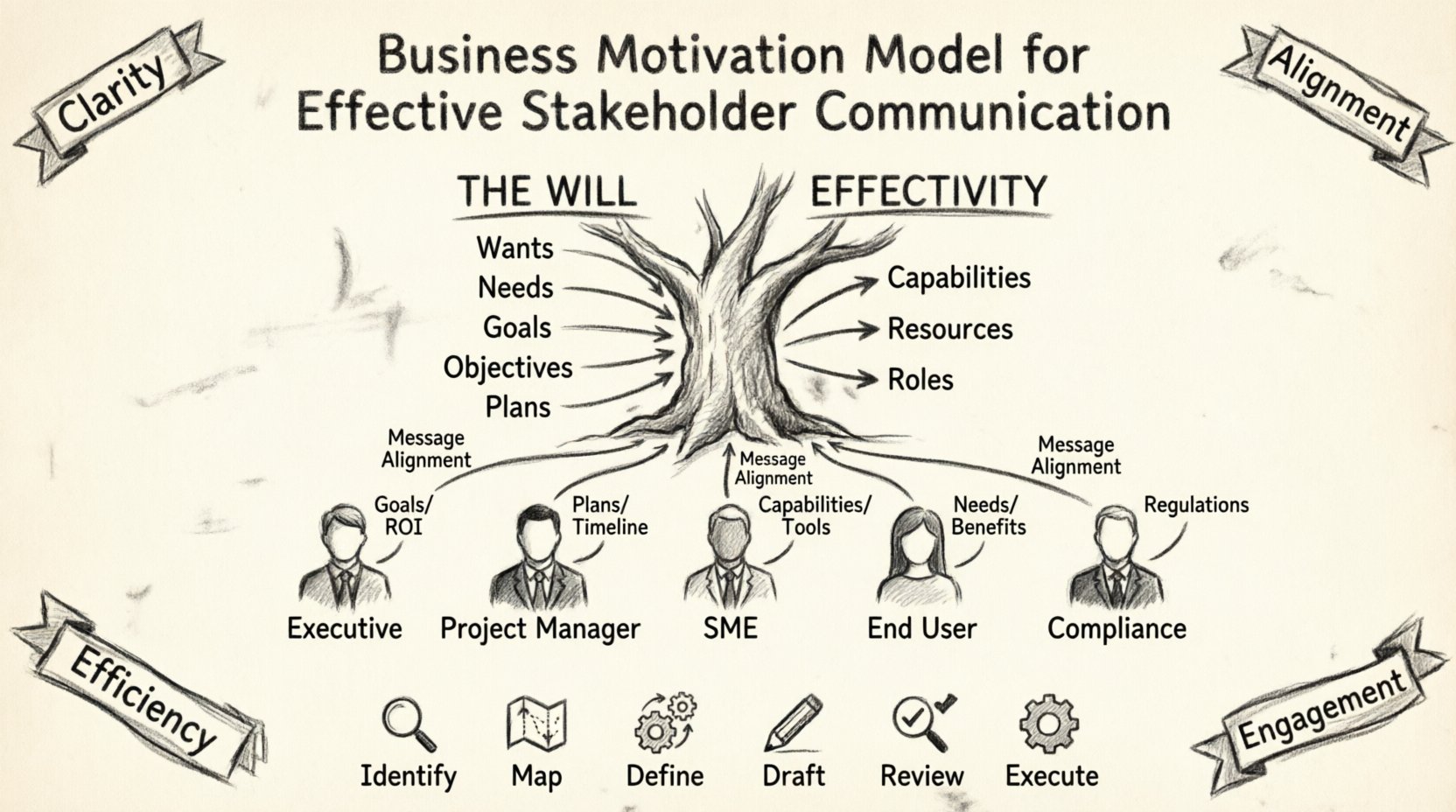
- Clarity: Reduces ambiguity about why a project exists.
- Alignment: Ensures individual efforts support organizational intentions.
- Engagement: Increases participation by addressing personal drivers.
- Efficiency: Reduces the need for repetitive clarifications.
🏗️ The Anatomy of the Business Motivation Model
To communicate effectively using BMM, one must first understand its core components. The model divides motivation into two main branches: the Will and the Effectivity. The Will represents what the organization wants to achieve. The Effectivity represents the means used to achieve those ends. Understanding this distinction is vital for communication.
1. The Will Branch
This branch focuses on the aspirations of the organization. It includes:
- Wants: Broad desires or needs that drive the organization forward.
- Needs: Specific requirements that must be met to satisfy Wants.
- Goals: High-level targets that define success.
- Objectives: Measurable steps taken to achieve Goals.
- Plans: The specific courses of action or projects selected to meet Objectives.
When communicating with stakeholders, it is crucial to identify which of these elements they care about most. A C-level executive might focus on Goals, while a project manager might focus on Plans. Tailoring the message to their level of concern prevents communication gaps.
2. The Effectivity Branch
This branch focuses on the execution and the capabilities required. It includes:
- Capabilities: Abilities the organization possesses or needs to acquire.
- Resources: Assets such as people, budget, and technology available.
- Roles: Specific positions or functions responsible for execution.
Communication regarding Effectivity is often more operational. It involves discussing how work gets done, who is responsible, and what is available. Stakeholders involved in the execution phase need clear details here.
👥 Mapping Stakeholders to Motivation Elements
One of the most practical applications of the Business Motivation Model is mapping stakeholders to specific motivation elements. Not every stakeholder needs to know every detail of the model. However, knowing which part of the model drives a stakeholder allows for precise messaging. Below is a table outlining common stakeholder profiles and their corresponding motivation drivers.
| Stakeholder Profile | Primary Motivation Driver | Communication Focus |
|---|---|---|
| Executive Leadership | Goals and High-Level Objectives | Strategic alignment, ROI, risk mitigation, and major milestones. |
| Project Managers | Plans and Tactics | Schedules, resource allocation, task dependencies, and delivery timelines. |
| Subject Matter Experts | Capabilities and Resources | Technical requirements, tool availability, and skill gaps. |
| End Users | Needs and Wants | Usability improvements, problem resolution, and feature benefits. |
| Compliance Officers | Regulatory Needs | Adherence to standards, audit trails, and security protocols. |
Using this mapping, a business analyst can create a communication plan that addresses the specific interests of each group. This avoids information overload for executives and ensures that technical teams receive the granular details they require.
🗣️ Aligning Messages with Intentions
Once stakeholders are mapped, the next step is to align the communication content with their intentions. The Business Motivation Model suggests that intentions drive behavior. If a stakeholder has a strong intention to achieve a specific Goal, they will respond better to messages that reinforce how the current project supports that Goal.
1. Connecting Plans to Goals
When discussing specific Plans, always link them back to the higher-level Objectives and Goals. This provides context. For example, instead of simply stating, “The server upgrade is scheduled for Tuesday,” frame it as, “The server upgrade is scheduled for Tuesday to support the Goal of reducing system downtime by 20%.” This connects the tactical action to the strategic intent.
2. Addressing Environmental Influences
The model includes Influencers, which are external or internal factors that impact the Will or Effectivity. These can be market trends, regulatory changes, or competitor actions. Stakeholders often care deeply about these Influencers. Communication should highlight how the project responds to these pressures.
- Positive Influencers: Opportunities to leverage.
- Negative Influencers: Risks to mitigate.
By explicitly discussing Influencers, you validate the stakeholder’s concerns about the environment. This builds trust and demonstrates that the plan is robust and aware of external realities.
3. Managing Impact and Measurement
The model also defines Impact and Measurement. Impact refers to the result of a Plan or Tactic. Measurement refers to how success is quantified. Stakeholders need to know how success will be measured to feel secure. Clear communication about metrics ensures that expectations are managed.
When reporting progress, use the Measurement terms defined in the model. If the Goal is to “Increase Revenue,” the Measurement should be “Revenue Growth %”. Avoid vague terms like “doing better.” Specificity in measurement aligns expectations and reduces ambiguity.
🛠️ Implementation Workflow
Integrating the Business Motivation Model into communication workflows requires a structured approach. It is not enough to understand the theory; one must apply it to daily interactions. The following steps outline a practical workflow for implementation.
- Identify Key Stakeholders: List all individuals involved in the initiative. Categorize them by their role and influence.
- Map Motivations: Determine which part of the BMM drives each stakeholder. Are they focused on the Will (Goals) or the Effectivity (Resources)?
- Define Communication Channels: Select the appropriate medium for each stakeholder group. Executives may prefer summary dashboards, while technical teams may require detailed documentation.
- Draft Tailored Messages: Write communication drafts that link project updates to the mapped motivations. Ensure the language matches the stakeholder’s driver.
- Review and Refine: Check if the messages address the identified Influencers and Impacts. Ensure alignment with the defined Measurement criteria.
- Execute and Monitor: Send the communications and monitor feedback. Adjust the approach if stakeholders do not respond as expected.
This workflow ensures that communication is not an afterthought but a strategic element of the project management process. It transforms communication from a passive activity into an active driver of stakeholder buy-in.
🚧 Handling Conflicting Motivations
In any complex initiative, stakeholders often have conflicting motivations. One group may prioritize speed (a Goal), while another prioritizes cost (another Goal). The Business Motivation Model helps visualize these conflicts objectively. By mapping the conflict to specific elements, such as competing Objectives or conflicting Plans, the issue becomes a structural problem rather than a personal one.
When addressing conflicts, use the model to facilitate discussion. Ask stakeholders to identify which elements of the Will or Effectivity are in tension. This shifts the conversation from “who is right” to “how do we balance these intentions?”.
- Clarify Priorities: Determine which Goal takes precedence.
- Explore Trade-offs: Discuss the impact of prioritizing one Objective over another.
- Seek Integration: Look for Plans that can satisfy multiple Influencers simultaneously.
This approach maintains professional relationships while resolving substantive issues. It leverages the model as a neutral framework for negotiation.
📈 Measuring Communication Effectiveness
Just as the Business Motivation Model defines how to measure business success, communication effectiveness should also be measured. This ensures that the strategy is working and allows for continuous improvement. Key metrics for communication aligned with BMM include:
- Engagement Rates: How many stakeholders are actively participating in discussions?
- Feedback Quality: Are stakeholders providing relevant feedback that addresses the mapped motivations?
- Decision Velocity: Is decision-making faster when communication aligns with stakeholder motivations?
- Alignment Score: Can stakeholders accurately articulate the project Goals and Objectives?
Tracking these metrics helps validate the use of the Business Motivation Model. If engagement is low, it may indicate that the messages are not resonating with the stakeholders’ core drivers. Adjustments can then be made to the communication strategy.
🔄 Iterative Refinement
Motivations are not static. As a project progresses, the Will and Effectivity may shift. New Influencers may emerge, or Goals may evolve. The Business Motivation Model supports this evolution. Communication strategies must be reviewed regularly to ensure they remain aligned with the current state of the organization.
Set regular intervals to revisit the motivation map. Ask stakeholders if their drivers have changed. This proactive approach prevents misalignment before it becomes a major issue. It demonstrates a commitment to understanding the evolving needs of the organization.
🔑 Key Takeaways for Practitioners
To summarize the practical application of the Business Motivation Model in communication:
- Understand the Will: Know what the organization wants to achieve before communicating.
- Map Stakeholders: Identify which motivation elements drive each individual.
- Align Messages: Connect project updates to the specific drivers of the audience.
- Visualize Conflicts: Use the model to resolve disagreements objectively.
- Measure Success: Track engagement and alignment as part of the project metrics.
By adopting this structured approach, practitioners can move beyond generic broadcasting to targeted, meaningful dialogue. This leads to stronger partnerships, smoother execution, and better business outcomes.
🌟 Final Considerations
Effective communication is the bridge between business strategy and execution. The Business Motivation Model provides the map for this journey. By understanding the intentions that drive stakeholders, communicators can navigate complex environments with confidence. This is not about manipulation; it is about clarity. When everyone understands the “why” behind the “what,” collaboration becomes natural.
Start by reviewing your current communication plans. Identify where they might miss the mark. Apply the principles of the Business Motivation Model to refine them. Over time, you will notice a shift in how stakeholders engage with your initiatives. The result is a more resilient organization capable of adapting to change with precision.
Remember, the model is a tool for understanding, not a constraint. Use it to illuminate the path forward. With a clear understanding of motivations, the path to effective stakeholder communication becomes much clearer.