
Mergers and acquisitions (M&A) represent some of the most significant strategic moves an organization can undertake. While financial metrics often dominate the decision-making process, the human and operational factors frequently determine long-term success. The Business Motivation Model (BMM) provides a structured framework to analyze these intangible drivers. By applying BMM principles to M&A integration, organizations can align strategic goals with operational realities, ensuring that the combined entity functions cohesively.
This guide explores how to leverage the Business Motivation Model to navigate the complexities of acquisition. We will examine the core constructs of BMM, map them to integration phases, and outline methods for stakeholder alignment. The goal is to create a clear roadmap that connects high-level vision with day-to-day execution.
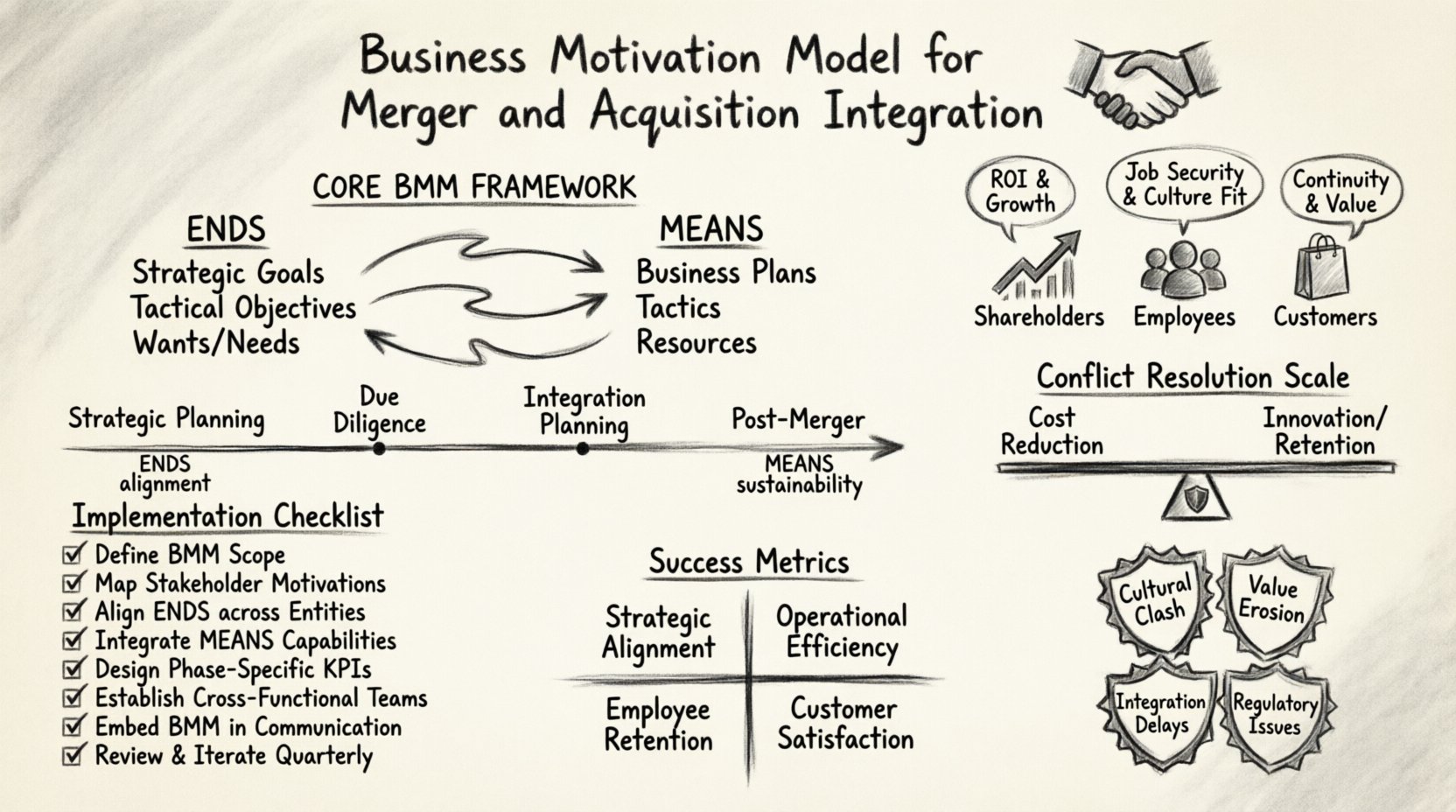
🧩 Understanding the Business Motivation Model
The Business Motivation Model is a standard designed to help organizations describe their business situations clearly. It breaks down the motivation behind business decisions into specific elements. Instead of treating a merger as a single event, BMM allows you to deconstruct it into goals, objectives, and the means to achieve them.
At its core, BMM distinguishes between two main categories:
- Ends: What the organization wants to achieve. This includes strategic goals and tactical objectives.
- Means: How the organization plans to achieve those ends. This includes business plans, tactics, and resources.
Within the Ends category, there is a distinction between Wants and Needs. Wants are desirable outcomes, while Needs are mandatory requirements. In an M&A context, financial synergy might be a Want, but regulatory compliance is a Need. Recognizing this difference prevents critical oversights during integration.
The Means category encompasses the actions taken to realize the Ends. These are not just tasks but are influenced by external and internal factors. By modeling these relationships, leaders can see how a change in one area affects the entire organization.
🤝 Why BMM Matters in M&A Contexts
Integration failure is common. Statistics often cite cultural clashes and misaligned objectives as primary causes. The Business Motivation Model addresses these issues by forcing clarity on motivations. Without a formal model, assumptions often go unchallenged. BMM requires explicit definition of what success looks like for every stakeholder group.
Applying this model offers several advantages:
- Clarity of Purpose: It defines the “why” behind the merger, ensuring all teams understand the strategic intent.
- Risk Identification: It highlights conflicting motivations between the acquiring and acquired entities.
- Resource Allocation: It helps prioritize investments based on their contribution to key goals.
- Stakeholder Alignment: It creates a shared language for discussing objectives across different departments.
When organizations move from vague aspirations to defined motivations, they reduce ambiguity. This reduces the friction that often slows down post-merger progress.
📊 Mapping BMM Constructs to M&A Phases
To effectively use BMM, it is necessary to map its constructs to the specific stages of an acquisition. The following table illustrates how Ends and Means evolve throughout the lifecycle of a merger.
| M&A Phase | BMM Construct | Focus Area | Key Question |
|---|---|---|---|
| Strategic Planning | Strategic Goals (Ends) | Market Position & Vision | What is the long-term value of this combination? |
| Due Diligence | Wants & Needs (Ends) | Feasibility & Constraints | What are the mandatory requirements for success? |
| Integration Planning | Tactics & Plans (Means) | Operational Execution | How do we execute the synergy targets? |
| Post-Merger | Influencers | Culture & Environment | What external factors are impacting our goals? |
This mapping ensures that the model is not just theoretical but actively guides decision-making at every step.
🎯 Key BMM Constructs for Acquisitions
Deep understanding of specific BMM constructs is essential for effective integration. Each construct plays a unique role in defining the path forward.
1. Strategic Goals
These are high-level statements of what the combined organization aims to achieve. In M&A, these often relate to market share, revenue growth, or technological capability. Strategic goals must be durable and not change with every market fluctuation. They serve as the North Star for the integration team.
2. Tactical Objectives
Objectives are more specific and measurable than goals. They are the stepping stones to achieving the goals. For example, if a goal is “Expand into new markets,” an objective might be “Launch product line X in Region Y by Q3.” Objectives allow for tracking progress and adjusting tactics if necessary.
3. Business Plans
Plans describe the sequence of activities required to meet objectives. In an integration scenario, plans detail the merger of IT systems, HR policies, and supply chains. A robust plan accounts for dependencies between different departments.
4. Tactics
Tactics are the specific actions taken to implement plans. These might include training programs, communication campaigns, or process re-engineering. Tactics are often the first area to suffer when resources are tight, yet they are critical for cultural integration.
👥 Stakeholder Analysis using BMM
Every merger affects a wide range of stakeholders. Each group has different motivations, which can be mapped using the BMM framework. Ignoring these differences leads to resistance and turnover.
Shareholders and Investors
- Motivation: Return on investment and stock price growth.
- Needs: Transparent reporting on synergy realization.
- Wants: Faster-than-expected cost savings.
Employees
- Motivation: Job security and career progression.
- Needs: Clear communication about role changes.
- Wants: Retention of company culture and benefits.
Customers
- Motivation: Continuity of service and product quality.
- Needs: No disruption in support or delivery.
- Wants: Improved products or expanded offerings.
By modeling these motivations, integration leaders can anticipate friction points. For instance, if the acquiring company prioritizes cost-cutting (a financial goal) while the acquired company prioritizes R&D investment (a growth goal), a conflict exists. BMM helps identify this early.
⚠️ Managing Conflicting Motivations
Conflict is inevitable in M&A. Different organizational cultures often hold competing values. The Business Motivation Model provides a mechanism to resolve these conflicts by prioritizing Ends over Means.
Identifying Conflicts
Conflicts arise when the Means of one entity hinder the Ends of another. A common example is the clash between aggressive integration speed and thorough cultural assessment. Speed serves the goal of cost reduction, while assessment serves the goal of retention.
Resolving Conflicts
To resolve these issues, leaders must revisit the Strategic Goals. If the primary goal is survival, cost reduction takes precedence. If the goal is innovation, retention takes precedence. The model forces a choice based on defined priorities rather than emotional reactions.
It is also important to manage Influencers. Influencers are factors that impact the ability to achieve Ends. In M&A, these include regulatory changes, market shifts, and internal morale. Tracking these continuously allows for adaptive planning.
📈 Measuring Integration Success
Success in M&A integration must be measured against the objectives defined in the BMM. Relying solely on financial statements is insufficient. A holistic view includes operational and cultural metrics.
Performance Indicators
- Strategic Alignment: Percentage of departments operating under the new strategic vision.
- Operational Efficiency: Time to complete key integration milestones.
- Employee Retention: Turnover rates in critical roles post-merger.
- Customer Satisfaction: Net Promoter Score (NPS) stability during transition.
Feedback Loops
Integration is not a linear process. Feedback loops are necessary to update the model. As new information emerges, Strategic Goals may need refinement. Tactical Objectives may need adjustment. The model should be a living document, updated regularly by the integration office.
🛡️ Common Risks and Mitigation Strategies
Using BMM helps mitigate risks by making them visible. However, certain risks remain prevalent in the M&A landscape. The table below outlines common risks and how BMM aids in managing them.
| Risk Category | Root Cause | BMM Mitigation Strategy |
|---|---|---|
| Cultural Clash | Unaligned values and behaviors | Define “Needs” for culture explicitly in the model. |
| Value Erosion | Loss of key talent or customers | Monitor “Influencers” related to talent retention. |
| Integration Delays | Poor planning and resource allocation | Review “Plans” and “Tactics” for resource gaps. |
| Regulatory Issues | Compliance failures | Set “Needs” as mandatory constraints in the model. |
Proactive monitoring of these areas prevents small issues from becoming crises. The model acts as an early warning system.
🚀 Implementation Steps
Implementing the Business Motivation Model for M&A requires a disciplined approach. Follow these steps to ensure successful adoption.
- Define the Scope: Determine which parts of the business will be modeled. Focus on the integration team first.
- Identify Stakeholders: List all groups affected by the merger and their motivations.
- Articulate Ends: Draft clear Strategic Goals and Tactical Objectives. Ensure they are measurable.
- Design Means: Outline the Plans and Tactics required to achieve the Ends.
- Map Influencers: Identify internal and external factors that could impact success.
- Validate with Leaders: Review the model with senior leadership to ensure alignment.
- Execute and Monitor: Begin integration activities while tracking progress against the model.
- Iterate: Update the model as the situation evolves.
This process ensures that the model is not just a theoretical exercise but a practical tool for management.
📋 Detailed Motivations in Acquisition Scenarios
Understanding specific motivations helps tailor the integration strategy. Different types of acquisitions require different motivational drivers.
- Horizontal Acquisitions: The primary motivation is often market consolidation. The goal is to reduce competition and increase pricing power. The BMM focus should be on operational synergy and brand integration.
- Vertical Acquisitions: The motivation is supply chain control. The goal is to reduce costs and secure inputs. The BMM focus should be on process integration and logistics alignment.
- Conglomerate Acquisitions: The motivation is diversification. The goal is to spread risk. The BMM focus should be on financial governance and resource allocation.
Recognizing the type of acquisition guides the weight given to specific BMM elements. For example, in a vertical acquisition, operational Needs take precedence over cultural Wants.
🛠️ Practical Application Checklist
Use this checklist to ensure the Business Motivation Model is effectively applied during your integration efforts.
- ☐ Have all Strategic Goals been documented and approved?
- ☐ Are Tactical Objectives linked directly to Strategic Goals?
- ☐ Have all stakeholder groups been identified and their motivations mapped?
- ☐ Is there a clear distinction between Wants and Needs?
- ☐ Have Plans and Tactics been assigned to responsible owners?
- ☐ Are Influencers tracked and monitored regularly?
- ☐ Is there a mechanism to update the model as new data arrives?
- ☐ Have risks been identified based on the model structure?
- ☐ Is the integration team trained on the BMM terminology?
- ☐ Are success metrics defined for each Objective?
This checklist serves as a quick reference for integration managers to validate their progress and alignment.
🔗 Connecting Strategy to Operations
One of the greatest challenges in M&A is the disconnect between high-level strategy and daily operations. The Business Motivation Model bridges this gap. By linking Strategic Goals to Tactics, every employee can see how their work contributes to the merger’s success.
This connection reduces confusion and increases engagement. When employees understand the “Why” behind their tasks, they are more likely to commit to the integration process. The model provides the narrative that connects the boardroom decision to the factory floor action.
Furthermore, it aids in resource prioritization. When resources are limited, the model indicates which Tactics are essential for the Ends. This prevents wasted effort on low-priority activities.
🔄 Continuous Improvement in Integration
Integration is a dynamic process. The environment changes, and so do the motivations. The BMM framework supports continuous improvement by allowing for regular reviews.
Regular reviews should focus on:
- Goal Relevance: Are the Strategic Goals still valid?
- Plan Effectiveness: Are the Tactics delivering the expected results?
- Stakeholder Sentiment: Have the motivations of key groups changed?
By treating the model as a living system, organizations can adapt to unexpected challenges. This flexibility is crucial in the volatile environment following a merger.
📝 Final Considerations
Applying the Business Motivation Model to Merger and Acquisition integration provides a robust foundation for success. It moves the conversation beyond financial numbers to include the human and operational drivers that truly sustain value.
Organizations that invest time in modeling their motivations before, during, and after a deal are better positioned to realize their strategic intent. The clarity gained through this process reduces risk and enhances the likelihood of a successful combination.
Start by defining your Ends. Map your Means. Monitor your Influencers. This disciplined approach transforms the chaos of integration into a structured path toward growth. By adhering to these principles, leadership can guide their organization through the complexities of M&A with confidence and precision.