
Establishing a clear framework for how an organization operates is essential for long-term stability and growth. The Business Motivation Model (BMM) provides a structured way to represent the intentions, plans, and drivers that guide enterprise actions. However, a model is only as valuable as its documentation. Without rigorous standards, the model becomes a static artifact rather than a living tool for decision-making. This guide outlines the necessary documentation standards required to maintain a robust BMM within an enterprise environment. We will explore the structural requirements, metadata definitions, and governance protocols needed to ensure clarity and alignment across departments.
1. Foundations of BMM Documentation 🏛️
Before diving into specific rules, it is vital to understand the core purpose of BMM documentation. The goal is not merely to record what the business does, but to articulate why it does it. This distinction separates a simple inventory of tasks from a strategic model. Documentation must bridge the gap between high-level strategy and low-level execution.
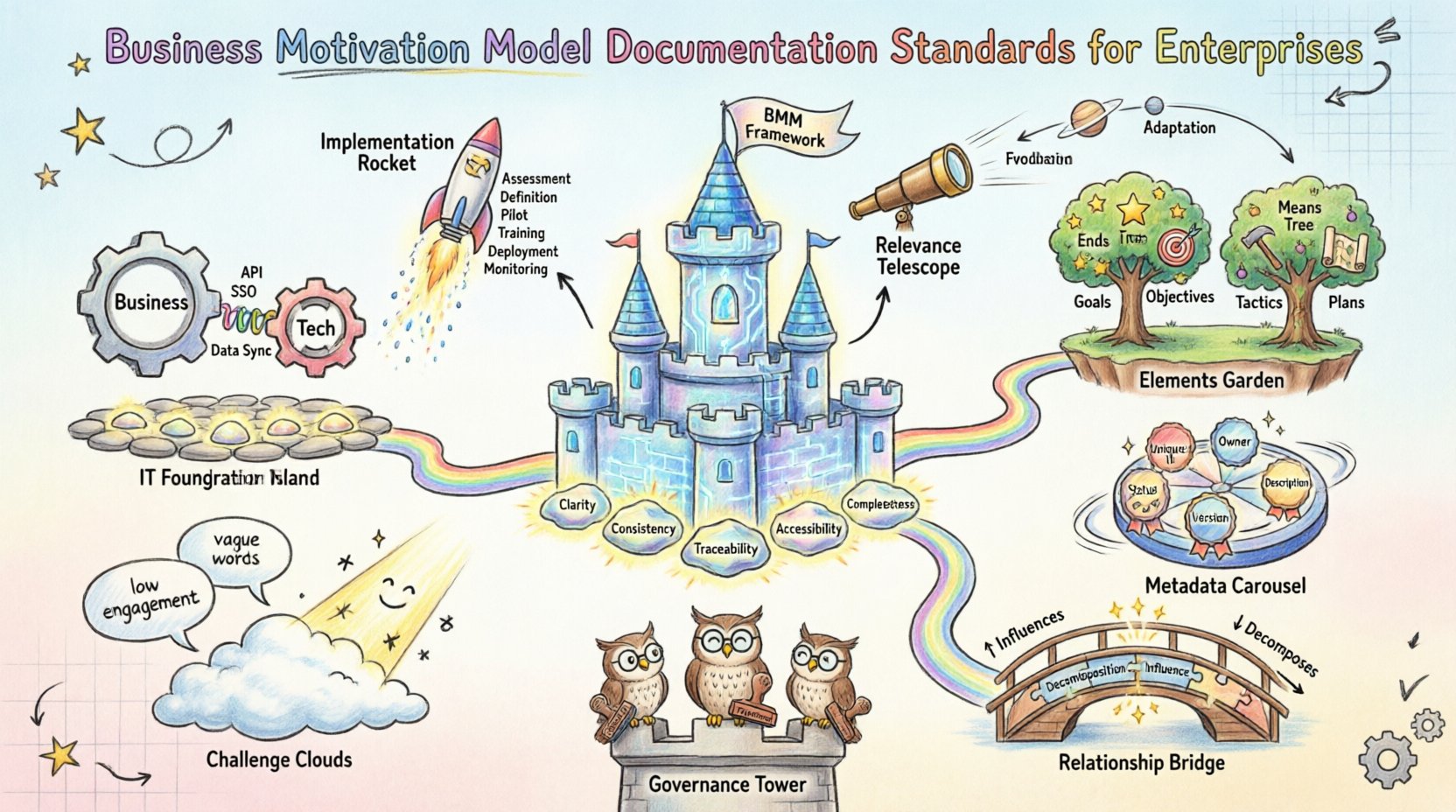
Effective documentation adheres to several foundational principles:
- Clarity: Terms must be unambiguous to all stakeholders.
- Consistency: Naming conventions and relationship types must remain uniform.
- Traceability: Every element must link back to a source of truth.
- Accessibility: Information must be findable by those who need it.
- Completeness: Critical attributes cannot be missing.
When these principles are ignored, silos form. Departments may define the same goal differently, leading to conflicting priorities. By enforcing standards early, organizations prevent these fractures from forming.
2. Core Elements and Naming Conventions 📝
The BMM relies on specific building blocks. Each block type serves a unique function in the logic of the organization. Documentation standards must dictate how these blocks are created and named.
2.1 Ends vs. Means
The distinction between Ends and Means is the cornerstone of the model. Ends represent the desired outcomes, while Means represent the actions taken to achieve them.
- Goals: A desired result that has no specific means attached yet. Documentation must ensure goals remain aspirational and measurable.
- Objectives: A specific subset of a goal. Objectives often have deadlines and quantitative metrics.
- Tactics: Specific courses of action taken to achieve objectives.
- Plans: A collection of tactics scheduled over time.
Documentation standards require that every Goal has at least one associated Objective. Every Objective must have at least one associated Plan. This ensures that no high-level intention floats without a path to execution.
2.2 Influencers and Drivers
External and internal factors influence the success of the Ends. These are categorized as Influencers, Drivers, or Barriers.
- Influencers: External factors like market trends or regulatory changes.
- Drivers: Internal motivations, such as profitability or customer satisfaction.
- Barriers: Obstacles that prevent the achievement of goals.
Each Influencer, Driver, or Barrier must be documented with a source. For example, a regulatory change should link to the specific law or policy document. This creates a verifiable audit trail.
3. Metadata and Lifecycle Management 🔄
A model element without metadata is just a label. Metadata provides the context necessary for the element to be understood and managed. Standards must define the minimum set of attributes required for every BMM element.
The following table outlines the recommended metadata schema for enterprise documentation:
| Metadata Field | Description | Requirement |
|---|---|---|
| Unique Identifier | A distinct code for the element (e.g., GOAL-001) | Mandatory |
| Element Name | The human-readable title | Mandatory |
| Owner | The individual accountable for the element | Mandatory |
| Status | Current state (Draft, Approved, Active, Retired) | Mandatory |
| Version | Revision number (e.g., v1.2) | Mandatory |
| Last Updated | Date of the most recent change | Mandatory |
| Description | Clear explanation of the element | Mandatory |
| Priority Level | High, Medium, Low | Recommended |
Versioning is particularly critical. As business needs shift, elements evolve. A strict versioning policy prevents confusion about which version of a goal is currently active. It also allows for the archiving of past states for historical analysis.
4. Relationship Definitions and Traceability 🔗
Isolated elements are of little value. The power of the BMM lies in the connections between them. Documentation standards must rigorously define how relationships are established and recorded.
4.1 Decomposition
Decomposition breaks down large Ends into smaller, manageable Means. A standard must specify that decomposition is hierarchical. A Goal decomposes into Objectives; an Objective decomposes into Plans.
- One-to-Many: One Goal can have multiple Objectives.
- Many-to-One: Multiple Objectives can support a single Goal.
- Verification: Every decomposed part must contribute directly to the parent element.
4.2 Satisfaction and Influence
Relationships are not always direct. Some elements simply influence the success of others. Documentation must capture the nature of this influence.
- Positive Influence: Increases the likelihood of success.
- Negative Influence: Decreases the likelihood of success.
- Dependency: One element cannot exist without another.
When documenting these links, the rationale must be recorded. For instance, if Plan A depends on Resource B, the documentation must state why this dependency exists. This supports risk analysis later on.
5. Governance and Review Protocols 🛡️
Standards are useless without enforcement. A governance framework ensures that documentation quality remains high over time. This involves defining roles, review cycles, and change control processes.
5.1 Roles and Responsibilities
Clear ownership prevents ambiguity. The following roles are essential for BMM governance:
- Model Owner: Responsible for the overall integrity of the model.
- Element Owner: Responsible for specific Goals or Plans.
- Reviewer: Validates documentation against standards before approval.
- Approver: Grants official status to new or changed elements.
5.2 Change Management
Business environments change. Documentation must reflect this fluidity without losing stability. A change management process should include:
- Request: A formal submission for a change.
- Impact Analysis: Assessing how the change affects connected elements.
- Approval: Sign-off from relevant stakeholders.
- Notification: Informing all affected parties of the update.
Without this process, the model becomes outdated quickly. A stale model erodes trust in the entire enterprise architecture.
6. Common Challenges in Enterprise Modeling ⚠️
Even with standards in place, organizations face hurdles. Recognizing these challenges helps in mitigating them proactively.
6.1 Ambiguity in Language
Vague terms lead to misinterpretation. Words like “improve” or “increase” are subjective. Standards should require quantifiable metrics where possible.
- Bad: “Improve customer service.”
- Good: “Reduce customer response time to under 2 hours.”
6.2 Over-Complexity
Models can become too detailed, making them unusable. Documentation standards should define a maximum level of granularity. If an element is too small, it belongs in a project charter, not the strategic model.
6.3 Lack of Engagement
If stakeholders do not use the model, it dies. Documentation should be integrated into existing workflows. It should not be a separate task that competes with daily work.
7. Integration with IT Strategy 💻
The Business Motivation Model does not exist in a vacuum. It must align with IT capabilities. Documentation standards should facilitate this alignment.
- Capability Mapping: Link Business Plans to IT Capabilities.
- Investment Justification: Use the BMM to justify technology spending.
- Risk Assessment: Identify where IT risks impact Business Goals.
When IT and Business speak the same language, resource allocation becomes more efficient. The documentation serves as the translation layer between these two domains.
8. Implementation Roadmap 🚀
Adopting these standards requires a phased approach. A sudden switch can disrupt operations. The following steps outline a logical rollout:
- Assessment: Review current documentation practices.
- Definition: Draft the specific standards and templates.
- Pilot: Test the standards on a single department.
- Training: Educate staff on the new requirements.
- Deployment: Roll out across the enterprise.
- Monitoring: Continuously review compliance and quality.
This method ensures that the organization adapts to the new standards without losing momentum.
9. Maintaining Long-Term Relevance 📈
Standards must evolve. What works today may not work in five years. Periodic reviews of the documentation standards themselves are necessary.
- Annual Review: Check if the metadata schema is still sufficient.
- Feedback Loop: Gather input from users on pain points.
- Industry Alignment: Ensure standards align with evolving industry practices.
By treating the standards as a living document, the enterprise ensures its modeling framework remains robust. This commitment to quality distinguishes mature organizations from those that struggle with alignment.