
In the landscape of software engineering, the architecture of a system often dictates its longevity. As applications grow in complexity, the codebase must evolve without collapsing under its own weight. Object-Oriented Analysis and Design provides a foundational framework for managing this complexity. Two pillars within this framework stand out for their ability to facilitate growth: inheritance and polymorphism. These mechanisms allow developers to construct systems that are not merely functional today but adaptable for tomorrow.
When designing scalable solutions, the goal is to minimize the cost of change. Every new feature or requirement should integrate seamlessly into the existing structure. This integration relies heavily on how classes relate to one another and how behaviors are dispatched. By leveraging inheritance, we establish clear hierarchies and shared behaviors. Through polymorphism, we ensure that different components can interact without knowing the specific details of one another. Together, they form a robust strategy for maintaining extensibility and reducing technical debt.
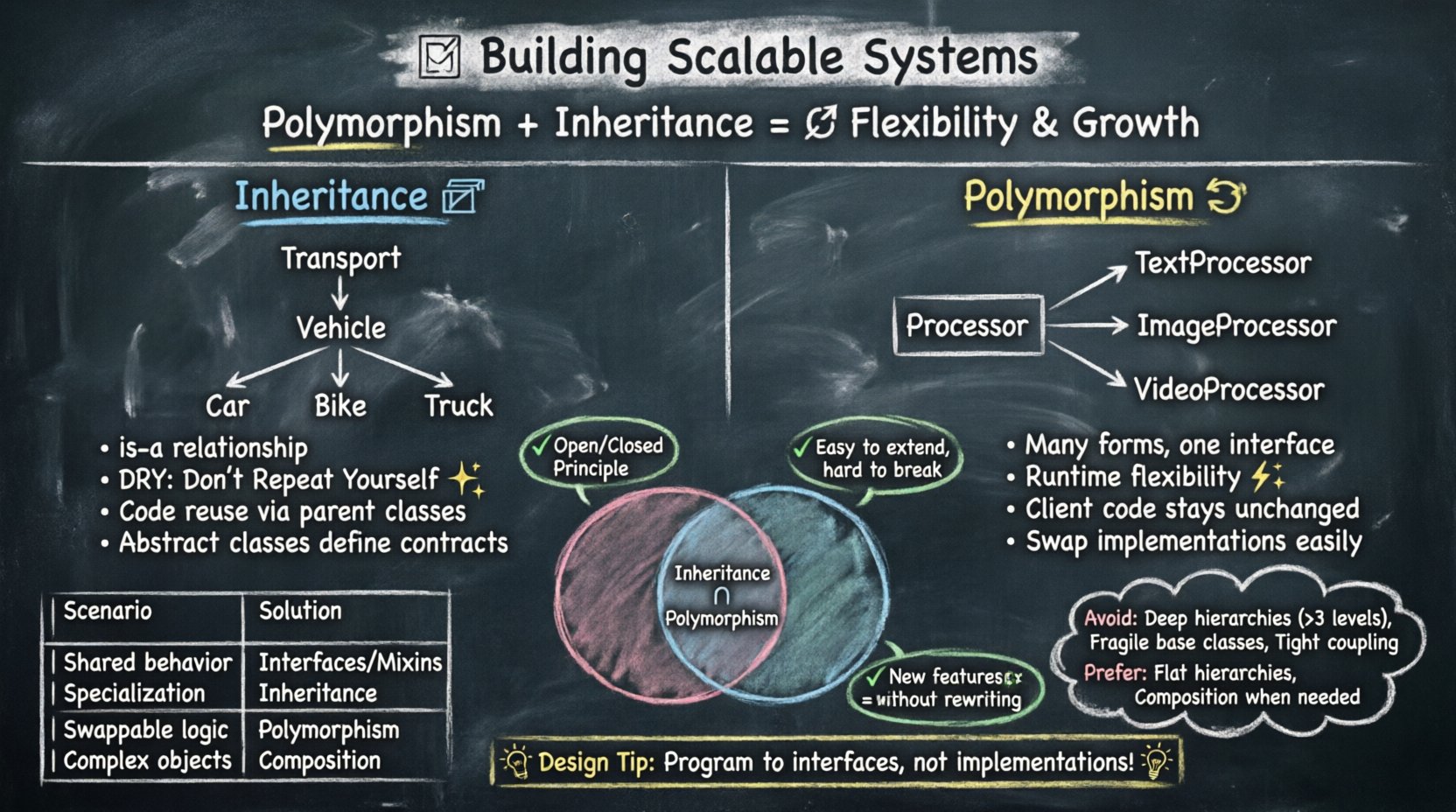
Understanding Inheritance: The Foundation of Reusability 🔗
Inheritance is the mechanism by which one class acquires the properties and behaviors of another. This relationship is often described as an is-a relationship. If a Vehicle is a type of Transport, then Vehicle inherits capabilities from Transport. This concept is fundamental to organizing code logically.
The Mechanics of Class Hierarchies
At its core, inheritance allows for code reuse. Instead of duplicating logic across multiple classes, common functionality is defined in a parent class. Subclasses then extend this functionality. This approach offers several distinct advantages:
DRY Principle: The Don’t Repeat Yourself principle is naturally supported. Common methods reside in the superclass.
Consistency: All subclasses adhere to a standard interface defined by the parent.
Abstraction: Parents can define abstract methods that force subclasses to implement specific behaviors.
Consider a scenario where you are building a notification system. You might have a base class representing a generic message. Specific types like email, SMS, and push notifications would inherit from this base. The base class handles the formatting of the timestamp and the logging of the delivery attempt. The subclasses handle the specific transmission logic.
Levels of Abstraction
Effective inheritance requires careful planning of abstraction levels. A deep hierarchy can become difficult to maintain. It is best to keep hierarchies flat unless there is a clear need for specialization.
Concrete Classes: These implement all methods and can be instantiated directly.
Abstract Classes: These may contain incomplete implementations and cannot be instantiated.
Interfaces: These define a contract of behavior without providing implementation details.
When designing these levels, ask if the subclass truly represents a specialized version of the parent. If the relationship is weak, composition might be a better choice than inheritance.
Polymorphism: Flexibility Through Substitutability 🔄
Polymorphism allows objects to be treated as instances of their parent class rather than their actual class. This enables code to operate on objects of different types through a common interface. The term comes from Greek roots meaning many forms.
Static vs Dynamic Polymorphism
Polymorphism manifests in different ways within the lifecycle of a program. Understanding the distinction is crucial for system design.
Compile-Time Polymorphism: Also known as method overloading. Multiple methods share the same name but differ in parameter lists. The compiler decides which method to call based on the arguments provided.
Runtime Polymorphism: Also known as dynamic dispatch. The method to execute is determined at runtime based on the actual object type. This is the primary driver of flexibility in scalable systems.
The Power of Interface Consistency
When polymorphism is applied correctly, client code does not need to know the specific type of object it is working with. It only needs to know the interface. This decouples the client from the implementation details.
For example, a processing pipeline might accept a stream of Processor objects. The pipeline does not care if the object is a TextProcessor or an ImageProcessor. It simply calls the process() method on every item in the stream. This allows new processors to be added to the system without modifying the pipeline logic.
Combining Inheritance and Polymorphism for Scalability 🚀
Using these concepts in isolation is less effective than using them together. The combination creates a system that is both modular and extensible. This synergy is often the key to handling growth without refactoring core components.
Extensibility Without Modification
A system built on these principles adheres to the Open/Closed Principle. It is open for extension but closed for modification. When a new requirement arises, you create a new subclass or implementation. You do not need to touch the existing code that consumes these objects.
New Features: Add a new subclass that inherits from the base.
Behavior Changes: Override specific methods in the new class.
Integration: The existing logic automatically supports the new class due to polymorphism.
Decoupling Logic
Polymorphism reduces coupling between components. The dependency is on the abstraction, not the concrete implementation. This makes testing easier and allows parts of the system to be swapped out independently.
In a scalable architecture, components must be replaceable. If a specific database strategy becomes too slow, a new implementation can be injected without rewriting the business logic that interacts with the data layer. This is possible because the business logic interacts with the interface, not the concrete class.
Common Pitfalls and Anti-Patterns ⚠️
While powerful, these principles can be misused. Improper application leads to fragile code that is harder to maintain than code without them. Awareness of these pitfalls is essential for writing robust systems.
The Fragile Base Class Problem
Changes made to a base class can inadvertently break subclasses. If a parent class relies on an internal state that a child class assumes exists, modifying the parent can break the child. To mitigate this, keep base classes stable and minimize the dependencies they impose on subclasses.
Deep Inheritance Hierarchies
Creating chains of inheritance that are too long makes the code difficult to understand. Debugging a call chain that spans ten levels is inefficient. Aim for a maximum depth of two or three levels. If you find yourself creating deeper hierarchies, consider extracting common behavior into separate mixins or composition.
Tight Coupling via Inheritance
Inheritance creates a tight bond between the parent and child. If the parent changes significantly, the child must change. This violates the desire for loose coupling. In many cases, composition is a superior alternative. Composition allows behavior to be added or removed at runtime, whereas inheritance is fixed at compile time.
Best Practices for Implementation 📋
To ensure your system remains scalable, follow a set of guidelines when applying these principles. The table below outlines the recommended approach for various scenarios.
Scenario | Recommended Approach | Reasoning |
|---|---|---|
Shared behavior across unrelated classes | Interfaces or Mixins | Avoids forcing a parent-child relationship where none exists. |
Specialization of a core concept | Inheritance | Clear is-a relationship justifies the hierarchy. |
Swappable algorithms | Polymorphism via Interfaces | Allows the algorithm to change without affecting the caller. |
Complex object construction | Composition | Reduces complexity compared to deep inheritance trees. |
Common validation logic | Abstract Base Class | Enforces structure while allowing specific validation rules. |
Strategic Planning for Design 🛠️
Before writing code, plan the structure. Visualizing the hierarchy helps identify potential issues early. Use diagrams to map out the relationships between classes.
Step-by-Step Design Process
Identify Core Entities: What are the primary objects in your domain? List their attributes and behaviors.
Determine Relationships: Do any entities share a common behavior? Do any entities represent specialized versions of others?
Define Interfaces: What contracts must these entities fulfill? Define the methods required for interaction.
Refactor Repeated Logic: Move common code into parent classes or utility modules.
Verify Substitutability: Ensure that any subclass can be used in place of the parent without breaking functionality.
Real-World Application Scenarios 💡
To fully grasp the impact of these concepts, consider how they apply to specific architectural challenges.
Event-Driven Architectures
In event-driven systems, various types of events trigger different handlers. Polymorphism allows a central dispatcher to handle all events uniformly. The dispatcher calls a handle() method on the event object. Each specific event type implements this method to perform the necessary action. This keeps the dispatcher logic clean and allows new event types to be added without touching the dispatcher.
Plugin Systems
Many applications support plugins to extend functionality. The core application defines a standard interface for plugins. Plugin developers create classes that implement this interface. The application scans for these plugins and loads them dynamically. This creates a modular ecosystem where functionality can grow indefinitely without modifying the core application code.
Strategy Patterns
When an object needs to choose from multiple algorithms, the Strategy pattern uses polymorphism to encapsulate each algorithm in a separate class. The context object holds a reference to the strategy interface. At runtime, the context can switch strategies. This allows the behavior to change independently of the object’s state.
Maintaining Code Quality Over Time 🔄
As the system grows, the quality of the code must be maintained. Regular refactoring is necessary to prevent the inheritance structure from becoming convoluted. Periodic reviews should check if any classes have become too specialized or if any abstractions have become too vague.
Refactoring Checklist
Are there any methods in a parent class that are only used by one subclass?
Are there any methods in a subclass that do not exist in the parent?
Can a deep hierarchy be flattened into a simpler structure?
Is the naming convention clear regarding the inheritance relationship?
Are dependencies on the parent class minimized?
The Impact on Testing and Debugging 🧪
A well-structured inheritance and polymorphism setup significantly improves testability. Mocking becomes straightforward when dealing with interfaces. You can create a mock implementation of a parent class to test a subclass without needing the full environment.
Unit Testing: Test subclasses in isolation by mocking parent dependencies.
Integration Testing: Verify that polymorphic calls work correctly across the system.
Regression Testing: Changes in a subclass should not affect the behavior of the parent or other siblings.
This isolation reduces the scope of testing required for each change. When a new feature is added, you only need to test the new class and its immediate interactions. The rest of the system remains stable.
Conclusion on Design Philosophy
Building scalable systems is not just about writing code that works; it is about writing code that evolves. Polymorphism and inheritance are the tools that enable this evolution. They provide the structure needed to manage complexity while allowing for the flexibility required by changing business needs. By adhering to sound design principles and avoiding common pitfalls, developers can create systems that remain robust and maintainable for years. The investment in proper design pays dividends in reduced maintenance costs and increased development velocity.
Focus on clear hierarchies, consistent interfaces, and loose coupling. Treat inheritance as a tool for abstraction and polymorphism as a tool for interaction. With these principles in place, your architecture will be ready for the demands of the future.