
Object-Oriented Design (OOD) is the backbone of maintainable software architecture. It provides a structured approach to modeling real-world entities within code, promoting reusability and clarity. However, applying these principles incorrectly can lead to brittle systems that are difficult to extend or debug. Many developers fall into predictable traps when designing classes and interactions.
This guide examines five critical errors found in typical OOD implementations. We will explore the mechanics behind these mistakes and provide concrete strategies to correct them. By understanding the underlying causes, you can build systems that stand the test of time.
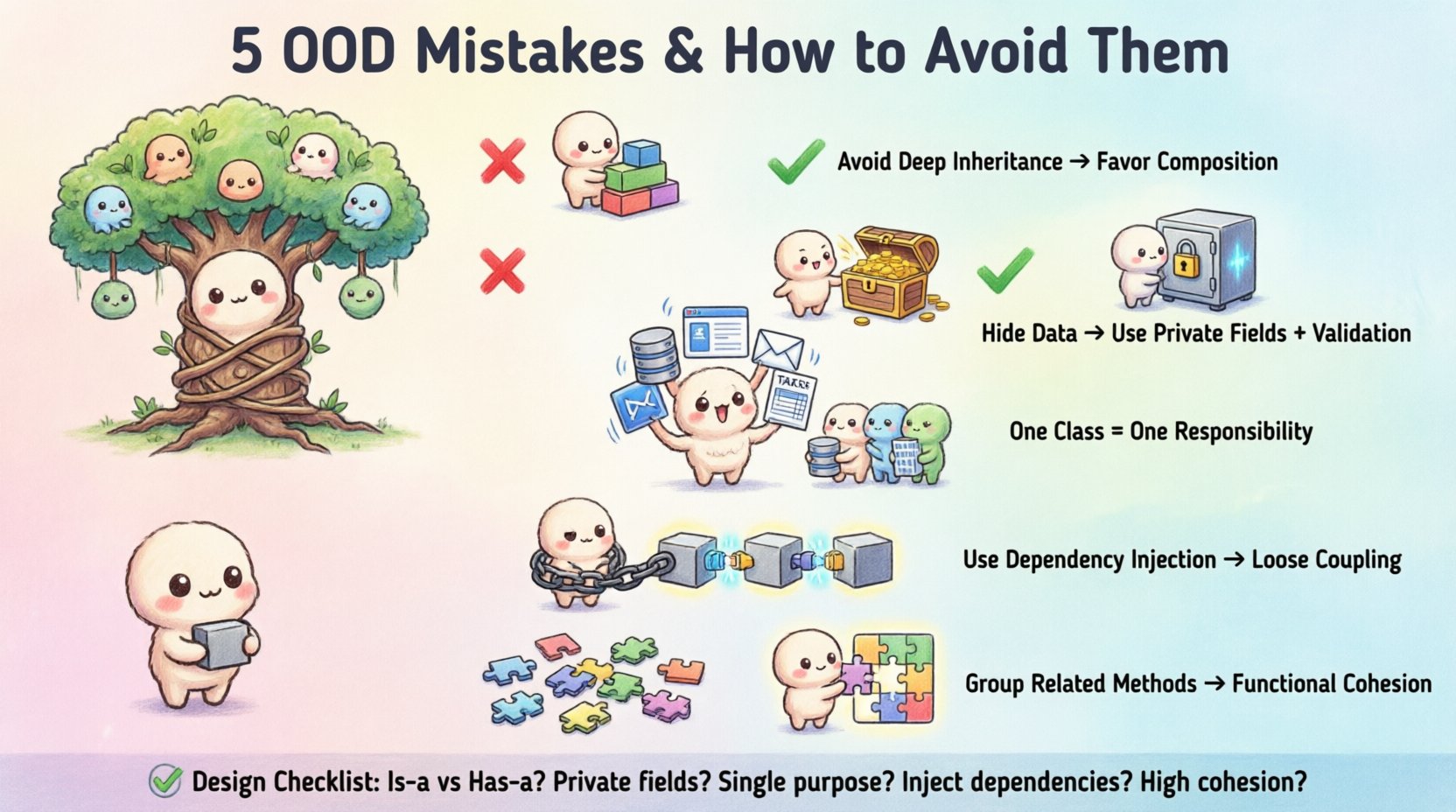
1. Overusing Inheritance Hierarchies 🌳
One of the most pervasive issues in object-oriented programming is the reliance on deep inheritance trees. While inheritance allows for code reuse through polymorphism, excessive use creates tight coupling between parent and child classes. When a base class changes, every derived class may break unexpectedly.
The Problem: Fragile Base Class
- Hidden Dependencies: Child classes often depend on the implementation details of the parent, not just its interface.
- Violation of Liskov Substitution: A subclass may not behave correctly when substituted for the parent, causing runtime errors.
- Complexity Growth: Adding a new feature often requires modifying the base class, affecting all existing subclasses.
The Solution: Favor Composition Over Inheritance
Instead of building “is-a” relationships, prefer “has-a” relationships. Combine small, focused objects to achieve functionality. This approach reduces coupling and allows for dynamic behavior changes at runtime.
Code Structure Comparison
| Approach | Flexibility | Maintainability | Recommended Usage |
|---|---|---|---|
| Deep Inheritance | Low | Low | Only for true mathematical hierarchies (e.g., Shape → Circle) |
| Composition | High | High | Most business logic and feature implementation |
When designing a system, ask yourself: Does the child truly represent the parent in every context? If the answer is no, consider using interfaces or composition to link the behaviors.
2. Violating Encapsulation 🚫📦
Encapsulation is the principle of hiding internal state and requiring interaction through defined methods. However, developers frequently expose public fields or provide trivial getters and setters without logic. This turns classes into data structures rather than objects with behavior.
Why Public State is Dangerous
- Loss of Control: External code can modify object state to an invalid condition instantly.
- Broken Invariants: Constraints that should always hold true (e.g., age cannot be negative) are ignored.
- Refactoring Difficulty: Changing how data is stored requires updates across every file that accesses that field directly.
Best Practices for Data Hiding
- Make Fields Private: Ensure all member variables are inaccessible from outside the class.
- Controlled Access: Use public methods to read or modify data.
- Validation Logic: Insert validation inside setter methods to maintain data integrity.
- Immutability: Where possible, make objects immutable after creation to prevent state changes entirely.
Consider a BankAccount class. If the balance is public, any code can set it to zero or a negative number. If the balance is private, the class can enforce rules such as “no overdraft” within a deposit method.
3. Creating God Objects (Large Classes) 🏛️
A God Object is a class that knows too much and does too much. These classes often handle database connections, user interface logic, business rules, and file I/O simultaneously. They become massive, unreadable files that are terrifying to modify.
Signs of a God Class
- Excessive Lines of Code: The class exceeds 500 lines without clear separation.
- Many Responsibilities: It performs unrelated tasks (e.g., sending emails and calculating taxes).
- High Fan-Out: It has dependencies on numerous other classes.
Solving with Single Responsibility
The Single Responsibility Principle states that a class should have only one reason to change. Break the God Object into smaller, focused classes.
Refactoring Strategy
- Identify Cohesion: Group methods that work together logically.
- Extract Classes: Move related methods into new classes.
- Introduce Interfaces: Define contracts for the new classes to ensure decoupling.
- Delegate: The original class should delegate tasks to the new, specialized classes.
For example, separate a ReportGenerator class from a DatabaseConnection class. The report generator should request data, not manage the connection itself.
4. Tight Coupling Between Modules 🔗
Coupling refers to the degree of interdependence between software modules. High coupling means that a change in one module forces changes in another. This creates a domino effect where fixing a bug in one area breaks functionality in another.
Types of Coupling to Avoid
- Direct Instantiation: Using
newinside a class to create dependencies makes testing difficult and creates hard links. - Concrete Dependencies: Depending on specific implementations rather than abstractions.
- Global State: Using global variables to share data creates hidden dependencies.
Strategies for Loose Coupling
Loose coupling allows modules to function independently. This is crucial for scalability and testing.
- Dependency Injection: Pass dependencies into a class via constructors or methods rather than creating them internally.
- Interface Segregation: Depend on interfaces that are specific to the client’s needs.
- Event-Driven Architecture: Use events to notify other systems of changes without direct calls.
By injecting dependencies, you can swap out implementations easily. For instance, you can use a mock database for testing while the production system uses a real one, without changing the core logic.
5. Ignoring Cohesion 🧩
Cohesion measures how closely related the responsibilities of a single module are. Low cohesion means a class contains methods that have little to do with each other. This makes the class hard to understand and reuse.
Levels of Cohesion
| Type | Description | Status |
|---|---|---|
| Accidental Cohesion | Methods grouped arbitrarily. | Bad |
| Logical Cohesion | Methods grouped by type (e.g., all “print” methods). | Acceptable |
| Functional Cohesion | Methods contribute to a single specific task. | Best |
Improving Cohesion
Aim for functional cohesion. Every method in a class should contribute to a single, well-defined purpose.
- Review Method Names: If a method name doesn’t fit the class purpose, move it.
- Split Large Classes: If a class handles multiple distinct tasks, split it.
- Focus on Domain: Align class structure with the business domain concepts.
High cohesion leads to code that is easier to test and debug. If a bug occurs, you know exactly which class to inspect.
Summary of Best Practices ✅
Avoiding these mistakes requires discipline and continuous refactoring. Here is a quick checklist for your design reviews.
- Check Inheritance: Is this an “is-a” relationship, or should it be composition?
- Verify Encapsulation: Are all data fields private?
- Analyze Size: Is the class doing too many things?
- Inspect Dependencies: Can this class run without its specific dependencies?
- Measure Cohesion: Do all methods serve one clear goal?
Final Thoughts on System Stability 🛡️
Good design is invisible. When you implement these principles correctly, the code flows naturally. You spend less time fixing bugs and more time adding value. The initial effort to structure classes properly pays off significantly during the maintenance phase. Prioritize clarity and flexibility over quick shortcuts.
Remember that design is an iterative process. Review your architecture regularly as requirements evolve. Stay alert to the signs of the mistakes outlined above. By maintaining high standards, you ensure your software remains robust and adaptable.