
Building a startup is an act of faith, but blind faith rarely sustains a business. Before committing resources to development, marketing, and operations, founders must rigorously test the viability of their concept. One of the most robust frameworks for this assessment is Porter’s Five Forces. While often taught in business schools, its application in the early stages of a venture provides a structured way to understand industry dynamics.
This guide walks through the mechanics of this analysis, tailored specifically for new ventures. We will explore how to dissect market forces, identify potential pitfalls, and make data-driven decisions. The goal is not to guarantee success, but to remove variables that could lead to failure.
📉 Why Gut Instinct Isn’t Enough for Market Fit
Many entrepreneurs fall in love with the solution before understanding the problem or the environment in which the solution exists. A great product in a terrible market structure will struggle regardless of execution quality. External factors often dictate profitability more than internal efficiency.
When validating a startup idea, founders need to answer critical questions about sustainability. The following list highlights common areas of failure that this framework addresses:
- Profitability Pressure: Are margins being squeezed by competitors?
- Switching Costs: Can customers leave easily if a better option appears?
- Supply Chain Stability: Are you dependent on a single vendor for critical inputs?
- Market Saturation: Is the industry crowded with established players?
- Disruption Risk: Is there a substitute technology ready to replace your offering?
Without answering these, a business plan is merely a hypothesis. This analysis moves the conversation from “Can we build it?” to “Should we build it?”
🔍 What is Porter’s Five Forces?
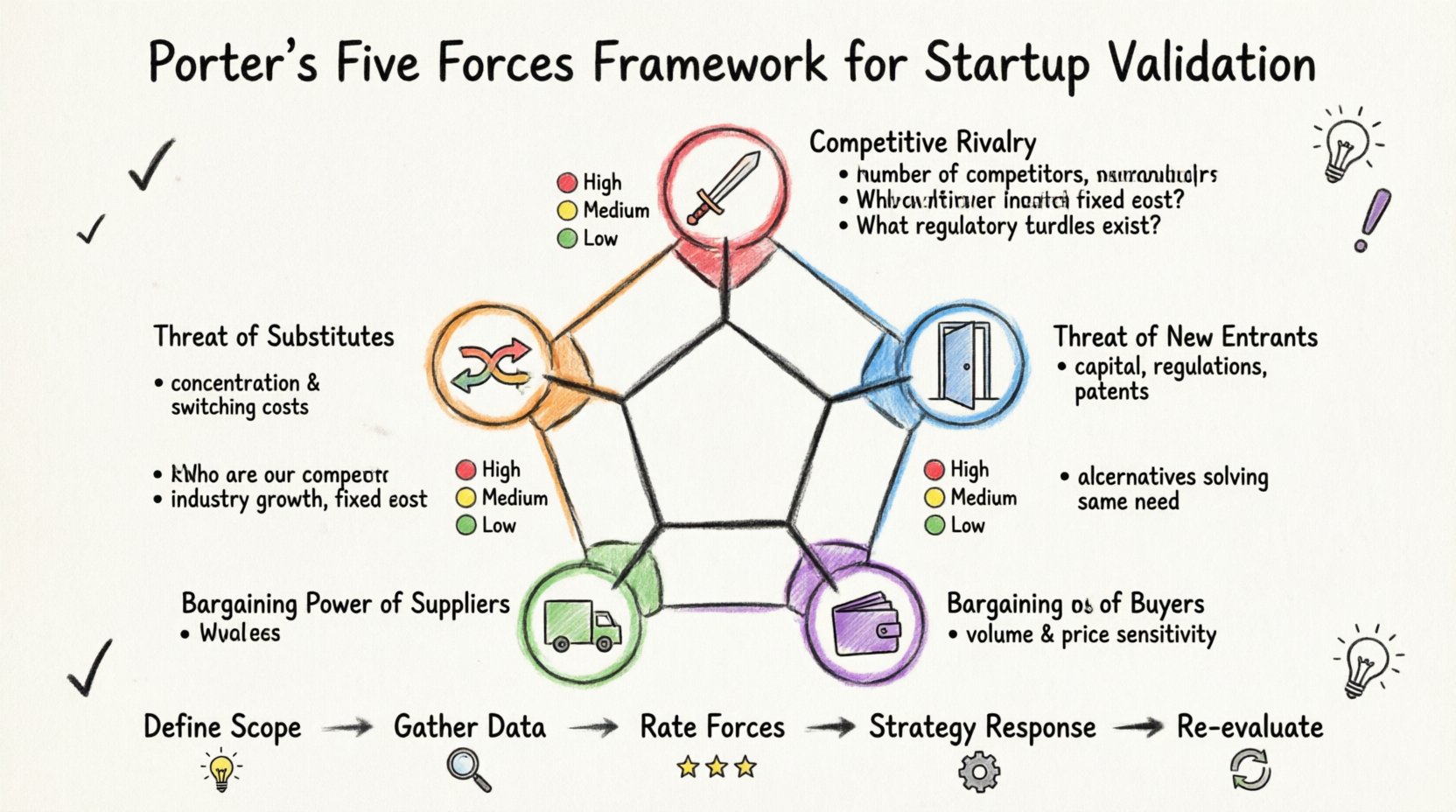
Developed by Michael Porter in 1979, this framework evaluates the competitive intensity and attractiveness of a market. It looks beyond direct competitors to include broader forces that influence pricing, costs, and customer loyalty. For a startup, this is not just about identifying rivals; it is about understanding the economic structure of the industry.
The five forces are:
- Competitive Rivalry
- Threat of New Entrants
- Threat of Substitutes
- Bargaining Power of Suppliers
- Bargaining Power of Buyers
Each force exerts pressure on the industry’s potential profitability. A strong force indicates a less attractive industry. A weak force suggests room for maneuver and margin.
🥊 Force 1: Competitive Rivalry
This force looks at how aggressively existing companies fight for market share. In a startup context, this is often the most intuitive force to analyze. However, it requires looking past brand names to the underlying mechanisms of competition.
Assessing the Level of Rivalry
High rivalry occurs when companies compete on price, features, or marketing spend. For a new entrant, entering a market with intense rivalry requires a significant competitive advantage. If the market is dominated by price wars, margins will be thin.
Key indicators of high rivalry include:
- Number of Competitors: Are there dozens of players or a few giants?
- Industry Growth Rate: Is the pie growing, or is everyone fighting for a slice of the same size?
- Fixed Costs: Are there high overheads that force companies to discount to maintain volume?
- Exit Barriers: Is it difficult to leave the market, forcing companies to stay and fight?
Startup Application
When evaluating your idea, map out the direct competitors. Do not just list names; analyze their business models. Are they funded by venture capital to burn cash? Are they profitable? If the industry is crowded, consider a niche strategy. Dominating a small segment is often more viable than fighting for a broad market share immediately.
🚪 Force 2: Threat of New Entrants
This force measures how easy it is for new companies to enter your market. If barriers to entry are low, any success you achieve could attract copycats quickly, eroding your advantage. Conversely, high barriers can protect your position once established.
Barriers to Entry
Barriers are the obstacles that make it hard for a competitor to start up. They can be structural, regulatory, or financial.
- Capital Requirements: Does the industry require millions in upfront investment?
- Regulations: Are there licenses, certifications, or compliance hurdles?
- Access to Distribution: Do incumbents control the channels to customers?
- Switching Costs: Do customers face high costs to move to a new provider?
- Proprietary Technology: Are there patents or trade secrets protecting the core tech?
Startup Application
If your idea relies on a proprietary algorithm or patent, the threat of new entrants is lower. If you are building a standard service with no unique tech, the threat is high. In low-barrier industries, speed and brand loyalty become your primary defenses. You must build a moat quickly before others arrive.
🔄 Force 3: Threat of Substitutes
Substitutes are not direct competitors; they are different products that solve the same underlying need. This is often the most overlooked force by founders. A customer might not buy your software because they prefer a manual process, a spreadsheet, or a competitor’s solution.
Identifying Substitutes
Look at the job your product does. What else do people do to get that job done today? If your product is a premium coffee subscription, the substitute is a local cafe or instant coffee.
- Price-Performance Trade-off: Is the substitute cheaper or better?
- Buyer Propensity to Substitute: Is it easy for customers to switch?
- Relative Price: How does the cost compare to the alternative?
Startup Application
Validate that your solution is significantly better than the status quo. If the substitute is “doing nothing” or using a spreadsheet, the switching cost is low. You need to demonstrate a clear value gap. If the substitute is a well-established industry standard, you must prove your solution is 10x better to justify the switch.
📦 Force 4: Bargaining Power of Suppliers
Suppliers include anyone who provides inputs to your business. This could be raw materials, cloud infrastructure, talent, or distribution partners. If suppliers have high power, they can raise prices or reduce quality, squeezing your margins.
Supplier Power Factors
Supplier power increases when there are few providers or when switching costs are high.
- Concentration: Is there one monopoly supplier or many options?
- Uniqueness: Is the input specialized or commoditized?
- Switching Costs: How hard is it to change vendors?
- Threat of Forward Integration: Could the supplier become your competitor?
Startup Application
For software startups, cloud providers (AWS, Azure, Google) are key suppliers. If you build your entire stack on one provider, they have leverage. Diversify your dependencies where possible. For hardware startups, supply chain resilience is critical. Ensure you have alternative sources for components to avoid bottlenecks.
👛 Force 5: Bargaining Power of Buyers
Buyers are your customers. Their power lies in their ability to demand lower prices or higher quality. If buyers have high power, they will drive down your revenue and margins.
Buyer Power Factors
Buyers gain power when they are concentrated or when products are undifferentiated.
- Volume: Do they buy in bulk or as individuals?
- Price Sensitivity: Is the product a small part of their budget or a major one?
- Availability of Information: Do they know the market prices?
- Threat of Backward Integration: Could the buyer make the product themselves?
Startup Application
If you sell to large enterprises, they have significant power. They can dictate terms and delay payments. If you sell to consumers (B2C), they have less individual power, but they have low switching costs. To reduce buyer power, focus on differentiation. If customers perceive your brand as unique, they are less likely to shop around on price.
📊 Analyzing the Forces: A Comparative View
Understanding each force individually is not enough. You must synthesize them to see the overall picture. The table below summarizes how these forces impact different startup scenarios.
| Force | High Threat | Low Threat | Implication for Startup |
|---|---|---|---|
| Competitive Rivalry | Many rivals, price wars | Few rivals, stable pricing | Focus on differentiation or niche |
| New Entrants | Low barriers, easy entry | High capital, regulations | Build speed and brand early |
| Substitutes | Many alternatives, low cost | Few alternatives, high cost | Prove superior value proposition |
| Suppliers | Monopoly, high switching cost | Many options, commoditized | Diversify supply chain |
| Buyers | Concentrated, price sensitive | Fragmented, loyal | Build loyalty and stickiness |
🛠️ Step-by-Step Application Guide
Now that the theory is clear, here is a practical workflow to apply this to your startup idea.
Step 1: Define the Industry Scope
Be specific. “Tech” is too broad. “Project management software for remote engineering teams” is specific. The scope determines the competitors and data points.
Step 2: Gather Data
Use public resources to gather information. Look at annual reports of public competitors, industry reports, and customer reviews. Do not rely on assumptions. Ask potential customers about their current solutions and pain points.
Step 3: Rate Each Force
Assign a rating of Low, Medium, or High to each force based on your research. Be honest. If you are entering a red ocean, acknowledge it.
Step 4: Identify Strategic Responses
For every High threat, determine a mitigation strategy. If supplier power is high, can you negotiate contracts or find alternatives? If rivalry is high, can you target a specific segment?
Step 5: Re-evaluate Regularly
Markets change. A force that is low today might be high tomorrow. Review this analysis quarterly or after major industry shifts.
⚠️ Common Pitfalls in Analysis
Even with a solid framework, errors can occur. Avoid these common mistakes to ensure accuracy.
- Ignoring the Ecosystem: Don’t look at the product in isolation. Look at the partners and complements.
- Overlooking Indirect Competitors: Your biggest rival might not be another startup but a legacy process.
- Assuming Static Markets: Technology evolves. A low threat today can become a high threat tomorrow.
- Confirmation Bias: Only looking for data that supports your idea. Actively seek evidence that contradicts your assumptions.
✅ Next Steps After Analysis
Once the analysis is complete, you have a clearer picture of the risks. If the forces indicate a hostile environment, you may need to pivot. If the environment looks favorable, you can proceed with a higher degree of confidence.
Combine this with a financial model. The Five Forces explain the structural profitability, but the financial model explains the unit economics. Both are necessary for a complete validation.
Consider the following actions based on your findings:
- Proceed: If threats are manageable and margins are viable.
- Pivot: If a specific force (e.g., buyer power) is too strong, change your target customer.
- Pause: If the market structure is fundamentally broken, wait for conditions to improve.
Final Thoughts on Market Validation
Porter’s Five Forces is not a crystal ball. It will not predict the future with certainty. However, it provides a structured lens to examine the present reality. It forces founders to look outside their product and understand the economic forces that will determine their survival.
By systematically evaluating competition, entrants, substitutes, suppliers, and buyers, you reduce the uncertainty inherent in entrepreneurship. This discipline separates successful ventures from those that fail due to external market pressures. Use this tool to inform your strategy, not to dictate it. Build your vision, but ground it in the reality of the market structure.