
Object-oriented analysis and design provides powerful mechanisms for code reuse and abstraction. However, when class structures grow deep and branching becomes frequent, the maintenance burden often outpaces the benefits gained. Complex inheritance hierarchies can become a source of significant technical debt, introducing subtle bugs that are difficult to trace. This guide addresses the structural challenges inherent in deep object models and offers a path toward stability.
Developers often inherit from existing classes to extend functionality without rewriting logic. While efficient, this practice accumulates hidden dependencies. Over time, the relationships between classes become opaque. Understanding these relationships is critical for long-term project health. We will explore the symptoms of hierarchy decay, the specific problems that arise from deep nesting, and the architectural patterns that mitigate these risks.
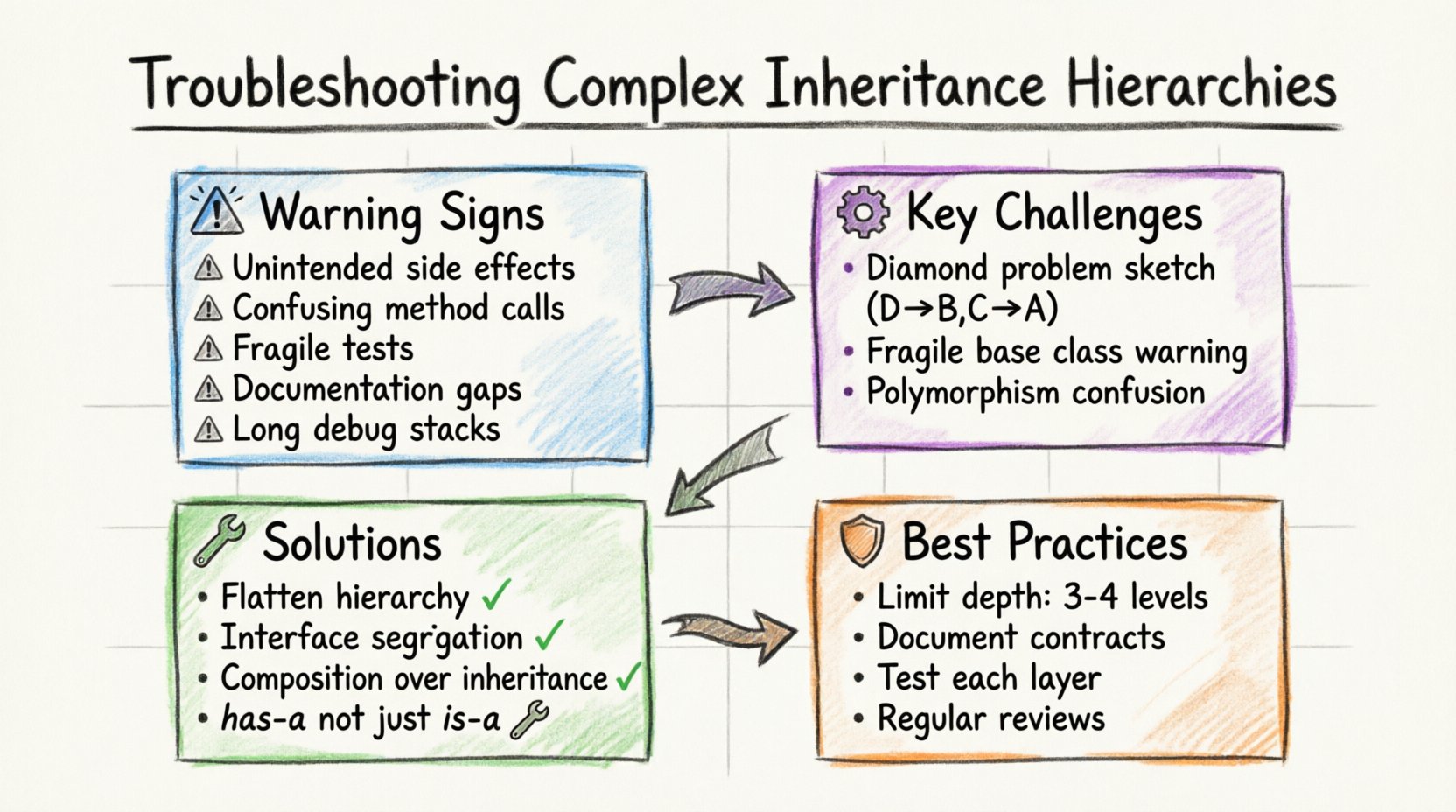
Recognizing Signs of Structural Decay 📉
The first step in troubleshooting is identifying that a hierarchy has become problematic. You do not need to wait for a system failure to notice these issues. The symptoms often appear during routine development tasks. A developer might hesitate before modifying a base class because the impact is unclear. This hesitation is a primary indicator of high coupling and low visibility.
- Unintended Side Effects: Changes in a parent class ripple unpredictably through child classes.
- Confusion in Method Calls: It becomes difficult to determine which implementation of a method is actually executing.
- Test Fragility: Unit tests break frequently when refactoring unrelated parts of the tree.
- Documentation Gaps: The intended purpose of specific classes is unclear or undocumented.
- Long Call Stacks: Debugging requires tracing through multiple layers of abstraction.
When these symptoms appear, the hierarchy is likely too deep. The cognitive load required to understand the flow of control exceeds the capacity of the team. This leads to slower development speeds and increased bug rates. Early recognition allows for intervention before the system becomes unmanageable.
The Diamond Problem and Resolution Order 💎
One of the most notorious challenges in inheritance is the diamond problem. This occurs when a class inherits from two or more classes that share a common ancestor. The resulting structure creates ambiguity regarding which parent implementation should be used. Different programming environments handle this ambiguity in various ways, but the underlying risk remains the same.
When a method is called on a descendant class, the system must decide which version of that method to invoke. If multiple paths lead to the same base method, the resolution order determines the outcome. If this order is not well-documented or understood, the behavior of the software becomes non-deterministic.
- Multiple Inheritance: Allows a class to inherit from more than one parent.
- Conflict Resolution: The system must prioritize which parent takes precedence.
- State Initialization: Ensuring constructors run in the correct sequence is vital.
- Hidden Dependencies: Methods may rely on state set by a parent class that is not immediately visible.
To troubleshoot this, you must map the method resolution order explicitly. Static analysis tools can help visualize the paths taken during execution. If the resolution order is inconsistent, you may need to flatten the hierarchy. This often involves removing intermediate classes that serve only as bridges between unrelated parents.
The Fragile Base Class Syndrome 🏗️
Another critical issue is the fragile base class syndrome. This occurs when a change in a base class breaks the assumptions made by derived classes. The base class is not designed to be a stable contract, but derived classes rely on its internal implementation details.
For example, if a base class changes how it calculates a value, a child class that depends on that calculation may fail. The child class might not have access to the internal logic of the base class, making it impossible to verify the impact of the change. This creates a situation where the base class becomes locked, unable to evolve without breaking the ecosystem built upon it.
- Encapsulation Violations: Child classes access private or protected members of the parent.
- Implicit Contracts: Behavior is assumed rather than explicitly defined in an interface.
- Refactoring Resistance: Developers avoid changing the base class due to fear of breaking children.
- Testing Blindspots: Tests for the base class do not cover the specific usage patterns of children.
Solving this requires strict boundaries. The base class should expose only stable, public interfaces. Internal implementation details should be hidden. If a child class needs specific behavior, it should be passed into the parent or implemented via composition. This reduces the coupling between the levels of the hierarchy.
Method Resolution and Polymorphism Pitfalls 🔄
Polymorphism allows different classes to be treated as instances of the same super-class. This is a core tenet of object-oriented design. However, complex hierarchies can obscure which method is actually being called. This is often referred to as the “hidden implementation” problem.
When debugging, a developer may see a method call on a reference type. At runtime, the specific object instance determines the actual code path. If the hierarchy is deep, tracing this path becomes laborious. Furthermore, overriding methods without understanding the full context can lead to logical errors that propagate silently.
- Dynamic Dispatch: The method is chosen at runtime based on the actual object type.
- Override vs. Overload: Confusion between changing behavior and adding new signatures.
- Shadowing: A child class hides a parent variable or method without proper intent.
- Abstract Methods: Ensuring all derived classes implement required abstract methods.
To mitigate this, maintain clear documentation on which methods are overridden and why. Use abstract base classes to enforce contracts. Ensure that any overridden method maintains the preconditions and postconditions of the parent implementation. If a method is overridden, it should not weaken the contract established by the parent.
Strategies for Remediation 🔧
Once problems are identified, specific strategies can be applied to stabilize the hierarchy. The goal is not to eliminate inheritance entirely, but to use it where it makes logical sense. In many cases, inheritance is used for code reuse where composition would be more appropriate.
Flattening the Hierarchy
If a class extends another which extends another, consider merging these into a single level of abstraction. Remove intermediate classes that do not add significant behavioral complexity. This reduces the depth of the tree and makes the flow of control easier to follow.
Interface Segregation
Break large interfaces into smaller, more specific ones. This ensures that child classes only implement the methods they actually need. It prevents the “leaky abstraction” where a child inherits methods it cannot use or does not understand.
Composition Over Inheritance
Replace inheritance relationships with composition. Instead of a child class inheriting from a parent, have the child hold a reference to an instance of the parent or a related component. This allows for greater flexibility and easier testing. You can swap components at runtime without changing the class structure.
Common Symptoms and Fixes Table 📊
| Symptom | Potential Cause | Recommended Fix |
|---|---|---|
| Base class changes break children | Fragile base class syndrome | Reduce coupling, use interfaces |
| Unclear which method runs | Deep method resolution order | Map resolution order, flatten hierarchy |
| Difficulty in unit testing | Hidden dependencies on state | Inject dependencies, use mocks |
| Excessive boilerplate code | Repetitive logic in base class | Extract common logic to utility classes |
| Confusion about ownership | Mixing implementation with abstraction | Separate interface from implementation |
Documentation as a Safety Net 📝
When hierarchies are complex, documentation becomes the primary source of truth. Code comments are often outdated. However, architectural documentation that explains the intent of the hierarchy can guide future development. This documentation should focus on the “why” rather than the “how”.
- Class Contracts: Define what a class guarantees regarding behavior.
- Dependency Maps: Visualize which classes depend on which others.
- Change Logs: Track significant changes to the inheritance structure.
- Usage Guidelines: Explain when to use specific classes and when to avoid them.
Without this documentation, new team members will struggle to understand the system. They may introduce new bugs by making changes that violate implicit assumptions. Regular reviews of the documentation ensure it remains accurate as the code evolves.
Testing Hierarchies Effectively 🧪
Testing a complex inheritance hierarchy requires a multi-layered approach. Unit tests for the base class are not enough. Tests must verify that derived classes behave correctly in the context of the hierarchy.
- Integration Tests: Verify that the entire hierarchy works together.
- Regression Tests: Ensure that changes to the base class do not break children.
- Contract Tests: Validate that all derived classes adhere to the parent contract.
- Mocking: Use mocks to isolate specific layers of the hierarchy during testing.
Automated testing is essential. Manual testing cannot cover every combination of class interactions. A robust test suite provides confidence when refactoring. If the tests pass, the hierarchy is likely stable. If they fail, the specific layer causing the issue is highlighted.
When to Stop Inheriting 🛑
There is a point where inheritance adds more complexity than value. If a class has too many descendants, it becomes a bottleneck. If the descendants vary significantly in behavior, inheritance is likely the wrong tool. In these cases, consider using polymorphism through interfaces or composition.
Ask yourself if the relationship is “is-a” or “has-a”. If a class is not strictly a type of its parent, inheritance is being misused. For example, a “Square” is a “Rectangle” in some mathematical models, but in object design, they often have different behaviors that make inheritance problematic. In such cases, composition allows you to share functionality without forcing a rigid type relationship.
- Evaluate Relationships: Ensure the “is-a” relationship is logically sound.
- Limit Depth: Keep the hierarchy depth to three or four levels maximum.
- Encourage Flexibility: Allow for behavior changes without modifying the class structure.
- Review Regularly: Periodically audit the hierarchy for signs of decay.
Maintaining Architectural Integrity 🛡️
Maintaining a healthy hierarchy is an ongoing process. It requires discipline and vigilance from the entire team. Code reviews should specifically look for signs of hierarchy complexity. New features should be added with the existing structure in mind, not just the immediate requirement.
Refactoring is a continuous activity. Do not wait for the system to break before making changes. Small, incremental improvements to the hierarchy are better than large, risky overhauls. This approach minimizes the risk of introducing new bugs while gradually improving the structure.
By understanding the pitfalls of inheritance and applying these strategies, you can maintain a codebase that is both flexible and stable. The goal is not to avoid inheritance, but to use it wisely. When used correctly, it provides a strong foundation for scalable design. When misused, it creates a fragile system that is hard to change.
Focus on clarity. Make the intent of your classes obvious. Reduce the cognitive load on future developers. This investment in structural health pays dividends in reduced maintenance costs and faster development cycles. A well-structured hierarchy is invisible; it simply works as intended.
Final Thoughts on Object Structure 🧠
Complex inheritance hierarchies are a common challenge in software engineering. They arise from the natural tendency to organize code by similarity and reuse. However, without careful management, they become obstacles to progress. By recognizing the symptoms early and applying the strategies outlined here, you can navigate these challenges effectively.
Remember that the structure of your code reflects the structure of your thinking. A messy hierarchy often indicates a messy understanding of the domain. Take the time to model your domain accurately. Ensure that your classes represent concepts clearly. This alignment between design and domain is the key to a maintainable system.
Keep your hierarchies shallow. Prefer composition for flexibility. Document your assumptions. Test your layers. These practices will help you build systems that stand the test of time. The complexity of inheritance is manageable if you approach it with caution and clarity.