
Business growth relies on clarity. Too often, leaders spend time on strategy without distinguishing between looking inward and looking outward. You might be optimizing internal processes while your competitors are stealing your market share. Or perhaps you are reacting to every market trend without understanding your own core capabilities. To drive sustainable revenue, you need to know which strategic lens provides the highest return on investment.
This guide breaks down the mechanics of SWOT Analysis and Competitor Analysis. We will explore how each functions, where they overlap, and which one delivers tangible financial results more quickly. Understanding the difference is not just about academic classification; it is about allocating resources where they yield the highest impact.
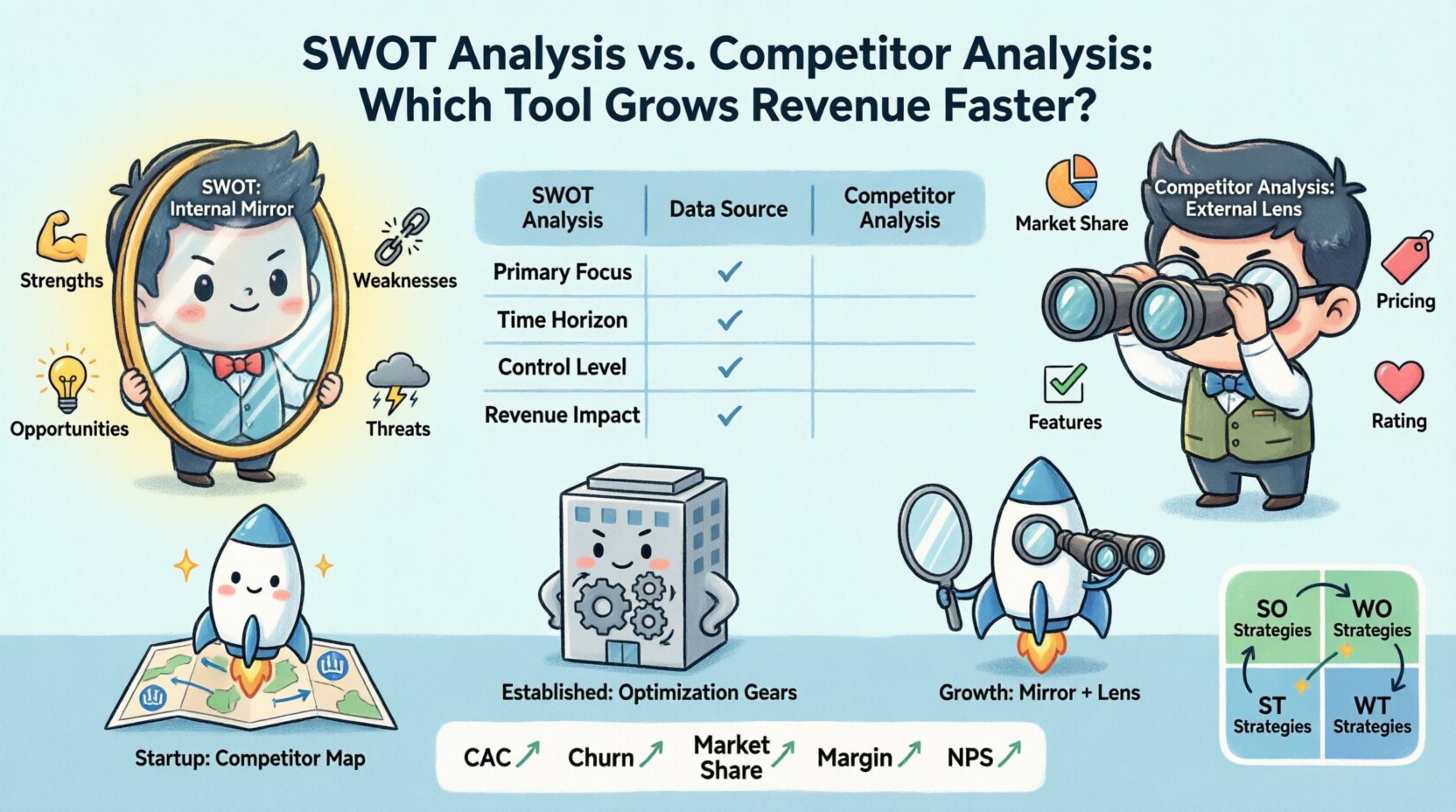
🔍 Defining SWOT Analysis: The Internal Mirror
SWOT stands for Strengths, Weaknesses, Opportunities, and Threats. It is a foundational framework used to evaluate the strategic position of a business. The core distinction lies in the first two components: Strengths and Weaknesses. These are internal factors. They exist within your organization and are under your direct control to modify.
- Strengths: What does your team do better than anyone else? This could be proprietary technology, brand reputation, or specialized talent.
- Weaknesses: Where does your operation leak value? This includes outdated software, high employee turnover, or slow supply chains.
The remaining two components, Opportunities and Threats, are external. However, in a SWOT framework, they are viewed through the lens of how they affect your internal standing.
- Opportunities: Market gaps you can fill based on your strengths.
- Threats: External risks that could damage your current revenue streams.
When executed correctly, SWOT provides a snapshot of your current health. It answers the question: “Are we built to win?” However, it does not inherently tell you who you are competing against or what price point they are holding.
🛠️ How to Conduct a Robust SWOT Analysis
Building a reliable SWOT requires more than a whiteboard session. It demands data.
- Gather Internal Data: Look at financial reports, customer support logs, and employee performance reviews. Identify patterns in where revenue is lost or gained.
- Involve Cross-Functional Teams: Sales knows the customers. Engineering knows the bottlenecks. Marketing knows the messaging. Combine these perspectives to avoid blind spots.
- Categorize Rigorously: Be honest. If a “Strength” relies on a single person leaving, it is actually a risk. If a “Weakness” is a process that is easy to fix, it is a low priority.
- Link to Strategy: Every item on the list must connect to a business goal. If you list a weakness that does not impact the bottom line, it is noise.
The output of a SWOT is a clear picture of your operational capacity. It tells you what you can build and where you are vulnerable. But it does not tell you if the market wants what you are building.
🏆 Defining Competitor Analysis: The External Lens
While SWOT looks at the company, Competitor Analysis looks at the market. This process involves identifying who else is vying for the same customers and evaluating their capabilities. It is an external audit that reveals the landscape you are operating in.
This analysis focuses on:
- Market Share: How much of the pie do they control?
- Pricing Models: Are they undercutting you or charging a premium?
- Product Features: What functionality do they offer that you do not?
- Customer Sentiment: What do users say about their service?
The primary goal here is benchmarking. You need to know where you stand relative to the competition. If you are the only player in town, you have a monopoly. If you are one of five, you need to know why a customer chooses you over the other four.
🛠️ How to Conduct a Robust Competitor Analysis
This process requires research and observation.
- Identify Direct and Indirect Rivals: Direct rivals sell the same product. Indirect rivals solve the same problem differently. Both compete for budget.
- Analyze Marketing Channels: Where are they advertising? What messaging are they using? This reveals their acquisition strategy.
- Review Public Financials: For public companies, earnings calls reveal growth rates and strategic shifts. For private companies, press releases and funding rounds offer clues.
- Monitor Product Updates: Track release notes and feature announcements. This shows their innovation pipeline.
Competitor Analysis answers the question: “Are we playing the right game?” It reveals market trends before they become mainstream. However, it does not reveal your internal ability to execute on a new strategy.
⚖️ Key Differences at a Glance
Understanding the distinction helps you decide which tool to deploy when. The table below outlines the structural differences.
| Feature | SWOT Analysis | Competitor Analysis |
|---|---|---|
| Primary Focus | Internal capabilities and external risks | External market positioning and rivals |
| Data Source | Internal reports, employee feedback | Public data, customer reviews, market reports |
| Time Horizon | Current state to near future | Ongoing market shifts and long-term trends |
| Control Level | High (Internal factors) | Low (External factors) |
| Revenue Impact | Operational efficiency and risk mitigation | Market share gain and pricing power |
Notice that SWOT is largely about control. You can fix a weakness. You cannot fix a competitor’s new product launch. Conversely, Competitor Analysis is about adaptation. You cannot control the market, but you can position yourself to ride the waves it creates.
💰 Which Tool Drives Revenue Faster?
This is the critical question. Does fixing your internal processes yield more money than beating the competition? The answer depends on your current business maturity.
🚀 Scenario 1: Early Stage or Startup
If you are building a product from scratch, Competitor Analysis is often the priority. You need to know if a market exists. If you build a solution that no one wants because a better one already exists, your internal strengths are irrelevant. You need to find a wedge in the market.
- Focus: Differentiation and positioning.
- Revenue Driver: Finding product-market fit.
- Strategy: Use Competitor Analysis to identify gaps in the market that your Strengths can fill.
🚀 Scenario 2: Established Business
If you have steady revenue but growth has stalled, SWOT Analysis becomes vital. You might be losing customers due to operational friction. If your product is great but your support team is slow, you have a Weakness bleeding revenue. Competitor Analysis might show you that your rivals are similar, meaning the problem is internal.
- Focus: Retention and efficiency.
- Revenue Driver: Reducing churn and increasing lifetime value.
- Strategy: Use SWOT to identify internal bottlenecks that prevent you from scaling.
🚀 Scenario 3: Aggressive Growth Phase
When scaling, you need both. You need to ensure your infrastructure (SWOT) can handle the load while you hunt for new territory (Competitor Analysis). Ignoring one leads to failure. If you grow too fast without fixing Weaknesses, you break your service. If you fix Weaknesses but ignore Competitors, you get locked out of new markets.
Generally, Competitor Analysis drives acquisition revenue faster. It shows you where the customers are. SWOT Analysis drives efficiency revenue faster. It shows you how to keep the customers you have.
🔗 Integrating Both for Maximum Impact
Relying on only one tool is a strategic error. The most effective revenue growth comes from synthesizing internal reality with external opportunity.
🤝 The TOWS Matrix Approach
A TOWS matrix is an advanced version of SWOT that explicitly links internal factors with external factors. It forces you to make strategic decisions based on the data.
- SO Strategies (Strengths-Opportunities): How can you use your Strengths to maximize Opportunities?
Example: Use your strong engineering team (Strength) to launch a feature the market is demanding (Opportunity). - WO Strategies (Weaknesses-Opportunities): How can you overcome Weaknesses to take advantage of Opportunities?
Example: Hire a sales team (fix Weakness) to enter a new region (Opportunity). - ST Strategies (Strengths-Threats): How can you use Strengths to minimize Threats?
Example: Use your brand reputation (Strength) to defend against a price war (Threat). - WT Strategies (Weaknesses-Threats): How can you minimize Weaknesses to avoid Threats?
Example: Diversify your supply chain (fix Weakness) to avoid disruption from a competitor’s shortage (Threat).
This integration ensures that your external analysis informs your internal priorities.
⚠️ Common Pitfalls to Avoid
Even with the right tools, execution often fails. Here are the most common mistakes that stall revenue growth.
🚫 Analysis Paralysis
Teams spend months analyzing data without taking action. A SWOT analysis is only useful if it leads to a decision. If you identify a Weakness, you must assign an owner to fix it. If you identify a Competitor’s move, you must decide whether to counter it or ignore it.
🚫 Outdated Data
Market conditions change rapidly. A Competitor Analysis done six months ago might be obsolete. Competitors launch new features, change pricing, or pivot strategies. Ensure your data sources are current.
🚫 Internal Bias
SWOT Analysis is prone to optimism bias. Teams often list Strengths that are not actually true competitive advantages. Be ruthless. If a Strength is just “we work hard,” it is not a strategic advantage. It is a requirement.
🚫 Ignoring the Customer
Both analyses fail if they ignore the end-user. A competitor might be losing money, but if they have a loyal customer base, they are still a threat. A weakness in your process might be invisible to you but obvious to a customer.
📊 Metrics to Track for Revenue Growth
To validate which tool is working for you, you need to track specific KPIs. Do not just measure activity; measure outcomes.
- Customer Acquisition Cost (CAC): Does Competitor Analysis help lower this? (e.g., by finding underserved channels).
- Churn Rate: Does SWOT Analysis help lower this? (e.g., by fixing product bugs).
- Market Share: The direct result of Competitor Analysis.
- Operational Margin: The direct result of SWOT Analysis.
- Net Promoter Score (NPS): Indicates if your Strengths are resonating with users.
By correlating these metrics with your strategic activities, you can see which analysis is driving the needle. If CAC drops after a Competitor Analysis, the tool worked. If Churn drops after a SWOT, the tool worked.
🏁 Final Thoughts on Strategic Clarity
Choosing between SWOT and Competitor Analysis is a false dichotomy. Both are necessary for a complete picture. The difference lies in the timing and the specific revenue goal you are chasing.
If you are looking for new markets, look outward. If you are looking to retain value, look inward. The most successful organizations do not choose one over the other. They cycle through them continuously. They scan the horizon for threats and opportunities while auditing their own engine for efficiency.
Revenue growth is not a magic trick. It is the result of aligning your internal capabilities with external market realities. Use SWOT to ensure you are strong enough to play the game. Use Competitor Analysis to ensure you are playing the right game. When these two align, growth becomes inevitable.
Start today. Pick one of these frameworks. Gather the data. Be honest about what you find. Then, make the decision to act. That action is where the revenue lives.