
Launching a new venture involves navigating uncertainty. While passion drives the initial spark, strategic planning sustains the flame. One of the most effective tools for clarifying direction is the SWOT analysis. For early-stage companies, this framework provides a structured way to evaluate internal capabilities and external market conditions.
This guide walks you through conducting a comprehensive SWOT analysis. We will explore how to identify strengths, uncover weaknesses, spot opportunities, and mitigate threats. The goal is not just to create a document, but to build a foundation for decision-making that supports sustainable growth.
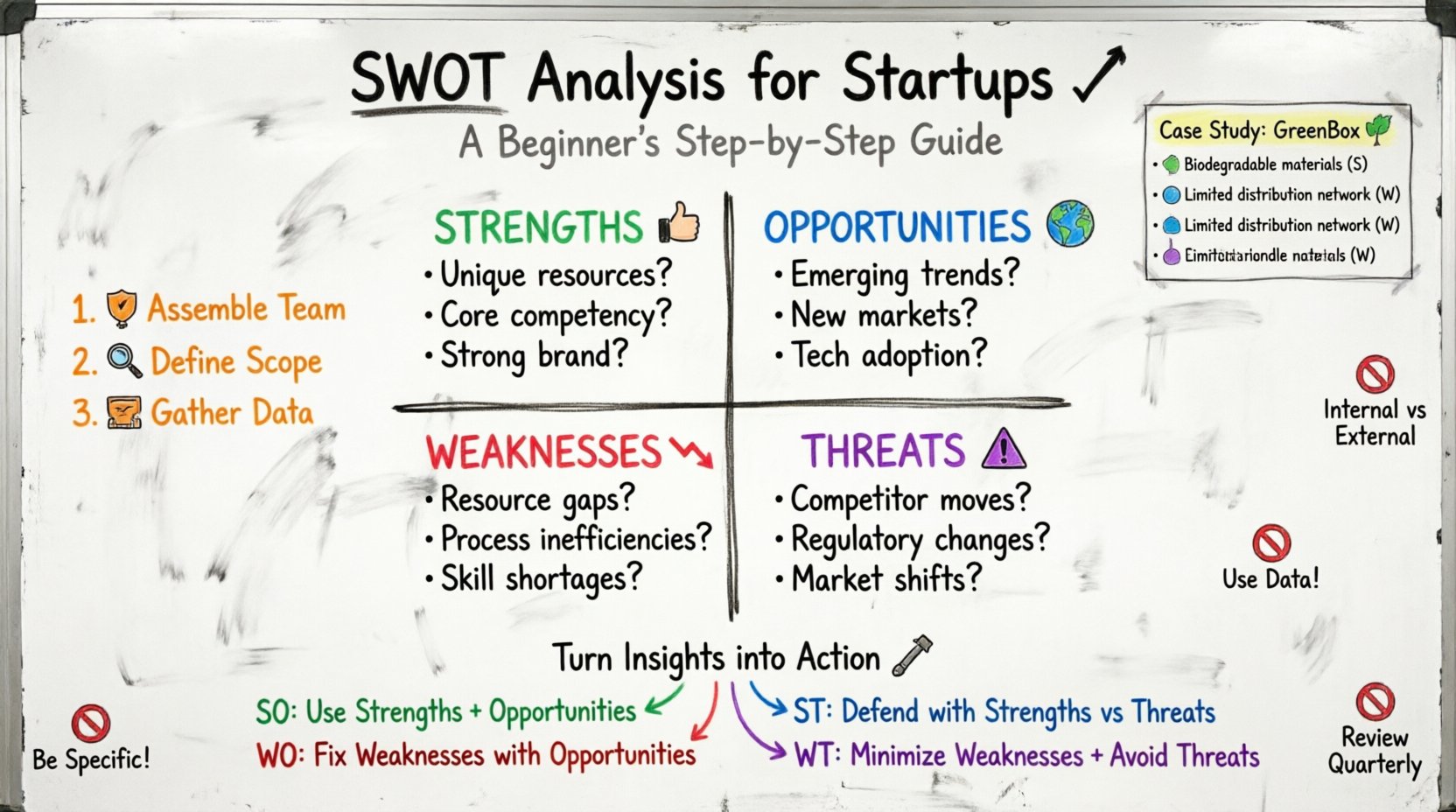
What is a SWOT Analysis? 🧐
SWOT stands for Strengths, Weaknesses, Opportunities, and Threats. It is a strategic planning technique used to evaluate these four elements associated with a business project or a specific venture.
The framework divides factors into two distinct categories:
- Internal Factors: These are elements within the organization’s control. This includes Strengths and Weaknesses.
- External Factors: These are elements outside the organization’s control. This includes Opportunities and Threats.
Understanding this distinction is critical. You cannot change the market economy, but you can improve your operational efficiency. By separating these factors, founders gain clarity on where they have agency and where they must adapt.
Why Startups Need This Framework 💡
Startups often operate in a state of rapid flux. Resources are limited, and the margin for error is thin. A SWOT analysis offers several tangible benefits for new businesses:
- Risk Mitigation: Identifying threats early allows teams to prepare contingency plans before issues become crises.
- Resource Allocation: Knowing your strengths helps you invest in areas where you have a competitive edge.
- Investor Confidence: Demonstrating a clear understanding of your market landscape builds trust with stakeholders.
- Strategic Alignment: It ensures the whole team is working toward the same goals based on shared data.
- Reality Check: It forces a confrontation with hard truths about weaknesses that might otherwise be ignored.
Without this structured approach, decision-making often relies on intuition. While intuition has value, data-driven strategy reduces the likelihood of costly pivots.
Preparing for the Analysis 📝
Before filling out the grid, preparation ensures the results are accurate and actionable. A poorly conducted analysis leads to vague insights that offer no direction.
1. Assemble the Right Team 👥
Do not conduct this alone. Include team members from different functions:
- Founder/CEO: To provide vision and high-level context.
- Marketing Lead: To offer insights on customer perception and market trends.
- Product/Technical Lead: To assess technical capabilities and limitations.
- Operations/Finance: To review resource constraints and financial health.
Diverse perspectives prevent blind spots. What looks like a strength to the developer might be a weakness to the sales team.
2. Define the Scope 🔭
Are you analyzing the entire company? A specific product line? A new market entry? Define the scope clearly. A SWOT for a new mobile app differs from one for a physical retail location. Keep the focus tight to ensure relevance.
3. Gather Data 📊
Relying on assumptions is a common pitfall. Collect data from:
- Customer feedback and reviews.
- Competitor research and public filings.
- Internal financial reports.
- Industry reports and trend analyses.
Objective data grounds the discussion in reality rather than opinion.
Step-by-Step Execution: The Four Quadrants 🔍
Now, let us move into the core of the process. We will examine each quadrant in detail, including questions to ask and examples of what to look for.
1. Strengths (Internal) 💪
Strengths are the positive attributes within your control that give you an advantage over others. These are the things you are good at.
Key Questions to Ask:
- What unique resources do we have? (e.g., proprietary technology, patents).
- What do our customers say we do better than anyone else?
- What is our core competency?
- Do we have a strong brand reputation or loyal community?
- Is our team highly skilled or agile?
Example: A SaaS startup might identify its strength as a highly intuitive user interface that reduces onboarding time compared to competitors.
2. Weaknesses (Internal) 📉
Weaknesses are internal factors that place you at a disadvantage. These are areas where you need improvement. Be honest here; hiding weaknesses leads to failure.
Key Questions to Ask:
- What resources are we lacking? (e.g., budget, talent).
- Where do we lag behind competitors?
- What processes are inefficient or broken?
- Do we have a limited brand presence?
- Are there skill gaps in the current team?
Example: The same SaaS startup might acknowledge a weakness in its limited marketing budget compared to established enterprise players.
3. Opportunities (External) 🌍
Opportunities are external chances to improve performance or grow. These are favorable conditions in the market that you can leverage.
Key Questions to Ask:
- Are there emerging trends we can capitalize on?
- Has a competitor failed or exited the market?
- Are there new technologies we can adopt?
- Can we expand into a new geographic region?
- Are regulatory changes favorable to our model?
Example: A rise in remote work could be an opportunity for a collaboration tool to target enterprise clients looking for better remote solutions.
4. Threats (External) ⚠️
Threats are external elements that could cause trouble for the business. These are risks you must monitor and manage.
Key Questions to Ask:
- What are competitors doing that could hurt us?
- Are there economic downturns affecting our sector?
- Could new regulations restrict our operations?
- Is there a shift in consumer behavior we are missing?
- Are there supply chain vulnerabilities?
Example: A potential change in data privacy laws could threaten a startup that relies heavily on user data collection.
Visualizing the Analysis 📋
Using a table to organize these findings helps maintain clarity. Below is a structured example of how the final output should look.
| Internal Factors | External Factors |
|---|---|
| Strengths ✅ Proprietary Algorithm ✅ Agile Development Team |
Opportunities 🌍 Emerging Asian Markets 🌍 AI Integration Trends |
| Weaknesses ❌ Limited Cash Reserves ❌ Small Marketing Team |
Threats ⚠️ Major Competitor Funding Round ⚠️ Rising Cloud Costs |
Turning Insights into Action 🛠️
Completing the grid is only half the work. The value comes from translating these points into a strategic plan. This is often referred to as TOWS analysis, where you match factors to create strategies.
1. SO Strategies (Maximize)
Use strengths to take advantage of opportunities.
- If you have a strong tech team (Strength) and AI is trending (Opportunity), prioritize AI features in the roadmap.
2. WO Strategies (Fix)
Overcome weaknesses by taking advantage of opportunities.
- If you lack a marketing team (Weakness) but there is a growth hack trend (Opportunity), hire a consultant or partner with an agency.
3. ST Strategies (Defend)
Use strengths to avoid threats.
- If you have a loyal user base (Strength) and a competitor is lowering prices (Threat), focus on retention and value rather than price wars.
4. WT Strategies (Survive)
Minimize weaknesses and avoid threats.
- If you have limited cash (Weakness) and rising costs (Threat), cut non-essential spend and focus on cash flow positive activities immediately.
Common Pitfalls to Avoid 🚫
Even with a solid framework, teams can stumble. Be aware of these common mistakes to ensure the analysis remains useful.
- Being Too Vague: Writing “Good product” is not a strength. Write “Product has 99.9% uptime.” Specificity drives action.
- Confusing Internal and External: A recession is a threat (external), not a weakness (internal). Keep the distinction clear.
- Ignoring Data: If you claim a strength without proof, it is an assumption. Validate claims with metrics.
- One-Time Exercise: The market changes. A SWOT done once a year is better than never, but a quarterly review is ideal.
- Focusing Only on the Positive: Startups often gloss over weaknesses. This is dangerous. Address the hard truths first.
Example Case Study: Eco-Friendly Packaging 🌱
Let us look at a practical scenario. Imagine a startup called “GreenBox” that sells compostable packaging.
Strengths
- Patented biodegradable material.
- Strong relationships with local suppliers.
- Low overhead due to lean operations.
Weaknesses
- Higher production cost than plastic alternatives.
- Small brand awareness compared to legacy firms.
- Limited distribution network.
Opportunities
- Government bans on single-use plastics increasing.
- Consumer demand for sustainability rising.
- Partnerships with large e-commerce platforms.
Threats
- Raw material price volatility.
- Greenwashing by larger competitors.
- Economic downturn reducing discretionary spending.
Action Plan derived from above: GreenBox leverages its patented material (Strength) to target businesses facing plastic bans (Opportunity). They address the cost weakness by educating clients on the long-term brand value of sustainability. They defend against greenwashing by obtaining third-party certifications.
Review and Iterate 🔁
A SWOT analysis is not a static document. It is a living map of your business environment. As you execute your strategy, new data emerges.
- Set a Review Date: Schedule a session every quarter to update the grid.
- Track Metrics: Monitor the indicators you identified as threats or opportunities.
- Adjust Goals: If a weakness becomes a strength, adjust your strategy accordingly.
Continuous refinement ensures that your startup remains agile. It allows you to pivot before a threat becomes a crisis or to seize an opportunity before the window closes.
Final Thoughts on Strategic Clarity 🎯
Building a successful startup is a marathon, not a sprint. The path is rarely linear. Tools like the SWOT analysis provide the compass needed to navigate the terrain. They do not guarantee success, but they significantly increase the probability of it by grounding your efforts in reality.
By dedicating time to understand your internal capabilities and external landscape, you make informed choices. You stop guessing and start planning. This discipline separates fleeting ventures from lasting enterprises.
Start today. Gather your team. Define the scope. Be honest. The clarity you gain will be the bedrock of your future growth.