
Strategic planning is the backbone of sustainable growth, yet many organizations rely on a tool that has become a ritual rather than a resource. The SWOT analysis (Strengths, Weaknesses, Opportunities, Threats) is a classic framework designed to provide clarity. However, when executed poorly, it becomes a source of confusion rather than direction. Identifying the warning signs in your current approach is critical before resources are wasted on flawed foundations.
This guide details the specific red flags that indicate your strategic assessment is compromised. We will examine the nuances of internal and external analysis, the common linguistic traps, and the structural failures that turn a powerful diagnostic tool into a ceremonial exercise. By recognizing these indicators, you can recalibrate your approach and ensure your strategy is built on data, not optimism.
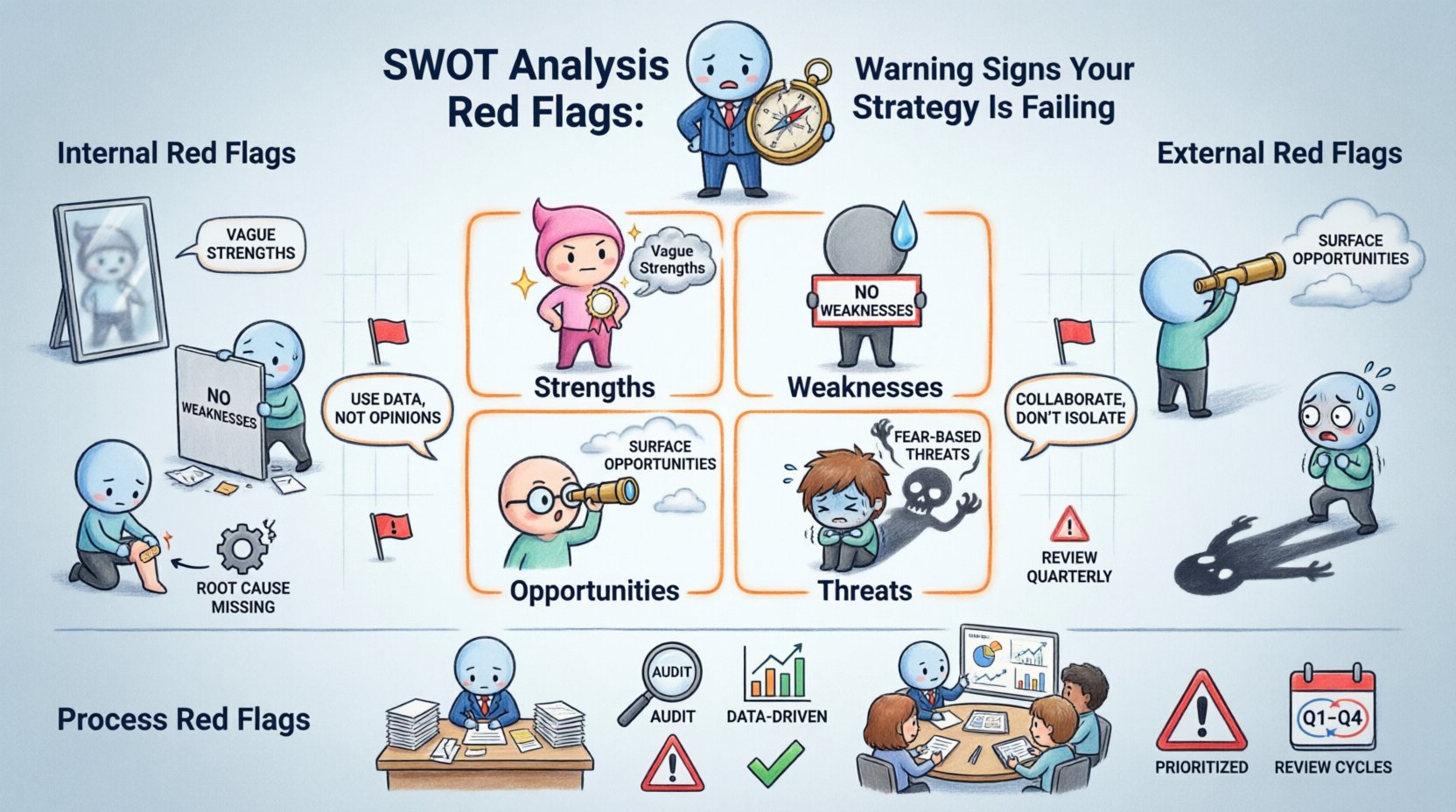
Why SWOT Analysis Often Fails to Deliver Value 📉
A successful SWOT analysis requires honest introspection and rigorous external validation. Too often, teams conflate a SWOT with a brainstorming session. The difference lies in specificity and strategic intent. When the output does not translate into actionable decisions, the process has failed. Several structural issues contribute to this disconnect.
- Lack of Data Support: Claims are made without evidence or metrics.
- Groupthink: Dominant voices override minority opinions, masking true weaknesses.
- Static Snapshot: The market changes rapidly, but the document remains fixed in time.
- Disconnect from Execution: The analysis sits on a shelf without influencing daily operations.
If your team feels that the session was merely a box-checking activity, you are likely encountering one of the red flags described below. These signs suggest that the current strategy is not only failing to identify risks but is actively creating a false sense of security.
Internal Red Flags: Strengths and Weaknesses 🛑
The internal quadrant of the SWOT matrix is often the most difficult to navigate accurately. Emotional bias frequently clouds judgment here. Teams tend to overestimate their capabilities while underestimating their vulnerabilities.
1. Vague Strengths Definitions
One of the most common red flags is the use of generic descriptors. If your strengths list includes phrases like “good reputation” or “high quality,” the analysis lacks the precision needed for strategic leverage. These terms are subjective and do not provide a competitive edge.
- Bad: “We have a strong brand.”
- Good: “We hold 15% market share in the regional sector with 85% customer retention.”
Specificity allows you to double down on what actually works. Vague strengths prevent you from knowing which assets to invest in and which to abandon. When you cannot quantify a strength, you cannot strategically deploy it.
2. Denial of Weaknesses
It is human nature to focus on positives and deflect negatives. If your weaknesses section is empty, or if it only lists minor operational issues like “slow website,” you are ignoring structural risks. A true SWOT must expose the vulnerabilities that could cause failure under pressure.
Warning signs of weak internal analysis include:
- Hidden Dependencies: Relying on a single vendor without a backup plan.
- Skill Gaps: Critical roles filled by untrained staff without a succession plan.
- Technical Debt: Outdated infrastructure that slows down innovation.
- Process Bottlenecks: Approval layers that delay time-to-market.
When teams refuse to list these issues, they are operating under a delusion. This prevents the organization from preparing contingency plans. If you cannot admit a weakness, you cannot fix it.
3. Confusing Symptoms with Root Causes
Weaknesses are often mistaken for symptoms of deeper problems. For example, “low morale” might be a symptom, not a weakness itself. The weakness is “lack of career development paths.” Identifying the root cause allows for targeted intervention. If your analysis stops at the symptom, the strategy will fail to resolve the underlying issue.
External Red Flags: Opportunities and Threats ⚠️
The external quadrant requires looking outward, beyond the organization’s control. This area is prone to wishful thinking or fear-mongering. Both extremes invalidate the strategic value of the analysis.
4. Surface-Level Opportunities
Opportunities must be actionable. If your list includes “expand into new markets” without specifying which markets or how you will enter them, it is not an opportunity; it is a wish. A valid opportunity must align with your existing strengths.
Common pitfalls in this section include:
- Market Trends vs. Strategy: Chasing a trend without the infrastructure to support it.
- Ignoring Competitor Moves: Focusing on your vision while competitors capture the market.
- Regulatory Changes: Failing to account for new laws that could open or close doors.
For an opportunity to be real, there must be a clear path to capture value. If the cost of entry outweighs the potential return, it is not a strategic opportunity.
5. Fear-Based Threats
Threats should be realistic risks, not worst-case scenarios. Listing “the company could go bankrupt” is not a threat analysis; it is anxiety. A useful threat analysis identifies specific external forces that could erode your position.
Effective threat indicators include:
- Supply Chain Disruption: Specific reliance on a region prone to instability.
- Technological Obsolescence: Competitors adopting a new standard you have not matched.
- Customer Churn: A measurable increase in attrition rates linked to market shifts.
- Economic Downturn: Sensitivity to interest rate changes affecting your cash flow.
If your threats are too broad, you cannot mitigate them. If they are too specific to unlikely events, you waste resources on protection that isn’t needed. Balance is key.
Process Red Flags: How the Analysis is Conducted 📝
Even with the right content, the process of generating the SWOT can be flawed. The methodology determines the quality of the output. Several procedural errors undermine the integrity of the entire exercise.
6. The One-Person Show
Strategic decisions affect the whole organization. If the SWOT is created by a single leader without input from operations, sales, or product teams, it lacks perspective. Frontline employees often see risks and opportunities that management does not.
A robust process involves cross-functional collaboration. If the document is drafted in isolation, it is likely to be out of touch with reality.
7. Lack of Prioritization
Not all factors are equal. A common failure is listing twenty strengths and twenty weaknesses without ranking them. Strategic resources are finite. Without prioritization, you treat minor issues with the same urgency as existential risks.
Effective analysis requires weighting. You must identify the top three strengths that drive revenue and the top three weaknesses that hinder growth. Everything else is secondary.
8. No Timeline or Review Cycle
Strategy is dynamic. A SWOT created six months ago may be irrelevant today. If there is no schedule for review, the document becomes obsolete. Market conditions shift, technology evolves, and customer preferences change. Without a refresh cycle, the strategy is based on outdated data.
Comparison Table: Common Mistakes vs. Correct Approach 📊
Understanding the difference between ineffective and effective SWOT practices helps in auditing your current strategy. Use this table as a checklist to evaluate your recent planning sessions.
| Category | Red Flag (Ineffective) | Correct Approach (Effective) |
|---|---|---|
| Language | Subjective adjectives (e.g., “best in class”) | Quantifiable metrics (e.g., “#1 in NPS scores”) |
| Scope | Too broad (e.g., “improve customer service”) | Specific actions (e.g., “reduce ticket response time to 2 hours”) |
| Input | Created by leadership only | Collaborative workshop with cross-functional teams |
| Frequency | One-time event | Quarterly or bi-annual review cycle |
| Output | Static document stored on a drive | Integrated into OKRs and project management |
| Threats | Generic fears (e.g., “competitors”) | Specific risks (e.g., “Competitor X launched AI feature”) |
The Vague Language Trap: Specificity Matters 🎯
Language shapes thought. When you use vague language, you invite vague thinking. This is particularly dangerous in strategic planning. Ambiguity allows stakeholders to interpret the strategy in ways that suit their interests rather than the organization’s goals.
Consider the phrase “Increase Market Share.” This is a goal, not a strategy. A specific strategy might be “Capture 5% of the enterprise segment in Q3 by launching the premium tier.” The latter dictates budget allocation, hiring needs, and marketing spend.
To avoid the vague language trap:
- Ask ‘How?’: For every item on the list, ask how it will be achieved.
- Assign Owners: Every point should ideally have a responsible party.
- Define Success: What does success look like for this specific point?
If you cannot answer these questions, the item does not belong in your strategic plan. It belongs in a brainstorming folder, not on the critical path.
How to Audit Your Current SWOT 🔍
Before making changes, you need to diagnose the current state. Conduct an audit of your existing SWOT analysis using the following criteria. This process helps identify exactly where the strategy is failing.
- Check the Evidence: Is every claim backed by data? If not, mark it for verification.
- Review the Stakeholders: Were the right people involved? If sales and engineering were excluded, the view is limited.
- Assess the Relevance: Is the analysis still true today? If the market has changed significantly, the document needs a rewrite.
- Trace the Impact: Can you trace current projects back to the SWOT points? If the SWOT has no influence on current work, it is disconnected.
- Test the Weaknesses: Are the weaknesses actually being addressed? If they persist, the plan was ignored.
Actionable Steps to Correct the Course 🛠️
Once you have identified the red flags, you must take action to realign your strategy. This requires discipline and a willingness to discard comfortable narratives.
1. Reset the Assumptions
Start by challenging every assumption made in the previous analysis. What if the “strength” is actually a liability in a new market? What if the “threat” is a catalyst for innovation? Testing assumptions prevents stagnation.
2. Implement Data-Driven Validation
Replace opinions with data. Gather customer feedback, analyze sales trends, and review competitor intelligence. A strategy built on data is resilient. A strategy built on gut feeling is fragile.
3. Create an Action Plan
A SWOT is not a destination; it is a map. Convert the top points into an action plan. Assign deadlines, budgets, and resources. If a weakness is identified, the plan must include a remediation timeline. If an opportunity is found, the plan must include a launch schedule.
4. Establish Accountability
Assign ownership for each strategic pillar. Without accountability, initiatives drift. Regular check-ins ensure that the SWOT is being used to guide decision-making, not just to document past thoughts.
5. Schedule Regular Reviews
Set a calendar reminder for quarterly reviews. Use these sessions to update the SWOT. Remove items that are no longer relevant and add new threats or opportunities that have emerged. This keeps the strategy agile.
When to Restart the Process Entirely 🔄
Sometimes, patching the existing analysis is not enough. If the foundational assumptions of the business have shifted, a full restart is necessary. This happens during major pivots, mergers, or significant economic shifts.
Indicators that a full restart is needed include:
- Product-Market Mismatch: The core offering no longer meets customer needs.
- Leadership Change: New leadership brings a different vision.
- Regulatory Overhaul: New laws change the competitive landscape.
- Revenue Decline: A sustained drop in performance suggests the strategy is broken.
Restarting is not a sign of failure; it is a sign of responsiveness. It demonstrates a commitment to accuracy over consistency.
Final Thoughts on Strategic Integrity 🧭
The goal of a SWOT analysis is not to create a pretty document for a board meeting. The goal is to provide a clear picture of reality so that decisions can be made with confidence. When the analysis is flawed, the decisions are flawed. This leads to wasted resources, missed opportunities, and strategic drift.
By watching for these red flags, you protect your organization from the illusion of planning. You ensure that your strengths are leveraged, your weaknesses are mitigated, your opportunities are captured, and your threats are managed. This discipline transforms the SWOT from a ritual into a competitive advantage.
Strategic clarity is rare. It requires honesty, rigor, and the courage to face uncomfortable truths. If you commit to these standards, your strategy will become a living tool that drives growth rather than a static artifact that gathers dust.
Start the audit today. Verify your assumptions. And build a strategy that holds up to scrutiny.