
Strategic planning and financial forecasting are often treated as separate disciplines within an organization. On one side, you have the qualitative assessments of Strengths, Weaknesses, Opportunities, and Threats (SWOT). On the other, you have the quantitative data of revenue, expenses, cash flow, and balance sheets. Too often, these two elements exist in silos. Strategy teams build decks that look impressive, while finance teams build models that look precise, yet rarely do they speak the same language. This disconnect creates a fragile foundation for business growth.
Integrating these two frameworks is not merely an administrative task; it is a fundamental requirement for sustainable performance. When you align your SWOT analysis directly with your financial projections, you transform abstract ideas into tangible economic realities. This guide explores the mechanics of this integration, providing a roadmap to ensure your strategy is backed by numbers and your numbers are driven by strategy.
Why the Disconnect Exists 🛑
Understanding why these two functions usually remain separate is the first step to bridging the gap. Strategy is inherently forward-looking and speculative. It deals with market positioning, brand perception, and competitive advantages. Financial projections, conversely, are rooted in historical data and mathematical extrapolation. They focus on liquidity, solvency, and profitability.
Leaders often view SWOT as a brainstorming exercise and finance as a compliance function. This perception leads to several issues:
- Lack of Accountability: Strategic goals are set without a clear understanding of the capital required to achieve them.
- Resource Misallocation: Funds are poured into areas that look good on paper but do not impact the bottom line significantly.
- Risk Blind Spots: Financial models assume a stable environment, ignoring the threats identified in the strategic review.
- Stakeholder Confusion: Investors and board members receive conflicting signals between the vision statement and the budget.
By unifying these processes, you create a single source of truth. The financial model becomes a living representation of the strategy, and the strategy becomes a financially viable plan.
Mapping SWOT to Financial Variables 🔄
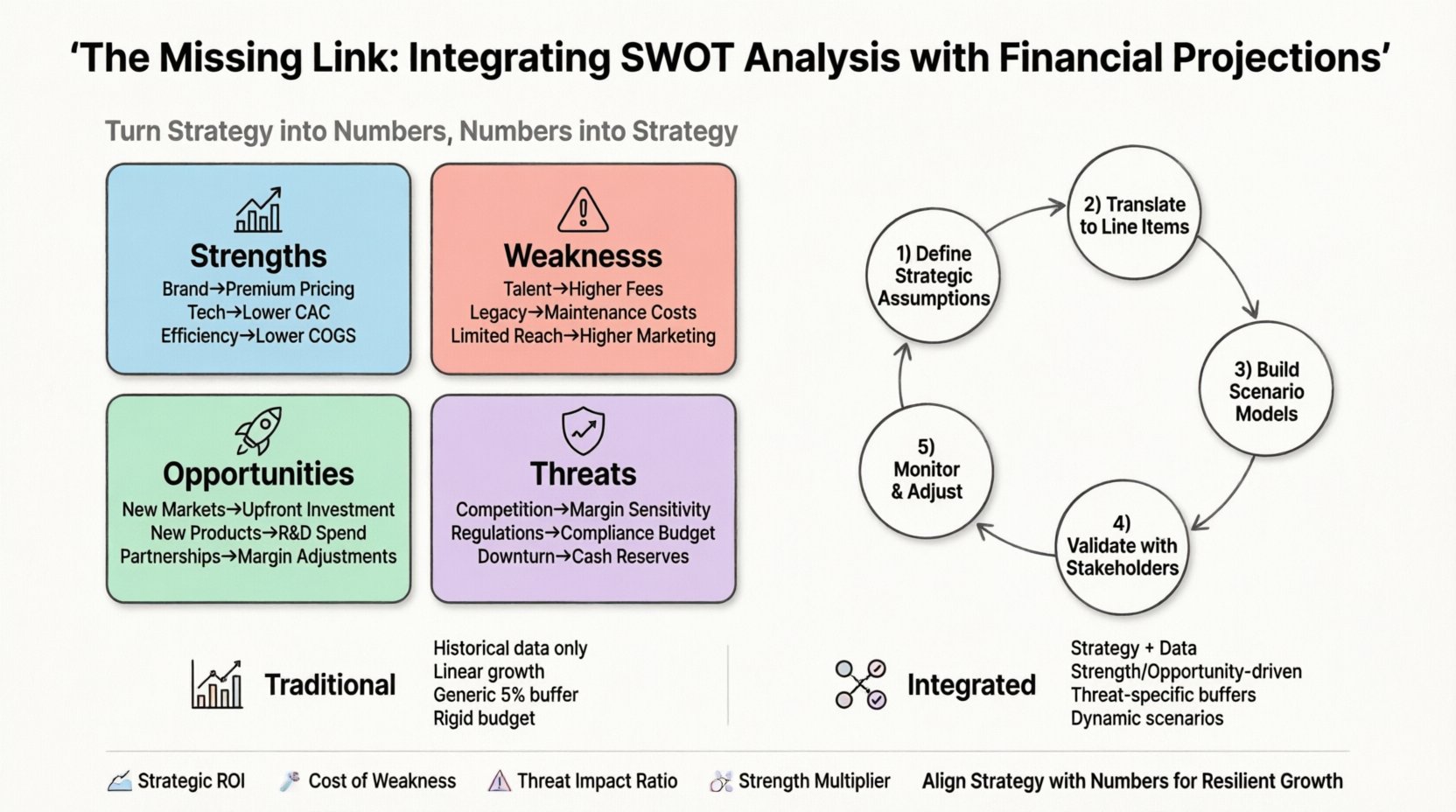
To integrate these frameworks effectively, you must map each quadrant of the SWOT matrix to specific financial line items. This translation turns qualitative insights into quantitative inputs.
1. Strengths and Revenue Drivers 💰
Strengths are internal capabilities that give you an advantage over competitors. In a financial context, strengths should directly correlate with revenue generation or cost efficiency. When building your projections, you must ask: how does this strength translate to money?
- Brand Reputation: A strong brand allows for premium pricing. Adjust your average revenue per unit (ARPU) upward based on this differentiator.
- Proprietary Technology: Patents or unique software can reduce customer acquisition costs (CAC) over time. Factor in lower marketing spend as the technology matures.
- Operational Efficiency: If you have a lean supply chain, your cost of goods sold (COGS) should be lower than industry averages.
Without explicitly linking these strengths to the top line, you risk underestimating your revenue potential. A strength that is not quantified is just a nice-to-have feature.
2. Weaknesses and Cost Structures 💸
Weaknesses are internal limitations that hinder performance. In financial modeling, these manifest as inefficiencies, higher costs, or delayed revenue recognition. Ignoring weaknesses in a forecast creates a best-case scenario that rarely materializes.
- Limited Talent Pool: If you lack specialized staff, you may need to outsource or hire at a premium. Budget for higher professional service fees.
- Outdated Infrastructure: Legacy systems often require more maintenance and carry higher downtime risks. Include contingency funds for IT repairs.
- Geographic Constraints: If your reach is limited, your marketing spend per lead will be higher. Increase the CAC variable accordingly.
Accounting for weaknesses ensures your financial model includes a buffer for internal friction. It prevents the shock of unexpected costs when reality sets in.
3. Opportunities and Capital Allocation 🚀
Opportunities are external factors you can exploit to grow. These represent potential future revenue streams. The challenge is determining the investment required to capture these opportunities.
- Market Expansion: Entering a new region requires upfront capital for logistics and licensing. Project these cash outflows in Year 1 or 2.
- New Product Lines: Research and development costs must be front-loaded. Ensure your cash flow statement reflects the burn rate before the new product hits revenue.
- Partnerships: Collaborations can accelerate growth but may require revenue sharing. Adjust your margin projections to reflect partnership splits.
Opportunities are the growth engine, but they are not free. Your financial projection must show the fuel needed to drive the engine.
4. Threats and Risk Mitigation 🛡️
Threats are external factors that could cause trouble. In finance, threats translate to risk. You cannot predict the future, but you can prepare for volatility.
- Competitive Pressure: If a competitor lowers prices, you may need to match them. Create a sensitivity analysis scenario where margins shrink by 10-20%.
- Regulatory Changes: New compliance requirements often involve administrative costs. Add a line item for legal and compliance consulting.
- Economic Downturns: If the economy slows, customer spending drops. Build a “worst-case” scenario into your cash reserves.
Integrating threats ensures your liquidity remains intact during downturns. It moves risk management from a reactive stance to a proactive budgeting line item.
The Integration Workflow 📝
Combining these elements requires a structured approach. It is not enough to simply mention the SWOT in the financial document. The data must flow from one to the other.
- Define Strategic Assumptions: Start with the SWOT. List the key assumptions derived from the analysis. For example, “We assume our new technology will reduce support tickets by 30%.”
- Translate to Line Items: Convert those assumptions into financial variables. “Support ticket reduction” becomes “Customer Success Headcount” and “Software Support Costs”.
- Build Scenario Models: Create at least three scenarios: Base, Optimistic (Strengths/Opportunities fully realized), and Pessimistic (Weaknesses/Threats impact realized).
- Validate with Stakeholders: Review the integrated model with both strategy and finance leaders. Ensure the numbers tell the story of the strategy.
- Monitor and Adjust: Set up a review cadence. As external threats materialize or strengths evolve, update the financial model immediately.
This workflow ensures that the financial plan is not static. It evolves as your strategic understanding deepens.
Comparing Traditional vs. Integrated Models 📊
To visualize the difference, consider how a traditional model differs from an integrated one. The table below highlights the structural changes.
| Feature | Traditional Model | Integrated Model |
|---|---|---|
| Data Source | Historical trends only | Historical data + Strategic Insights |
| Growth Assumptions | Linear extrapolation | Driven by Strengths & Opportunities |
| Risk Buffer | Generic contingency (e.g., 5%) | Specific to identified Threats |
| Cost Drivers | Departmental budgets | Linked to Weaknesses & Strategic Goals |
| Flexibility | Rigid annual budget | Dynamic scenario planning |
As shown, the integrated model offers a more robust framework for decision-making. It accounts for the nuances of the business environment that pure historical data misses.
Financial Metrics to Track 🎯
Once the integration is complete, you need specific metrics to monitor the relationship between your strategy and your finances. These KPIs ensure the alignment holds over time.
- Strategic ROI: Measure the return on investment specifically for initiatives identified in the “Opportunities” quadrant. Does the marketing spend on the new market actually yield the projected revenue?
- Cost of Weakness: Track the variance between projected costs and actual costs related to known weaknesses. Are you spending more on fixes than anticipated?
- Threat Impact Ratio: Calculate how often identified threats actually materialize and the financial cost associated with them. This helps refine future risk buffers.
- Strength Multiplier: Analyze how much revenue is generated per unit of strength (e.g., per patent or per key employee). This highlights where to double down.
Tracking these metrics keeps the integration alive. It prevents the model from becoming a dusty document that sits on a shelf.
Sensitivity Analysis and Scenario Planning 🎲
One of the most powerful tools in this integration is sensitivity analysis. This involves changing one variable at a time to see how it impacts the bottom line. When linked to SWOT, you are not guessing variables; you are testing specific strategic factors.
For example, if “Threat” is a price war, you run a sensitivity test where your pricing drops by 10%. Does your cash flow survive? If not, you must adjust your “Strength” (e.g., cost reduction) to compensate.
Consider these specific scenarios:
- The Strength Realization Scenario: What if our new technology adoption is 50% faster than expected? This increases revenue and decreases support costs. How much cash surplus do we have?
- The Weakness Exacerbation Scenario: What if our supply chain is 20% less efficient? This increases COGS. Do we have the working capital to absorb the margin drop?
- The Opportunity Capture Scenario: What if we capture 10% of the new market? Does our infrastructure scale, or do we need to raise capital?
- The Threat Mitigation Scenario: What if a competitor launches a similar product? We must budget for increased marketing spend to defend our share.
This level of granularity ensures that leadership is prepared for multiple futures, rather than betting on a single path.
Common Pitfalls to Avoid ⚠️
Even with a solid framework, errors can occur. Being aware of common mistakes helps you steer clear of them.
- Over-Optimism: It is easy to let the “Strengths” and “Opportunities” inflate revenue projections while ignoring the “Weaknesses” and “Threats.” Maintain a neutral stance. Assume the baseline is difficult.
- Static Assumptions: The market changes. A SWOT analysis done last year may be obsolete today. Financial models must be updated as frequently as the strategic review.
- Disconnect in Ownership: If the strategy team owns the SWOT and the finance team owns the numbers, no one owns the integration. Assign a cross-functional owner to the unified model.
- Ignoring Time Value: Strategic initiatives often take time to pay off. Ensure your cash flow projections account for the lag between investment and return.
- Complexity Creep: Do not over-complicate the model. If the integration becomes too complex to understand, it will not be used. Keep the link between the strategic driver and the financial line item clear.
Maintaining the Alignment 🔄
Integration is not a one-time event. It is a continuous cycle. Business environments shift, competitors react, and internal capabilities evolve. To maintain alignment:
- Quarterly Reviews: Dedicate a portion of quarterly business reviews to updating the SWOT and adjusting the financial forecast accordingly.
- Real-Time Data Feeds: If possible, connect operational data to your financial model. This allows you to see if a strategic initiative is actually moving the needle.
- Feedback Loops: Create a channel for finance staff to question strategic assumptions. They are often the first to notice if a plan is financially unviable.
- Training: Ensure strategy leaders understand basic finance and finance leaders understand strategy. Shared language improves communication.
By institutionalizing this process, you build an organization that is agile and financially disciplined.
Final Considerations on Strategy and Numbers 🔗
The relationship between qualitative strategy and quantitative finance is symbiotic. One provides the direction, and the other provides the fuel. Without the fuel, the direction is useless. Without the direction, the fuel is wasted.
Integrating SWOT analysis with financial projections is about creating a coherent narrative for the future of the business. It forces you to justify every number with a strategic reason and every strategic goal with a financial justification. This rigor reduces uncertainty and builds confidence among investors, employees, and partners.
Start by reviewing your current models. Look for the gaps where strategy stops and numbers begin. Fill those gaps with the frameworks outlined above. The result will be a plan that is not just aspirational, but actionable and resilient.