
Founders stand at the intersection of vision and reality. Every strategic pivot, every resource allocation, and every hiring decision ripples through the organization. Yet, many leaders rely on frameworks that promise clarity but deliver confusion. The SWOT analysis is one such tool. It is ubiquitous in boardrooms and startup pitches alike. But when the framework becomes a checkbox exercise rather than a rigorous interrogation of reality, it ceases to be useful. It becomes a source of strategic blindness.
The root cause often lies not in the matrix itself, but in the quality of the questions asked during its construction. Poor questioning leads to vague strengths, imagined opportunities, and ignored threats. This guide dissects the specific errors that plague strategic planning and offers a path toward clearer, more grounded decision-making.
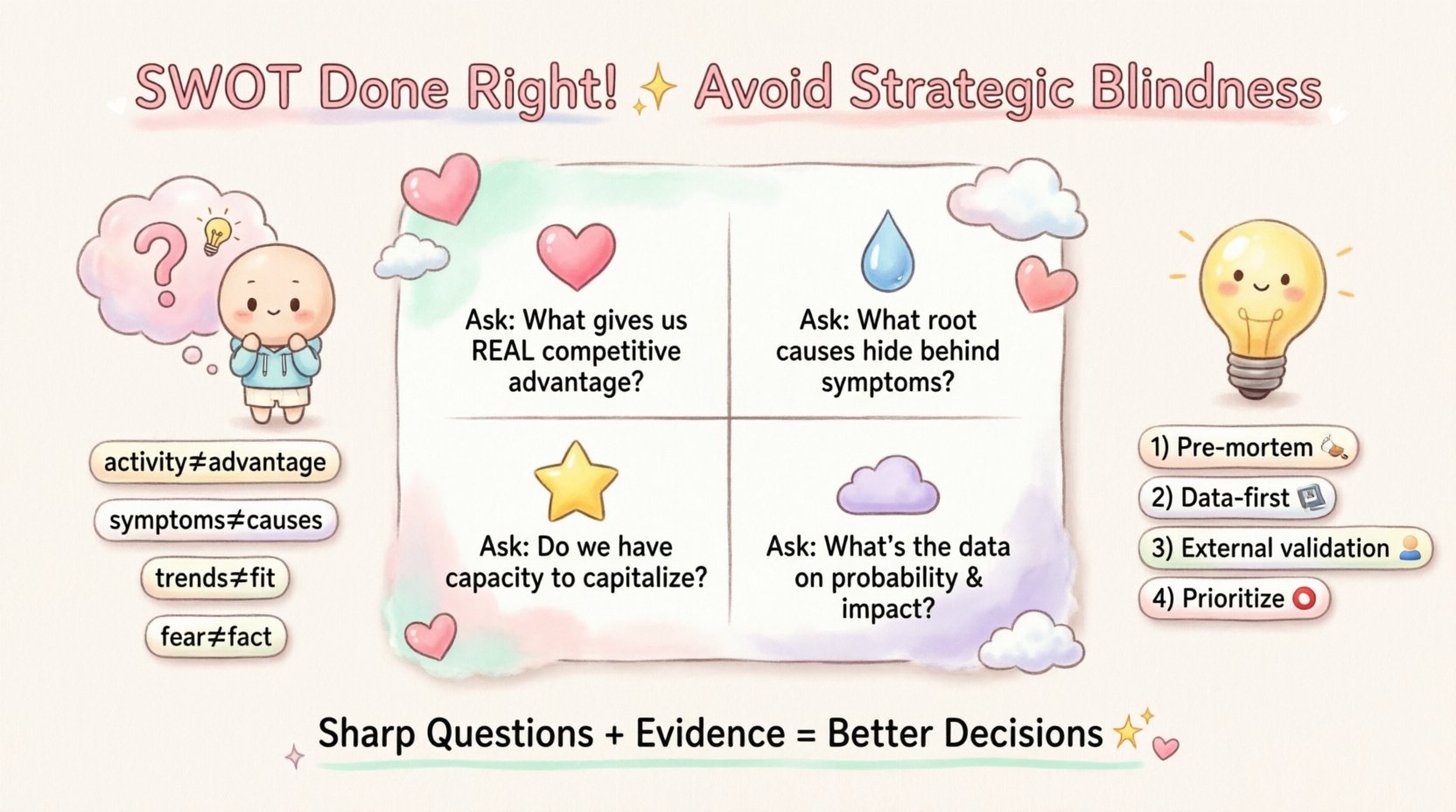
📉 The Foundation: Why SWOT Analysis Matters
Before diagnosing the errors, it is essential to understand the tool’s intended function. SWOT stands for Strengths, Weaknesses, Opportunities, and Threats. It is a structured planning method used to evaluate the internal and external factors affecting an entity. The goal is to identify factors that will help achieve objectives and those that could hinder progress.
- Strengths: Internal attributes that are helpful to achieving the objective (e.g., proprietary technology, loyal team).
- Weaknesses: Internal attributes that are harmful to achieving the objective (e.g., lack of capital, outdated systems).
- Opportunities: External conditions that are helpful to achieving the objective (e.g., market trends, regulatory changes).
- Threats: External conditions that could cause trouble for the business (e.g., new competitors, economic downturn).
When executed correctly, this analysis creates a snapshot of the strategic landscape. However, the snapshot is only as accurate as the lens used to capture it. That lens is the questioning process.
🤔 The Core Issue: The Quality of Inquiry
Most founders approach the SWOT analysis as a brainstorming session. They gather the team, write down ideas on sticky notes, and fill the quadrants. The problem is that brainstorming often defaults to comfort zones. People list what they know they are good at, rather than what is actually true. They list opportunities that sound exciting, rather than those that are viable.
Effective strategic planning requires interrogation, not just listing. It demands that we challenge assumptions. The difference between a strategic asset and a vanity metric often comes down to the specific questions asked.
| Aspect | Weak Questioning | Strong Questioning |
|---|---|---|
| Clarity | “We are innovative.” | “In what specific way does our R&D outpace competitors?” |
| Evidence | “We have a strong brand.” | “What data supports our brand loyalty? (NPS, retention rates)” |
| Scope | “The market is growing.” | “Which specific segment of the market is growing and why?” |
| Reality | “We have enough cash.” | “At what burn rate does our runway end if revenue drops 20%?” |
Notice the shift in the Strong Questioning column. It moves from assertion to evidence. It moves from the general to the specific. This shift is the antidote to strategic error.
⚠️ Common SWOT Analysis Errors
Founders often fall into specific traps when constructing these matrices. These errors are rarely accidental; they are usually the result of cognitive biases and a lack of rigorous questioning.
1. The Strengths Trap: Confusing Activity with Advantage
A common error is listing activity as a strength. “We work hard” is not a strength. “We have a proprietary algorithm that reduces latency by 50%” is a strength. Founders often confuse being busy with being effective.
- The Error: Listing resources without context.
- The Question to Ask: “Does this asset directly correlate to competitive advantage?”
- The Risk: Wasting time optimizing things that do not drive market differentiation.
2. The Weaknesses Trap: Ignoring the Invisible
It is easier to admit to a known bug than to admit to a cultural rot. Weaknesses are often internal blind spots. Founders might list “high turnover” as a weakness but fail to list “lack of clear career paths” as the root cause. Without digging deeper, the weakness remains unaddressed.
- The Error: Listing symptoms rather than root causes.
- The Question to Ask: “What systemic issue allows this weakness to persist?”
- The Risk: Applying band-aids to structural problems.
3. The Opportunities Trap: Chasing Noise
Opportunities are often conflated with desires. A founder might see a trend in the market and assume it is an opportunity for their specific business. However, just because a market exists does not mean the business has the capacity to serve it.
- The Error: Listing trends without assessing fit.
- The Question to Ask: “Do we have the infrastructure to capitalize on this trend?”
- The Risk: Resource dilution across too many fronts.
4. The Threats Trap: Fear vs. Fact
Threats are often exaggerated by anxiety or minimized by optimism bias. A competitor launching a similar feature might be seen as an existential threat, when in reality, it is a minor inconvenience. Conversely, a regulatory change might be ignored because it seems unlikely.
- The Error: Basing threats on emotion rather than data.
- The Question to Ask: “What is the probability and impact of this threat materializing?”
- The Risk: Panic responses or strategic complacency.
🧠 The Psychology Behind the Errors
Understanding the errors requires understanding the human mind. Founders are not immune to cognitive biases. These biases distort the questioning process.
Confirmation Bias
This occurs when people search for, interpret, and recall information in a way that confirms their preexisting beliefs. If a founder believes the product is perfect, they will ask questions that lead to strengths and ignore weaknesses.
Availability Heuristic
This is the tendency to overestimate the likelihood of events based on their availability in memory. Recent news about a competitor might make that threat feel more urgent than it actually is, skewing the SWOT analysis.
Overconfidence Effect
Founders often overestimate their own abilities and the accuracy of their knowledge. This leads to underestimating threats and overestimating the likelihood of success in new opportunities.
📊 Impact on Decision-Making
When the SWOT analysis is flawed, the decisions derived from it are compromised. The consequences are tangible and often costly.
- Resource Misallocation: Money is spent on marketing for a product that has a fundamental weakness.
- Delayed Pivots: Threats are ignored until it is too late to change course.
- Talent Mismatch: Hiring based on perceived strengths rather than actual gaps.
- Strategic Drift: The company moves in multiple directions without a clear central thesis.
These outcomes are not abstract. They result in lost runway, lost market share, and lost confidence among stakeholders.
🛠️ The Corrective Framework
How do we fix this? The solution lies in restructuring the inquiry process. It requires moving from a passive listing exercise to an active audit.
Step 1: Pre-Mortem Analysis
Before starting the SWOT, imagine the project has failed. Ask the team: “What went wrong?” This forces the identification of threats and weaknesses before they become reality. It bypasses optimism bias.
Step 2: Data-First Approach
No claim stands without evidence. Every item in the SWOT matrix must be backed by a metric, a customer quote, or a market report. If you cannot find data, do not include it.
- Strength: Must have a retention metric or efficiency gain.
- Weakness: Must have a churn rate or support ticket volume.
- Opportunity: Must have market size data or competitor gap analysis.
- Threat: Must have a probability estimate or regulatory filing.
Step 3: External Validation
Founders often operate in an echo chamber. Bring in external advisors, customers, or industry experts to review the analysis. Ask them to challenge the list. “Why do you think this is a strength?” “Why is this not a threat?”
Step 4: Prioritization
A SWOT list is often too long. It becomes a laundry list. The next step is to prioritize. Which strengths are core? Which weaknesses are critical? Which opportunities are immediate? Which threats are existential?
| Priority Level | Definition | Action Required |
|---|---|---|
| High | Directly impacts survival or core growth | Immediate action plan |
| Medium | Affects efficiency or medium-term goals | Scheduled review |
| Low | Minor impact or theoretical | Maintain status quo |
🚀 Real-World Scenarios
To illustrate the impact of poor questioning, consider two hypothetical scenarios.
Scenario A: The Optimistic Founder
A founder lists “Strong Brand” as a strength. They do not define what that means. They list “New Market” as an opportunity. They do not analyze the entry barriers. They launch a campaign in the new market and fail because the brand is not recognized there. The SWOT was a wish list, not a strategy.
Scenario B: The Analytical Founder
This founder asks, “What specific demographic responds to our brand?” They find data showing high engagement in a niche. They ask, “What barriers exist in the new market?” They find regulatory hurdles. They adjust the strategy to focus on the niche first. The SWOT led to a targeted, successful entry.
🔄 Continuous Iteration
A SWOT analysis is not a one-time event. The business environment changes. A strength today can become a weakness tomorrow (e.g., a proprietary technology that becomes obsolete). A threat today can become an opportunity (e.g., a competitor’s failure creates a vacuum).
Founders must treat the SWOT as a living document. It should be revisited quarterly. The questions should evolve as the company grows.
- Early Stage: Focus on product-market fit and cash flow.
- Growth Stage: Focus on operational scalability and team culture.
- Mature Stage: Focus on innovation, diversification, and market defense.
The questions asked must shift with these stages. Asking “how do we acquire users?” in a mature stage is different from asking “how do we retain users?”
🛡️ Protecting Against Strategic Drift
Strategic drift occurs when a company slowly moves away from its core value proposition without realizing it. Poor questioning accelerates this. By anchoring decisions in the evidence gathered during the SWOT process, founders create a guardrail against drift.
If a decision does not align with a verified Strength or Opportunity, it should be questioned. If a decision exacerbates a known Weakness or Threat, it should be rejected. This discipline is hard to maintain but essential for longevity.
📝 Final Thoughts
The SWOT analysis remains a valuable tool, but its value is entirely dependent on the rigor of the inquiry. It is not a magic box that generates strategy. It is a mirror that reflects the truth of the business, provided the questions asked are sharp enough to reveal it.
Founders who invest time in crafting the right questions will find that the answers lead to clearer paths. They will avoid the traps of vanity metrics, hidden blind spots, and noise. They will make decisions based on reality, not hope.
Remember, the goal is not to fill the matrix. The goal is to make better decisions. If the matrix does not lead to action, it is not serving its purpose. Keep the questioning sharp, keep the evidence strong, and keep the focus on what truly matters.