
In the complex landscape of enterprise architecture, governance often becomes a bottleneck rather than a facilitator. Organizations struggle to align high-level strategies with day-to-day operations. The Business Motivation Model (BMM) offers a structured approach to bridge this gap. By clarifying why an organization exists and how it intends to succeed, BMM provides the necessary context for robust governance frameworks. This guide explores how to apply BMM principles to streamline governance processes without relying on specific software tools.
Understanding the Business Motivation Model Core 🧩
The Business Motivation Model is a standard developed by the Object Management Group (OMG) to represent the business goals, strategies, and plans of an organization. It is not merely a diagramming tool but a conceptual framework for understanding motivation within a business context. At its heart, BMM distinguishes between what an organization wants to achieve and the means by which it achieves it.
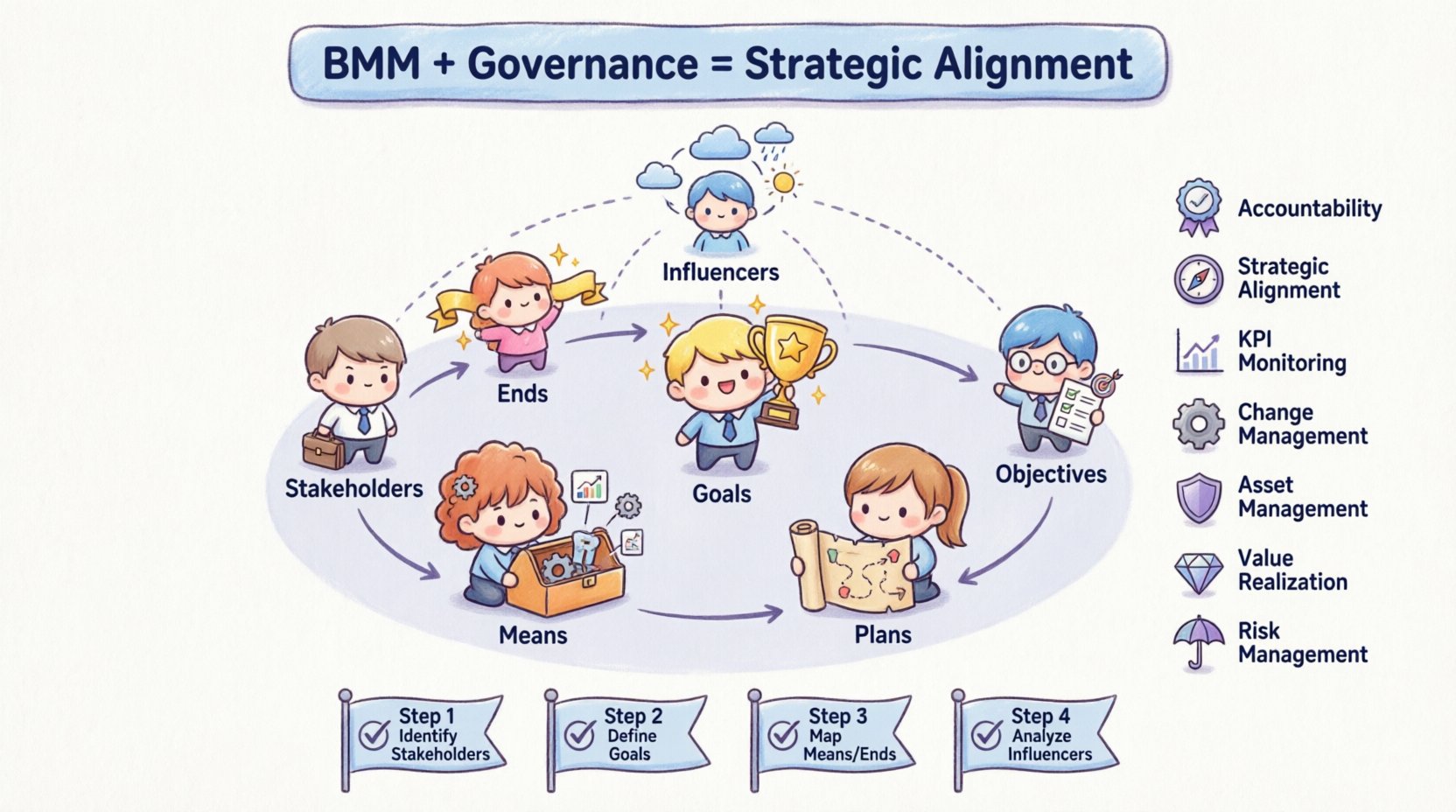
When applied to governance, BMM shifts the focus from rigid control to strategic alignment. Governance is often viewed as a set of restrictions. However, when grounded in BMM, governance becomes the mechanism that ensures resources are directed toward meaningful ends. It connects the Stakeholders to the Ends through Means.
Key Elements of the Model
- Stakeholders: Individuals or groups with a vested interest in the organization’s success.
- Goals: High-level desired states that are often qualitative.
- Objectives: Specific, measurable targets that support goals.
- Plans: Actions taken to achieve objectives.
- Means: Resources, capabilities, or assets required to execute plans.
- Ends: The ultimate outcomes or benefits realized from using means.
- Influencers: External or internal factors that affect the motivation to act.
Each of these elements plays a specific role in governance. For instance, Goals inform the vision that policies must protect. Means define the assets that need control and security. Influencers highlight the risks that governance must mitigate.
The Intersection of BMM and Governance 🤝
Governance is frequently misunderstood as simply compliance. While compliance is a component, effective governance ensures that the organization moves in the right direction. BMM provides the vocabulary to describe that direction. Without a clear model of motivation, governance rules become arbitrary constraints that hinder progress rather than enable it.
Why Governance Needs BMM
Integrating BMM into governance structures offers several distinct advantages:
- Clarity of Purpose: Policies are no longer just “rules.” They are enablers of specific goals.
- Traceability: You can trace a control back to a specific stakeholder need.
- Flexibility: As goals change, the governance model adapts based on the new motivation.
- Resource Allocation: Governance can prioritize controls based on the value of the Means involved.
This alignment reduces friction. When stakeholders understand the “why” behind a governance requirement, compliance rates improve naturally. It moves the conversation from “You must do this” to “This helps us achieve our goal.”
Mapping BMM Elements to Governance Functions 📊
To understand the practical application, it helps to map specific BMM components to standard governance activities. The following table illustrates this relationship.
| BMM Element | Governance Function | Practical Application |
|---|---|---|
| Stakeholders | Accountability Management | Defining who is responsible for decision-making. |
| Goals | Strategic Alignment | Ensuring IT and business strategies match. |
| Objectives | KPI Monitoring | Setting measurable targets for performance. |
| Plans | Change Management | Controlling how changes are proposed and approved. |
| Means | Asset Management | Securing and tracking critical resources. |
| Ends | Value Realization | Measuring the actual benefit delivered. |
| Influencers | Risk Management | Identifying threats and opportunities. |
This mapping ensures that governance is not a siloed activity. It is embedded within the business logic itself. For example, when managing Means, the governance process should not just track inventory. It should assess whether the asset is still necessary to achieve the current Objectives.
Implementing BMM for Strategic Alignment 🚀
Implementing this model requires a methodical approach. There is no software wizardry that can automate the thinking process, but there are structured steps to follow.
Step 1: Identify Stakeholders and Their Needs
Begin by listing all internal and external stakeholders. This includes investors, employees, customers, regulators, and partners. For each group, document what they expect from the organization. This forms the foundation of the Goals.
- Conduct interviews to understand motivations.
- Document expectations in a central repository.
- Assign priority levels to different stakeholder needs.
Step 2: Define Goals and Objectives
Distinguish clearly between goals and objectives. Goals are the vision; objectives are the milestones. In a governance context, goals define the boundaries of acceptable risk.
- Ensure goals are measurable where possible.
- Link objectives directly to the goals they support.
- Review objectives regularly to ensure they remain relevant.
Step 3: Identify Means and End
Define the resources available to achieve the objectives. This includes people, technology, processes, and capital. Simultaneously, define the expected outcomes or benefits.
- Inventory all critical assets.
- Assess the capability of each asset to deliver value.
- Identify gaps between current means and required means.
Step 4: Analyze Influencers
Influencers are the external and internal forces that impact the motivation to act. These could be market trends, regulatory changes, or internal cultural shifts.
- Conduct a risk assessment based on these influencers.
- Update governance policies to address new risks.
- Monitor influencers continuously for changes.
Managing Influencers and Policies 🛡️
One of the most powerful aspects of BMM is its handling of Influencers. In governance, policies are often static documents. When viewed through BMM, policies become dynamic responses to Influencers.
Consider a scenario where a new regulation is introduced. In traditional governance, this is treated as a compliance check. In BMM, this is a change in the Influencer environment. It triggers a review of the Goals and Objectives.
Policy Lifecycle within BMM
- Creation: Policies are written to support specific Goals.
- Monitoring: Influencers are tracked to see if they affect the Goal.
- Review: If an Influencer changes, the Policy is reviewed.
- Retirement: If the Goal is no longer relevant, the Policy is retired.
This lifecycle ensures that governance remains relevant. It prevents the accumulation of outdated rules that no longer serve the organization’s motivation.
Monitoring and Control Mechanisms 📈
Once the model is in place, you need mechanisms to monitor its effectiveness. Governance without measurement is merely a wish.
Key Performance Indicators (KPIs)
Use BMM Objectives to define KPIs. These should not just be operational metrics but strategic ones.
- Alignment Score: How well do projects match current Goals?
- Resource Utilization: Are Means being used efficiently?
- Risk Exposure: How do Influencers impact the End?
Feedback Loops
Establish regular feedback loops. Governance should not be a one-time event. It requires continuous adjustment based on performance data.
- Schedule quarterly reviews of the BMM model.
- Involve stakeholders in the review process.
- Update the model based on real-world outcomes.
Common Implementation Challenges ⚠️
While BMM is powerful, applying it to governance is not without challenges. Understanding these pitfalls helps organizations avoid common mistakes.
1. Over-Complexity
Organizations sometimes create BMM diagrams that are too detailed. If the model is too complex, stakeholders cannot understand it. Keep the high-level view clear.
- Focus on the critical Goals first.
- Add detail only as needed for specific projects.
- Ensure the model is understandable by non-technical stakeholders.
2. Lack of Ownership
BMM requires active maintenance. If no one owns the model, it becomes outdated quickly.
- Assign a specific role to maintain the BMM.
- Ensure this role has the authority to update plans.
- Integrate maintenance into regular governance meetings.
3. Disconnect from Operations
There is often a gap between the strategic BMM and the operational reality.
- Ensure operational teams understand the strategic context.
- Translate high-level Goals into daily tasks.
- Use BMM to explain the value of operational constraints.
Integrating with Existing Architecture 🏗️
BMM does not replace other architectural frameworks. It complements them. It can sit alongside TOGAF, Zachman, or COBIT.
Relationship with Other Frameworks
- TOGAF: BMM fits well within the Architecture Vision phase.
- COBIT: BMM provides the business context for governance objectives.
- ITIL: BMM helps prioritize IT services based on business value.
By integrating BMM, you ensure that technical architecture serves business motivation. This prevents the common issue of building systems that are technically sound but business-irrelevant.
Measuring Success 🎯
How do you know if streamlining governance with BMM is working? Look for specific indicators of improvement.
- Faster Decision Making: Decisions are made faster because the motivation is clear.
- Reduced Redundancy: Duplicate efforts are eliminated as goals are aligned.
- Higher Stakeholder Satisfaction: Stakeholders feel their needs are being met.
- Better Risk Management: Risks are identified earlier due to influencer tracking.
These metrics provide a clear picture of the value added by the model. They move the discussion from effort spent to value realized.
Future Trends in Motivation-Based Governance 🔮
The landscape of enterprise architecture is evolving. BMM is well-positioned to adapt to future trends.
Agility and Adaptability
As organizations become more agile, the need for a flexible governance model increases. BMM supports this by allowing goals to shift without breaking the entire structure.
Data-Driven Motivation
Future implementations will rely more heavily on data. Analytics will help identify Influencers and measure the impact of Means on Ends.
Automated Governance
While we avoid specific software, the trend toward automation will make BMM updates more frequent. Automated tools will help maintain the links between Goals and Policies.
Conclusion on Strategic Alignment 🌟
Streamlining governance with the Business Motivation Model is about more than just drawing diagrams. It is about creating a shared understanding of why the organization exists and how it plans to succeed. By focusing on Stakeholders, Goals, Means, and Ends, governance becomes a strategic partner rather than a bureaucratic hurdle.
Adopting this model requires commitment and discipline. It demands that leaders articulate their motivations clearly and that teams align their actions accordingly. The result is a more resilient, responsive, and effective organization. The path forward is clear: define the motivation, align the governance, and execute with purpose.
Final Checklist for Implementation ✅
- Have all key stakeholders been identified?
- Are Goals clearly defined and measurable?
- Is there a clear link between Goals and Policies?
- Are Influencers being monitored regularly?
- Is there a mechanism for continuous improvement?
By answering these questions, organizations can ensure they are on the right track. The Business Motivation Model provides the structure needed to turn strategy into action. It is a timeless framework that adapts to the changing needs of the modern enterprise.