
Effective strategic planning requires more than just high-level goals and vague aspirations. It demands a structured approach to understanding why an organization exists, what it intends to achieve, and how it will get there. The Business Motivation Model (BMM) provides this structure. By mapping the relationships between stakeholder needs, business rules, and capabilities, organizations can build a resilient framework for decision-making. This guide explores the essential components of strategic planning through the lens of BMM, offering a clear path to alignment and execution.
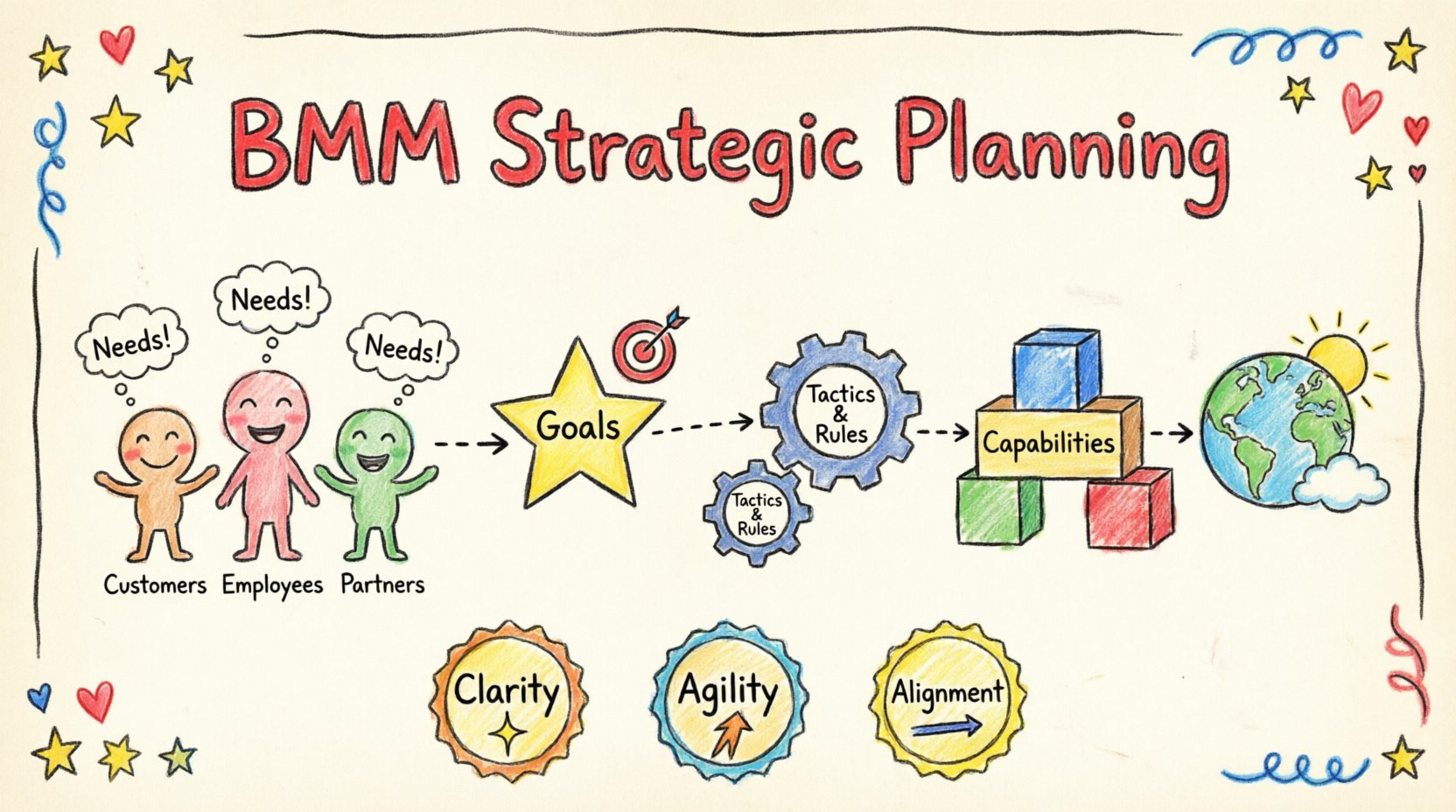
Understanding the Business Motivation Model 🧠
The Business Motivation Model is a standardized framework designed to capture and model the motivations behind business decisions. It originates from the Object Management Group (OMG) as a meta-model for business architecture. Unlike traditional planning methods that often focus solely on financial metrics or product roadmaps, BMM delves into the underlying drivers. It connects the external environment to internal capabilities, ensuring that every action taken has a clear purpose.
When implementing BMM, the focus shifts from what to do to why to do it. This distinction is critical for long-term sustainability. Organizations that rely on intuition often struggle when market conditions shift. BMM offers a structured vocabulary to describe these shifts and adapt quickly.
Core Philosophy
- Stakeholder-Centric: It begins with understanding the people and groups who influence or are influenced by the business.
- Goal-Oriented: Every tactic and rule serves a specific objective.
- Traceable: You can trace a capability back to a specific stakeholder need.
- Flexible: It accommodates change without breaking the entire structure.
Key Constructs of BMM 🔑
To utilize BMM effectively, one must understand its fundamental building blocks. These constructs form the vocabulary of the model. They are not isolated concepts; they exist in a network of relationships that drive the business forward.
1. Stakeholders and Needs 👥
Stakeholders are the individuals or groups with an interest in the business. They include employees, customers, shareholders, regulators, and partners. Within BMM, a stakeholder expresses a Need. A need is a requirement or desire that, if satisfied, leads to a positive outcome.
Needs are often vague initially. They require refinement. For example, a customer need might be “I want a fast checkout process”. This need is not yet a goal, but it is the seed from which goals grow.
2. Drivers and Enablers 🚀
A Driver is a factor that influences the motivation of a stakeholder. It pushes them toward or away from a need. Drivers can be external, such as a new regulation, or internal, such as a cost-cutting initiative.
Enablers are the factors that make achieving a goal possible. In BMM, this often maps to business capabilities or resources. Without the right enablers, goals remain aspirations rather than achievable targets.
3. Business Objectives and Goals 🎯
Business Objectives represent the desired end states of the organization. They are often long-term and broad. Goals are specific, measurable steps taken to achieve objectives.
The distinction is vital. An objective might be to “Improve Customer Satisfaction”. A goal supporting that objective could be “Reduce response time to under 24 hours”. BMM allows you to link these goals directly to the needs that inspired them.
4. Tactics and Rules ⚙️
Tactics are the specific actions taken to achieve a goal. They are the bridge between strategy and execution. A tactic might involve launching a new training program or changing a workflow.
Business Rules are constraints or directives that govern behavior. They define what is allowed or required. Rules ensure that tactics do not violate regulatory standards or internal policies. In BMM, rules can influence tactics and goals, ensuring compliance and consistency.
5. Business Capabilities and Environment 🌍
A Business Capability is the ability of the organization to perform a specific function. It is independent of the organization structure. Knowing your capabilities allows you to see where gaps exist between what you can do and what you need to do.
The External Environment encompasses everything outside the organization that impacts it. This includes market trends, competitors, and economic conditions. BMM models the relationship between the external environment and internal motivations.
Integrating BMM into Strategic Planning 🛠️
Applying BMM to strategic planning is a systematic process. It requires discipline and clarity. The following steps outline how to move from concept to execution without relying on specific software tools.
Step 1: Identify Stakeholders
- Map out all groups affected by the strategy.
- Categorize them by influence and interest.
- Document who they are and what they care about.
Step 2: Elicit Needs and Drivers
- Conduct interviews or workshops with key stakeholders.
- Record their explicit needs.
- Identify the drivers pushing them to act.
- Distinguish between wants and critical requirements.
Step 3: Formulate Objectives and Goals
- Translate needs into measurable objectives.
- Break objectives down into specific goals.
- Ensure each goal has a clear owner.
- Validate that goals align with the organization’s vision.
Step 4: Define Tactics and Capabilities
- Identify the actions required to meet each goal.
- Assess current capabilities against required actions.
- Highlight gaps where new capabilities must be built.
- Assign resources to bridge these gaps.
Step 5: Establish Business Rules
- Document constraints that apply to the new tactics.
- Ensure rules are consistent across departments.
- Review rules periodically for relevance.
The Power of Alignment 📏
One of the primary benefits of using the Business Motivation Model is alignment. In many organizations, departments work in silos. Marketing might pursue one set of goals while Operations focuses on efficiency. These goals can sometimes conflict. BMM provides a unified view.
By linking every tactic back to a stakeholder need, you create a chain of accountability. If a tactic fails, you can trace the failure back to a specific goal or need. This traceability simplifies problem-solving and resource allocation.
Consider the relationship between End States and Means. The end state is the desired outcome. The means are the capabilities and tactics used to reach it. BMM ensures that the means are sufficient to achieve the end state.
Traceability Matrix
| Element | Role in Strategy | Example |
|---|---|---|
| Stakeholder | Source of Needs | Customer |
| Need | Problem to Solve | Fast Delivery |
| Goal | Target Outcome | Delivery within 2 days |
| Tactic | Action Taken | Open regional warehouse |
| Capability | Resource Required | Logistics Management |
This table illustrates how a simple need transforms into a concrete capability requirement. Each row depends on the previous one. If the need changes, the goal, tactic, and capability must all be re-evaluated.
Benefits of BMM Integration 💡
Adopting this model brings tangible advantages to the strategic planning process. These benefits extend beyond documentation; they influence culture and decision-making.
- Clarity: Everyone understands the “why” behind projects.
- Agility: Changes in the environment are easier to incorporate.
- Consistency: Business rules ensure uniform execution.
- Transparency: Stakeholders see how their needs are addressed.
- Efficiency: Resources are directed toward high-value goals.
Furthermore, BMM supports Enterprise Architecture. It connects business strategy with IT and operational architecture. When the business layer is clear, the technical layer can be designed more accurately. This reduces rework and technical debt.
Addressing Common Implementation Hurdles 🚧
While powerful, BMM is not without challenges. Organizations often encounter resistance or confusion during adoption. Recognizing these hurdles early allows for better planning.
Complexity Management
The model can appear complex due to the number of constructs. To mitigate this:
- Start with a pilot project.
- Train teams on core concepts only.
- Use simplified diagrams for communication.
- Focus on the most critical stakeholders first.
Resistance to Change
Employees may feel that new modeling processes add bureaucracy. To overcome this:
- Demonstrate how BMM reduces ambiguity.
- Highlight time saved on conflicting requirements.
- Involve staff in the modeling process.
- Showcase quick wins from early adoption.
Data Overload
Collecting too much information can stall progress. Keep the focus on strategic relevance.
- Document only what is necessary for decision-making.
- Review and archive outdated motivations.
- Use automation where possible for data collection.
Ensuring Long-Term Alignment 🎯
Strategic planning is not a one-time event. It is an ongoing cycle. The Business Motivation Model supports this continuity. As the external environment changes, the model allows you to update motivations without discarding the entire strategy.
Regular reviews are essential. Schedule periodic assessments of your business rules and goals. Ask questions like:
- Has the stakeholder need changed?
- Are the current tactics still effective?
- Do we have the capabilities to execute?
- Are the business rules still compliant?
By maintaining this discipline, the organization remains responsive. It avoids the trap of sticking to a plan that no longer fits the reality of the market.
Conclusion on Strategic Application
Implementing the Business Motivation Model transforms strategic planning from a static document into a dynamic system. It provides the structure needed to navigate uncertainty. By focusing on motivations, needs, and capabilities, leaders can make decisions that are grounded in reality rather than assumption.
The effort required to build this framework pays off in reduced conflict and improved execution. When every action is tied to a clear motivation, the organization moves with purpose. This clarity is the foundation of sustainable growth.
Start small. Identify a key strategic area. Apply the constructs. Refine the relationships. Expand the model as confidence grows. With consistent application, BMM becomes an integral part of how the business operates, ensuring that strategy and execution remain in lockstep.