
State diagrams serve as the backbone for defining the behavior of reactive systems. They provide a clear visual representation of how a system transitions between different modes of operation based on events. However, as systems grow in functionality, these diagrams often accumulate unnecessary complexity. A bloated state model can become difficult to maintain, prone to errors, and a barrier to effective team collaboration. This guide explores the systematic approach to refactoring state diagrams, ensuring they remain clear, efficient, and robust. 🧩
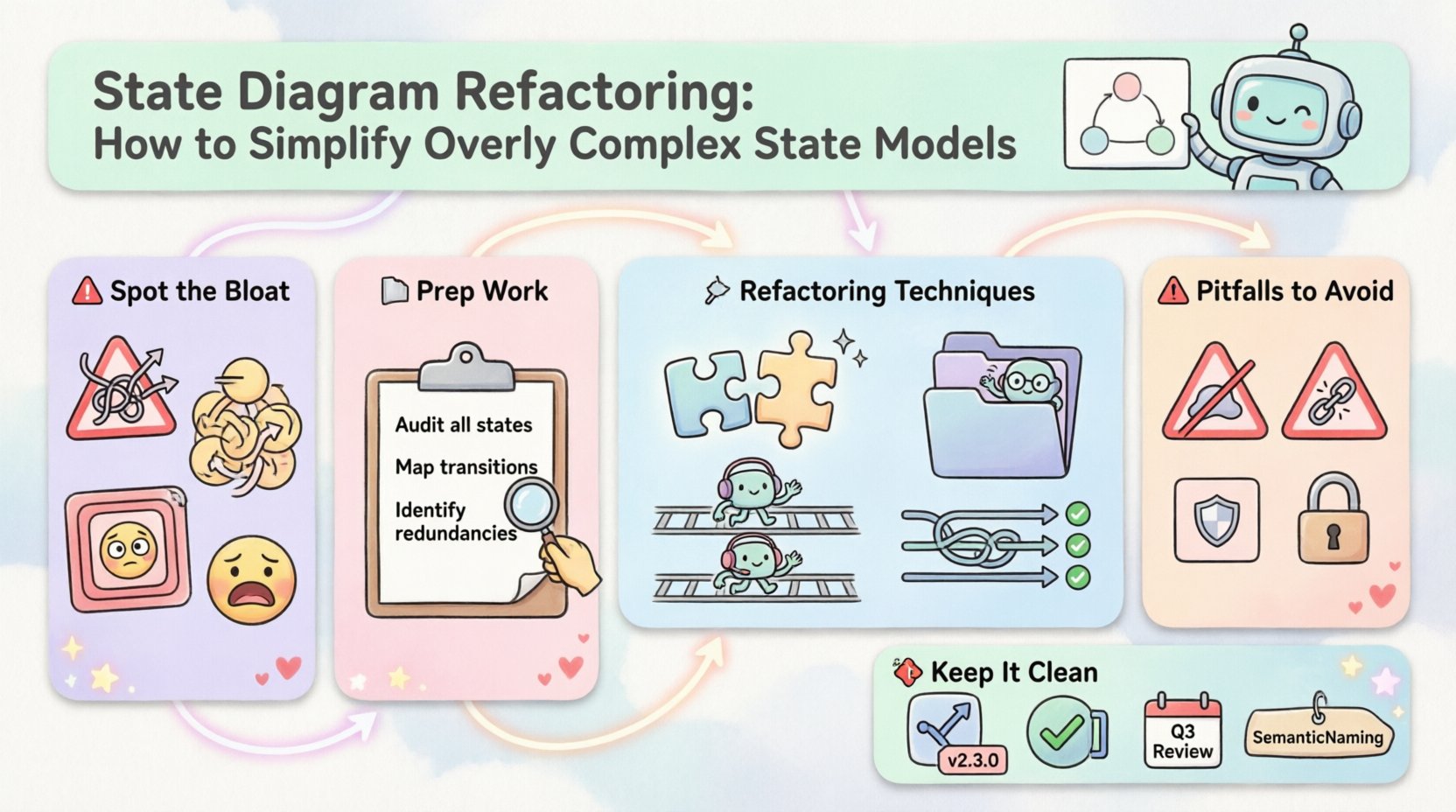
Identifying the Symptoms of a Bloated State Model 🚩
Before attempting any changes, it is critical to recognize when a model requires intervention. A healthy state diagram should be intuitive. If developers struggle to trace a specific flow or if the number of transitions exceeds the number of states significantly, the model may be suffering from complexity debt. Below are common indicators that refactoring is necessary.
- Spaghetti Logic: Transitions cross over one another repeatedly, making the flow hard to follow visually.
- High Fan-In and Fan-Out: A single state has an excessive number of incoming or outgoing transitions (e.g., more than 10).
- Redundant States: Multiple states perform the exact same function but are triggered by different events.
- Deep Nesting: States are nested within states to an impractical degree, obscuring the top-level behavior.
- Unclear Exit Conditions: It is difficult to determine what happens when a state is left.
To better understand the impact of these issues, consider the following breakdown of symptoms versus their operational consequences.
| Symptom | Operational Impact |
|---|---|
| Excessive Transitions | Increased risk of logic errors during implementation. |
| Deep Hierarchy | Difficulty in debugging specific state entry and exit points. |
| Unclear Guard Conditions | Logic becomes dependent on hidden variables or assumptions. |
| Missing Final States | System hangs or enters undefined behavior loops. |
Preparation: Inventory and Analysis 📝
Refactoring should never be a blind process. Before modifying the diagram, a thorough inventory of the current state machine is required. This phase ensures that no critical behavior is lost during simplification.
1. Audit the Existing Model
Begin by documenting every state, transition, event, and action currently defined. Create a checklist that maps the logical flow from the initial state to the final states. This inventory acts as a safety net. If a specific state is removed, verify that its functionality is preserved in a merged state or a different path.
- List all States: Note the entry and exit actions for each.
- List all Events: Identify what triggers the transitions.
- Map the Flow: Trace the path of data and control through the system.
2. Define Refactoring Goals
Set clear objectives for the refactoring effort. Is the goal to reduce the number of states? To improve readability? To facilitate easier implementation? Defining these goals upfront keeps the scope manageable.
- Reduce State Count: Merge equivalent states.
- Improve Readability: Use hierarchical structures to group related behaviors.
- Enhance Maintainability: Isolate volatile logic into specific substates.
Core Refactoring Techniques 🧩
Once the analysis is complete, apply specific structural patterns to simplify the diagram. These techniques are fundamental to state machine design and can be applied regardless of the implementation language or platform.
1. State Merging 🔄
One of the most effective ways to reduce complexity is to merge states that share the same behavior. If two states, State A and State B, perform identical entry actions, have the same exit actions, and transition to the same next states upon the same events, they can be combined into a single state.
- Identify Equivalence: Check if the internal logic is identical.
- Consolidate Transitions: Update all incoming transitions to point to the new merged state.
- Verify Guards: Ensure that guard conditions on transitions leading to the original states are still valid.
2. Hierarchical States (Substates) 🏗️
When a system has many states that share common behavior, hierarchical states allow you to group them. A composite state contains substates. This reduces the number of transitions at the top level because transitions to substates are inherited or managed locally.
- Group Related Behaviors: Put states that belong to the same logical phase into a parent state.
- Inherit Entry/Exit: Define actions at the parent level that apply to all children.
- Local Transitions: Move transitions between child states inside the composite state to avoid cluttering the parent diagram.
For example, instead of having a top-level state called “Processing” with ten different sub-states for different processing types, you can create a “Processing Mode” composite state. This keeps the main diagram clean while retaining detailed logic within the composite state.
3. Orthogonal Regions ⚔️
Orthogonality allows a state to exist in multiple sub-states simultaneously. This is useful when a system has independent aspects of behavior that do not interfere with each other. Instead of creating a single state with a massive list of transitions, orthogonal regions split the state into parallel components.
- Identify Independent Variables: Determine which behaviors can run in parallel.
- Split the State: Create orthogonal regions for each independent aspect.
- Manage Interactions: Ensure that transitions in one region do not conflict with the other.
This technique is particularly effective for systems that need to track both “Status” and “Configuration” simultaneously without creating a Cartesian product of states.
4. Transition Consolidation 📉
Complex models often suffer from redundant transitions. If multiple states transition to the same state upon the same event, consider using a common intermediate state or a hierarchical structure to handle the transition once.
- Eliminate Duplicates: Look for identical transitions and merge them.
- Use Default Transitions: Where appropriate, define default paths for events that are not explicitly handled.
- Guard Condition Simplification: Refactor complex boolean logic into named guards or variables.
Common Pitfalls During Refactoring ⚠️
While simplification is the goal, poor execution can introduce new bugs. Avoid these common mistakes to ensure the integrity of the system.
1. Over-Abstraction
Do not simplify to the point where the diagram becomes meaningless. If a state is too generic, developers will not know what it represents. Keep state names descriptive and specific to the domain.
2. Losing Traceability
Ensure that requirements can still be traced to the new diagram. If a requirement was mapped to a specific state that is now removed, update the documentation to reflect the new location of that logic.
3. Ignoring Error Handling
Refactoring often focuses on the happy path. Ensure that error states, timeout states, and recovery logic are preserved during the simplification process. Missing error handling can lead to silent failures.
4. Breaking Invariants
Check system invariants before and after changes. For example, if a system must never be in both “Locked” and “Unlocked” states simultaneously, verify that your new state structure enforces this constraint.
Documentation and Long-term Maintenance 📚
A simplified state diagram is a living artifact. It requires ongoing maintenance to remain effective. The following practices help sustain the quality of the model over time.
- Version Control: Treat the state diagram as code. Commit changes with descriptive messages explaining the refactoring rationale.
- Automated Testing: Implement unit tests that cover state transitions. This ensures that refactoring does not break existing behavior.
- Regular Reviews: Schedule periodic reviews of the state model to identify drift or new complexity as features are added.
- Clear Naming Conventions: Use consistent naming for states, events, and actions to reduce cognitive load.
Summary of Best Practices
Maintaining a clean state diagram is an investment in the long-term stability of the software. By following structured refactoring techniques, teams can reduce technical debt and improve system reliability. The key is to balance simplicity with expressiveness. A good state model should be easy to read for a new developer while being precise enough to handle complex logic.
- Start with Analysis: Know what you are changing before you change it.
- Use Hierarchy: Group related states to reduce top-level clutter.
- Verify Logic: Test every transition after a change.
- Document Changes: Keep a record of why decisions were made.
Applying these principles ensures that your state machine remains a valuable asset rather than a source of confusion. Regular maintenance and disciplined design patterns will keep your models robust and scalable. 🚀