
System architecture relies heavily on precise behavioral models. When engineers design complex software systems, they often turn to state machine diagrams to map out how the system reacts to various inputs. However, ambiguity in these diagrams can lead to significant defects during deployment. A single unclear transition rule can cause a system to freeze, crash, or behave unpredictably. This guide provides a detailed examination of how to clarify state diagrams, ensuring that every state, event, and transition is defined with mathematical precision.
Understanding the nuances of state transitions is not merely about drawing boxes and arrows. It involves defining the logic that governs the movement from one condition to another. In this document, we explore the fundamental components of state machines, identify common sources of confusion, and outline strategies for verification. By the end of this review, you will have a robust framework for creating unambiguous behavioral models.
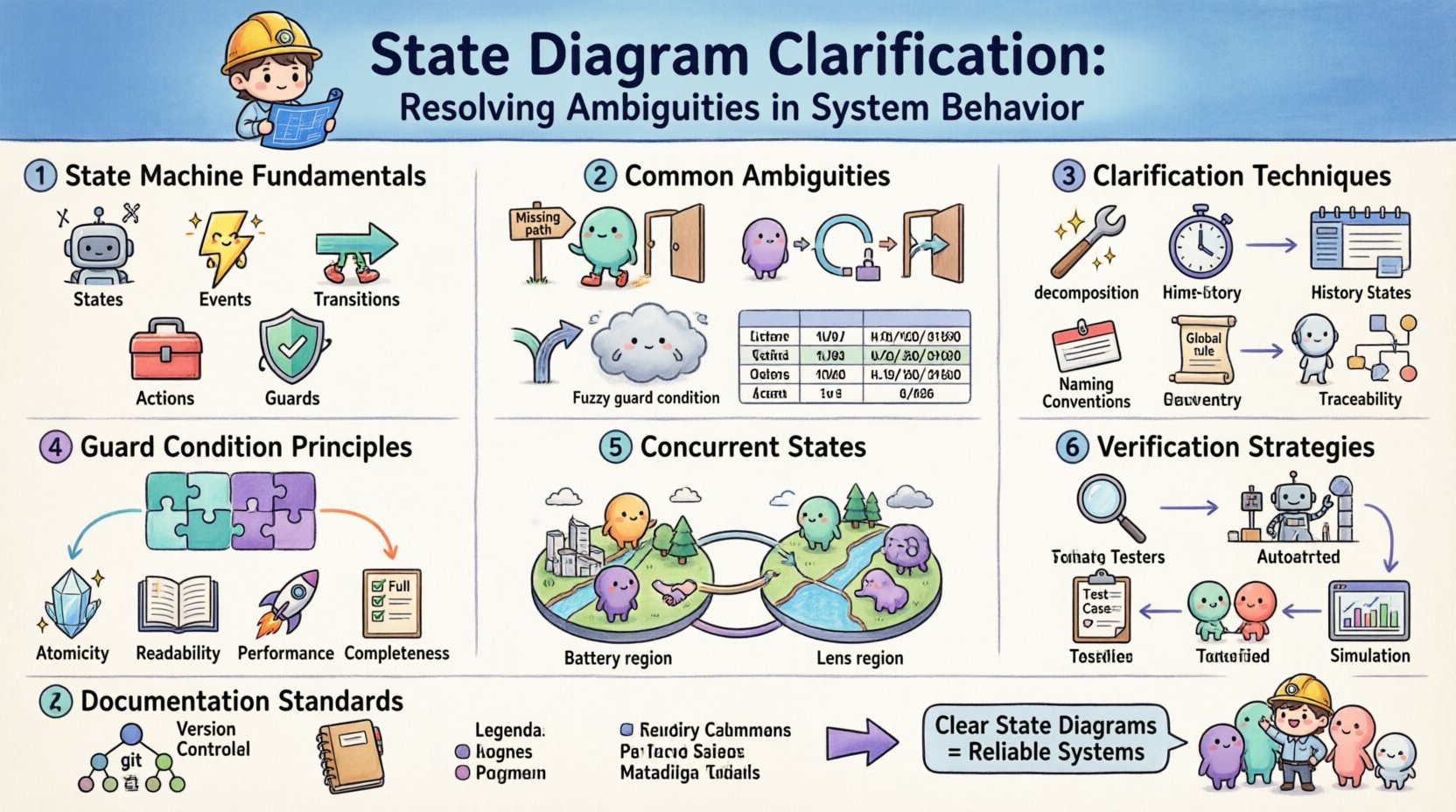
🏗️ Understanding State Machine Fundamentals
Before resolving ambiguities, one must understand the core elements that constitute a state diagram. These elements act as the vocabulary of system behavior. Without a shared understanding of these terms, communication between designers and developers becomes prone to error.
- States: A state represents a condition or status of the system at a specific moment. It defines what the system is doing or waiting for. For example, a payment system might be in a “Processing” state or a “Completed” state.
- Events: An event is an occurrence that triggers a state transition. Events can be external inputs, such as a user clicking a button, or internal signals, such as a timer expiring.
- Transitions: A transition is the path taken from a source state to a destination state when an event occurs. It represents the change in the system’s condition.
- Actions: Actions are activities performed during a state entry, during a transition, or upon state exit. These are the operations the system executes to respond to the event.
- Guards: A guard condition is a boolean expression that must evaluate to true for a transition to occur. If the guard is false, the transition is ignored, even if the event occurs.
Each of these components must be explicitly defined. Vague descriptions such as “system handles error” are insufficient. The system must specify exactly which state is entered, which event triggered it, and what actions are executed. This level of detail is the foundation of clarity.
🔍 Common Sources of Ambiguity
Even experienced designers can introduce ambiguity into their models. These ambiguities often stem from assumptions about implicit behavior or insufficient documentation. Identifying these common pitfalls is the first step toward resolution.
1. Missing Default Transitions
In many state diagrams, designers assume that if no transition is defined for a specific event in a specific state, the system should ignore the event. However, some specifications require the system to enter an error state or log a warning. If the diagram does not explicitly define this behavior, developers may implement different solutions, leading to inconsistent products.
2. Confusion Between Entry and Exit Actions
A frequent source of confusion is the placement of actions. Does a specific initialization routine run when entering the state, or does it run when the transition leading to the state occurs? Similarly, cleanup routines might be intended for the exit phase. Mixing these up can result in resource leaks or incorrect initializations.
3. Self-Loops vs. State Re-Entry
When an event occurs within a state, should the system execute a self-loop transition, or should it leave and re-enter the state? These two scenarios often have different side effects. A self-loop typically skips entry actions but executes transition actions. Re-entering the state triggers entry actions again. Failing to distinguish these in the diagram leads to logic errors.
4. Ambiguous Guard Conditions
Guard conditions must be deterministic. If a guard condition relies on a variable that is not guaranteed to be initialized or updated, the outcome is undefined. This is particularly problematic in concurrent systems where multiple processes might modify shared variables.
The following table summarizes common ambiguities and their potential impact on system stability:
| Source of Ambiguity | Impact on System | Resolution Strategy |
|---|---|---|
| Missing Transitions | Unhandled exceptions or silent failures | Define a catch-all error state |
| Unclear Entry/Exit Points | Resource leaks or duplicate processing | Explicitly label entry and exit actions |
| Self-Loop Confusion | Incorrect state initialization | Use distinct transition paths for re-entry |
| Non-Deterministic Guards | Unpredictable behavior | Ensure guards depend only on stable data |
| Concurrent State Interaction | Race conditions | Define event queues and priority rules |
🛠️ Techniques for Clarification
Once ambiguities are identified, specific techniques can be applied to resolve them. These methods focus on reducing complexity and increasing explicitness in the diagram.
- Decompose Complex States: If a state contains too much logic, it is often too complex. Break it down into sub-states. This hierarchical approach reduces the number of transitions required and isolates specific behaviors.
- Use History States: In systems that return to a previous state, using a history state allows the system to recall the last active sub-state. This prevents the need to redraw every possible path back to the original condition.
- Standardize Naming Conventions: Events, states, and actions should follow a consistent naming convention. For example, events might use the prefix “evt_” while actions use “act_”. This makes the diagram easier to parse visually.
- Define Global Constraints: Some rules apply to the entire system regardless of the current state. Document these constraints separately or as notes attached to the state machine. This keeps the diagram clean while ensuring critical rules are not overlooked.
- Traceability Matrix: Link every state and transition back to a specific requirement. If a transition cannot be traced to a requirement, it may be unnecessary or indicative of a misunderstanding.
⚙️ Transition Rules & Guard Conditions
The logic governing transitions is the heart of the state machine. It determines whether a change in state is permissible. Guard conditions add a layer of logic that must be evaluated before the transition occurs.
When defining guard conditions, adhere to the following principles:
- Atomicity: Guard conditions should be atomic boolean expressions. Avoid complex logic that requires multiple steps to evaluate. If a condition requires multiple checks, break it down into intermediate states.
- Readability: Write guards in plain language or standard logic syntax. Avoid mathematical notation that requires specialized knowledge to interpret.
- Performance: Ensure that guards do not perform expensive operations. A guard should evaluate quickly to prevent delays in event processing.
- Completeness: For every event in a state, define whether a transition is mandatory, optional, or impossible. This prevents the system from entering a “trap” state where no action is taken.
Consider the scenario of an order processing system. An event “CancelOrder” might be valid only if the order is in the “Pending” state and has not yet been “Shipped”. The guard condition must explicitly check both the state and the shipment status. Without this precision, an order might be cancelled after shipping, causing financial discrepancies.
🔄 Handling Concurrent States
Complex systems often need to manage multiple behaviors simultaneously. This is achieved through orthogonal regions or concurrent states. While powerful, this feature introduces significant complexity regarding event handling.
- Orthogonal Regions: These allow independent state machines to run in parallel. For example, a camera system might have a “Battery” state and a “Lens” state running concurrently. Events in one region should not affect the other unless explicitly linked.
- Event Broadcasting: Decide how events are distributed across regions. Should an event trigger transitions in all regions, or only specific ones? This decision must be documented clearly.
- Termination: Define how concurrent states terminate. If one region reaches a final state, does the entire system stop, or does it continue until all regions are finished?
- Synchronization: When regions need to communicate, define the synchronization mechanism. This often involves a shared variable or a specific event that signals readiness.
Failure to define these rules can lead to race conditions. For instance, if two regions update a shared counter simultaneously, the final value may be incorrect. State diagrams must explicitly show where these interactions occur.
✅ Verification & Validation Strategies
A state diagram is only as good as its verification. Verification ensures the diagram is correct according to the specification, while validation ensures it meets the user’s needs. Several strategies can be employed to ensure the model is robust.
- Formal Verification: Use formal methods to mathematically prove that the state machine satisfies certain properties, such as the absence of deadlocks. This is crucial for safety-critical systems like medical devices or aerospace control.
- Model Checking: Automated tools can traverse all possible states to find unreachable code or dead ends. These tools highlight paths in the diagram that are logically impossible to reach.
- Test Case Generation: Generate test cases directly from the state transitions. Every transition should correspond to at least one test case. This ensures that the implementation matches the diagram.
- Peer Review: Have another engineer review the diagram. Fresh eyes can often spot ambiguities that the original designer missed, especially in complex logic flows.
- Simulation: Run a simulation of the state machine with various input sequences. Observe the behavior to ensure it matches expectations. This is particularly useful for visualizing complex interactions.
📝 Documentation Standards
Documentation plays a vital role in maintaining clarity over time. As systems evolve, state diagrams can become outdated or difficult to interpret without context. Establishing standards for documentation helps preserve the integrity of the model.
- Version Control: Treat state diagrams as code. Store them in version control systems to track changes over time. This allows you to revert to previous states if a change introduces errors.
- Change Logs: Maintain a log of every modification made to the diagram. Record the reason for the change, the date, and the author. This history is invaluable for troubleshooting.
- Legend and Keys: Always include a legend that explains symbols, colors, and notation used in the diagram. Different teams might interpret symbols differently without a key.
- Metadata: Include metadata such as the system version, the date of creation, and the applicable requirements. This links the diagram directly to the project scope.
🚀 Final Considerations for System Design
Creating a state machine diagram is an exercise in precision. It requires a mindset that prioritizes clarity over speed. While it might take longer to define every transition explicitly, the cost of fixing ambiguities later in the development lifecycle is far higher.
By adhering to the principles outlined in this guide, teams can reduce the risk of defects. Clear state diagrams serve as a single source of truth for developers, testers, and stakeholders. They facilitate communication and ensure that the system behaves exactly as intended under all conditions.
Remember that state diagrams are living documents. As requirements change, the diagram must evolve to reflect the new reality. Regular reviews and updates are necessary to maintain accuracy. Invest the effort now to prevent problems later. A well-defined state machine is a testament to disciplined engineering and a commitment to quality.
Apply these techniques to your next project. Start by auditing existing diagrams for ambiguity. Look for missing transitions, unclear guards, and complex states that need decomposition. With a systematic approach, you can transform a confusing model into a clear and reliable blueprint for system behavior.