
Design is often mistaken for the arrangement of pixels, the selection of fonts, or the placement of buttons. However, at its core, user experience is about human connection. It is the bridge between a person’s intent and a digital solution. When we talk about user-centered thinking, we are not just talking about usability; we are talking about understanding the emotional landscape of the people who will interact with a product every day. This is where empathy steps in.
Empathy in UX is not merely a soft skill or a buzzword for kindness. It is a rigorous methodology for gathering insights, validating assumptions, and ensuring that the final output resonates with real human needs. Without it, even the most technically advanced solution can fail because it misses the mark on what the user actually values. This guide explores the mechanics of empathy in design, how to cultivate it, and why it remains the cornerstone of successful user experience strategies.
Defining Empathy in the Context of Design 🎯
To build something that works, we must first understand who we are building it for. In the context of digital products, empathy is the ability to understand and share the feelings of the user. It goes beyond sympathy, which is feeling for someone, to feeling with them.
When a designer lacks empathy, the product becomes a collection of features that solves problems the user did not realize they had. When empathy is present, the product feels intuitive because it aligns with the user’s mental model and emotional state. This alignment reduces friction, increases satisfaction, and fosters loyalty.
Key components of empathetic design include:
- Active Listening: Hearing what users say and, more importantly, hearing what they do not say.
- Observation: Watching users interact with existing solutions in their natural environment.
- Contextual Understanding: Recognizing the environment, stress levels, and goals of the user.
- Non-Judgment: Approaching user feedback without bias or defensiveness.
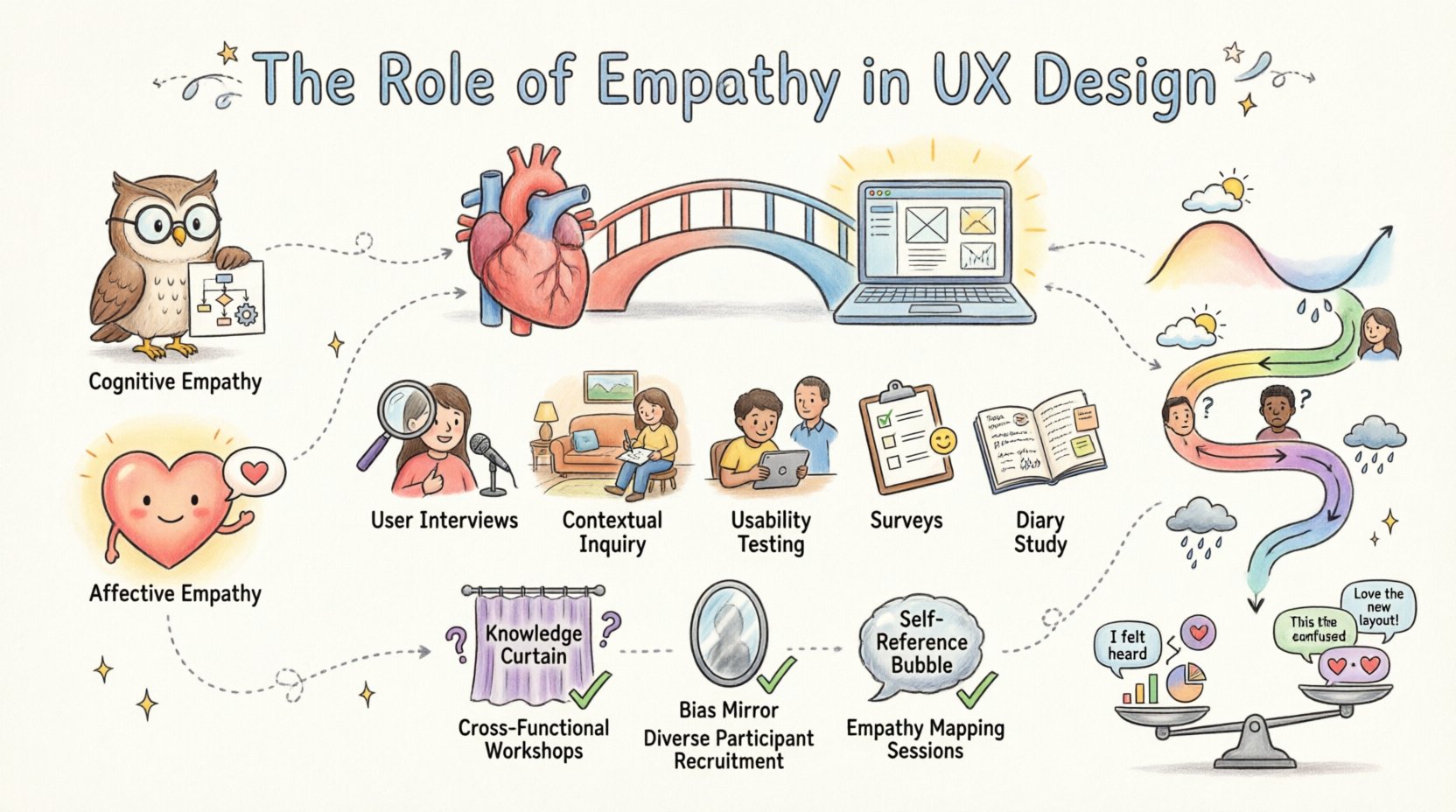
Cognitive vs. Affective Empathy: Understanding the Difference 🧩
Not all empathy is the same. In psychology and design, there are two primary types of empathy that influence how we approach problem-solving. Distinguishing between them helps teams apply the right methods at the right time.
1. Cognitive Empathy
This is the intellectual understanding of another person’s perspective. It involves knowing what the user is thinking and why they are doing it. In UX, this translates to understanding the user’s workflow, their goals, and the obstacles they face.
- Focus: Logic, process, and mental models.
- Application: Creating user flows, wireframes, and information architecture.
- Example: Understanding that a user on a mobile device needs a larger touch target because of their physical limitations.
2. Affective Empathy
This is the emotional capacity to feel what another person is feeling. It connects the user’s emotional state to the design experience. If a user is anxious about a financial transaction, affective empathy drives the design to provide reassurance and clarity.
- Focus: Emotions, feelings, and psychological safety.
- Application: Copywriting, micro-interactions, and visual tone.
- Example: Using a calming color palette and reassuring language during a checkout process to reduce anxiety.
Effective design requires a balance of both. Cognitive empathy ensures the product works; affective empathy ensures the product feels good to use.
The Business Case for Emotional Connection 💰
Some stakeholders view empathy as a cost center, something that slows down development to “feel things out.” However, the data suggests that empathetic design is a significant driver of return on investment. Products that fail to connect emotionally often see high abandonment rates.
Why empathy drives business value:
- Reduced Support Costs: When a product is intuitive and emotionally reassuring, users make fewer errors and require less customer support.
- Higher Retention: Users stick with platforms that understand them. Emotional connection creates habit formation.
- Brand Advocacy: Users who feel heard are more likely to recommend the product to others.
- Lower Churn: Empathy helps identify pain points before they become reasons to leave.
Investing time in understanding the user is not a delay; it is a preventative measure against expensive post-launch fixes.
Research Methods That Build Understanding 🔍
You cannot be empathetic without data. Assumptions are the enemy of empathy. To truly understand a user, you must engage in research methods that put you in their shoes. These methods should be integrated throughout the product lifecycle, not just at the beginning.
| Method | Primary Insight Type | Best Used For |
|---|---|---|
| One-on-One Interviews | Deep Motivations | Understanding the “Why” behind behaviors. |
| Contextual Inquiry | Environmental Factors | Seeing how users interact in their actual workspace. |
| Usability Testing | Friction Points | Identifying where the process breaks down. |
| Surveys | Broad Trends | Gathering quantitative data from a larger group. |
| Diary Studies | Long-term Habits | Tracking user behavior over weeks or months. |
Each method offers a different lens. Interviews reveal stories, testing reveals mechanics, and surveys reveal patterns. A robust strategy combines these to form a complete picture.
Creating Personas That Represent Real Humans 👥
User personas are fictional characters created to represent different user types. When done poorly, they become marketing avatars with made-up names and hobbies. When done well, they are research artifacts that keep the team aligned on user needs.
What makes a persona empathetic?
- Based on Data: Every attribute must come from research, not guesswork.
- Goal-Oriented: Focus on what the persona wants to achieve, not just demographics.
- Emotional State: Include their frustrations, fears, and motivations.
- Accessible: The persona should be a reference point available to the whole team, not buried in a document.
A strong persona answers questions like: “How does this persona feel when they encounter this error?” and “What is their priority right now?” This keeps the team focused on the human behind the screen.
Journey Mapping: Walking in Their Shoes 👣
A journey map visualizes the entire experience a user has with a service or product. It tracks their actions, thoughts, and emotions across different touchpoints. It is one of the most powerful tools for cultivating empathy because it forces the designer to see the timeline of the user’s life, not just the app screen.
Elements of an Empathetic Journey Map:
- Phases: Pre-purchase, purchase, onboarding, usage, support.
- Actions: What the user physically does.
- Thoughts: What the user is thinking at that moment.
- Emotions: The emotional curve (frustration, delight, confusion).
- Opportunities: Where the team can intervene to improve the experience.
By mapping the emotional curve, teams can identify “low points” where users feel discouraged. Fixing these low points often yields higher satisfaction than optimizing the high points.
Barriers to Empathetic Design 🚧
Even with the best intentions, teams face barriers that prevent true empathy. Recognizing these obstacles is the first step to overcoming them.
The Curse of Knowledge
Designers know too much. They understand the system, the backend, and the logic. This makes it difficult to remember what it is like to be a novice. We must actively try to forget our expertise to see the problem through fresh eyes.
Confirmation Bias
This is the tendency to look for information that confirms our existing beliefs. If we believe a feature is great, we might ignore feedback that says it is confusing. We must seek disconfirming evidence to challenge our assumptions.
The Self-Reference Effect
We tend to assume that others think and feel the same way we do. If we like a certain color scheme, we assume everyone does. This is dangerous. We must rely on data about the actual audience, not our personal preferences.
Measuring Success Beyond Metrics 📊
Traditional metrics like conversion rates and time-on-site are important, but they do not tell the whole story. They measure what happened, not how it felt. To truly measure the impact of empathy, we need qualitative metrics and sentiment analysis.
- Net Promoter Score (NPS): Measures loyalty and emotional attachment.
- User Satisfaction (CSAT): Direct feedback on specific interactions.
- System Usability Scale (SUS): A standardized questionnaire for perceived ease of use.
- Task Success Rate: Can the user actually complete the goal?
- Emotional Feedback: Direct quotes from users about how the product made them feel.
Combining quantitative data with qualitative stories creates a holistic view of performance. A feature might have a high usage rate (quantitative), but if users report feeling stressed while using it (qualitative), the design is failing.
Cultivating an Empathetic Team Culture 🤝
Empathy cannot be the job of a single person. It must be a cultural value within the organization. When the whole team cares about the user, the product improves exponentially.
Strategies to build this culture:
- Share Research Findings: Regularly present user quotes and videos to the entire company, including engineering and sales.
- Rotate Roles: Allow developers and marketers to participate in user testing sessions.
- Create User Personas: Ensure everyone has access to and understands the personas.
- Empathy Workshops: Conduct training sessions focused on active listening and bias awareness.
- Feedback Loops: Establish channels for customer support to relay feedback directly to product teams.
When engineers hear directly from a user struggling with a bug, their motivation to fix it changes from a task to a mission. This shift in perspective is the power of empathy.
Practical Steps to Integrate Empathy Today
You do not need a massive budget to start being more empathetic. Small changes in process can yield significant results.
- Invite Users to Meetings: Whenever possible, include a user in a design review or strategy meeting.
- Review Support Tickets: Read the latest customer support logs to see real-world complaints.
- Conduct “Walkthroughs”: Ask a colleague to perform a task while you watch without helping.
- Write Empathy Statements: Start design documents with a statement about who the user is and what they need.
- Audit Past Designs: Look at old features and ask if they still serve the original user intent.
These actions keep the human element at the forefront of decision-making. They prevent the product from becoming a hollow shell of functionality.
The Future of User-Centered Thinking
As technology evolves, the core need for human connection remains constant. Artificial intelligence and automation can speed up processes, but they cannot replace the need for understanding human emotion. In fact, as interfaces become more complex, the need for empathetic design increases to guide users through uncertainty.
The future of UX belongs to those who can blend technical proficiency with deep human understanding. It is about creating systems that are not just efficient, but also humane. By prioritizing empathy, we create products that people trust, rely on, and love.
Start today. Listen more than you speak. Observe more than you assume. And remember that behind every data point is a person with a story.