
Investors evaluate more than just a product or a team. They scrutinize the structural integrity of the industry in which a startup operates. A compelling business model within a hostile industry often fails, while a robust model in a favorable industry can thrive. This is where Porter’s Five Forces Analysis becomes indispensable.
For founders, integrating this framework into a pitch deck signals more than data literacy. It demonstrates a quiet confidence in navigating market dynamics. It shows that you understand the forces that will shape profitability, risk, and long-term value creation.
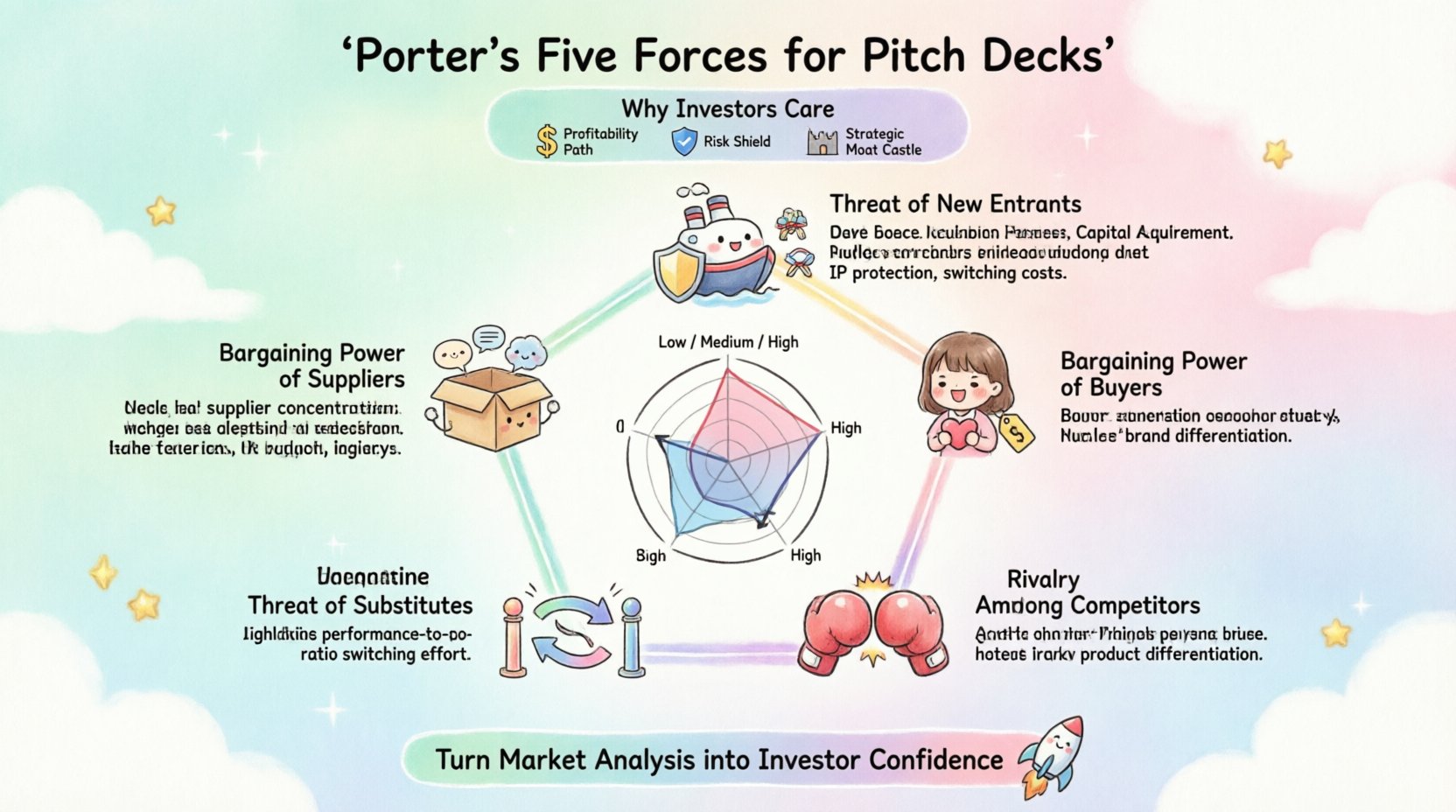
Why This Framework Matters to Investors 💰
When a venture capitalist or angel investor reviews a presentation, they are looking for defensibility. They want to know what protects the business from erosion over time. Traditional market sizing (TAM, SAM, SOM) tells them how big the pie is. Porter’s Five Forces tells them how much of that pie the company can actually capture and retain.
Profitability Potential: High supplier power or intense rivalry often squeezes margins. Investors need to see a path to healthy gross margins.
Risk Assessment: Understanding the threat of substitution helps quantify the risk of obsolescence.
Strategic Moats: The analysis highlights where barriers to entry exist and where they are weak.
Incorporating this analysis transforms a generic pitch into a strategic document. It moves the conversation from “what you are building” to “why you can win.”
Understanding the Five Forces 🧭
Developed by Michael Porter, this framework assesses the competitive intensity and attractiveness of a market. It consists of five distinct forces. In the context of a pitch deck, each force represents a specific risk or opportunity that must be addressed.
1. Threat of New Entrants 🚢
This force measures how easy it is for new competitors to enter the market. High threat means low barriers, which leads to price wars and fragmented market share. Low threat implies strong barriers, protecting existing players.
Key Considerations for the Pitch:
Capital Requirements: Does the business require significant upfront investment to compete? If yes, this is a barrier.
Regulatory Hurdles: Are there licenses or compliance standards that slow down new players?
Intellectual Property: Do patents or proprietary technology prevent copying?
Customer Switching Costs: Is it difficult for customers to move to a new solution?
For a startup, you must articulate where your barriers lie. If the barrier is low, explain how your first-mover advantage or network effect creates a temporary moat.
2. Bargaining Power of Suppliers 📦
Suppliers can dictate prices and terms. If suppliers are few and strong, they can erode your profits. If the market is fragmented with many vendors, you hold the leverage.
Key Considerations for the Pitch:
Supplier Concentration: Are you reliant on a single vendor for critical inputs?
Uniqueness of Supply: Is the raw material or technology commoditized or unique?
Switching Costs: How expensive is it to change suppliers?
Forward Integration: Can the supplier easily become your competitor?
Investors look for supply chain resilience. Highlighting multiple sourcing options or proprietary manufacturing capabilities reduces perceived risk.
3. Bargaining Power of Buyers 👧
Buyers drive down prices and demand better quality. Power is high if there are few buyers, the product is standardized, or switching costs are low.
Key Considerations for the Pitch:
Buyer Concentration: Do a few large clients control your revenue?
Product Differentiation: Is your solution unique enough to justify a premium?
Price Sensitivity: How much does cost influence the buying decision?
Information Availability: Can buyers easily compare your offering with others?
In a pitch, demonstrate high switching costs or high customer loyalty. This shows recurring revenue stability and pricing power.
4. Threat of Substitute Products or Services 🔄
Substitutes are not just direct competitors; they are alternative ways to solve the same problem. A high threat limits the price you can charge.
Key Considerations for the Pitch:
Performance-to-Price Ratio: How does your solution compare to the alternative in value?
Switching Costs: How much effort does it take to switch to the substitute?
Customer Habit: Is the current behavior deeply ingrained?
Emerging Technologies: Are there new tech trends that make your solution obsolete?
Addressing this force shows you understand the broader ecosystem. It proves you aren’t ignoring the “status quo” or alternative methods of task completion.
5. Rivalry Among Existing Competitors 🥊
This is the most visible force. Intense rivalry leads to price wars, increased marketing spend, and innovation races.
Key Considerations for the Pitch:
Number of Competitors: Is the market crowded or nascent?
Industry Growth Rate: In stagnant markets, fighting for share is harder.
Differentiation: Is the market defined by price or features?
Exit Barriers: Is it easy for competitors to leave, or will they stay and fight?
Your pitch should focus on your unique value proposition. If the market is crowded, explain your niche strategy. If the market is fragmented, explain how you consolidate.
Structuring the Analysis in a Pitch Deck 📄
Integrating this framework requires more than a single slide. It should be woven into the narrative of market opportunity and competitive advantage. Here is how to structure it effectively without overwhelming the audience.
Slide 1: Market Landscape Overview
Start with a high-level view. Use a diagram to show where the company fits within the ecosystem. This sets the stage for the deeper dive.
Slide 2: The Five Forces Assessment
Use a visual matrix or a radar chart to display the intensity of each force. This allows investors to scan the risks quickly.
Example Table for Pitch Deck:
Force | Intensity | Implication for Business | Strategic Response |
|---|---|---|---|
Supplier Power | Medium | Margin pressure on raw materials | Long-term contracts & local sourcing |
Buyer Power | Low | High switching costs | Integration & API connectivity |
Competitive Rivalry | High | Price competition in core segment | Focus on premium enterprise tier |
Threat of New Entry | Medium | Regulatory barriers exist | Accelerate time-to-market |
Substitute Threat | Low | Task complexity prevents substitution | Emphasize efficiency gains |
Slide 3: Competitive Moat
Based on the analysis, explicitly state the moat. If supplier power is low, the moat is cost efficiency. If buyer power is low, the moat is stickiness.
Slide 4: Risk Mitigation
For every high-intensity force identified, show a mitigation strategy. This turns a risk into a management capability.
Common Pitfalls to Avoid ⚠️
Even with a solid framework, execution errors can undermine credibility. Avoid these common mistakes when presenting.
Generic Statements: Avoid saying “competition is high.” Define which competitors and why. Specificity builds trust.
Ignoring the “Do Nothing” Option: The biggest substitute is often the current manual process. Acknowledge this reality.
Overlooking Supply Chain Risks: In hardware or logistics, supplier power is a deal-breaker. Do not gloss over it.
Static Analysis: Markets change. A pitch deck should acknowledge how these forces might evolve over the next 3 to 5 years.
Data Without Context: Presenting a chart without explaining what it means for profitability is wasted effort.
Deep Dive: Applying the Framework to Different Sectors 🌍
The weight of each force varies by industry. Tailoring the analysis to the sector increases relevance.
Software & SaaS
New Entrants: Often high. Development is easy. Focus on network effects.
Buyer Power: Often high. Churn is a major metric.
Substitution: High. Users can switch to Excel or pen and paper.
Manufacturing & Hardware
Suppliers: Often high. Component scarcity matters.
New Entrants: Low. Capital intensity is a barrier.
Rivalry: High on price and speed to market.
Services & Consulting
Suppliers: Low (talent is the input).
Buyer Power: High. Relationships drive retention.
Rivalry: High on reputation and expertise.
How to Present Data Visually 🗃️
Visuals should aid comprehension, not obscure it. Use simple, clean graphics.
Bar Charts: Compare the intensity of forces across the industry vs. your company.
Heat Maps: Color-code risks (Red = High, Yellow = Medium, Green = Low).
Flowcharts: Show how value flows through the supply chain and where you capture it.
Before/After: Show how the market looked before your intervention versus the current state.
Keep text minimal on slides. Use the speaker notes to elaborate on the strategic nuance. Investors appreciate conciseness.
Strategic Questions for Founders 🤔
Before finalizing the deck, ask yourself these questions to ensure the analysis holds up.
Have I talked to real customers? Does their feedback align with the buyer power analysis?
Have I spoken to suppliers? Do I know their pricing power?
Is my defense real? Can a competitor replicate this in six months?
Is the market growing? If the market is shrinking, all forces become more aggressive.
Am I being honest? Investors value transparency. Hiding a high threat of entry is risky.
Final Thoughts on Market Dynamics 🚀
A pitch deck is a tool for alignment. It aligns the founder’s vision with the investor’s risk assessment. Porter’s Five Forces provides a structured language for this alignment.
By systematically addressing each force, you demonstrate that the business is not just a good idea, but a viable enterprise. You show that you have mapped the terrain and prepared for the obstacles. This level of preparation distinguishes serious ventures from speculative ones.
Investors fund teams that see the world clearly. When you present this analysis with clarity and confidence, you invite them into a partnership based on shared understanding. The market is complex. Your pitch should reflect that complexity, not simplify it away.
Focus on the implications. Don’t just list the forces. Explain what they mean for your unit economics, your growth trajectory, and your exit potential. This is the core of investor relations. It is about managing expectations and building a narrative of resilience.
Ensure every slide contributes to the story. If a force analysis does not lead to a strategic insight, remove it. Keep the deck tight, relevant, and grounded in the reality of the industry structure. This approach builds the foundation for a successful raise.
Ultimately, the goal is to show that you understand the game before you play it. The Five Forces framework is the map. Your strategy is the path. Investors want to see both.