
Understanding the competitive landscape is the foundation of sustainable strategy. For decades, industry analysts and executives have relied on a specific framework to dissect market dynamics. This tool, known as Porter’s Five Forces, offers a structured way to evaluate the profitability and attractiveness of an industry. Developed by Michael Porter in 1979, it remains a cornerstone of strategic management today.
Every organization operates within an ecosystem. The strength of competitors, the threat of new players, and the leverage of suppliers and customers all dictate margins and long-term viability. Without a clear view of these forces, leaders risk making decisions based on incomplete data. This guide breaks down each component, providing actionable insights for strategic planning.
🧩 Understanding the Framework
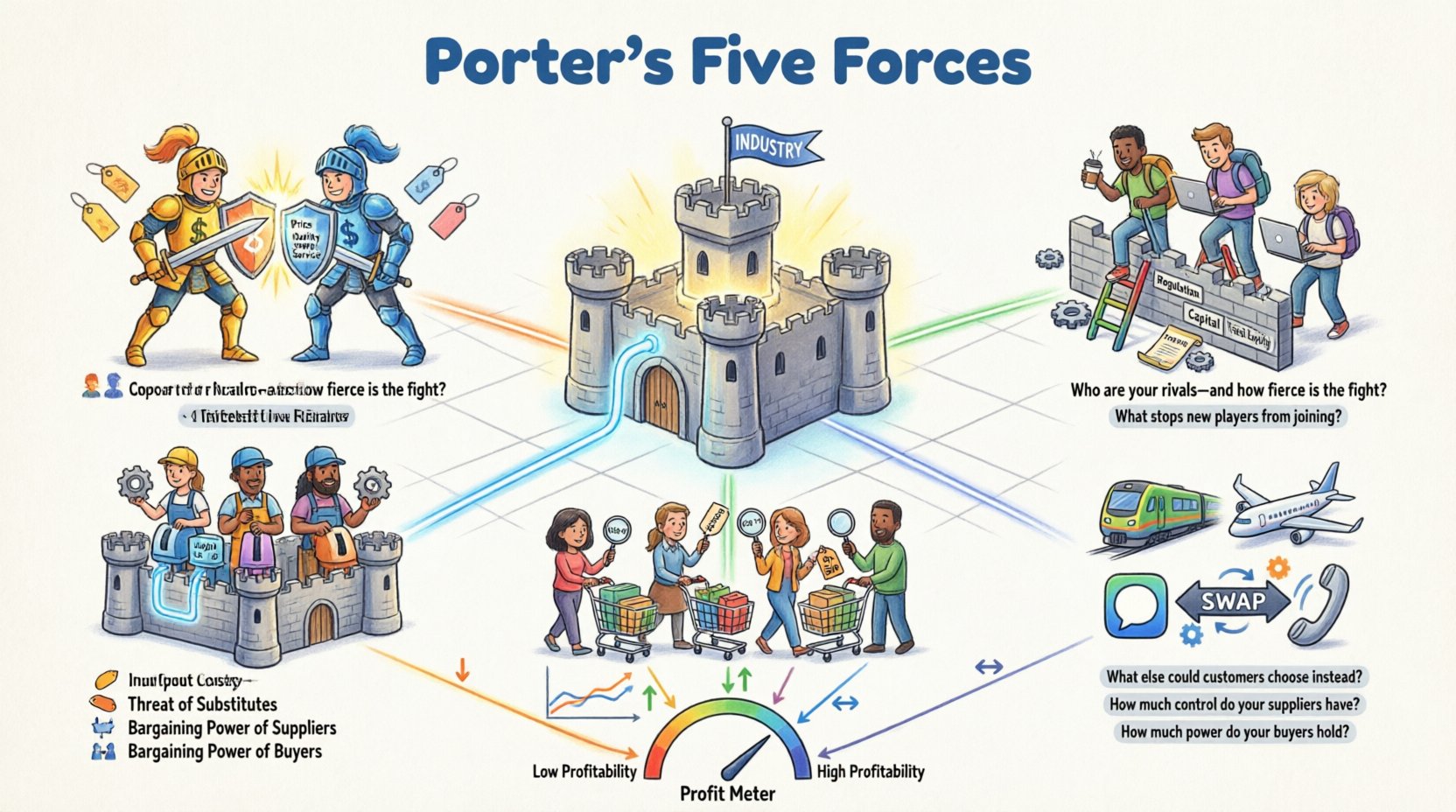
The model posits that five specific forces shape the competitive environment of an industry. These forces determine the intensity of competition and the profit potential within a sector. By analyzing each force, businesses can identify where power lies and where opportunities for improvement exist.
It is not merely about looking at direct rivals. It involves a broader view of the value chain. The analysis helps answer critical questions regarding pricing power, cost structures, and investment risks. Below is a summary of the core components.
| Force | Key Question | Impact on Profitability |
|---|---|---|
| Competitive Rivalry | How intense is the competition? | High rivalry drives down prices and margins. |
| Threat of New Entrants | How easy is it for new players to enter? | Low barriers increase supply and reduce prices. |
| Threat of Substitutes | Are there alternative solutions? | High substitution caps price increases. |
| Bargaining Power of Suppliers | How much control do suppliers have? | Strong suppliers raise input costs. |
| Bargaining Power of Buyers | How much control do customers have? | Strong buyers demand lower prices. |
🔥 1. Competitive Rivalry
This force focuses on the intensity of competition among existing firms in the industry. When rivalry is high, companies fight for market share through price wars, advertising battles, and new product launches. This often leads to reduced profitability for everyone involved.
Factors Influencing Rivalry
- Number of Competitors: An industry with many players of similar size tends to be more competitive. Consolidation can reduce this intensity.
- Industry Growth Rate: In a slow-growth market, companies must steal share from rivals to increase revenue. In a growing market, expansion is easier for everyone.
- Product Differentiation: If products are commoditized, customers switch based on price. Differentiated products allow for higher pricing power.
- Exit Barriers: If it is difficult or costly to leave the industry, companies stay and fight, increasing rivalry.
Strategic Implications
When rivalry is high, leaders should focus on differentiation or cost leadership. Avoiding direct price competition is crucial. Building brand loyalty and enhancing customer service can insulate a business from aggressive competitors. Additionally, monitoring competitor moves allows for proactive rather than reactive strategies.
🚪 2. Threat of New Entrants
New competitors entering the market can disrupt established players. They bring new capacity, aggressive pricing, and often a willingness to take risks that incumbents cannot. The threat depends on the barriers to entry.
Barriers to Entry
- Capital Requirements: Industries requiring massive investment (like manufacturing or telecom) are harder to enter than service-based sectors.
- Regulatory Hurdles: Licenses, patents, and compliance standards can block new players.
- Economies of Scale: Large incumbents often have lower unit costs. New entrants must achieve scale quickly to compete on price.
- Brand Identity: Strong established brands create loyalty that is hard to break.
- Access to Distribution: Securing shelf space or sales channels can be a significant hurdle.
Strategic Implications
Businesses must invest in maintaining high barriers to protect their market position. This includes accumulating patents, securing exclusive distribution contracts, and building a reputation for quality. However, some industries naturally attract new entrants. In these cases, agility and continuous innovation are the best defenses.
🔄 3. Threat of Substitutes
Substitutes are products from other industries that solve the same problem. A customer might buy a train ticket instead of a flight, or use a messaging app instead of a phone call. These alternatives limit the price ceiling an industry can charge.
Identifying Substitutes
- Performance vs. Price: If a substitute offers better performance at a lower cost, it poses a high threat.
- Switching Costs: If it is easy and cheap for customers to switch to a substitute, the threat increases.
- Consumer Preferences: Trends can shift quickly. For example, digital media substituted for physical media.
Strategic Implications
Companies should look beyond their direct competitors. Analyzing substitute threats requires looking at the core customer need, not just the product. If the need is “transportation,” a car manufacturer must consider ride-sharing apps. Mitigation strategies include improving the value proposition of the current product or bundling services to increase switching costs.
📦 4. Bargaining Power of Suppliers
Suppliers can raise prices or reduce the quality of goods and services. This directly impacts the cost structure of the business. Power is concentrated when there are few suppliers for a critical input.
Supplier Power Drivers
- Concentration: Few suppliers mean more power. Many suppliers mean more competition among them.
- Uniqueness: If the input is specialized or patented, buyers have no choice but to pay the price.
- Switching Costs: Changing suppliers might require new equipment or retraining staff. High costs lock the buyer in.
- Threat of Forward Integration: If suppliers can easily enter the buyer’s industry, they hold leverage.
Strategic Implications
Reducing dependency on single sources is a primary goal. Businesses should diversify their supply chain to avoid bottlenecks. Long-term contracts can lock in favorable pricing. In some cases, companies choose to integrate backward, producing their own inputs to control costs and quality.
🛒 5. Bargaining Power of Buyers
Buyers exert power by demanding lower prices or higher quality. They can play competitors against each other. This force is strong when buyers have many options or when the purchase represents a large portion of their costs.
Buyer Power Drivers
- Volume: Large buyers who purchase in bulk have more leverage to negotiate discounts.
- Price Sensitivity: If the product is a small part of their total cost, they care less about price. If it is a major expense, they scrutinize costs closely.
- Availability of Information: Access to price comparisons online increases buyer power.
- Threat of Backward Integration: If buyers can produce the product themselves, they have a strong negotiating chip.
Strategic Implications
To counter strong buyers, businesses must create switching costs. This can be achieved through proprietary technology, loyalty programs, or integrated ecosystems. Differentiating the product so that it cannot be easily compared on price alone is also effective. Focusing on niche markets where buyer power is lower can also improve margins.
🛠️ Conducting the Analysis
Implementing this framework requires a systematic approach. It is not a one-time exercise but a continuous process of monitoring market shifts.
Step-by-Step Process
- Define the Industry: Clearly outline the scope. Are you analyzing a specific product line or the entire sector?
- Gather Data: Collect information on competitors, costs, regulations, and customer behaviors.
- Assess Each Force: Rate each force as high, medium, or low impact on profitability.
- Identify Trends: Look for changes. Is the threat of entry increasing? Are suppliers consolidating?
- Formulate Strategy: Adjust business tactics based on the findings. Where can you gain leverage?
⚖️ Limitations and Considerations
While powerful, the model is not without limitations. It is primarily static, capturing a snapshot in time. Markets are dynamic, and digital transformation can alter forces overnight. For example, technology can lower barriers to entry quickly, a factor the original model did not fully anticipate.
- Interconnectivity: Forces influence each other. High supplier power might increase rivalry if margins are squeezed.
- Complementors: The model does not explicitly account for companies that add value to your product (e.g., app developers for smartphone makers). Some modern adaptations include a sixth force for this.
- External Factors: Political and economic changes can override industry dynamics.
🔗 Integrating with Other Tools
To get a complete picture of the business environment, combine this framework with other strategic tools. Using it alongside a PESTLE analysis helps account for macroeconomic factors. A SWOT analysis can translate the findings into internal strengths and weaknesses.
For example, if the Five Forces analysis reveals high buyer power, a SWOT analysis might highlight “lack of brand loyalty” as a weakness. This connection allows for more targeted action plans. Strategic planning becomes more robust when multiple lenses are applied to the same data.
🌍 Real-World Application
Consider the airline industry. Rivalry is intense due to similar services and high fixed costs. Substitutes like trains or video conferencing are threats for short-haul travel. Suppliers (aircraft manufacturers) have high power due to limited options. Buyers have moderate power due to price comparison sites. New entrants are limited by high capital costs.
Contrast this with the software industry. Rivalry is high but differentiation is easier. Substitutes are often manual processes. Supplier power is lower unless specific hardware is needed. Buyer power is high due to low switching costs for SaaS. New entrants are common due to lower capital requirements.
These examples show how the same framework applies differently across sectors. Leaders must tailor their understanding to the specific nuances of their field.
📈 Maintaining Competitive Advantage
Once the analysis is complete, the focus shifts to action. Strategies should aim to alter the balance of power in the company’s favor.
- Reduce Supplier Power: Develop alternative sourcing strategies or negotiate volume discounts.
- Lower Buyer Power: Increase switching costs through data integration or exclusive features.
- Deter Entrants: Invest in brand equity and proprietary technology.
- Manage Rivalry: Focus on niche segments where competition is less fierce.
- Counter Substitutes: Innovate continuously to stay ahead of alternative solutions.
🔍 Final Considerations
Strategic leadership requires a deep understanding of the forces at play. Relying on intuition alone is insufficient in complex markets. This framework provides a disciplined approach to evaluating risk and opportunity.
Regular updates to the analysis are necessary. Markets evolve, and what was true five years ago may no longer apply. By keeping a close watch on these five forces, organizations can navigate changes more effectively. The goal is not just to survive but to position the business for long-term growth and resilience.
Using this knowledge allows leaders to allocate resources wisely. It prevents investment in sectors with low profit potential and highlights areas where differentiation can command premium pricing. Ultimately, a clear view of the competitive landscape is the difference between reactive management and proactive strategy.