
Strategic consulting demands more than intuition; it requires rigorous frameworks that withstand scrutiny. Among the most enduring tools in the strategist’s toolkit is Michael Porter’s Five Forces framework. For consultants, this model is not merely an academic exercise but a practical instrument for diagnosing industry profitability and shaping client strategy. When applied correctly, it reveals the underlying dynamics of competition, supply chains, and market entry barriers. This guide outlines how to leverage this framework to deliver high-value insights.
Understanding the Framework’s Purpose 🧭
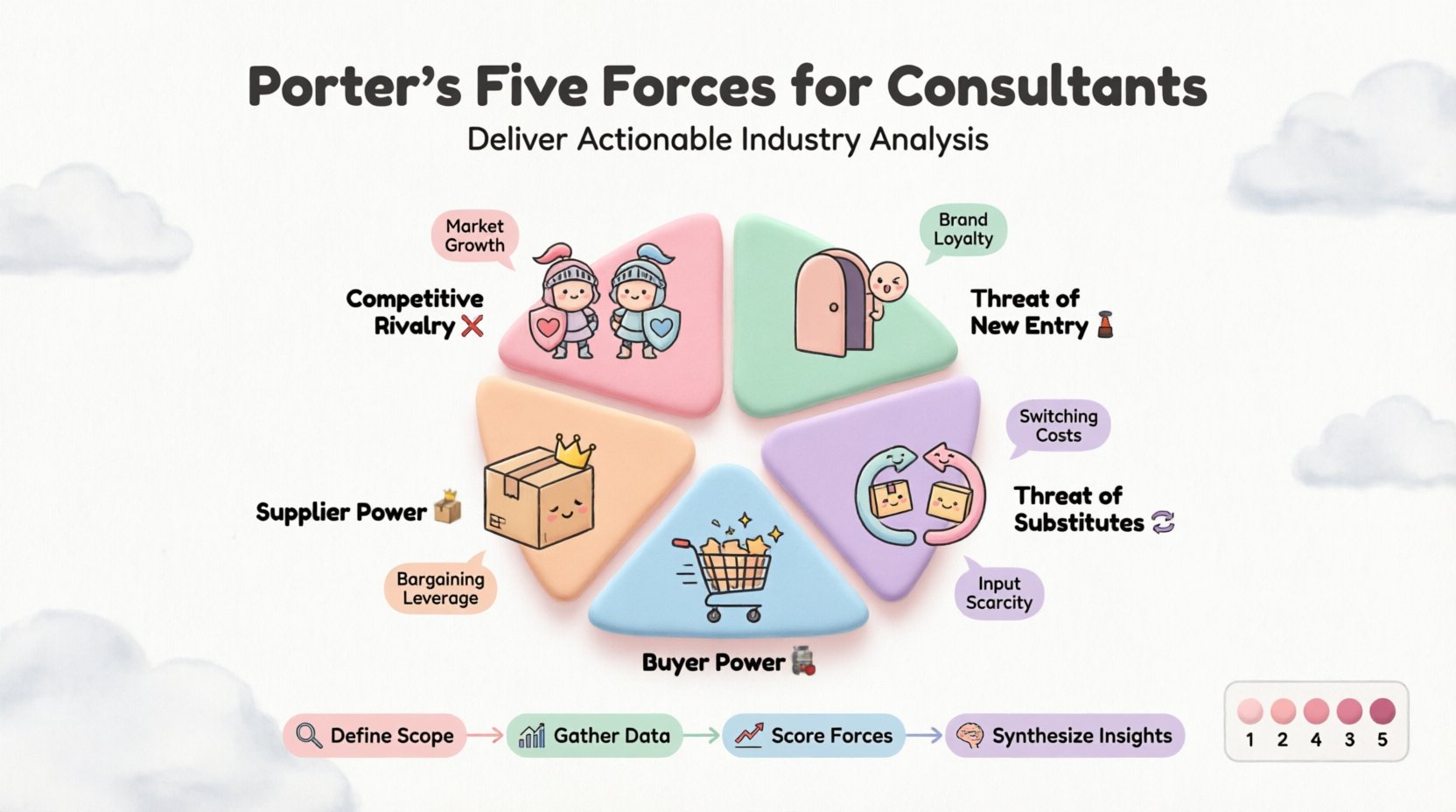
Porter’s Five Forces analysis examines the competitive environment of an industry. It moves beyond simple revenue figures to explore the structural factors that determine long-term profitability. For a consultant, the objective is to identify where value is created and where it is eroded. The framework consists of five distinct forces that shape every market.
- Competitive Rivalry: The intensity of competition among existing firms.
- Threat of New Entry: The ease with which new competitors can enter the market.
- Threat of Substitutes: The likelihood of customers switching to alternative solutions.
- Bargaining Power of Suppliers: The ability of vendors to dictate terms.
- Bargaining Power of Buyers: The ability of customers to demand lower prices or better quality.
Applying this framework requires deep industry knowledge and the ability to synthesize complex data into clear narratives. It is about understanding the why behind the numbers.
Deep Dive: The Five Forces Explained 🔍
To deliver actionable analysis, a consultant must understand the drivers within each force. Below is a detailed breakdown of how to analyze each component for a client engagement.
1. Competitive Rivalry ⚔️
This force represents the intensity of competition among existing players. High rivalry often leads to price wars, heavy marketing spend, and reduced profit margins. When assessing this for a client, consider the following drivers:
- Number of Competitors: A fragmented market with many small players behaves differently than an oligopoly with a few dominant firms.
- Industry Growth: Slow growth forces firms to fight for market share. Fast growth allows everyone to expand without conflict.
- Product Differentiation: If products are commoditized, price becomes the primary lever. Unique value propositions reduce rivalry.
- Exit Barriers: High costs to leave the industry (e.g., specialized assets) keep struggling firms in the market, sustaining competition.
- Fixed Costs: High fixed costs encourage firms to cut prices to utilize capacity, intensifying competition.
2. Threat of New Entry 🚪
The threat of new entrants depends on the barriers to entry. If barriers are low, new competitors can easily disrupt the status quo. Consultants must evaluate what protects the client’s market position.
- Capital Requirements: Does entering the market require significant investment? High capital needs deter new players.
- Regulatory Hurdles: Licenses, patents, or government approvals can restrict access.
- Access to Distribution Channels: Can a new player reach customers as easily as incumbents?
- Economies of Scale: If incumbents produce at a lower cost per unit due to volume, new entrants struggle to compete on price.
- Brand Loyalty: Strong established brands make it difficult for new names to gain traction.
3. Threat of Substitutes 🔄
Substitutes are products or services from outside the industry that fulfill the same need. This is often overlooked but is critical for long-term viability. A substitute may come from a completely different sector.
- Price-Performance Ratio: If a substitute offers better value, customers will switch.
- Switching Costs: How much does it cost the customer to change? High switching costs protect incumbents.
- Customer Tendency to Substitute: Some industries have a history of innovation making substitution easy (e.g., streaming vs. cable).
4. Bargaining Power of Suppliers 📦
Suppliers can squeeze profitability by raising prices or reducing quality. Their power depends on their ability to pass costs on to the industry.
- Supplier Concentration: If there are few suppliers, they hold more power.
- Uniqueness of Inputs: If the input is unique or patented, suppliers have leverage.
- Switching Costs: Is it expensive for the client to change suppliers?
- Threat of Forward Integration: Can the supplier enter the client’s business and become a competitor?
5. Bargaining Power of Buyers 🛒
Buyers (customers) demand lower prices or higher quality. Their power increases when they have many alternatives or when the product is a small part of their total cost.
- Buyer Concentration: Few large buyers hold more power than many small ones.
- Price Sensitivity: If the product is a small portion of the buyer’s budget, they are less sensitive.
- Availability of Information: Modern buyers have access to pricing data, increasing their leverage.
- Threat of Backward Integration: Can the buyer manufacture the product themselves?
Consultant’s Guide to Implementation 🛠️
Translating theory into client value requires a structured approach. The following steps outline the process of conducting a Five Forces analysis for a project.
Step 1: Define the Industry Scope 🔎
Clarity is essential. An industry definition that is too broad dilutes insights, while one that is too narrow misses context. Work with the client to agree on the boundaries. Is this a global analysis or regional? Is it the entire supply chain or just the final assembly?
Step 2: Data Gathering 📊
Reliable analysis rests on robust data. Sources should include:
- Public financial reports and filings.
- Industry association reports.
- Customer interviews and supplier surveys.
- Competitor press releases and strategic announcements.
- Regulatory documents and patent databases.
Avoid relying solely on secondary research. Primary interviews with industry insiders provide context that data cannot capture.
Step 3: Scoring the Forces 📉
Qualitative assessments must be standardized. Use a scoring matrix to evaluate the intensity of each force. This helps in comparing findings across different industries or time periods.
| Force | Intensity (1-5) | Key Driver | Impact on Profitability |
|---|---|---|---|
| Competitive Rivalry | 4 | Market Saturation | High |
| Threat of Entry | 2 | High Capital Needs | Low |
| Threat of Substitutes | 3 | Technology Shift | Medium |
| Supplier Power | 3 | Concentrated Supply | Medium |
| Buyer Power | 4 | Price Sensitivity | High |
This table structure allows stakeholders to quickly grasp the risk profile of the industry.
Step 4: Synthesizing Insights 🧠
Data alone does not equal strategy. The consultant’s role is to interpret what the forces mean for the client. For example, high buyer power might suggest a need for product differentiation or a shift to a subscription model to lock in recurring revenue.
Common Pitfalls in Analysis ⚠️
Even experienced strategists can stumble when applying this framework. Awareness of common errors ensures the quality of the deliverable.
- Static Analysis: Industries change. A snapshot analysis might miss emerging trends. Always consider how forces evolve over the next 3-5 years.
- Ignoring Ecosystem Dynamics: Focus only on direct competitors and miss indirect threats like platform shifts or regulatory changes.
- Overlooking Internal Capabilities: The framework analyzes the industry, but the client must have the capability to respond. Analyze the fit between industry forces and internal strengths.
- Generic Recommendations: Avoid advice that applies to everyone. Tailor strategies to the specific scorecard of the client’s situation.
Delivering Findings to Clients 📢
The final output of this work is the presentation of findings. How you communicate the analysis determines its impact.
Visualizing the Landscape 🎨
Use visual aids to represent the forces. A spider chart or a heat map can effectively show the intensity of each force. Visuals help executives grasp complex relationships quickly.
Focusing on Strategic Options 🚀
Connect the analysis directly to strategic choices. For each force, propose a mitigation strategy:
- High Rivalry: Focus on niche segmentation or operational efficiency.
- High Supplier Power: Diversify the supply base or invest in vertical integration.
- High Buyer Power: Increase switching costs through loyalty programs or proprietary technology.
- High Entry Threat: Build patents or secure exclusive distribution rights.
- High Substitute Threat: Innovate continuously to stay ahead of alternatives.
Case Scenarios: Applying the Framework 📝
To illustrate the practical application, consider two hypothetical scenarios.
Scenario A: Traditional Retail Banking 🏦
In this sector, Competitive Rivalry is high due to the presence of major national banks and credit unions. Buyer Power is increasing as customers compare fees digitally. Threat of New Entry is low due to heavy regulation, but Threat of Substitutes is rising from fintech startups offering better user experiences. Supplier Power is moderate, driven by technology vendors.
The strategic recommendation for a traditional bank here involves digital transformation to reduce costs and improve customer experience, thereby countering buyer power and substitutes.
Scenario B: Specialty Pharmaceuticals 💊
Here, Threat of New Entry is low due to patent protections and R&D costs. Competitive Rivalry is moderate within specific drug classes. Buyer Power is complex, involving insurers and government bodies rather than just patients. Supplier Power is high for raw materials if specialized.
The strategy focuses on pipeline innovation to maintain patent protection and negotiate favorable terms with payers to manage buyer power.
Limitations and Contextual Nuances 🧩
No framework is perfect. Porter’s Five Forces has limitations that consultants must acknowledge to maintain credibility.
- Focus on Industry Structure: It focuses on the external environment and less on the internal capabilities of the firm. It does not account for culture or management quality.
- Static Nature: It provides a snapshot in time. In rapidly evolving tech sectors, the analysis can become outdated quickly.
- Assumption of Profit Maximization: It assumes firms aim to maximize profit, which may not always be true in non-profits or public sector organizations.
- Network Effects: In digital platforms, network effects can override traditional force dynamics. A new entrant with a large network can displace incumbents regardless of capital barriers.
Addressing these limitations shows a sophisticated understanding of the tool. It demonstrates that the consultant knows when to use the framework and when to supplement it with other models.
Measuring the Impact of the Analysis 📏
How do you know the analysis was successful? Evaluation should happen post-engagement.
- Strategy Adoption: Did the client implement the recommended changes?
- Performance Metrics: Did the proposed strategies improve margins or market share over time?
- Stakeholder Confidence: Did the board and executives feel more confident in their strategic direction?
- Resource Allocation: Did the analysis help the client stop investing in low-value areas and focus on high-potential ones?
Tracking these outcomes validates the consulting engagement and builds trust for future work.
Integrating with Other Strategic Tools 🔗
A robust analysis rarely relies on a single model. Porter’s Five Forces pairs well with other frameworks.
- SWOT Analysis: Use Five Forces to inform the Opportunities and Threats sections.
- Value Chain Analysis: Use Five Forces to understand external pressure on specific activities within the value chain.
- PESTLE Analysis: Use PESTLE to understand macro-environmental factors that influence the Five Forces.
This integration creates a holistic view of the business environment.
Final Thoughts on Strategic Rigor 🧐
The value of Porter’s Five Forces lies in its discipline. It forces consultants and clients to look beyond the surface and question the structure of the market. It prevents assumptions and encourages evidence-based decision-making. For the modern consultant, it remains a foundational element of the strategic toolkit.
Success comes from applying the framework with rigor, maintaining objectivity, and translating findings into clear, actionable steps. By mastering the nuances of each force and understanding how they interact, consultants can provide guidance that stands the test of time. The goal is not just to analyze, but to enable the client to navigate their industry with clarity and confidence.
When you move from theory to practice, the impact is measurable. Clients who understand their competitive landscape are better equipped to defend their position and seize opportunities. This is the essence of strategic consulting.