
Understanding the structural dynamics of an industry is the foundation of sustainable business success. Michael Porter introduced the Five Forces framework in 1979, providing a method to assess the competitive intensity and attractiveness of a market. This guide explores how to move beyond simple analysis and translate those insights into concrete strategic action plans. We will examine each force in detail, discuss how they interact to shape profitability, and outline steps to operationalize this knowledge.
Why Industry Structure Matters 🏗️
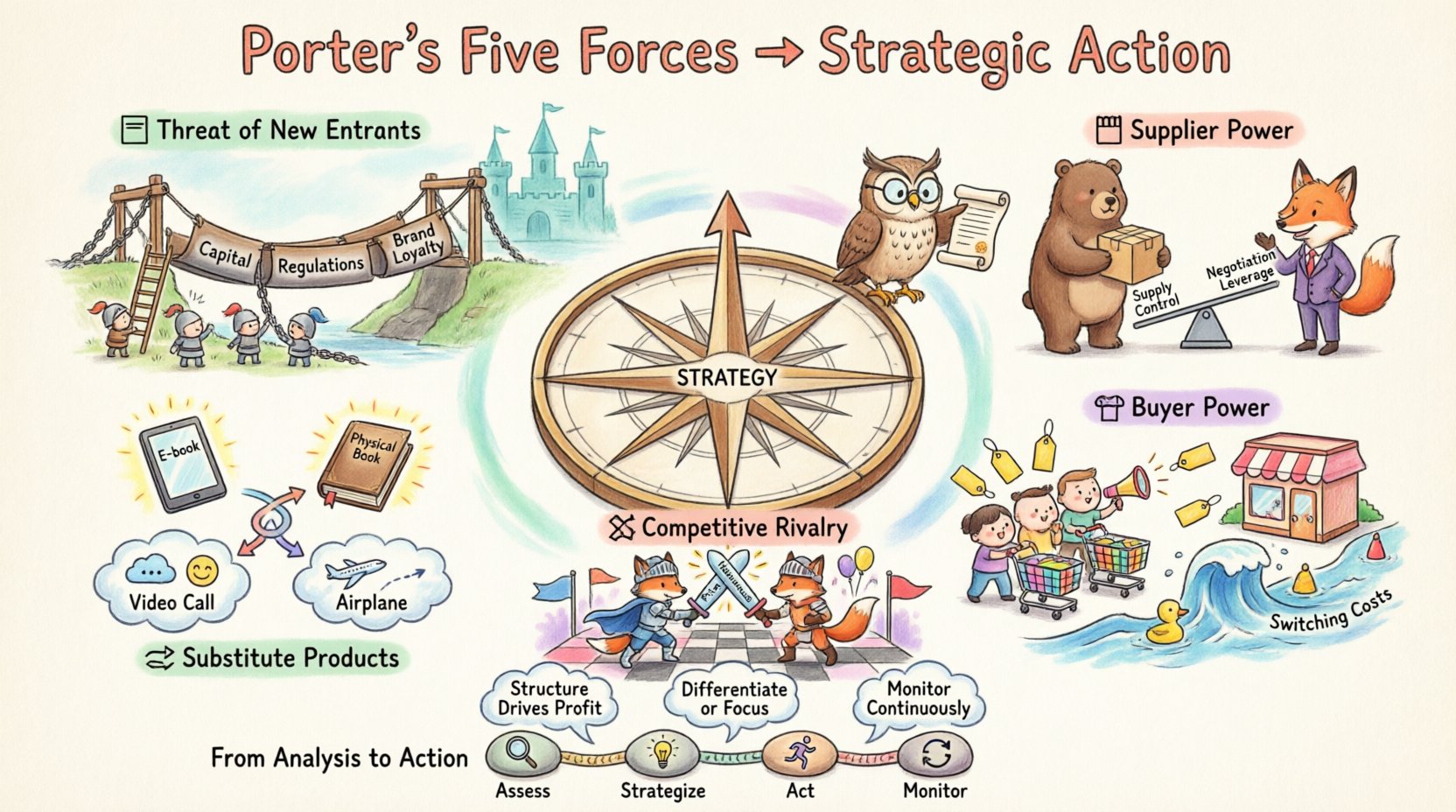
Profitability is not solely determined by a company’s internal efficiency. It is heavily influenced by the external environment. A company can be exceptionally efficient, yet if the industry structure is unfavorable, profitability will remain low. The Five Forces model identifies the five key factors that determine the intensity of competition and the profit potential of an industry.
- Threat of New Entrants: How easy is it for new competitors to enter the market?
- Bargaining Power of Suppliers: How much control do suppliers have over prices?
- Bargaining Power of Buyers: How much pressure can customers exert to drive prices down?
- Threat of Substitute Products: Are there alternative solutions available to customers?
- Rivalry Among Existing Competitors: How intense is the competition between current players?
When these forces are strong, the collective power suppresses profit margins. When they are weak, the industry offers opportunities for higher returns. The goal is to position the organization where these forces are weakest or to influence them in the company’s favor.
Deep Dive into the Five Forces 🔍
1. Threat of New Entrants 🚪
Barriers to entry protect existing companies from new competition. High barriers mean the threat is low, preserving profitability. Low barriers invite a flood of competitors, driving prices down and increasing marketing costs.
Key Barriers to Consider:
- Capital Requirements: Is significant investment needed for equipment, inventory, or R&D?
- Economies of Scale: Can existing players produce at a lower unit cost due to volume?
- Regulatory Hurdles: Are there licenses, patents, or compliance standards required?
- Customer Loyalty: Is it difficult to persuade customers to switch brands?
- Distribution Channels: Are established channels blocked by long-term contracts?
If barriers are low, a strategic action plan must focus on creating unique value that cannot be easily replicated. If barriers are high, the strategy shifts to maintaining those barriers through continuous innovation and brand strength.
2. Bargaining Power of Suppliers 📦
Suppliers can squeeze profitability by raising prices or reducing the quality of goods. Their power depends on how many suppliers exist relative to the number of buyers.
Indicators of Supplier Power:
- Supplier Concentration: Are there few suppliers dominating the market?
- Switching Costs: How expensive is it to change suppliers?
- Criticality of Input: Is the supplier’s product a major component of the final good?
- Threat of Forward Integration: Can the supplier become a competitor?
Strategic responses include diversifying the supplier base, vertical integration (buying the supplier), or designing products that are less dependent on specific inputs. Reducing reliance on a single source is a common mitigation tactic.
3. Bargaining Power of Buyers 🛒
Customers exert pressure to lower prices or demand higher quality. Their power increases when they can easily switch between competitors or when they buy in large volumes.
Indicators of Buyer Power:
- Volume of Purchase: Do buyers purchase a significant portion of the seller’s output?
- Price Sensitivity: Is the product a commodity where price is the main differentiator?
- Switching Costs: Is it easy for buyers to change providers?
- Availability of Information: Do buyers know the market price clearly?
High buyer power often leads to price wars. To counter this, companies focus on differentiation. Creating a unique brand, offering superior service, or locking customers into a system increases switching costs and reduces buyer leverage.
4. Threat of Substitute Products 🔄
Substitutes are products from outside the industry that perform the same function. They place a ceiling on prices because customers can switch if the price gets too high.
Considerations for Substitutes:
- Price-Performance Ratio: Is the substitute cheaper and equally effective?
- Switching Incentive: Do customers perceive enough benefit in switching?
- Technological Change: Are new technologies making old solutions obsolete?
For example, video conferencing software acts as a substitute for business travel. A strategic plan must address this by improving the core value proposition or expanding into complementary services that make the substitute less attractive.
5. Rivalry Among Existing Competitors ⚔️
This is often the most visible force. It involves competing for market share through price, advertising, innovation, and service. Intense rivalry can erode profits for everyone involved.
Factors Driving Rivalry:
- Number of Competitors: More competitors usually mean more intense fighting.
- Industry Growth Rate: Slow growth forces companies to fight for existing market share.
- Exit Barriers: Are there high costs to leave the industry (e.g., specialized assets)?
- Product Homogeneity: If products are identical, competition becomes purely price-based.
When rivalry is high, differentiation is crucial. Companies must find niches or segments where they can dominate rather than fighting across the entire market.
Linking Analysis to Strategic Action Plans 📝
Conducting the analysis is only the first step. The real value lies in connecting these findings to specific strategic actions. This section outlines how to translate insights into operational reality.
Step 1: Assess Current Position
Begin by gathering data on each force. Use internal financial reports, market research, and competitor analysis. Create a visual matrix to score the intensity of each force (Low, Medium, High).
| Force | Intensity Score (1-5) | Key Driver |
|---|---|---|
| New Entrants | 3 | Low Capital Requirement |
| Supplier Power | 2 | Many Available Suppliers |
| Buyer Power | 4 | High Switching Costs |
| Substitutes | 3 | Emerging Tech |
| Rivalry | 5 | Price Wars |
This table highlights where the pressure is greatest. In the example above, Rivalry and Buyer Power are the critical areas requiring immediate attention.
Step 2: Define Strategic Direction
Based on the assessment, select a general strategic approach. Porter identified three generic strategies that help organizations cope with competitive forces.
- Cost Leadership: Aim to be the lowest-cost producer. This protects against buyer power and allows for price wars.
- Differentiation: Offer unique features that justify a premium price. This reduces buyer power and mitigates rivalry.
- Focus: Target a specific niche market. This allows for deep understanding of buyer needs and reduces direct competition.
Choosing a strategy requires commitment. Trying to be everything to everyone often results in being stuck in the middle, unable to compete on cost or uniqueness.
Step 3: Develop Specific Action Items
Generic strategies need specific actions to succeed. Below are examples of how to link force analysis to action.
| Force Identified | Strategic Goal | Actionable Plan |
|---|---|---|
| High Buyer Power | Reduce Switching Costs | Develop loyalty programs and integrated software ecosystems. |
| High Supplier Power | Diversify Supply Chain | Identify and qualify three alternative suppliers per critical component. |
| High Rivalry | Differentiate Service | Implement 24/7 customer support and faster delivery windows. |
| Threat of Entrants | Build Brand Equity | Invest in marketing campaigns highlighting brand heritage and trust. |
Step 4: Resource Allocation
Once actions are defined, allocate resources accordingly. Budget for R&D if differentiation is the goal. Invest in supply chain logistics if cost leadership is the path. Ensure the budget aligns with the strategic intent. A mismatch here leads to strategic drift.
Implementation and Monitoring 🔄
Strategy is not a one-time event. The competitive landscape changes. A new technology, regulation, or economic shift can alter the Five Forces overnight.
Establish KPIs
Define metrics to track the effectiveness of your strategic plan. These should relate directly to the forces being addressed.
- For Buyer Power: Customer retention rate, Net Promoter Score (NPS), churn rate.
- For Cost Leadership: Gross margin percentage, operating expense ratio.
- For Rivalry: Market share percentage, brand sentiment analysis.
Regular Review Cycles
Schedule quarterly or bi-annual reviews of the Five Forces analysis. Update the data and reassess the intensity scores. If a force has shifted from High to Low, you may be able to adjust your strategy to capture more profit. If a force has shifted from Low to High, you must pivot quickly.
Common Pitfalls in Analysis ⚠️
Even experienced strategists can make mistakes when applying this framework. Being aware of these pitfalls ensures more accurate planning.
- Static Analysis: Treating the industry as unchanging. Industries evolve. A static view leads to outdated strategies.
- Ignoring Complements: Porter later added a sixth force: Complements. Products that increase the value of your offering (e.g., apps for a phone) are crucial to consider.
- Internal Focus: Focusing too much on internal capabilities and ignoring external threats. You can be efficient but in a dying industry.
- Overgeneralization: Applying the same analysis to all segments of a company. A company might have low rivalry in one division and high rivalry in another.
Case Example: The Streaming Industry 📺
To illustrate the practical application, consider the streaming media sector.
- Rivalry: Extremely high. Multiple platforms compete for the same subscription dollars.
- Buyer Power: High. Subscription cancellations are easy (low switching costs).
- Supplier Power: Mixed. Content creators have power, but platforms are aggregating rights.
- Threat of Substitutes: High. Social media, video games, and traditional TV compete for leisure time.
- Entrants: Moderate. Capital requirements are high, but tech giants have entered the space.
Strategic Action: To survive high rivalry and buyer power, a streaming service must focus on exclusive content (Differentiation) and create a bundled ecosystem (Reducing Switching Costs).
Final Considerations for Strategy 🎯
Porter’s Five Forces remains a vital tool for understanding where profits come from. It shifts the focus from internal operations to external market dynamics. By systematically analyzing each force, leaders can identify the specific levers they need to pull to improve their market position.
The transition from analysis to action requires discipline. It involves making tough choices about where to invest, where to cut, and where to innovate. There is no magic formula, but there is a clear methodology. Start with the data, identify the strongest pressures, and build a plan that neutralizes those threats or leverages them.
Remember that strategy is about choice. You cannot be the lowest cost, the best quality, and the most exclusive simultaneously. The framework helps you see where the trade-offs lie. Use it to find a position where you can defend against competitive forces and sustain profitability over the long term.
Summary of Key Takeaways ✅
- Structure Drives Profit: Industry structure determines the potential for profit more than internal efficiency alone.
- Five Forces Framework: Analyze entrants, suppliers, buyers, substitutes, and rivalry to understand market dynamics.
- Actionable Insights: Translate force intensity into specific strategic goals like cost reduction or differentiation.
- Continuous Monitoring: Reassess the forces regularly as the market evolves.
- Resource Alignment: Ensure budget and talent align with the chosen strategic direction.
By following this structured approach, organizations can navigate complex competitive environments with clarity and confidence. The goal is not just to survive the competition, but to shape the industry in a way that favors your long-term growth and stability.