
Strategic management education relies heavily on practical application. For MBA students, understanding theoretical frameworks is only the first step. The true value lies in applying these models to complex, real-world business environments. One of the most enduring tools in this toolkit is Porter’s Five Forces. This framework provides a structured way to evaluate the competitive intensity and attractiveness of a market.
When approaching a case study, students must move beyond simple definitions. They need to dissect industry dynamics, quantify risks, and formulate actionable recommendations. This guide details the methodical process of using Porter’s Five Forces within an academic case study context. It covers data gathering, analysis techniques, and common pitfalls to avoid during the evaluation process.
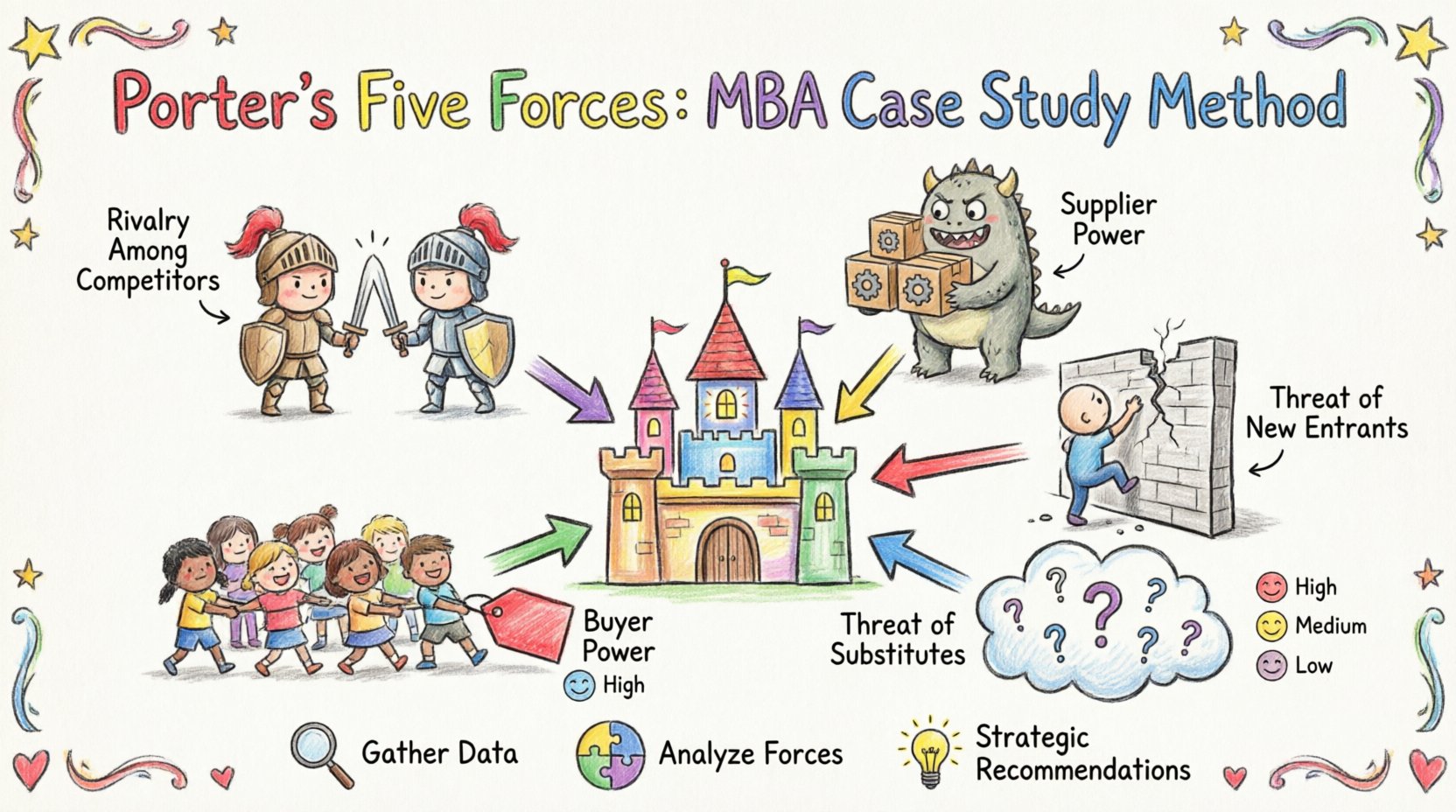
🔍 Understanding the Core Framework
Michael Porter introduced this model to explain why different industries possess varying levels of profitability. It shifts the focus from internal company capabilities to external market conditions. By analyzing five specific forces, a strategist can determine the balance of power between buyers, suppliers, competitors, and substitutes.
In an MBA setting, this analysis often serves as the foundation for broader strategic decisions. Whether evaluating a potential market entry or assessing a merger, the Five Forces provide context. The goal is not just to list the forces, but to understand their interplay.
Why This Matters for Strategy
- Identifying Profitability Drivers: It reveals where margins are likely to be squeezed.
- Assessing Entry Barriers: It helps determine how difficult it is for new players to disrupt the market.
- Forecasting Trends: It highlights structural changes that may occur over time.
- Informing Negotiations: It clarifies the bargaining power of stakeholders during deal-making.
🧩 Deconstructing the Five Forces
To analyze a scenario effectively, each force must be examined individually. Below is a breakdown of each component, including the specific questions an analyst should ask during a case study review.
| Force | Definition | Key Analytical Questions |
|---|---|---|
| Rivalry Among Competitors | The intensity of competition among existing firms. | How many competitors exist? Is growth slow or fast? Are products commoditized? |
| Threat of New Entrants | The ease with which new competitors can enter the market. | Are there high capital requirements? Is there strong brand loyalty? Are regulations restrictive? |
| Bargaining Power of Suppliers | The ability of suppliers to drive up prices or reduce quality. | How many suppliers are there? Is there a risk of backward integration? Are switching costs high? |
| Bargaining Power of Buyers | The ability of customers to drive down prices or demand better quality. | Are buyers concentrated? Is the product differentiated? Are there low switching costs? |
| Threat of Substitutes | The availability of alternative solutions that fulfill the same need. | What are the alternatives? Is the price-performance ratio favorable? Is the switching cost low? |
📚 The Case Study Approach
A case study is rarely a simple snapshot of a static environment. It often involves historical data, future projections, and specific company constraints. The method requires a disciplined workflow to ensure all variables are considered.
Phase 1: Information Gathering
Before applying the framework, sufficient data must be collected. In a classroom setting, this usually comes from the case packet. In real-world scenarios, it involves external research.
- Financial Reports: Review annual reports for revenue trends, margin analysis, and R&D spending.
- Industry Reports: Look for market size data, growth rates, and CAGR figures from research firms.
- News Articles: Scan for recent mergers, regulatory changes, or technological disruptions.
- Competitor Analysis: Examine the websites and public filings of direct and indirect competitors.
Phase 2: Structural Analysis
Once data is assembled, map it to the five forces. This step is qualitative but should be supported by quantitative evidence where possible.
- Map the Industry: Draw a diagram showing the five forces around the central company.
- Assign Strength: Label each force as High, Medium, or Low impact on profitability.
- Identify Drivers: Note specific factors (e.g., technology, regulation, consolidation) driving the strength of each force.
🛠️ Step-by-Step Execution Guide
Executing a Five Forces analysis requires attention to detail. The following steps outline a robust workflow for students tackling complex business problems.
Step 1: Define the Industry Boundaries
Clarity on scope is essential. If the scope is too broad, the analysis becomes vague. If it is too narrow, it misses external threats.
- Product Definition: Define what the product actually does. Is it a “beverage” or specifically “carbonated soft drinks”?
- Geographic Scope: Is the analysis global, regional, or local? Regulations differ significantly by region.
- Customer Segments: Identify who buys the product. B2B and B2C dynamics vary widely.
Step 2: Evaluate Competitive Rivalry
This is often the most visible force. Look at the market structure.
- Number of Players: A monopoly or oligopoly behaves differently than a fragmented market.
- Industry Growth: In stagnant markets, firms fight for market share. In growing markets, they can expand together.
- Exit Barriers: High exit barriers (e.g., specialized assets, emotional ties) lead to aggressive competition to stay afloat.
- Differentiation: If products are identical, price wars are common. If unique, margins are protected.
Step 3: Assess Entry and Exit Barriers
New entrants threaten profitability by adding capacity and reducing prices.
- Capital Requirements: Does entering require billions in investment?
- Access to Distribution: Can new players get their product on shelves or online?
- Government Policy: Licenses, patents, and tariffs can block entry.
- Economies of Scale: If incumbents are much larger and cheaper, new entrants struggle.
Step 4: Analyze Supplier Power
Suppliers can reduce profitability by raising prices or lowering quality.
- Concentration: Are there few suppliers or many?
- Uniqueness: Is the input proprietary or commoditized?
- Switching Costs: How hard is it to change suppliers? Technical integration or training costs matter.
- Threat of Forward Integration: Can suppliers start making the product themselves?
Step 5: Analyze Buyer Power
Buyers can reduce profitability by demanding lower prices or better service.
- Concentration: Are a few large buyers purchasing the majority of output?
- Price Sensitivity: Does the product represent a significant portion of the buyer’s costs?
- Threat of Backward Integration: Can buyers start making the product themselves?
- Availability of Information: Do buyers know the market price easily?
Step 6: Evaluate Substitute Threats
Substitutes limit the price a company can charge.
- Performance: Does the substitute offer better value or convenience?
- Cost: Is the alternative cheaper to acquire?
- Switching Propensity: How easily can customers move to the alternative?
- Psychological Factors: Are there habits or brand preferences preventing the switch?
📈 Integrating Financial Metrics
Theoretical analysis must be grounded in financial reality. A strong case study links the Five Forces to Return on Invested Capital (ROIC) and Operating Margins.
Connecting Forces to Margins
- High Rivalry: Typically leads to lower operating margins due to price competition.
- High Supplier Power: Increases Cost of Goods Sold (COGS), reducing gross margin.
- High Buyer Power: Limits the ability to raise prices, constraining revenue growth.
- High Substitute Threat: Caps the price ceiling, preventing premium pricing strategies.
Using Ratios
When analyzing a specific company case, use ratios to validate the force assessment.
- Gross Margin: Compare against industry averages to gauge pricing power.
- Operating Margin: Reflects efficiency and competitive pressure on costs.
- Inventory Turnover: High turnover often indicates strong demand or low rivalry.
- Asset Turnover: Indicates how efficiently the company uses its assets to generate sales.
⚠️ Common Mistakes to Avoid
Even experienced analysts make errors when applying this framework. Recognizing these pitfalls helps improve the quality of the analysis.
- Static Analysis: Forgetting that forces change over time. Technology can shift power dynamics rapidly.
- Ignoring Macro Trends: Focusing only on industry specifics while missing regulatory or economic shifts.
- Overgeneralizing: Assuming all forces are high or low without specific evidence.
- Neglecting Substitutes: Focusing only on direct competitors while missing disruptive alternative technologies.
- Confusing Forces with SWOT: The Five Forces are external. SWOT includes internal strengths and weaknesses. Do not mix them in the same section.
🏢 Example Scenario: The Electric Vehicle Industry
To illustrate the method, consider a hypothetical analysis of the Electric Vehicle (EV) sector. This demonstrates how to synthesize the forces into a cohesive narrative.
1. Competitive Rivalry: High
Traditional automakers are pivoting to EVs, increasing the number of players. Tech companies are also entering the space. Price wars are emerging as production scales.
2. Threat of New Entrants: Medium
While capital requirements are high, government subsidies and contract manufacturing lower barriers. However, brand trust and battery supply chains remain significant hurdles.
3. Supplier Power: High
Lithium, cobalt, and nickel suppliers hold significant leverage. Battery technology is concentrated among a few manufacturers. This drives up input costs.
4. Buyer Power: Medium to High
Consumers have many choices. Range anxiety and charging infrastructure are key concerns. However, government tax credits reduce price sensitivity for some segments.
5. Threat of Substitutes: Medium
Hybrid vehicles, public transportation, and improved internal combustion engines act as substitutes. Fuel prices also influence this dynamic.
Strategic Implication
In this scenario, a company must secure its supply chain to mitigate supplier power. It must differentiate through technology to counter rivalry. Vertical integration may be necessary to control costs.
🏁 Building a Strategic Recommendation
The analysis is useless without a clear path forward. Recommendations should directly address the findings from the Five Forces.
- If Rivalry is High: Recommend differentiation or cost leadership. Suggest niche targeting.
- If Supplier Power is High: Suggest vertical integration or long-term contracts.
- If Buyer Power is High: Focus on loyalty programs or switching costs.
- If Threat of Entry is High: Invest in patents or build brand equity.
- If Substitute Threat is High: Innovate to stay ahead of alternatives.
📝 Conclusion
Applying Porter’s Five Forces in a case study requires rigor and depth. It moves beyond simple categorization to a nuanced understanding of industry dynamics. By systematically evaluating each force and linking them to financial metrics, students can produce robust strategic recommendations. The framework remains relevant because it focuses on the fundamental economics of competition.
Success in this analysis depends on the quality of data and the clarity of the argument. Avoid assumptions. Support every claim with evidence from the case or external research. With practice, this method becomes a reliable tool for dissecting any business scenario.
Remember that industries evolve. The forces present today may shift tomorrow. Continuous monitoring and adaptation are necessary for long-term strategic success. This framework serves as a baseline for that ongoing evaluation.