
Entering a new market is a high-stakes endeavor. For founders and strategic leaders, the difference between a thriving venture and a failed startup often lies in understanding the underlying structural forces of the industry. Before writing a single line of code or drafting a pitch deck, entrepreneurs must assess the competitive landscape. This is where Porter’s Five Forces Analysis becomes an essential tool. It provides a structured method to evaluate the intensity of competition and the profitability of an industry.
This guide explores how to apply this framework specifically to new ventures. By dissecting the five critical forces, you can identify risks, uncover opportunities, and construct a business model that is resilient against market pressures. We will move beyond theory into practical application, examining how each force impacts startup strategy and what actions can be taken to secure a competitive advantage.
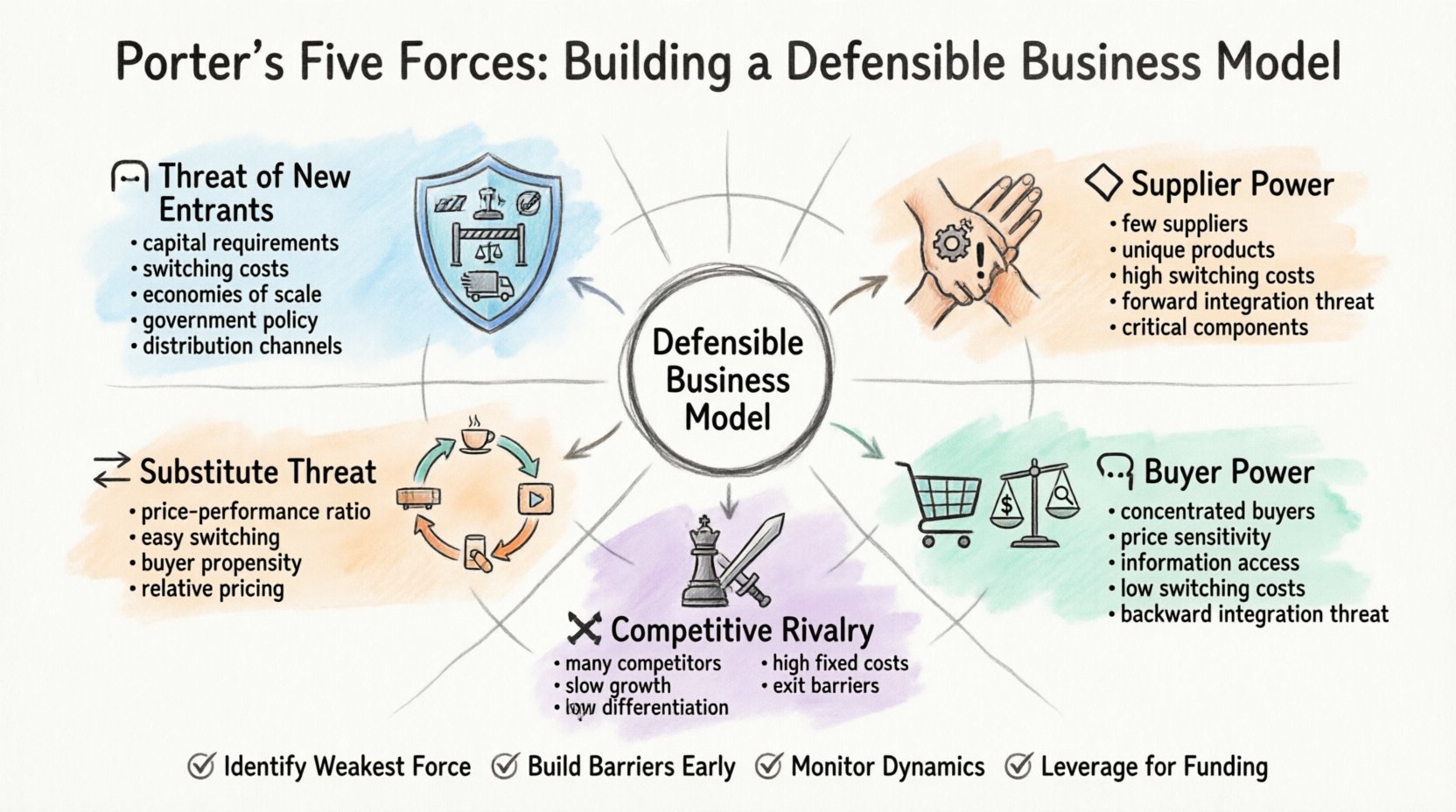
📚 Understanding the Five Forces Framework
Developed by Michael Porter in 1979, this framework analyzes the competitive environment of an industry. It posits that the profitability of an industry is determined by five specific forces. These forces collectively determine the intensity of competition and the potential for profit.
For a new venture, this analysis is not just about survival; it is about positioning. It helps answer critical questions regarding:
- Is the industry attractive for entry?
- Where are the margins likely to be compressed?
- What barriers exist to protect market share?
- How dependent is the business on key suppliers or customers?
Unlike a SWOT analysis, which is often internal, the Five Forces model is external. It focuses strictly on the market environment. When combined with internal capabilities, it forms the basis of a defensible business model. A defensible model is one that creates barriers to entry for competitors and reduces the leverage held by suppliers and customers.
🚪 1️⃣ Threat of New Entrants
This force measures how easy or difficult it is for potential competitors to enter your industry. If barriers to entry are low, new players can flood the market, driving down prices and reducing profitability for everyone. For a new venture, understanding these barriers is crucial because you are essentially a new entrant yourself, and you must anticipate future ones.
Key Factors Influencing Entry Barriers
Several factors contribute to the threat of new entrants. These include:
- Capital Requirements: High upfront investment in equipment, inventory, or technology can deter entry. A venture with a lean capital model might struggle to compete against incumbents with deep pockets, or conversely, succeed if the incumbents are burdened by legacy costs.
- Switching Costs: If customers face high costs to switch from one provider to another, they are less likely to try a new competitor. New ventures often try to lower these costs for the buyer to gain traction.
- Economies of Scale: Incumbents who produce at a large scale enjoy lower per-unit costs. New ventures must find a niche or a unique value proposition that does not rely on competing on price alone.
- Government Policy: Regulations, licensing, and patents can create legal barriers that protect existing players.
- Access to Distribution Channels: If established players control the primary channels through which products reach consumers, new entrants face a significant hurdle.
For a startup, the strategy here involves either building your own barriers or finding a segment where these barriers are already high enough to protect you from future disruption. Alternatively, you might design a business model that is agile enough to survive low barriers by pivoting quickly.
🤝 2️⃣ Bargaining Power of Suppliers
Suppliers can exert power by raising prices or reducing the quality of goods and services. If a business relies on a single source for a critical component, that supplier holds significant leverage. This power directly impacts the cost structure and profit margins of the venture.
Indicators of Supplier Power
To assess this force, consider the following dynamics:
- Number of Suppliers: Fewer suppliers generally mean higher power. If there are only two sources for a key ingredient, the supplier can dictate terms.
- Uniqueness of Product: If a supplier offers a differentiated product with no substitutes, their power increases. Generic commodities usually result in lower supplier power.
- Switching Costs: If changing suppliers requires significant retooling or retraining, the incumbent supplier has more leverage.
- Forward Integration: If a supplier can easily enter your market and become a competitor, they may use that threat to negotiate better terms.
- Criticality: If the supplied item is a major portion of your total cost or essential to the final product, their power is higher.
New ventures often face high supplier power because they lack volume and brand recognition. To mitigate this, startups should look for multiple sourcing options, develop long-term partnerships, or vertically integrate where feasible. Reducing dependency on any single entity is a core tenet of building a robust supply chain.
🛒 3️⃣ Bargaining Power of Buyers
Customers also hold power. If buyers can easily switch to competitors, demand price sensitivity, or have access to information, they can drive down prices. For a new venture, customer acquisition cost and retention are directly tied to buyer power.
Indicators of Buyer Power
Analyze the buyer side of the equation with these criteria:
- Concentration of Buyers: If a few large customers account for most of your revenue, they hold significant power. They can demand discounts or special treatment.
- Price Sensitivity: If the product is a commodity or a small portion of the buyer’s total cost, price sensitivity is lower. If it is a significant expense, buyers will haggle.
- Availability of Information: Modern buyers are well-informed. If they can easily compare prices and features, you must compete on value beyond just cost.
- Switching Costs: If it is easy for a customer to leave you for a competitor, your retention will be difficult.
- Threat of Backward Integration: If buyers can produce the product themselves, they can threaten to do so to lower costs.
Strategies to reduce buyer power include differentiation. If your product is unique, customers cannot easily switch. Building strong brand loyalty also reduces sensitivity to price changes. For new ventures, focusing on a specific niche where buyers are less price-sensitive can be a viable entry strategy.
🔄 4️⃣ Threat of Substitute Products or Services
Substitutes are not direct competitors but offer different solutions to the same problem. A coffee shop does not just compete with other coffee shops; it competes with tea shops, energy drinks, or even home brewing setups. This force limits the potential price you can charge, as customers have alternatives.
Assessing the Substitute Threat
Consider these factors when evaluating substitutes:
- Price-Performance Ratio: If a substitute offers better value or performance for the same price, the threat is high.
- Switching Costs: How hard is it for the customer to switch to the alternative? Low switching costs increase the threat.
- Buyer Propensity to Substitute: Do customers actively look for alternatives? Some industries have high substitution rates, while others are sticky.
- Relative Price: If substitutes are cheaper, they become more attractive.
For new ventures, ignoring substitutes is a common pitfall. You must define the problem you are solving, not just the product you are building. If a substitute can solve the problem more efficiently, your business model may be vulnerable. Innovation often comes from beating the substitute, not just the direct competitor.
⚔️ 5️⃣ Rivalry Among Existing Competitors
This is the most visible force. It involves the intensity of competition among current players in the industry. High rivalry leads to price wars, advertising battles, and product innovations, which can erode profits for everyone involved.
Factors Driving Competitive Rivalry
Several elements dictate the level of rivalry:
- Number of Competitors: Many competitors of similar size create intense rivalry. A monopoly or duopoly reduces it.
- Industry Growth: In a slow-growth market, competitors fight for market share. In a fast-growth market, they can grow without fighting.
- Fixed Costs: High fixed costs pressure companies to fill capacity, often leading to price cuts.
- Product Differentiation: If products are undifferentiated, competition focuses on price. Differentiation allows for premium pricing.
- Exit Barriers: If it is expensive or difficult to leave the industry, companies may stay and fight, increasing rivalry.
New ventures should look for markets where growth is high or where differentiation is possible. Entering a saturated market with low growth requires a significant competitive advantage to succeed. Analyzing the rivals’ strategies helps identify gaps in the market that the new venture can exploit.
📊 Analyzing the Forces: A Comparison Table
To make this analysis actionable, it helps to compare the indicators for each force. This table summarizes the key drivers for each force that a new venture should evaluate.
| Force | Key Question for Startups | Strategic Implication |
|---|---|---|
| New Entrants | How easy is it for others to copy us? | Build IP, brand, or network effects. |
| Suppliers | Can they raise our costs? | Diversify sourcing, negotiate long-term deals. |
| Buyers | Can they force us to lower prices? | Differentiate, increase switching costs. |
| Substitutes | Can customers solve this differently? | Focus on user experience, not just features. |
| Rivalry | Are competitors fighting on price? | Avoid price wars; focus on niche value. |
🚀 Strategic Application for New Ventures
Conducting the analysis is only the first step. The value lies in translating the findings into a strategic plan. Here is how to apply these insights to build a defensible business model.
1. Identify the Weakest Force
Not all forces are equally strong. In some industries, supplier power is high, but buyer power is low. In others, rivalry is fierce, but substitutes are rare. A new venture should position itself where the forces are weakest. If supplier power is high, avoid industries where raw materials are scarce. If rivalry is high, look for a niche that incumbents ignore.
2. Build Barriers Early
Once you identify the forces that threaten you, build barriers to mitigate them. If the threat of new entrants is high, focus on building a brand that new players cannot easily replicate. If buyer power is high, create a platform or ecosystem that increases switching costs for the customer.
3. Monitor Industry Dynamics
The Five Forces are not static. Technology changes, regulations shift, and consumer preferences evolve. A force that is weak today might become strong tomorrow. Continuous monitoring is required to keep the business model defensible over time.
4. Leverage the Analysis for Funding
Investors want to know that you understand the risks of your market. Using the Five Forces framework in a pitch deck demonstrates strategic depth. It shows that you have analyzed the industry structure and have a plan to navigate the competitive landscape. This builds confidence in your leadership and your long-term viability.
⚠️ Common Pitfalls in Analysis
Even with a solid framework, errors can occur during the assessment process. Being aware of common pitfalls ensures the analysis remains accurate and useful.
- Confusing Industry with Company: The framework analyzes the industry structure, not the specific company. A strong company can exist in a weak industry, and vice versa. Do not use the analysis to excuse poor internal performance.
- Static Viewpoint: Treating the forces as unchanging. The digital economy changes rapidly. A substitute that did not exist five years ago might now dominate the market.
- Ignoring Complementary Products: Sometimes, products that complement yours are more important than substitutes. If the complementary product fails, your product may fail too.
- Over-Generalization: Applying broad industry trends to a specific niche without nuance. A new venture often targets a specific segment, which may have different force dynamics than the broader industry.
- Analysis Paralysis: Spending too much time analyzing and not enough time executing. The goal is to inform decisions, not to replace action.
🔗 Integrating with Broader Strategic Planning
The Five Forces Analysis should not stand alone. It works best when integrated with other strategic tools. This creates a holistic view of the venture’s position.
Combining with SWOT
SWOT (Strengths, Weaknesses, Opportunities, Threats) complements the Five Forces. The external threats identified in the Five Forces become the Threats in the SWOT analysis. The internal strengths and weaknesses can then be matched against these external forces to determine strategy. For example, if the analysis reveals high supplier power, your internal strength might be a strong cash reserve to negotiate long-term contracts.
Combining with Value Chain Analysis
Once you know the external pressures, you can look at your internal value chain. Where can you add value to withstand supplier pressure? Where can you reduce costs to withstand buyer pressure? This internal view ensures that the external analysis leads to actionable operational changes.
💡 Final Considerations for Founders
Building a defensible business model requires a clear understanding of the forces that shape your industry. Porter’s Five Forces provides the lens through which to view these dynamics. It is a diagnostic tool, not a crystal ball. It helps you see the risks and opportunities that exist today.
For new ventures, the stakes are high. Resources are limited, and the margin for error is small. Using this framework helps allocate those resources wisely. It prevents founders from entering markets that are structurally unprofitable and encourages them to build barriers that protect their growth.
Remember that strategy is about making choices. The Five Forces analysis informs those choices. It tells you where to compete and where to avoid. By understanding the competitive landscape deeply, you can build a venture that is not just a participant in the market, but a resilient player capable of long-term success.
Regularly revisit this analysis. As your venture grows, the forces may shift. What was a low barrier to entry for you might become a high barrier for others. What was a weak competitor today might be a strong one tomorrow. Continuous strategic review ensures that your business model remains defensible as the market evolves.
Start your analysis today. Gather data on your industry. Talk to suppliers and customers. Map the competitive landscape. The insights you gain will form the foundation of a business that is built to last.