
Entering a new market is a critical decision for any organization aiming for growth. It requires capital, resources, and a clear understanding of the competitive landscape. Without a structured approach, expansion efforts can lead to wasted budgets and diminished market share. This guide explores how to apply Porter’s Five Forces framework specifically to prioritize market expansion opportunities. By analyzing industry attractiveness, leaders can make data-driven decisions that align with long-term strategic goals.
📊 Understanding the Strategic Value of Five Forces
Michael Porter’s framework was originally designed to assess the profitability of an industry. However, its utility extends far beyond simple industry analysis. When evaluating potential markets for expansion, the model offers a lens to view external pressures that could impact success. It moves the conversation from “can we do this?” to “should we do this?”.
The core advantage of this method lies in its ability to quantify competitive intensity. Instead of relying on gut feeling, teams can evaluate specific factors that influence pricing power, cost structures, and customer loyalty. This analytical rigor is essential when comparing multiple expansion targets.
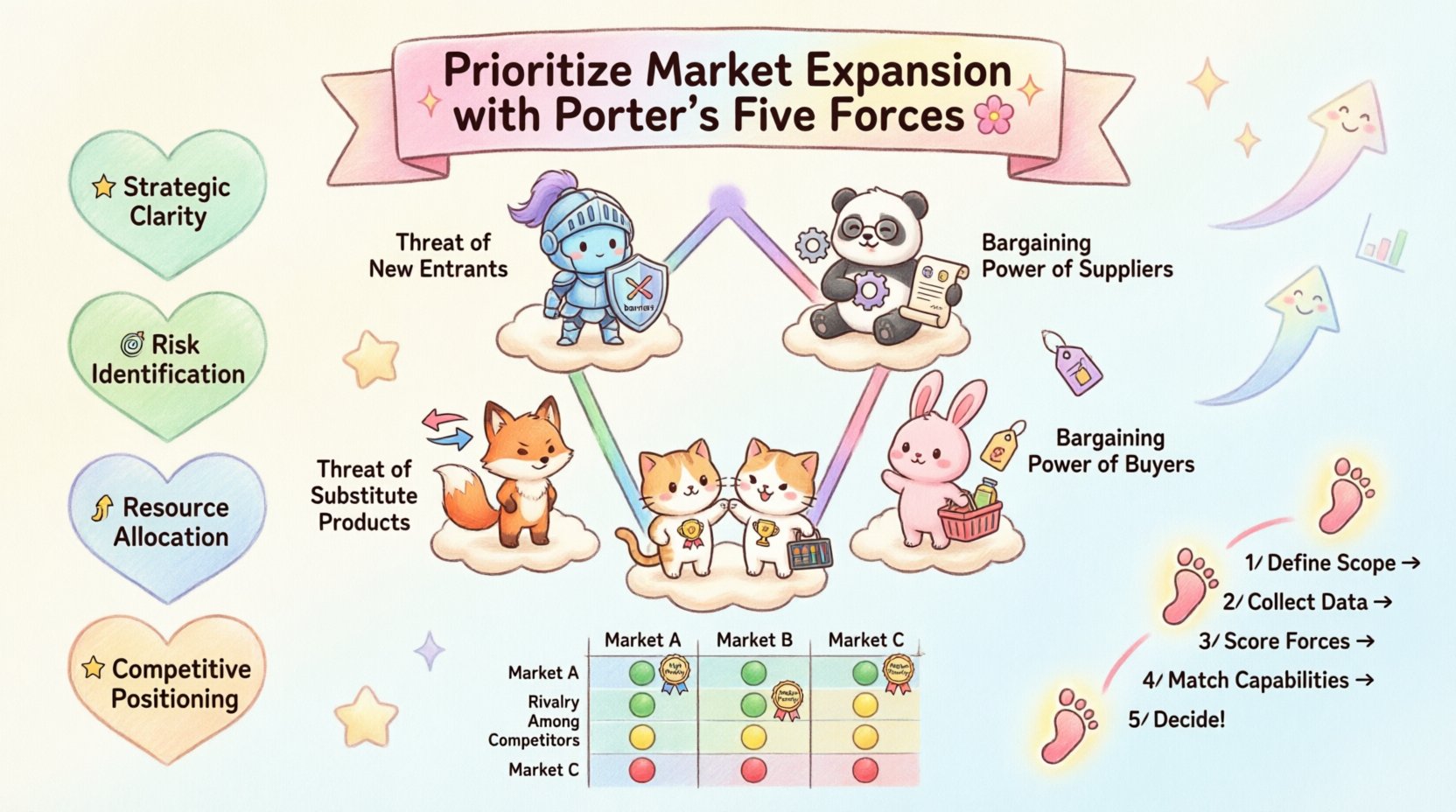
- Strategic Clarity: Provides a standardized way to compare different regions or sectors.
- Risk Identification: Highlights hidden threats before capital is committed.
- Resource Allocation: Helps direct investment toward markets with sustainable margins.
- Competitive Positioning: Clarifies where the organization holds an advantage versus where it faces barriers.
🔍 The Five Forces: A Deep Dive for Expansion
To prioritize expansion effectively, each force must be examined through the lens of the specific target market. The intensity of these forces varies significantly between industries and geographic locations. Below is a detailed breakdown of how each force influences expansion decisions.
1️⃣ Threat of New Entrants
This force measures how easy it is for competitors to enter the market. High barriers to entry generally protect existing players and suggest a more stable environment for expansion. Low barriers indicate a crowded field where margins may erode quickly.
When assessing this for expansion, consider the following:
- Capital Requirements: Does the new market require massive infrastructure investment? High costs deter newcomers.
- Regulatory Hurdles: Are there licenses, permits, or compliance standards that limit access?
- Brand Loyalty: Is the customer base entrenched with existing local players?
- Access to Distribution: Can new competitors easily reach customers, or are channels controlled?
If barriers are low, expansion might require a strategy focused on speed and differentiation rather than volume. If barriers are high, the opportunity may lie in acquiring a local player or forming a joint venture.
2️⃣ Bargaining Power of Suppliers
Supplier power dictates the cost structure and reliability of the supply chain. In an expansion context, this force determines operational risk and margin stability. If suppliers hold significant leverage, they can dictate terms that hurt profitability.
Key indicators to evaluate include:
- Supplier Concentration: Are there few dominant suppliers, or many alternatives?
- Switching Costs: How difficult is it to change vendors in this specific region?
- Substitute Inputs: Are there alternative materials or services available?
- Integration Threats: Can suppliers easily enter your market as competitors?
High supplier power in a target market suggests a need for vertical integration or long-term contracting strategies. It may also signal a market that is less attractive unless the organization has unique leverage.
3️⃣ Bargaining Power of Buyers
Buyer power affects the ability to maintain pricing. In expansion scenarios, understanding customer behavior is vital. If buyers are price-sensitive and have many options, margins will be under constant pressure.
Factors influencing buyer power include:
- Concentration of Buyers: Are customers few and large, or fragmented?
- Product Differentiation: Is the offering commoditized or unique?
- Price Sensitivity: How much does cost impact the purchasing decision?
- Information Availability: Do customers have easy access to competitor pricing and features?
Markets with high buyer power require a strategy focused on value creation and customer retention. Markets with low buyer power may allow for premium pricing strategies.
4️⃣ Threat of Substitute Products
Substitutes limit the price ceiling of a product or service. They often come from outside the immediate industry. In expansion, this force is crucial for assessing long-term viability. A market with many viable substitutes may not support sustainable growth.
Consider these dimensions:
- Price-Performance Trade-off: Are substitutes significantly cheaper or better?
- Switching Costs: How easy is it for customers to switch to the alternative?
- Adoption Trends: Is the substitute gaining popularity in the region?
- Regulatory Environment: Do laws favor the substitute or the incumbent?
Identifying substitutes early allows for proactive product adaptation. Ignoring them can lead to market entry followed by rapid obsolescence.
5️⃣ Rivalry Among Existing Competitors
This is often the most visible force. Intense rivalry leads to price wars, increased marketing spend, and reduced profitability. For expansion, the intensity of existing competition is a primary filter for opportunity.
Assess rivalry using these criteria:
- Number of Competitors: Is the market fragmented or consolidated?
- Industry Growth Rate: Is the market stagnant (fighting for share) or growing (creating new share)?
- Exit Barriers: Is it hard for competitors to leave, keeping capacity high?
- Product Homogeneity: Are competitors offering identical solutions?
A market with high rivalry and slow growth is often a red flag for expansion unless a clear differentiation strategy exists.
📝 Step-by-Step Application Guide
Applying this framework requires a disciplined process. It is not enough to read the theory; the analysis must be specific to the target geography or sector. Follow these steps to conduct a rigorous assessment.
Step 1: Define the Scope
Clearly define the market boundaries. Is this a geographic region, a specific demographic, or a vertical industry? Ambiguity here leads to inaccurate data. Ensure all stakeholders agree on the definition of “the market”.
Step 2: Data Collection
Gather quantitative and qualitative data for each force. Sources include industry reports, competitor financial statements, customer interviews, and regulatory filings. Avoid relying on assumptions.
Step 3: Score the Forces
Rate each force on a scale (e.g., Low, Medium, High) based on the evidence gathered. Be objective. If data is missing, note it as a risk rather than forcing a score.
Step 4: Cross-Reference with Capabilities
Map the external analysis against internal strengths. A market with high rivalry might be acceptable if the organization possesses a unique technology that competitors lack. Alignment is key.
Step 5: Synthesize and Decide
Combine the force analysis with internal capabilities to form a recommendation. Prioritize markets where the forces are favorable or manageable.
🏆 Prioritization Matrix
To make the analysis actionable, organizations can use a scoring matrix. This table structure helps compare multiple opportunities side-by-side.
| Market Opportunity | Entry Barriers | Supplier Power | Buyer Power | Substitutes | Rivalry | Priority Score |
|---|---|---|---|---|---|---|
| Market A (High Growth) | High | Medium | Low | Medium | High | 1 – High Priority |
| Market B (Stable) | Low | Low | High | Low | Medium | 2 – Medium Priority |
| Market C (Saturated) | Low | High | High | High | High | 3 – Low Priority |
Note: Scores depend on the specific context. High Entry Barriers and Low Rivalry generally indicate a favorable environment.
⚠️ Common Pitfalls to Avoid
Even with a robust framework, execution errors can derail the expansion strategy. Be aware of these common mistakes.
- Static Analysis: Markets change. A snapshot in time may not reflect future conditions. Regularly update the analysis.
- Ignoring Internal Factors: External analysis is useless if internal capabilities do not match. Ensure the organization can execute.
- Over-reliance on Historical Data: Past performance does not guarantee future results. Focus on current trends.
- Neglecting Cultural Nuances: In global expansion, local culture impacts buyer behavior and supplier relationships significantly.
- Groupthink: Encourage diverse viewpoints during the analysis to avoid bias toward a preferred market.
🔗 Integrating with Other Strategic Tools
Porter’s Five Forces is powerful, but it works best when combined with other strategic frameworks. This creates a holistic view of the opportunity.
SWOT Analysis
Use the Five Forces to inform the “Opportunities” and “Threats” sections of a SWOT analysis. The internal strengths and weaknesses can then be matched against these external factors.
PESTLE Analysis
PESTLE (Political, Economic, Social, Technological, Legal, Environmental) covers macro-environmental factors. Five Forces covers industry-level dynamics. Using both ensures no blind spots.
BCG Matrix
Once markets are prioritized, the BCG Matrix can help decide resource allocation between cash cows, stars, question marks, and dogs across the portfolio.
🌍 Real-World Application Scenarios
To illustrate the practical value, consider hypothetical scenarios where this analysis changes the decision-making process.
Scenario 1: Retail Expansion
A retail chain considers opening in a new city. The Five Forces analysis reveals high rivalry and high buyer power due to established discounters. However, entry barriers are low. The recommendation shifts from organic expansion to acquiring a local chain to instantly gain market share and reduce rivalry.
Scenario 2: Tech Services
A software firm looks to expand internationally. Analysis shows low supplier power and low substitute threat. However, regulatory hurdles create high entry barriers. The firm decides to partner with a local firm to navigate regulations rather than building from scratch.
Scenario 3: Manufacturing
A manufacturer evaluates a new region. Supplier power is high because raw materials are scarce. Buyer power is low due to unique product specs. The decision is made to invest in vertical integration to secure supply, ensuring long-term margin stability.
📈 Measuring Success Post-Expansion
Applying the framework is not the end of the process. Post-expansion monitoring validates the initial analysis. Track the following metrics to ensure the Five Forces assessment remains accurate.
- Margin Trends: Are margins holding up, or are they being squeezed by new competitors?
- Customer Acquisition Costs: Are they rising due to increased rivalry?
- Supplier Contract Terms: Are terms worsening, indicating shifting power dynamics?
- Market Share Velocity: Is growth consistent with the initial growth rate assumptions?
Regular reviews allow for agile adjustments. If the threat of substitutes increases, the product roadmap must adapt quickly. If buyer power grows, loyalty programs may need strengthening.
💡 Final Thoughts on Strategic Discipline
Market expansion is a high-stakes endeavor. The cost of failure is significant, not just in financial terms but in reputation and resource drain. Porter’s Five Forces provides a disciplined method to navigate this complexity. It forces leaders to look beyond revenue potential and consider the structural forces that determine profitability.
By systematically evaluating entry barriers, supplier leverage, customer power, substitutes, and rivalry, organizations can prioritize opportunities with confidence. This approach reduces reliance on intuition and replaces it with evidence. While the framework is not a crystal ball, it offers the clearest available map for strategic planning.
Remember, the goal is not just to enter a market, but to succeed within it. Prioritization based on industry structure ensures that the chosen path is sustainable. Continuous monitoring and adaptation ensure that the strategy remains relevant as the landscape evolves.
Start with the data. Challenge the assumptions. Prioritize with precision. This is the path to effective market expansion.