
Software architecture relies heavily on established solutions to recurring problems. Object-Oriented Analysis and Design (OOAD) provides a framework for modeling systems using objects that contain both data and behavior. Within this framework, design patterns serve as proven templates for solving common issues in software design. These patterns are not finished code but descriptions of problems and their solutions. They describe how to organize code to ensure maintainability, scalability, and flexibility.
Understanding these patterns allows developers to communicate complex design ideas efficiently. When a team discusses a specific pattern, everyone understands the implied structure and trade-offs. This guide explores the core categories of design patterns, providing real-world analogies and structural breakdowns without relying on specific programming languages or proprietary software products.
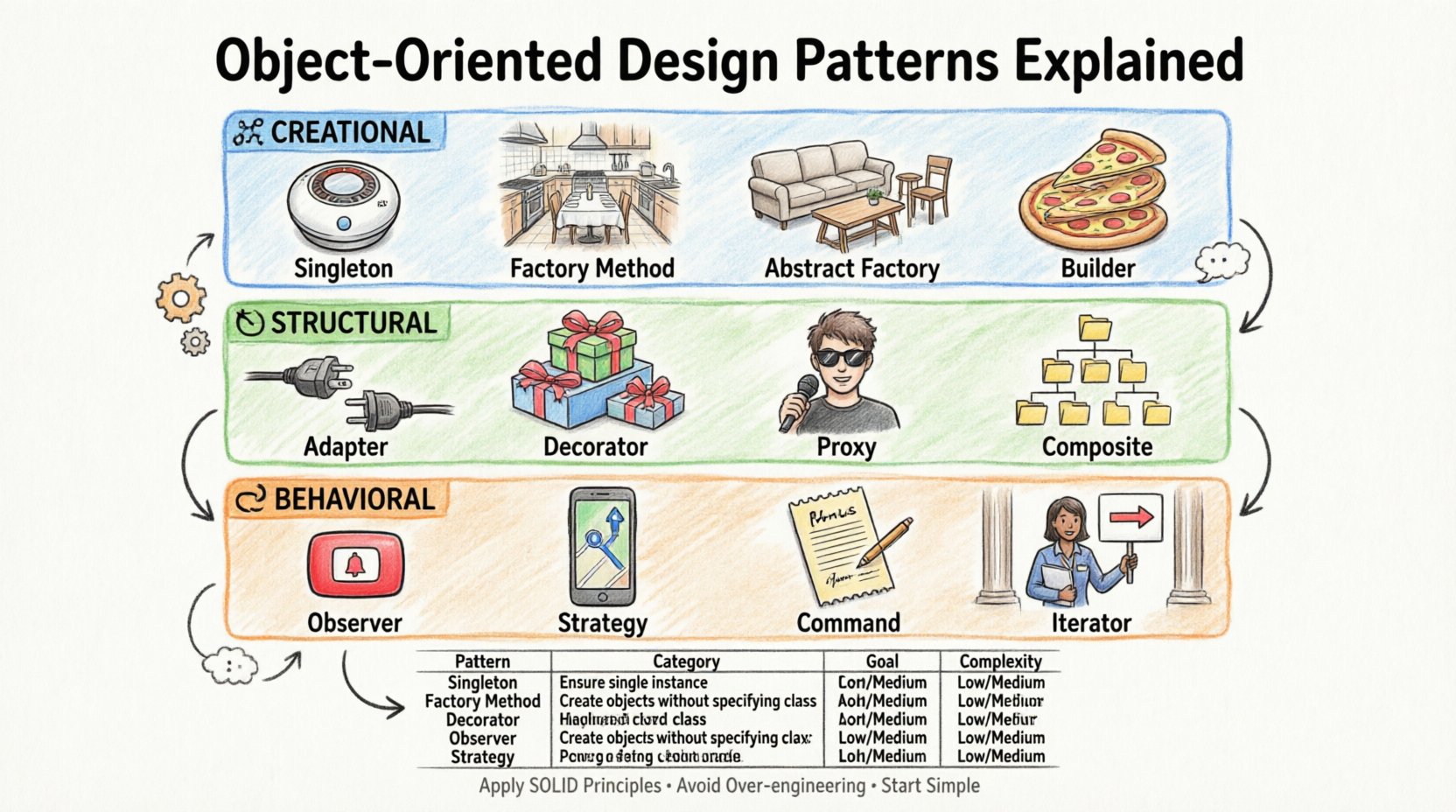
🧩 The Three Main Categories of Design Patterns
Design patterns are generally grouped into three distinct categories based on their purpose and scope. Each category addresses a different aspect of the object-oriented paradigm.
- Creational Patterns: Focus on object creation mechanisms. They increase flexibility and reuse by abstracting the instantiation process.
- Structural Patterns: Deal with class and object composition. They ensure that objects work together effectively by forming larger structures.
- Behavioral Patterns: Characterize the ways in which objects interact and distribute responsibility among them.
🏭 Creational Patterns: Managing Object Creation
Creational patterns are concerned with how objects are created. A naive approach to object creation can lead to tight coupling, making the system difficult to modify or extend. These patterns provide various ways to create objects while keeping the system independent of how these objects are created, composed, and represented.
1. Singleton Pattern 🎯
The Singleton pattern ensures that a class has only one instance and provides a global point of access to it. This is useful when exactly one object is needed to coordinate actions across a system.
- Real-World Analogy: Consider a thermostat in a smart home. There should be only one control unit managing the temperature settings for the entire house. Multiple units trying to set the temperature would cause conflicts.
- Key Characteristics:
- Private constructor to prevent direct instantiation.
- Static method to access the single instance.
- Lazy or Eager initialization strategies.
- Use Cases: Configuration managers, logging services, connection pools.
2. Factory Method Pattern 🏭
The Factory Method defines an interface for creating an object but lets subclasses decide which class to instantiate. This pattern defers the instantiation process to the subclasses.
- Real-World Analogy: Think of a restaurant menu. The menu (interface) lists dishes, but the kitchen (concrete factory) decides how to prepare them. If the restaurant adds a new cuisine, the kitchen adapts without changing the menu structure.
- Key Characteristics:
- Separates object creation logic from client code.
- Supports the Open/Closed Principle.
- Encourages polymorphism.
- Use Cases: Document editors (creating Word vs. PDF files), payment processing (Credit Card vs. PayPal).
3. Abstract Factory Pattern 📦
The Abstract Factory pattern provides an interface for creating families of related or dependent objects without specifying their concrete classes. It ensures that the products created are compatible with each other.
- Real-World Analogy: A furniture store sells a “Modern” set and a “Vintage” set. A customer buying a “Modern” sofa gets matching “Modern” chairs and tables. The factory ensures the style matches across all furniture pieces.
- Key Characteristics:
- Creates families of related objects.
- Client code depends on interfaces, not concrete classes.
- Easy to switch entire product families.
- Use Cases: Operating system specific UI widgets (Windows vs. macOS themes), cross-platform data access layers.
4. Builder Pattern 🛠️
The Builder pattern constructs complex objects step by step. The same construction process can create different representations. This pattern is useful when an object requires many optional parameters or a complex initialization sequence.
- Real-World Analogy: Ordering a custom pizza. You select the base, then the sauce, then toppings, then cheese. Each step adds to the final product. You can stop at any point to get a simple pizza or continue for a gourmet one.
- Key Characteristics:
- Encapsulates construction logic.
- Allows for fluent interfaces (method chaining).
- Produces immutable objects.
- Use Cases: Complex configuration objects, HTML document generation, SQL query building.
🔗 Structural Patterns: Organizing Class Relationships
Structural patterns explain how to assemble objects and classes into larger structures while keeping these structures flexible and efficient. They focus on class composition and object composition.
1. Adapter Pattern 🔌
The Adapter pattern allows objects with incompatible interfaces to collaborate. It converts the interface of a class into another interface clients expect.
- Real-World Analogy: A travel power adapter. You have a plug from one country (source interface) and an outlet in another (target interface). The adapter bridges the physical difference so the device works.
- Key Characteristics:
- Decouples the client from the existing implementation.
- Can be implemented via class inheritance or composition.
- Enables legacy code integration.
- Use Cases: Integrating third-party libraries, legacy system migration, API versioning.
2. Decorator Pattern 🎨
The Decorator pattern allows behavior to be added to an individual object, dynamically, without affecting the behavior of other objects from the same class. It wraps the original object to provide additional functionality.
- Real-World Analogy: Wrapping a gift. The gift is the core object. You can add wrapping paper, then a ribbon, then a bow. Each layer adds decoration without changing the gift itself.
- Key Characteristics:
- Extends functionality without subclassing.
- Follows the Single Responsibility Principle.
- Can be stacked multiple times.
- Use Cases: Input/Output stream buffering, UI component styling, encryption layers.
3. Proxy Pattern 🕵️♂️
The Proxy pattern provides a surrogate or placeholder for another object to control access to it. This is useful when direct access to an object is not desirable or possible.
- Real-World Analogy: A celebrity’s agent. Fans cannot contact the celebrity directly. They must go through the agent, who manages requests, schedules, and permissions.
- Key Characteristics:
- Controls access to the real object.
- Can handle lazy initialization (virtual proxy).
- Can manage security or logging (protection proxy).
- Use Cases: Virtual proxies for large images, remote proxies for network objects, access control layers.
4. Composite Pattern 🌳
The Composite pattern lets clients treat individual objects and compositions of objects uniformly. It is used to represent part-whole hierarchies.
- Real-World Analogy: A file system. A folder contains files and other folders. You can open a file or a folder. The operation “List Contents” works on both a single file (list itself) and a folder (list children).
- Key Characteristics:
- Creates a tree structure of objects.
- Clients treat individual objects and compositions the same.
- Simplifies client code complexity.
- Use Cases: User interface components (menus, buttons), organizational charts, file systems.
🔄 Behavioral Patterns: Managing Communication
Behavioral patterns are concerned with algorithms and the assignment of responsibilities between objects. They describe how objects communicate and distribute responsibility.
1. Observer Pattern 👀
The Observer pattern defines a subscription mechanism to notify multiple objects about events related to a subject object. It implements a one-to-many dependency.
- Real-World Analogy: A YouTube subscription. When a creator posts a video, all subscribers are notified. The creator does not need to know who the subscribers are, only that they exist.
- Key Characteristics:
- Loose coupling between subject and observers.
- Supports broadcast communication.
- Event-driven architecture foundation.
- Use Cases: Event handling systems, news feeds, real-time data updates, GUI event listeners.
2. Strategy Pattern 🎲
The Strategy pattern defines a family of algorithms, encapsulates each one, and makes them interchangeable. Strategy lets the algorithm vary independently from clients that use it.
- Real-World Analogy: A navigation app. You can choose the fastest route, the shortest distance, or the least traffic route. The app (client) changes the route strategy without changing the map logic.
- Key Characteristics:
- Eliminates conditional statements for algorithm selection.
- Follows the Open/Closed Principle.
- Allows runtime algorithm switching.
- Use Cases: Sorting algorithms, compression methods, payment gateways, pricing models.
3. Command Pattern 📜
The Command pattern encapsulates a request as an object, thereby letting you parameterize clients with different requests, queue or log requests, and support undoable operations.
- Real-World Analogy: A restaurant order ticket. The waiter (client) takes the order (request) and gives it to the chef (receiver). The ticket (command object) stores the details until the chef processes it.
- Key Characteristics:
- Decouples the sender from the receiver.
- Supports undo and redo operations.
- Enables queuing of requests.
- Use Cases: GUI button actions, transaction processing, macro recording, task scheduling.
4. Iterator Pattern 🚶
The Iterator pattern provides a way to access the elements of an aggregate object sequentially without exposing its underlying representation.
- Real-World Analogy: A tour guide leading a group through a museum. Visitors (clients) follow the guide (iterator) to see exhibits (elements) one by one without needing to know the museum layout.
- Key Characteristics:
- Hides collection implementation details.
- Provides a standard interface for traversal.
- Allows different traversal strategies.
- Use Cases: Collection traversal, database result sets, linked list iteration.
📊 Pattern Comparison Table
| Pattern | Category | Primary Goal | Complexity |
|---|---|---|---|
| Singleton | Creational | Ensure single instance | Low |
| Factory Method | Creational | Delegate creation | Medium |
| Adapter | Structural | Interface compatibility | Low |
| Decorator | Structural | Dynamic responsibility addition | Medium |
| Observer | Behavioral | Event notification | Medium |
| Strategy | Behavioral | Algorithm interchange | Medium |
🔍 Applying SOLID Principles
Design patterns align closely with the SOLID principles of object-oriented design. Adhering to these principles ensures that the patterns are applied correctly.
- Single Responsibility Principle: A class should have only one reason to change. The Strategy pattern supports this by isolating algorithms into separate classes.
- Open/Closed Principle: Software entities should be open for extension but closed for modification. The Factory Method and Decorator patterns exemplify this.
- Liskov Substitution Principle: Subtypes must be substitutable for their base types. All patterns relying on inheritance must respect this to avoid runtime errors.
- Interface Segregation Principle: Clients should not be forced to depend on interfaces they do not use. The Adapter pattern helps by creating specific interfaces for specific needs.
- Dependency Inversion Principle: High-level modules should not depend on low-level modules. Both Factory and Strategy patterns reduce dependencies on concrete implementations.
⚠️ Common Pitfalls and Considerations
While patterns are powerful, they are not a silver bullet. Misusing them can introduce unnecessary complexity.
- Over-engineering: Do not use a pattern if a simple solution suffices. A Singleton is often overkill for a simple configuration object.
- Hidden Dependencies: Patterns like Observer can create hidden dependencies that make debugging difficult. Ensure event flows are documented.
- Performance Overhead: Adding layers of indirection, such as in the Proxy or Decorator patterns, can impact performance. Measure before optimizing.
- Readability: Deeply nested structures can reduce code readability. Ensure the design remains understandable to the team.
🚀 Selecting the Right Pattern
Choosing the correct pattern depends on the specific problem context. Consider the following questions when making a decision:
- How is the object created? If complex, consider Builder or Factory. If single instance is needed, consider Singleton.
- How are objects related? If composition is needed, consider Composite or Decorator. If interfaces differ, consider Adapter.
- How do objects communicate? If event-driven, consider Observer. If requests need queuing, consider Command.
- Is the algorithm variable? If logic changes frequently, consider Strategy.
📝 Implementation Guidelines
To ensure successful implementation of these patterns, follow these guidelines:
- Start Simple: Begin with the simplest code that works. Refactor into a pattern only when the complexity warrants it.
- Document Intent: Use comments to explain why a pattern was chosen. Future maintainers need to understand the rationale.
- Standardize: Create team standards for pattern usage to ensure consistency across the codebase.
- Review: Conduct design reviews to ensure patterns are not being used incorrectly or unnecessarily.
- Test: Write unit tests that verify the behavior of the pattern, ensuring that the abstraction works as intended.
🔮 Final Considerations
Design patterns are a vocabulary for software design. They represent the collective wisdom of experienced developers. By understanding and applying these patterns, teams can build systems that are robust, maintainable, and scalable. The key lies in understanding the underlying principles rather than blindly copying code structures.
Effective design is an iterative process. As requirements evolve, the architecture may need to shift. Patterns provide the flexibility to adapt without rewriting the entire system. Focus on clarity and simplicity. If a pattern obscures more than it clarifies, reconsider the approach. The goal is a system that is easy to understand and easy to change.
Continual learning and practice are essential. Studying existing codebases, reviewing architectural decisions, and applying patterns in small projects will deepen understanding. Remember that patterns are tools, not rules. Use them to solve real problems, not to create theoretical structures.