
Software architecture and system design form the backbone of any robust technological solution. When project teams begin the development lifecycle, the choice between analysis methodologies dictates the structure, scalability, and maintainability of the final product. Understanding the distinction between Object-Oriented Analysis (OOA) and Traditional Methods is critical for architects, analysts, and stakeholders.
This guide explores the nuances of both approaches. We will examine how data and behavior are modeled, how changes impact the system, and which strategy aligns best with modern development needs. 🚀
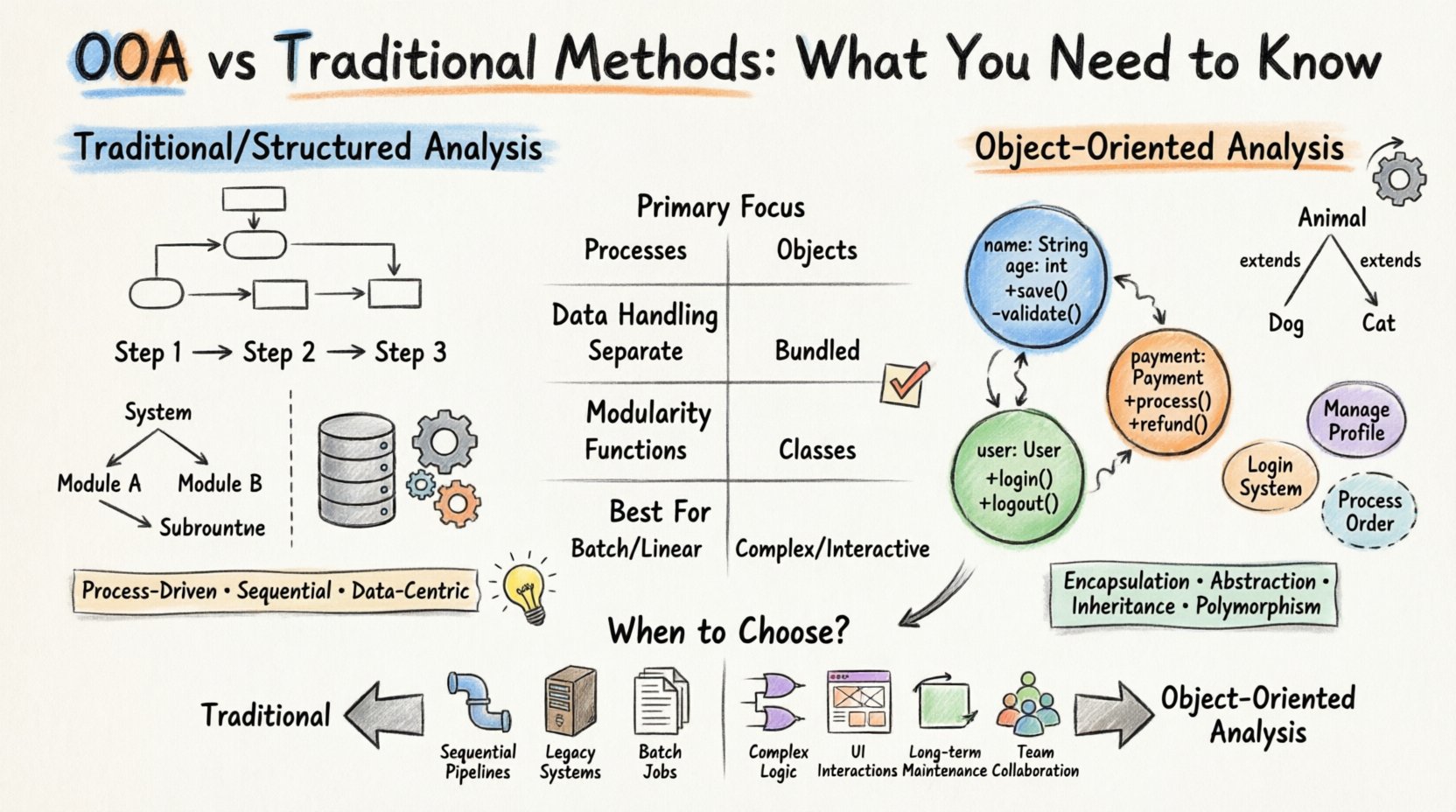
Understanding Traditional Analysis Methods 🏗️
Traditional analysis, often referred to as Structured Analysis, emerged in the 1960s and 1970s. It focuses heavily on the processes that transform data into information. The system is viewed as a collection of functions or processes, where data flows between them. This approach prioritizes logic and flow over data structures.
Core Characteristics of Traditional Methods
- Data-Centric: Data is often stored in flat files or databases, separated from the logic that manipulates it.
- Process-Driven: The primary unit of analysis is the process or function.
- Top-Down Design: Systems are broken down from a high-level context into smaller, manageable sub-processes.
- Sequential Flow: Execution typically follows a linear or hierarchical path.
In this paradigm, a Data Flow Diagram (DFD) is the primary modeling tool. It visualizes how data enters the system, moves through processes, and exits as output. While effective for batch processing or simple transaction systems, it can struggle with complex, interactive applications.
Key Components of Structured Analysis
- Context Diagrams: Define the system boundaries and external entities.
- Process Decomposition: Breaking complex processes into lower-level details.
- Data Dictionaries: Defining the structure and attributes of data elements.
- Control Flow Diagrams: Mapping the sequence of operations.
The separation of data and logic is a defining feature. When a change occurs in the data structure, it often requires sweeping updates across multiple processes. This coupling can lead to fragility in the codebase over time.
Exploring Object-Oriented Analysis (OOA) 💼
Object-Oriented Analysis represents a paradigm shift. Instead of focusing on the processes that act on data, OOA focuses on the data itself and the objects that contain both state and behavior. This approach mirrors real-world entities, making the system design more intuitive for human understanding.
Core Pillars of Object-Oriented Analysis
- Encapsulation: Data and methods are bundled together within objects.
- Abstraction: Complex realities are simplified into manageable models.
- Inheritance: New classes are created based on existing ones, promoting code reuse.
- Polymorphism: Objects can respond to the same message in different ways.
In OOA, the system is modeled as a network of interacting objects. Each object has responsibilities and collaborates with others to achieve system goals. Use Case modeling and Class Diagrams are the primary tools used to capture these interactions.
The Role of the Analyst in OOA
The analyst identifies objects rather than just processes. An object is an instance of a class that holds state (attributes) and performs actions (methods). The focus shifts from “what happens” to “who does what”.
- Identify Nouns: Scan the problem domain for entities (e.g., Customer, Order, Invoice).
- Identify Verbs: Determine interactions and actions (e.g., PlaceOrder, CalculateTax).
- Define Relationships: Establish how objects connect (e.g., An Order belongs to a Customer).
Comparing the Two Approaches 📊
To fully grasp the implications of each method, we must compare them side-by-side. The following table highlights the fundamental differences in structure, data handling, and adaptability.
| Feature | Traditional (Structured) Methods | Object-Oriented Analysis (OOA) |
|---|---|---|
| Primary Focus | Processes and Data Flow | Objects and Data Encapsulation |
| Data Handling | Data is separate from logic | Data is bundled with behavior |
| Modularity | Function-based modules | Class-based modules |
| Change Management | Harder to isolate changes | Easier to localize changes |
| Modeling Tools | Data Flow Diagrams (DFD) | Class Diagrams, Use Cases |
| Best For | Batch processing, Linear systems | Complex, interactive systems |
Impact on System Lifecycle 🔄
The choice of analysis method influences every phase of the software development lifecycle. From requirements gathering to maintenance, the underlying philosophy dictates the workflow.
Requirements Gathering
- Traditional: Focuses on functional requirements. What functions must the system perform? Inputs and outputs are mapped meticulously.
- OOA: Focuses on use cases and scenarios. How do users interact with the system? What objects are involved in the interaction?
Design Phase
- Traditional: Designers create detailed process specifications. The emphasis is on algorithm efficiency and data flow paths.
- OOA: Designers create class structures. The emphasis is on object relationships, inheritance hierarchies, and interface definitions.
Implementation
- Traditional: Code is often written as a series of functions that manipulate global data structures. Modularization is achieved through libraries of functions.
- OOA: Code is written as classes. The implementation of a class is hidden behind an interface. Logic resides within the class itself.
Maintenance and Evolution
- Traditional: Adding a new feature often requires modifying existing functions. This increases the risk of introducing bugs into unrelated areas.
- OOA: New features can often be added by creating new classes that interact with existing ones. The encapsulation protects existing code from unintended side effects.
When to Choose Traditional Methods ⚖️
While Object-Oriented Analysis is prevalent in modern development, Traditional Methods still hold value in specific contexts. It is not a matter of one being strictly superior, but rather about fit for purpose.
- Highly Sequential Processes: If the system is essentially a pipeline where data moves linearly from input to output, structured analysis is efficient.
- Legacy Integration: Working with older mainframe systems often requires understanding the procedural logic that underpins them.
- Simple Batch Jobs: Systems that process large volumes of data in a single run without complex user interaction benefit from the simplicity of data flow modeling.
- Strict Regulatory Environments: Some industries require exhaustive documentation of every process step, which aligns well with structured techniques.
When to Choose Object-Oriented Analysis 🎯
OOA is generally the preferred choice for complex, dynamic systems. It scales better as requirements grow.
- Complex Business Logic: When the system requires modeling complex relationships between entities, OOA handles this naturally.
- Interactive User Interfaces: Systems requiring frequent user input and dynamic response are better modeled as interacting objects.
- Long-Term Maintenance: If the system is expected to evolve over years, the modularity of OOA reduces technical debt.
- Team Collaboration: OOA allows different developers to work on different classes with less risk of conflict, as interfaces define the boundaries.
Deep Dive: Data Flow vs. Object Interaction 🔄
One of the most significant technical differences lies in how data moves through the system. In Traditional Analysis, data flows are explicit. Arrows in a diagram represent the movement of data packages between processes.
In Object-Oriented Analysis, data flow is implicit. Objects send messages to other objects. The receiving object decides how to handle the message based on its internal state. This decouples the sender from the receiver. The sender does not need to know the internal logic of the receiver, only the interface.
Example Scenario: Processing a Payment
Consider a system that processes a payment.
- Traditional View: A process called “Validate Payment” receives transaction data. It calls “Check Balance”. It calls “Update Ledger”. If any step fails, the process must handle the error and roll back the transaction.
- OOA View: A
Paymentobject receives a request. It sends a message to aBankAccountobject to check balance. If sufficient, it sends a message to aTransactionHistoryobject to record the event. The logic for validation lives inside thePaymentobject.
The OOA approach encapsulates the rules of payment within the object. If the rules change, only the Payment object needs to be updated. In the traditional view, multiple processes might need modification.
Challenges in Object-Oriented Analysis 🧱
Adopting OOA is not without its challenges. Teams must navigate a learning curve and manage specific complexities.
- Over-Abstraction: It is easy to create too many layers of classes. This can make the system harder to understand than a simple procedural script.
- Performance Overhead: Message passing and dynamic binding can introduce slight performance costs compared to direct function calls, though this is rarely significant in modern hardware.
- Coupling Risks: If not managed carefully, objects can become highly coupled, negating the benefits of encapsulation.
- Complexity in Modeling: Creating accurate class diagrams requires a deep understanding of the domain. Poor modeling leads to poor code.
Best Practices for Modern System Design 🛠️
Regardless of the method chosen, certain principles apply to ensure high-quality software architecture.
- Separation of Concerns: Ensure that data storage, business logic, and user interface are distinct layers.
- Single Responsibility: Every class or function should have one reason to change.
- Open/Closed Principle: Software entities should be open for extension but closed for modification.
- Documentation: Maintain clear diagrams and specifications. Models are useless if they do not reflect the implementation.
The Evolution of System Modeling 📈
As technology advances, the lines between analysis methods sometimes blur. Modern tools often support hybrid approaches. Developers might use data flow concepts for backend services while using object models for the frontend application.
The trend in software engineering is moving towards service-oriented and component-based architectures. These architectures rely heavily on the principles of OOA. The focus remains on encapsulating functionality within discrete units that can be deployed and scaled independently.
Understanding the roots of structured analysis provides a foundation for appreciating the benefits of object-oriented design. It highlights why we moved away from monolithic procedural code towards modular, scalable systems.
Final Thoughts on Selection 🤔
Selecting between Object-Oriented Analysis and Traditional Methods is a strategic decision. It depends on the problem domain, the team’s expertise, and the long-term goals of the project. There is no single correct answer for every scenario.
- For linear, data-heavy batch systems, structured methods offer clarity and simplicity.
- For complex, interactive, and evolving systems, object-oriented analysis provides the necessary flexibility and structure.
By understanding the strengths and limitations of each, architects can make informed decisions. This leads to systems that are robust, maintainable, and aligned with business needs. The goal is always to build software that serves its purpose effectively over time. ⚙️
Key Takeaways for Teams 📝
- Define the Problem: Start by understanding the nature of the data and the processes involved.
- Consider Future Changes: Choose a method that allows for easier adaptation to new requirements.
- Train the Team: Ensure all stakeholders understand the modeling language being used.
- Review Continuously: Re-evaluate the design approach as the project evolves.
Effective system design is a balance between theory and practice. It requires a deep understanding of both the tools available and the constraints of the environment. Whether you choose OOA or traditional methods, the commitment to clear, logical modeling remains the same. 🎯