

Understanding the foundational layers of software development is critical for building systems that are maintainable, scalable, and robust. Object-Oriented Analysis (OOA) sits at the heart of this process, acting as the bridge between raw user requirements and technical design specifications. This comprehensive guide addresses the most frequently asked questions regarding Object-Oriented Analysis, providing clarity on its purpose, process, and output.
Whether you are a business analyst, a software architect, or a developer transitioning into design roles, grasping the nuances of OOA ensures that the final product aligns with business needs without unnecessary technical debt. We will explore the core concepts, distinctions from related disciplines, and best practices without relying on specific software tools.
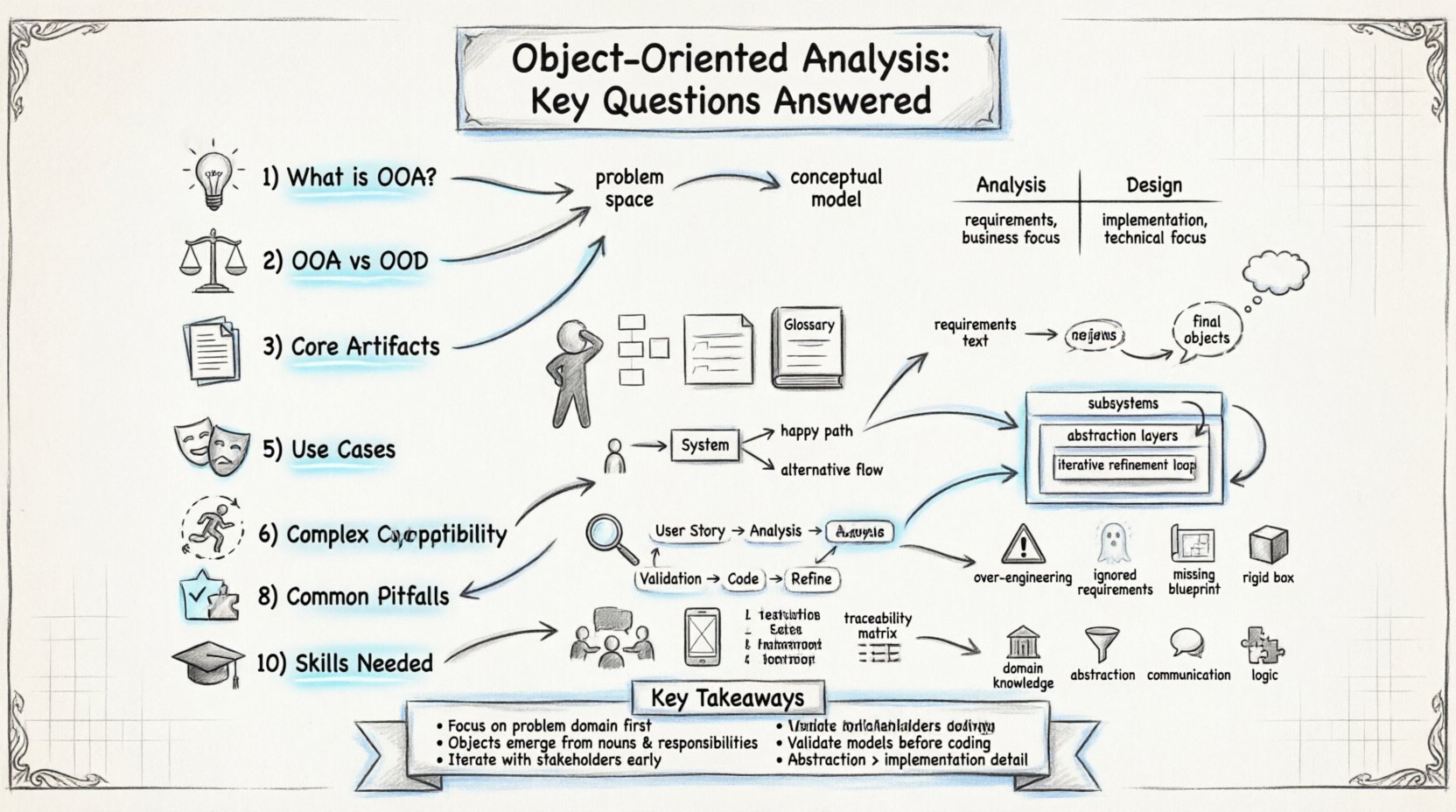
1️⃣ What Exactly Is Object-Oriented Analysis? 🤔
Object-Oriented Analysis is the phase of software development where the problem space is understood and modeled. It focuses on identifying the “what” rather than the “how.” The goal is to create a conceptual model of the system that represents the real-world entities involved and their interactions.
- Focus: Requirements and functionality.
- Input: User stories, business goals, and stakeholder needs.
- Output: A domain model, use case diagrams, and a glossary of terms.
- Key Concept: Objects that encapsulate both data and behavior.
Unlike procedural analysis, which breaks a problem down into functions and processes, OOA breaks the problem down into objects. These objects represent the nouns found in the problem description. For example, in a banking system, objects might include Account, Customer, and Transaction.
2️⃣ How Does OOA Differ From OOD? 🔄
A common point of confusion lies between Object-Oriented Analysis (OOA) and Object-Oriented Design (OOD). While they are closely related, they serve distinct purposes in the development lifecycle. OOA is about understanding the problem, while OOD is about defining the solution.
| Aspect | Object-Oriented Analysis (OOA) | Object-Oriented Design (OOD) |
|---|---|---|
| Primary Goal | Understand the problem domain | Define the technical solution |
| Focus | Business requirements and rules | Implementation details and structure |
| Abstraction Level | High-level conceptual models | Low-level technical specifications |
| Key Artifacts | Use Cases, Domain Models | Class Diagrams, Sequence Diagrams |
| Stakeholders | Business Analysts, Domain Experts | Software Architects, Developers |
When you move from OOA to OOD, you translate the conceptual objects into design classes. You determine how data will be stored, how methods will be implemented, and how the system will interface with external components. Keeping these phases distinct helps prevent premature optimization and ensures the design remains aligned with business value.
3️⃣ What Are The Core Artifacts In OOA? 📝
To conduct a successful analysis, specific artifacts must be produced. These documents serve as the contract between the business stakeholders and the technical team. They ensure everyone understands the system’s scope and behavior.
Use Case Models
Use cases describe the functional requirements of the system from the perspective of an actor. They detail the interactions between users (or external systems) and the software.
- Actor: A role played by a user or system (e.g., Admin, Customer).
- Scenario: A specific sequence of steps to achieve a goal.
- Flow of Events: The standard path and alternative paths within a use case.
Domain Models
A domain model represents the key concepts in the business area. It is a static view of the system that shows how different entities relate to one another. This model is crucial because it captures the rules of the business.
- Classes: Represent entities (e.g., Order, Invoice).
- Attributes: Data held by the entities (e.g., Price, Date).
- Associations: Relationships between entities (e.g., A Customer places an Order).
Glossaries and Dictionaries
Ambiguity is the enemy of analysis. A shared vocabulary ensures that when a stakeholder says “Customer,” it means the same thing to the developer. This artifact defines terms specific to the domain.
4️⃣ How Do You Identify Objects? 🔍
Identifying objects is often the first practical step in OOA. It involves scanning the problem description to find the nouns that represent real-world entities. However, not every noun is an object. Some are attributes, and some are actions.
Techniques for Identification
- Noun Method: Read the requirements and circle the nouns. These are potential objects.
- Responsibility Analysis: Ask what data an entity holds and what operations it performs. If it has responsibilities, it is likely an object.
- System Boundary: Determine if the object is internal to the system or external (an actor).
Consider a library system. Nouns like “Book,” “Member,” and “Loan” are strong candidates for objects. However, words like “Borrow” are verbs and become methods or actions, not objects themselves. “Date” might be an attribute of the Loan object rather than a standalone object.
Refining the List
Once identified, objects must be refined. Some nouns might be too granular (e.g., “Street Address” inside “Customer”). Others might be too broad. The goal is to find the right level of granularity that balances flexibility with simplicity.
5️⃣ What Is The Role Of Use Cases? 🎭
Use cases are the primary vehicle for capturing functional requirements in OOA. They provide a narrative description of how the system behaves under different conditions.
Why Use Cases Matter
- Clarity: They describe behavior in plain language.
- Completeness: They help ensure all user goals are covered.
- Validation: They serve as a checklist for testing later in the process.
A well-written use case includes a primary flow (the happy path) and alternative flows (error handling, edge cases). For instance, in an online store, the primary flow for “Checkout” involves adding items and paying. An alternative flow might involve a credit card decline or an out-of-stock item.
6️⃣ How Do You Handle Complex Systems? 🏗️
Complexity is inevitable in large-scale software. When dealing with complex systems, OOA must employ strategies to manage that complexity without losing clarity.
Decomposition
Break the system down into subsystems or packages. Each subsystem should have a clear responsibility. For example, in a hospital system, you might have separate subsystems for Patient Management, Billing, and Medical Records.
Abstraction
Use abstract classes or interfaces to define common behaviors. This allows you to group similar objects together. If you have different types of vehicles, you might have a base class of Vehicle with common attributes like color and speed, while specific types (Car, Truck) add their own unique details.
Iterative Refinement
Do not try to model everything at once. Start with the core functionality and refine the analysis as more information becomes available. This approach reduces the risk of building a model that is too rigid for the actual requirements.
7️⃣ Can OOA Work With Agile Methods? ⚡
Yes. While OOA is often associated with traditional waterfall models, it is fully compatible with Agile methodologies. The difference lies in the depth and timing of the analysis.
Just Enough Analysis
In Agile, you perform “just enough” analysis to understand the current sprint’s requirements. You do not necessarily model the entire system upfront. You focus on the features being developed now and leave the future for later refinement.
Continuous Feedback
Agile OOA relies heavily on feedback loops. As you build the software, you validate the analysis against working code. If the domain model changes, the analysis updates. This keeps the model relevant and accurate.
User Stories as Input
Instead of large requirement documents, Agile OOA often uses User Stories. These short descriptions act as placeholders for conversations. The analysis phase is where those conversations are formalized into the domain model.
8️⃣ What Are Common Pitfalls? ⚠️
Even experienced teams can stumble during the analysis phase. Recognizing these pitfalls early can save significant time and resources.
- Over-Engineering: Creating objects for every tiny detail. Keep it simple. If a concept doesn’t have behavior or complex state, it might not need to be an object.
- Ignoring Non-Functional Requirements: Performance, security, and scalability need to be considered during analysis, not just design.
- Skipping the Domain Model: Jumping straight to technical design leads to code that is hard to maintain and doesn’t reflect business rules.
- Static Thinking: Assuming the requirements won’t change. Build models that are flexible enough to accommodate evolution.
9️⃣ How Do You Validate Your Analysis? ✅
Validation ensures that the analysis accurately reflects the needs of the business. There are several methods to achieve this without writing code.
- Walkthroughs: Review the models with domain experts. Ask them to trace a scenario to ensure it matches reality.
- Prototyping: Create a mockup of the user interface to verify the workflow described in the use cases.
- Test Case Generation: Derive test cases from the use cases. If you cannot derive a test case, the requirement might be unclear.
- Traceability Matrices: Link requirements to analysis artifacts. This ensures every requirement is addressed in the model.
🔟 What Skills Are Needed For Effective OOA? 🎓
Performing Object-Oriented Analysis requires a specific set of cognitive and technical skills. It is less about knowing syntax and more about understanding structure and logic.
- Domain Knowledge: You must understand the business you are analyzing. If you don’t understand how a bank works, you cannot model a banking system effectively.
- Abstraction Skills: The ability to ignore irrelevant details and focus on the essential characteristics of objects.
- Communication: You must be able to translate business jargon into technical concepts and vice versa.
- Logical Thinking: OOA requires rigorous logic to define relationships and constraints accurately.
🛠️ The Impact Of Good Analysis on Development 🚀
Investing time in Object-Oriented Analysis yields tangible returns. Projects with thorough analysis typically experience fewer defects in the early stages of development. The code is cleaner because the design was thought out before implementation began.
Furthermore, maintenance becomes easier. When requirements change, the impact can be assessed by looking at the domain model. If the model is well-structured, changes are localized. If the analysis was poor, a small change might ripple through the entire system.
Think of OOA as the architectural blueprint for a building. You would not start laying bricks without a plan. Similarly, you should not write production code without an analysis of the problem space.
📋 Summary of Key Takeaways 📌
- OOA focuses on the “what” of the system, not the “how”.
- Distinguish clearly between Analysis (requirements) and Design (implementation).
- Use cases and domain models are the primary artifacts.
- Objects are identified through nouns and responsibilities.
- Complexity is managed through decomposition and abstraction.
- Agile methods support iterative OOA.
- Validation through walkthroughs and traceability is essential.
By adhering to these principles, teams can build software that is not only functional but also adaptable to future needs. The discipline of Object-Oriented Analysis provides the structure necessary to navigate the complexities of modern software engineering.
Remember, the goal is not to create the perfect model immediately, but to create a model that facilitates understanding and guides development effectively. Continuous refinement and communication are the keys to success in any analysis effort.