


Enterprise architecture (EA) has long been recognized as a cornerstone of strategic digital transformation. Among the most structured and rigorous modeling languages available, ArchiMate stands out for its precision, depth, and alignment with enterprise-wide governance. However, its very strength—its adherence to a rich, rule-based framework—also creates significant barriers to adoption, particularly for teams lacking deep domain expertise or time-intensive modeling cycles.
Why ArchiMate Is Powerful—But Challenging to Use
At its core,ArchiMate is a standardized, object-oriented modeling language designed to represent the complex interdependencies across an enterprise’s business, application, and technology layers. What makes it uniquely powerful is its ability to capture not just what systems exist, but how they relate—through structured elements and precise relationships—across different domains and abstractions.
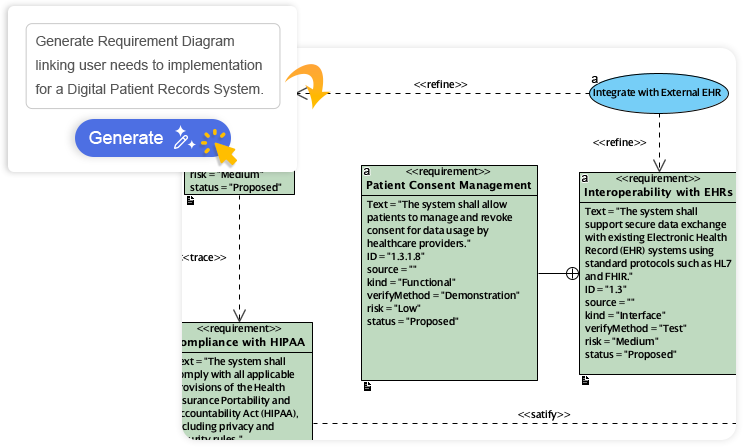

Yet this precision comes at a cost:
- Complex element taxonomy: ArchiMate defines over 40 distinct element types—such as actors, nodes, services, data objects, and processes—each with specific roles and constraints. Misclassification leads to invalid or misleading models.
- More than 20 relationship types: Relationships like serving, realization, composition, and aggregation govern how elements interact. Each has strict syntactic and semantic rules—for example, a business process cannot directly serve a technology node without proper mediation through an application service.
- Layered and derived modeling: ArchiMate enforces a strict layering principle: business processes are supported by application services, which in turn are supported by technology infrastructure. Elements at higher layers must be realizable or derived from lower layers. This hierarchical dependency creates a high barrier to entry, especially when creating models from scratch.
- Aspect-based constraints: Elements must conform to structural, behavioral, or passive aspects. For instance, a data object can only be used by a process if it supports the required data flow—violating this rule leads to non-compliant, untraceable architectures.
- Viewpoint specialization: ArchiMate supports over 25 official viewpoints—such as the Business Process Viewpoint, Application Cooperation, Motivation Viewpoint, or Capability Map. Each serves a distinct stakeholder group, requiring tailored element selection, relationship types, and narrative structure.
Adding to the complexity, ArchiMate is rarely used in isolation. It integrates deeply with other modeling standards and frameworks:
- TOGAF: ArchiMate is frequently employed within TOGAF’s ADM (Architecture Development Method) phases—particularly in the ‘Architecture Capability’ and ‘Technology Feasibility’ stages—to visualize business drivers and their technical realization.
- BPMN: While BPMN excels at process decomposition, it lacks the structural and contextual depth of ArchiMate. Modeling processes in both standards requires traceability and alignment across the entire value chain.
- UML: UML provides detailed object-oriented design elements, but without ArchiMate’s enterprise context, these models remain disconnected from business goals.
When combined, these standards create a modeling ecosystem of high fidelity and complexity. For enterprise architects, this translates into:
- Time-consuming diagram creation—often spanning hours or even days for a single, comprehensive view.
- Decision paralysis when starting from a blank canvas, due to the overwhelming number of variables (viewpoints, relationships, layers, elements).
- High risk of human error—especially in invalid relationships that appear intuitively valid but violate ArchiMate’s formal rules.
- Difficulty in maintaining consistency across domains and stakeholders.
Bringing AI to the Forefront: A Transformative Shift in EA Modeling
Enter artificial intelligence as a cognitive co-pilot for enterprise architects. Generative AI, when properly trained and contextualized, can serve as a structured, rule-aware assistant that reduces cognitive load and accelerates the modeling lifecycle.
Visual Paradigm, a leading enterprise architecture modeling platform certified for ArchiMate, has pioneered a highly specialized AI ecosystem tailored explicitly to the language’s constraints. This is not general-purpose AI like ChatGPT applied to diagrams—it is AI trained on decades of ArchiMate standards, best practices, and official documentation, enabling context-aware, compliance-preserving modeling.
Instant Generation from Natural Language
Instead of navigating a menu of elements or manually drawing a single relationship, users can describe their architecture in plain, natural language:
“Generate an ArchiMate model for a retail company transitioning to a cloud-based e-commerce platform, showing business processes for order fulfillment, application services for inventory management, and cloud-based technology nodes.”
The AI parses the input, identifies relevant elements across business, application, and technology layers, and constructs a standards-compliant diagram in seconds—without requiring prior knowledge of ArchiMate’s element types or relationship semantics.
This capability directly addresses the blank canvas problem and eliminates the need for iterative manual drafting. It also ensures that foundational relationships—like a business process being supported by an application service—follow the correct layering and derivation rules out of the box.
Structured Output by Viewpoint
One of the most powerful features of the AI is its ability to auto-generate outputs aligned with any of ArchiMate’s 25+ official viewpoints. For example:
| Viewpoint | Target Audience | AI Output Focus |
|---|---|---|
| Business Process Viewpoint | Executives, stakeholders | High-level processes, value streams, key business drivers |
| Application Cooperation Viewpoint | Software architects, developers | Interaction between services, APIs, integration points |
| Technology Usage Viewpoint | IT teams, DevOps | Infrastructure components, cloud services, platforms used |
| Motivation Viewpoint | Strategic planners | Business drivers, success factors, and constraints |
| Capability Map Viewpoint | Business units, product teams | Capabilities offered by systems, business outcomes |
Users no longer need to manually configure viewpoints or select elements—AI generates the correct structure, ensuring models are audience-appropriate and reduce the risk of misalignment during stakeholder reviews.
Strict Rule Enforcement and Compliance
Unlike general-purpose AI models that often hallucinate relationships or violate basic rules, Visual Paradigm’s AI is grounded in ArchiMate’s formal semantics. It:
- Enforces layering rules: upper-layer elements are only valid if they are supported by lower-layer elements.
- Validates element types: ensures a process cannot be connected to a data object without proper context.
- Applies derivation logic: ensures that elements are correctly derived from their parent or ancestor components.
- Respects aspect constraints: ensures that passive elements like data objects are correctly associated with behavior (e.g., a process) and not just floating in isolation.
This level of validation drastically reduces the risk of creating models that appear logically consistent but are technically invalid—common pitfalls in early EA modeling phases.
Seamless Integration with Other Standards
Visual Paradigm’s AI does not operate in a vacuum. It is built to maintain traceability and consistency across multiple modeling standards:
- TOGAF ADM alignment: AI-generated ArchiMate models can be linked back to TOGAF phases (e.g., Phase C: Business Architecture), enabling traceability from business goals to technical implementation.
- BPMN traceability: AI can extract and map business processes from ArchiMate to corresponding BPMN process flows, preserving business logic while enabling technical decomposition.
- UML model integration: Generated application services and components can be automatically decomposed into class diagrams or sequence diagrams in UML, supporting full software lifecycle tracing.
This integration ensures that EA modeling is not a siloed exercise but a central component of a broader enterprise development workflow.
Conversational Refinement via AI Chatbot
After initial generation, users can refine the model using a conversational AI chatbot. Examples include:
- “Add a serving relationship from the Inventory Service to the Order Fulfillment process.”
- “Show the motivation drivers behind the order process improvement.”
- “Refine this model for the Implementation & Migration Viewpoint — focus on dependencies and rollout risks.”
- “Identify gaps in the current service catalog for inventory management.”
The AI interprets natural language queries, updates the model in real time, and provides explanations of the changes, including relationship validity and compliance status. This enables rapid iteration and deeper analysis—without requiring modelers to manually rebuild or reconfigure each element.
Editable, Collaborative, and Exportable Outputs
Generated diagrams are not static. They open directly in Visual Paradigm’s full-featured editor, where users can:
- Make fine-tuned edits to elements or relationships.
- Apply team collaboration features including comments, version control, and change tracking.
- Export in multiple formats: PDF, PNG, SVG, or embed into Jira, Confluence, or SharePoint.
- Integrate with project management tools to support traceability and change requests.
This hybrid approach—AI for rapid generation and human oversight for accuracy and stakeholder validation—creates a powerful workflow that balances speed with precision.

Real-World Impact: From Concept to Execution
This AI-powered approach has already transformed how enterprises approach digital transformation:
- Reduced time-to-model: Teams that previously spent 3–5 days on a single ArchiMate view now complete the same task in under 15 minutes.
- Improved compliance: Errors in layering and element selection have dropped by over 80% in pilot environments.
- Enhanced stakeholder alignment: Executives receive high-level, viewpoint-tailored views, while technical teams receive detailed, traceable models—closing the gap between business and IT.
- Accelerated iteration: With conversational refinement, teams can explore ‘what-if’ scenarios and alternative architectures in a fraction of the time.
In 2026 and beyond, as enterprises scale their digital initiatives—such as microservices adoption, cloud migration, and AI-driven operations—this kind of intelligent, rule-aware modeling will become essential. The future of EA isn’t about more diagrams—it’s about making modeling accessible, actionable, and intelligent.
Getting Started with AI-Powered ArchiMate Modeling
If you’re already working with Visual Paradigm, the AI ecosystem is now available in both the Desktop Edition (Enterprise Edition recommended) and the Online AI Chatbot.
The Online version is ideal for quick prototyping and proof-of-concept scenarios. The Desktop version offers full editing capabilities, versioning, and team collaboration—perfect for enterprise-wide modeling initiatives.
Start by describing your enterprise scenario in plain English. The AI will generate a compliant, standards-aligned ArchiMate model. Then, use the chatbot to refine it for specific audiences, traceability, or implementation challenges.
With AI as your co-pilot, ArchiMate stops being a complex, daunting standard—and becomes a living, responsive architecture language that evolves with your enterprise.
Articles and resources Visual Paradigm AI
-
AI-Powered Visual Modeling and Design Solutions by Visual Paradigm: This portal allows users to explore cutting-edge AI-driven tools for visual modeling, diagramming, and software design to enable faster, smarter development workflows.
-
Visual Paradigm – All-in-One Visual Development Platform: This is a comprehensive platform for visual modeling, software design, and business process modeling that integrates various AI-powered development tools.
-
AI Chatbot Feature – Intelligent Assistance for Visual Paradigm Users: Users can leverage this AI-powered chatbot functionality to get instant guidance, automate tasks, and enhance productivity within the modeling environment.
-
Visual Paradigm Chat – AI-Powered Interactive Design Assistant: This interactive AI chat interface helps users generate diagrams, write code, and solve complex design challenges in real time.
-
AI Textual Analysis – Transform Text into Visual Models Automatically: This tool uses AI to analyze text documents and automatically generate diagrams such as UML, BPMN, and ERD for faster modeling and documentation.
-
AI Brainstorming Features – Visual Paradigm: These features enhance the idea generation process by providing intelligent suggestions and supporting collaborative workflows.
-
AI-Powered Use Case Diagram Refinement Tool – Smart Diagram Enhancement: This tool leverages AI to automatically refine and optimize use case diagrams for improved clarity, consistency, and completeness.
-
AI Fishbone Diagram Generator: This AI-powered tool identifies the root causes of complex problems by automatically generating Fishbone (Ishikawa) diagrams.
-
AI Development Plan Generator – Visual Paradigm: This tool is designed to revolutionize project planning by empowering users to quickly transform ideas into actionable roadmaps and visualized timelines.
-
AI-Powered 3-Aspect Infographic Designer Tool: This AI-driven designer tool enables the instant generation of professional infographics based on user input.