
The Business Motivation Model (BMM) provides a structured framework for understanding why an organization acts the way it does. At the heart of this framework lies the concept of influencers. These are the forces that drive, hinder, or shape business goals, capabilities, and plans. Without accurately mapping these influencers, a business architecture lacks the necessary context to predict outcomes or allocate resources effectively.
This guide details the process of identifying and mapping influencers within BMM diagrams. It focuses on semantic relationships, impact assessment, and maintaining model integrity without relying on specific software tools. Whether you are defining strategic intent or auditing current operations, understanding these mappings is critical for clarity.
🧠 Understanding the Role of Influencers
In the context of Business Motivation Model, an influencer is any factor that affects the likelihood of achieving a specific business motivation element. These elements typically include Business Goals, Business Objectives, Business Capabilities, and Business Rules. Influencers do not necessarily initiate action themselves; rather, they exert pressure or provide the conditions under which action occurs.
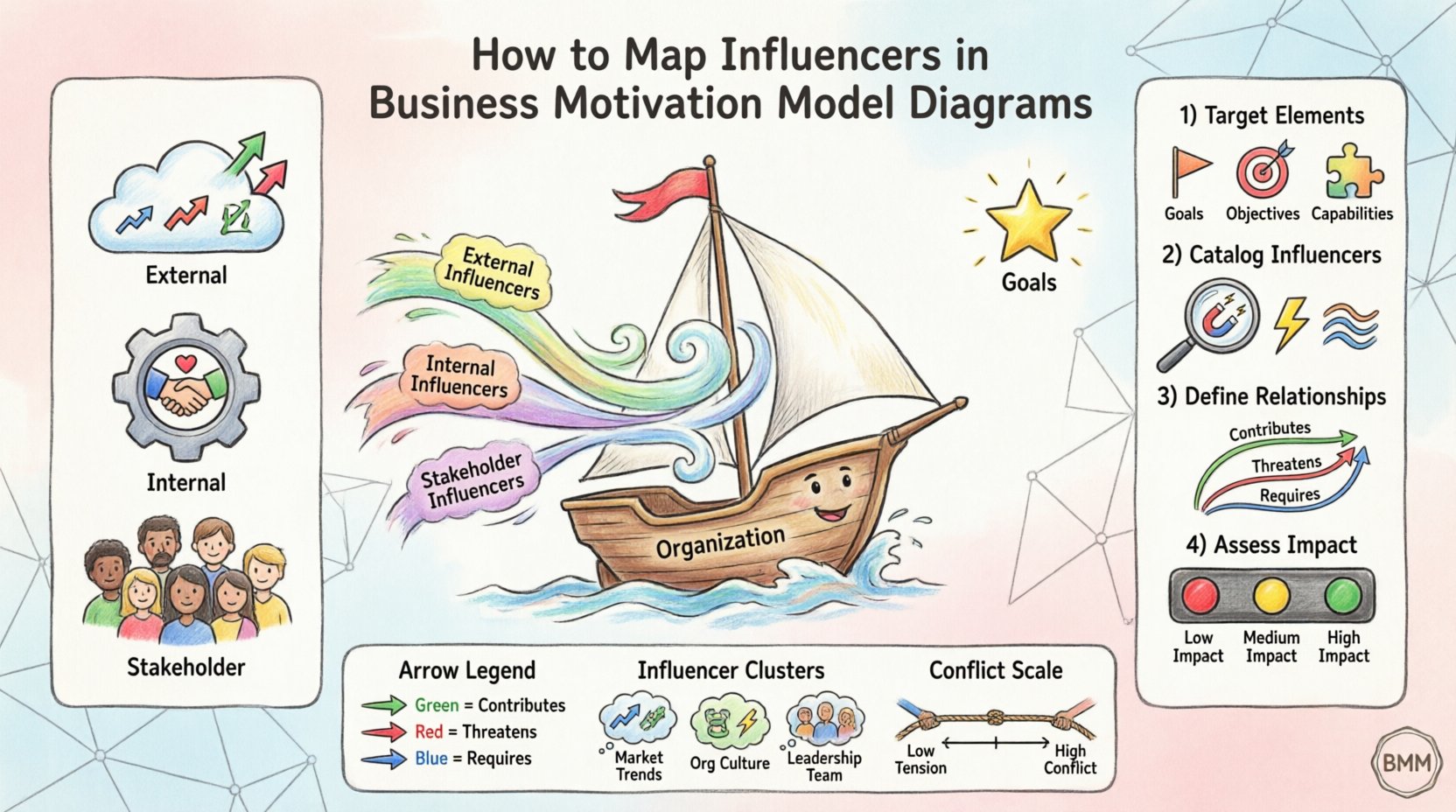
Think of influencers as the wind in the sails of a ship. The ship (the organization) moves toward a destination (the Goal), but the wind (the Influencer) determines the speed and direction. Mapping these forces allows architects to see not just what the business wants to do, but what makes it possible or difficult.
Types of Influencers
Influencers are generally categorized based on their origin and nature. A robust model distinguishes between these types to ensure accurate tracing of impact.
- External Influencers: Factors outside the organization’s direct control. These include market trends, regulatory changes, competitor actions, and economic shifts.
- Internal Influencers: Factors originating within the organization. These include budget constraints, organizational culture, existing technology infrastructure, and workforce skills.
- Stakeholder Influencers: Specific individuals or groups whose needs or power affect business outcomes. This includes investors, customers, or regulatory bodies.
🔍 Why Map Influencers in BMM?
Simply listing goals is insufficient for strategic planning. Mapping influencers provides traceability and risk visibility. Here are the primary reasons to invest time in this activity:
- Impact Analysis: Understand how a change in one area (e.g., a new regulation) ripples through to specific capabilities or goals.
- Risk Identification: Negative influencers often represent risks. Mapping them explicitly highlights areas of vulnerability.
- Opportunity Recognition: Positive influencers can be leveraged as strengths to accelerate progress.
- Alignment Verification: Ensures that resources are not being poured into goals that are actively being hindered by unaddressed external factors.
🛠️ The Process of Mapping Influencers
Creating a reliable map requires a disciplined approach. The following steps outline how to integrate influencers into your diagrams logically and consistently.
Step 1: Identify the Target Elements
Before mapping an influence, you must define what is being influenced. In BMM, the primary elements subject to influence are:
- Business Goals: High-level desired states.
- Business Objectives: Measurable steps toward goals.
- Business Capabilities: The abilities required to perform functions.
- Business Rules: Constraints that must be adhered to.
- Initiatives: Specific projects designed to achieve motivation.
Start by auditing your existing model. List the core goals and capabilities that are most critical to the current strategy. Do not attempt to map influencers for every single minor capability; focus on the strategic drivers.
Step 2: Catalog Potential Influencers
Brainstorm all potential forces that could affect these target elements. Use a collaborative workshop approach to gather input from various departments. Consider the following categories:
- Market Forces: Customer demand shifts, pricing pressure.
- Technological Forces: New software availability, legacy system limitations.
- Regulatory Forces: Compliance requirements, legal statutes.
- Resource Forces: Budget availability, talent pool size.
- Organizational Forces: Leadership changes, policy updates.
Document each influencer as a distinct entity in your model. Assign it a clear identifier and a definition to avoid ambiguity later.
Step 3: Define the Relationship
Once you have your targets and your influencers, you must draw the lines. In BMM, relationships are directional. An influencer acts upon a motivation element. The direction of the arrow points from the Influencer to the Target.
Common relationship types include:
- Contributes To: The influencer positively impacts the likelihood of success.
- Threatens: The influencer negatively impacts the likelihood of success.
- Requires: The target element cannot exist without the influencer.
- Constrained By: The target element is limited by the influencer.
Step 4: Assess Impact and Priority
Not all influences are equal. Some factors are minor, while others are critical. Use a qualitative or quantitative scale to assess impact.
| Level | Description | Example |
|---|---|---|
| High | Critical impact; success is impossible without addressing this. | New tax law affecting revenue stream. |
| Medium | Significant impact; alters the timeline or cost. | Competitor launches a similar feature. |
| Low | Negligible impact; monitored but not immediate concern. | Minor change in industry terminology. |
Tagging influencers with these levels allows for prioritization during planning phases. High-impact negative influencers become risk registers; high-impact positive influencers become strategic enablers.
🔗 Visualizing Relationships in Diagrams
Clarity in a diagram is paramount. When mapping influencers, visual cues help stakeholders understand the dynamics at a glance. While standards may vary, consistent visual language improves communication.
Directionality and Color Coding
Use arrows to denote the flow of influence. A solid line often denotes a direct relationship, while a dashed line might indicate an indirect or conditional relationship. Color coding can further distinguish between positive and negative impacts:
- Green Lines: Positive contribution (Opportunity).
- Red Lines: Negative contribution (Risk/Constraint).
- Blue Lines: Dependency or Requirement.
Ensure that these colors are defined in a legend within the diagram documentation. Consistency across multiple diagrams within the same architecture repository is essential for a cohesive view.
Grouping Influencers
If the number of influencers becomes large, grouping them by category can prevent visual clutter. For instance, all Regulatory Influencers can be grouped together, and the group can be linked to the relevant Business Goals. This keeps the core model clean while maintaining detailed traceability.
📊 Integrating Influencers with Business Capabilities
Influencers do not just affect goals; they often directly impact the Business Capabilities required to achieve them. A capability map shows what the organization can do. An influencer map shows what affects those abilities.
Consider a scenario where a company wants to launch a digital product (Goal). This requires a specific technical capability (Capability). An influencer such as Lack of Skilled Developers directly threatens the capability. Mapping this relationship highlights a gap in the workforce that must be addressed before the goal can be realized.
When linking influencers to capabilities, ask:
- Does this factor enhance the capability?
- Does this factor degrade the capability?
- Does this factor enable a new capability?
- Does this factor obsolete a current capability?
This integration ensures that capability planning is grounded in reality. It prevents the creation of capability roadmaps that ignore external threats or internal limitations.
⚖️ Handling Conflicting Influences
Strategic environments are rarely linear. Often, multiple influencers act on the same goal in contradictory ways. For example, a goal to Reduce Costs might be positively influenced by Automation Software but negatively influenced by Union Labor Agreements.
When mapping these scenarios:
- Identify the Conflict: Explicitly note when opposing forces are active.
- Quantify the Net Effect: If possible, estimate which force is stronger.
- Document the Trade-off: Record the decision logic regarding which influence takes precedence.
Visualizing these conflicts helps management understand the complexity of the strategy. It moves the conversation from “We will achieve this goal” to “We will achieve this goal, provided we mitigate X and leverage Y.”
🔄 Maintaining the Model Over Time
A static map of influencers becomes obsolete quickly. Business environments change. A regulatory update today could render last quarter’s model inaccurate. Therefore, the mapping process must be treated as a living activity.
Review Cycles
Schedule regular reviews of the influencer mappings. These should coincide with strategic planning cycles. During these reviews:
- Check if any influencers have ceased to be relevant.
- Verify if new influencers have emerged.
- Re-assess the impact levels of existing influencers.
- Update the relationships if target elements have changed.
Version Control
Maintain versions of your diagrams. If a major shift occurs in the market (e.g., a pandemic, a merger), create a new version of the BMM model. This preserves the historical context and allows for retrospective analysis of how well the organization anticipated changes.
🚫 Common Pitfalls to Avoid
Even experienced architects make mistakes when mapping motivation elements. Awareness of common errors can save significant time and improve model quality.
Pitfall 1: Confusing Goals with Influencers
A common error is treating a business goal as an influencer. For example, “Increase Market Share” is a goal, not an influencer. “Competitor Pricing Strategy” is an influencer. Ensure you distinguish between the desired outcome and the force driving it.
Pitfall 2: Over-Granularity
Creating thousands of small influencers for every minor detail makes the model unreadable. Group low-level factors into broader categories. For instance, instead of mapping “New Laptop Price” and “New Monitor Price” separately, map “Hardware Cost Inflation” as a single influencer.
Pitfall 3: Ignoring Negative Influences
It is tempting to focus only on positive factors that help the business. However, negative influences (risks) are often more critical to map. Ignoring them creates a false sense of security in the strategic plan.
Pitfall 4: Static Relationships
Assuming a relationship is permanent when it is actually conditional. For example, a partnership might only be a positive influencer if a certain contract renewal occurs. Document conditions alongside relationships where possible.
📈 Measuring the Value of Mapping
How do you know if the mapping effort was worthwhile? Look for improvements in decision-making processes. Indicators of success include:
- Faster Risk Response: Teams can identify the root cause of issues more quickly because the influence path is documented.
- Better Resource Allocation: Budget is directed toward areas where positive influencers are leveraged and negative ones are mitigated.
- Clearer Communication: Stakeholders understand the “why” behind strategic decisions due to visible traceability.
- Improved Agility: When external conditions change, the model allows for rapid simulation of impacts on goals.
🎯 Final Thoughts on BMM Influencer Mapping
Mapping influencers within the Business Motivation Model is not merely a documentation exercise. It is a strategic discipline that grounds high-level ambition in operational reality. By systematically identifying forces, defining relationships, and assessing impact, organizations gain a clearer picture of their strategic landscape.
The effort required to maintain these diagrams is an investment in resilience. In a volatile business environment, knowing what drives your goals is as important as knowing the goals themselves. With a well-mapped model, you create a foundation that supports robust planning, clearer communication, and more adaptive execution.
Focus on accuracy, consistency, and regular updates. Avoid the temptation to overcomplicate, but do not shy away from the necessary complexity that comes with understanding how the business truly works. The resulting diagrams will serve as a reliable navigation system for your organization’s future.