
Object-Oriented Analysis and Design (OOAD) has long served as the backbone of robust software development. For decades, the principles of encapsulation, inheritance, and polymorphism have guided architects in building maintainable, scalable systems. However, the landscape of technology is shifting rapidly. Cloud-native computing, distributed systems, and the rise of artificial intelligence are pressuring traditional OOP models to evolve. This guide explores the future trends shaping object-oriented software architecture, providing a deep dive into how analysis and design methodologies are adapting to meet modern demands.
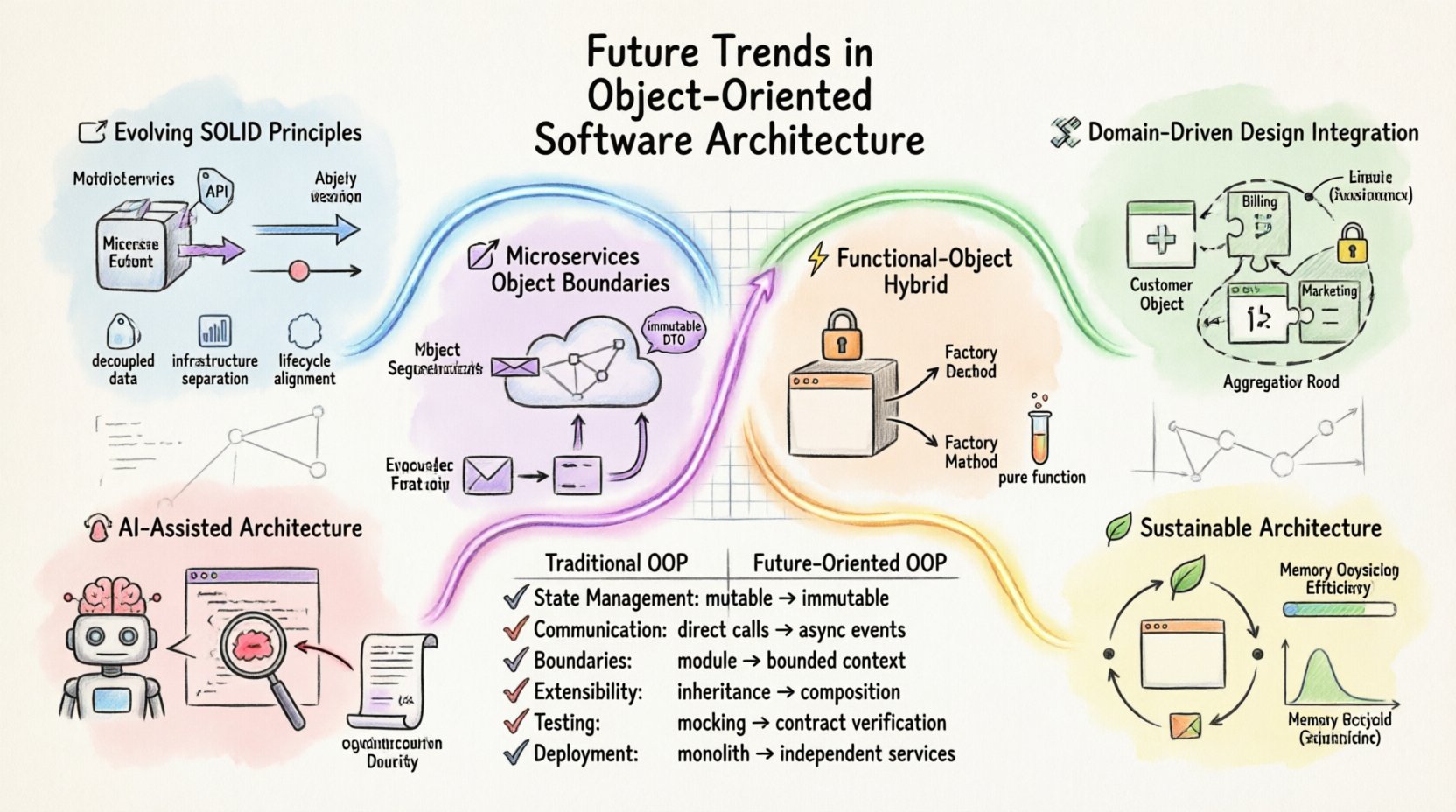
🔄 The Evolution of SOLID Principles
The SOLID principles remain a cornerstone of object-oriented design, yet their application is undergoing significant transformation. As systems move from monolithic structures to distributed environments, the interpretation of these principles must expand beyond the class level to encompass service boundaries and network interactions.
Single Responsibility Principle (SRP) in Distributed Systems
In traditional monoliths, SRP often dictated that a class should have one reason to change. In the future of OOAD, this responsibility extends to microservices. An object no longer represents just a single entity but might represent a bounded context within a larger ecosystem. Architects are moving towards defining responsibilities at the service level, ensuring that individual objects within a service remain cohesive while the service itself handles a specific business capability.
- Decoupling data access from business logic within objects.
- Ensuring classes do not manage infrastructure concerns like logging or transaction management.
- Aligning object lifecycles with service deployment cycles.
Open/Closed Principle (OCP) and API Evolution
Software must be open for extension but closed for modification. This concept is critical when dealing with versioning in API-driven architectures. Future object models will increasingly rely on interface segregation and contract-based design. This allows new features to be added through extension points without altering the core object definition, ensuring stability for downstream consumers.
- Using versioned interfaces to manage backward compatibility.
- Implementing feature flags within object state management.
- Designing extension points that do not require recompilation of dependent modules.
Interface Segregation and Dependency Inversion
The pressure to reduce coupling is driving a shift towards smaller, more focused interfaces. In OOAD, this means avoiding large interface implementations that force clients to depend on methods they do not use. Furthermore, Dependency Inversion is evolving to rely on asynchronous communication patterns rather than direct synchronous calls, allowing objects to remain decoupled even across network boundaries.
🧩 Deep Integration with Domain-Driven Design
Domain-Driven Design (DDD) is not a new concept, but its integration with object-oriented architecture is becoming more sophisticated. The focus is shifting from mere technical modeling to capturing the essence of the business domain within the software structure.
Bounded Contexts as Object Boundaries
Traditionally, object boundaries were defined by technical modules. Future architectures will define object boundaries by business context. This ensures that an object model accurately reflects the business reality without leaking concepts from unrelated domains. An object representing a “Customer” in a billing context will differ structurally from a “Customer” in a marketing context, even if they share similar attributes.
- Explicitly defining the scope of an aggregate root.
- Ensuring objects do not cross context boundaries without explicit translation.
- Maintaining a Ubiquitous Language within the object naming conventions.
Aggregates and Consistency Boundaries
In high-concurrency environments, maintaining data consistency within an object graph is challenging. Aggregates are evolving to serve as the primary consistency boundary. Future OOAD will emphasize the minimization of object interactions across aggregate boundaries. This reduces the complexity of distributed transactions and improves system resilience.
🌐 Microservices and Object Boundaries
The migration to microservices introduces a new challenge: how to model objects when they reside on different servers. The classic object-oriented assumption of direct memory access is no longer valid. Architects must design objects that can be serialized, transmitted, and reconstructed without losing their behavioral integrity.
Serialization and Object Identity
When objects cross network boundaries, identity management becomes critical. Future trends involve using immutable value objects for data transfer and distinct identity references for entities. This prevents the state corruption that can occur when distributed objects are modified concurrently.
- Adopting immutable data transfer objects (DTOs) for inter-service communication.
- Using unique identifiers to resolve object references across services.
- Implementing optimistic locking mechanisms within object states.
Event-Driven Object Models
The passive object model is giving way to active, event-driven models. Instead of waiting for a command to execute, objects react to events. This shift supports the asynchronous nature of microservices and allows for better decoupling of system components.
⚡ Functional-Object Hybrid Models
One of the most significant shifts in OOAD is the convergence with functional programming paradigms. Pure functions offer predictability and testability, while objects offer state management and organization. The future lies in a hybrid approach that leverages the strengths of both.
Immutability within Classes
While objects inherently manage state, future object models will favor immutability where possible. This reduces side effects and makes reasoning about object behavior easier. Constructors will be encouraged to create fully initialized, unchangeable instances.
- Using getters that return copies rather than references.
- Replacing setter methods with factory methods that return new instances.
- Encapsulating mutable state behind read-only interfaces.
Pure Functions as Methods
Behavior within an object will increasingly be implemented as pure functions. This ensures that the output depends solely on the input parameters and the object state, without hidden dependencies on external systems. This approach simplifies testing and improves reliability in complex workflows.
🤖 AI-Assisted Design and Architecture
Artificial Intelligence is no longer just a tool for coding; it is becoming a partner in architectural design. Large Language Models (LLMs) are being used to analyze codebases, suggest refactoring patterns, and identify architectural smells.
Automated Pattern Recognition
AI tools can scan existing object graphs to detect violations of design principles. They can suggest where to introduce interfaces or how to refactor inheritance hierarchies to improve flexibility. This automation accelerates the analysis phase of OOAD.
- Automated detection of tight coupling between classes.
- Recommendations for design pattern application based on context.
- Identification of potential scalability bottlenecks in object interactions.
Generative Architecture Documentation
Documentation often lags behind code. AI can generate up-to-date documentation by analyzing the object structure and relationships. This ensures that the design intent is preserved and accessible to new team members.
🌱 Sustainable Software Architecture
Environmental sustainability is becoming a metric for software quality. The energy consumption of object instantiation and garbage collection is now a consideration in architecture design. Efficient object management contributes to lower carbon footprints.
Resource-Efficient Object Lifecycle
Architects are considering the cost of creating and destroying objects. Techniques such as object pooling and minimizing temporary object creation during high-frequency operations are becoming standard practices.
- Reusing object instances where thread safety permits.
- Optimizing memory allocation strategies.
- Designing for efficient garbage collection cycles.
📊 Architectural Patterns Comparison
The following table outlines the key differences between traditional and future-oriented object-oriented architectural patterns.
| Feature | Traditional OOP | Future-Oriented OOP |
|---|---|---|
| State Management | Mutability is common | Immutability preferred for state |
| Communication | Direct method calls | Asynchronous events and messages |
| Boundaries | File or Module level | Bounded Context and Service level |
| Extensibility | Inheritance heavy | Composition and Interface Segregation |
| Testing | Mocking dependencies | Contract-based verification |
| Deployment | Monolithic blocks | Independent object services |
🛠️ Implementation Challenges
Adopting these future trends is not without obstacles. Organizations face significant hurdles when transitioning from legacy object models to these new paradigms.
Legacy Code Integration
Most organizations operate with decades of legacy code that does not follow modern principles. Strangling these legacy objects out of the system without breaking functionality requires a phased approach. Architects must design adapters that bridge old and new object models.
- Wrap legacy objects in modern interfaces.
- Incrementally refactor high-risk classes.
- Maintain dual interfaces during transition periods.
Learning Curve and Skill Gaps
New architectural patterns require new skills. Developers must understand distributed systems, event sourcing, and functional concepts alongside traditional OOP. Training programs must be updated to reflect these changing requirements.
Performance Overhead
Abstraction layers and immutable objects can introduce performance overhead. In high-performance systems, this cost must be carefully weighed against the benefits of maintainability and correctness.
🚀 The Path Forward for Object-Oriented Analysis
The trajectory of object-oriented architecture is clear. It is moving away from rigid, centralized structures towards flexible, distributed, and domain-aligned models. The core tenets of OOAD—encapsulation, abstraction, and modularity—remain valid, but their implementation is evolving.
Architects must prioritize clarity in domain modeling. They should embrace patterns that support scalability, such as event-driven communication and bounded contexts. The integration of functional principles will enhance reliability, while AI tools will assist in maintaining architectural integrity over time.
Success in this future environment depends on a commitment to continuous adaptation. Design is not a one-time activity but an ongoing process of refinement. By focusing on domain value and system resilience, object-oriented software architecture will continue to provide a solid foundation for complex software systems.
The convergence of these trends suggests a maturation of the discipline. It is no longer just about writing code that works; it is about designing systems that endure, adapt, and scale efficiently. As technology continues to advance, the object remains a vital unit of organization, provided it is designed with the future in mind.