
Strategic planning often relies on frameworks that have stood the test of time, yet in an era defined by volatility, the tools we use must evolve alongside the markets they serve. The SWOT analysis—Strengths, Weaknesses, Opportunities, and Threats—is a cornerstone of business strategy. However, the traditional application of this framework frequently leads to static, superficial insights that fail to capture the nuance of contemporary commerce. 📉
This guide explores a dynamic approach to strategic assessment. We move beyond the static grid into a living, breathing methodology that accounts for time, external volatility, and internal adaptability. By rethinking how we categorize data and apply it to decision-making, organizations can achieve a deeper understanding of their position without relying on rigid templates. 🧭
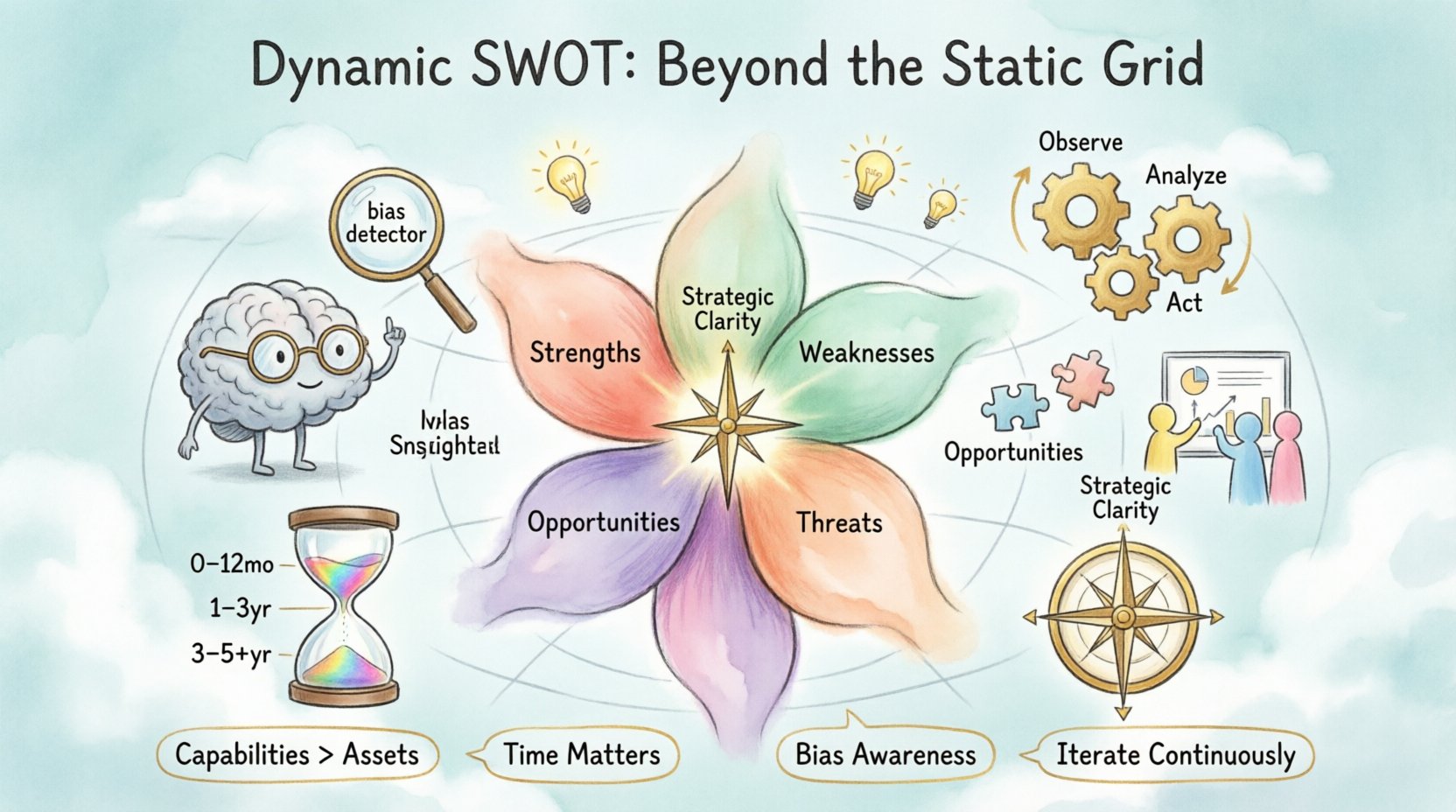
🛑 The Stagnation of Static Analysis
Traditional SWOT matrices are often treated as one-time exercises. A team gathers in a room, fills out four boxes, and files the document away. This linear approach assumes a level of stability that rarely exists in modern markets. When the environment changes rapidly, a static document becomes obsolete before it is even finalized. The problem lies not in the concept itself, but in the execution and the lack of temporal context.
Consider the following limitations inherent in the standard approach:
- Lack of Context: Lists of strengths often lack the necessary evidence to prove competitive advantage. Is a large team a strength if productivity is low?
- Static Snapshot: A document created in January may not reflect market realities by March. The speed of disruption requires continuous monitoring.
- Internal Focus: Traditional exercises often dwell too heavily on internal factors while treating external threats as generic bullet points.
- Confirmation Bias: Teams tend to fill boxes with what they already know, ignoring data that contradicts their existing narrative.
To break free from these constraints, we must treat the SWOT analysis as a process rather than a product. It requires an iterative cycle of observation, analysis, and action. The goal is not to produce a document, but to produce clarity. 🧠
🏗️ Redefining Strengths and Weaknesses
Strengths and Weaknesses are often conflated with resources and capabilities. While resources (capital, equipment, staff) are tangible, capabilities are the ability to deploy those resources effectively. A fresh perspective distinguishes between having an asset and the capacity to leverage it. This distinction is critical for accurate self-assessment.
Internal Capabilities vs. Tangible Assets
When listing internal factors, avoid generic terms like “good reputation” or “strong team.” Instead, define specific competencies. For example, instead of “strong marketing,” specify “high conversion rate on organic search channels.” This specificity allows for actionable strategy.
- Strengths: Focus on sustainable competitive advantages. What can you do that competitors cannot easily replicate? Is it proprietary technology, deep customer relationships, or agile supply chains?
- Weaknesses: Identify areas where execution falls short. These are not just failures, but gaps between current performance and potential. Acknowledge technical debt, skill shortages, or process bottlenecks.
By shifting the focus from assets to capabilities, the analysis becomes more predictive. You are not just cataloging what you have, but evaluating what you can achieve with it.
🌪️ Opportunities and Threats in a Volatile Landscape
External factors are no longer predictable using historical data alone. The modern market is influenced by technological disruption, regulatory shifts, and changing consumer behaviors. Opportunities and Threats require a broader lens, often integrating elements of PESTLE analysis (Political, Economic, Social, Technological, Legal, Environmental) to ensure comprehensive coverage.
The Intersection of External Forces
A threat today might be an opportunity tomorrow, and vice versa. For instance, a new regulation could increase compliance costs (Threat) but also serve as a barrier to entry for less prepared competitors (Opportunity). This duality requires a nuanced view.
When assessing external factors, categorize them by impact and probability. Not every trend warrants a strategic response. Focus on the signals that have the highest likelihood of affecting your core operations.
- Technological Shifts: AI adoption, automation, and data security are not just trends; they are foundational changes.
- Consumer Sentiment: Sustainability and ethical sourcing are driving purchasing decisions more than price in many sectors.
- Regulatory Environment: Changes in trade laws or labor standards can alter the cost structure of an entire industry.
⏳ Integrating Temporal Dynamics
The most significant departure from the traditional template is the introduction of time. A dynamic SWOT acknowledges that factors change velocity. Some strengths degrade over time, while some threats emerge suddenly. By adding a timeline to the analysis, you create a roadmap for strategic evolution.
Short-Term vs. Long-Term Factors
| Time Horizon | Focus Area | Example Factor |
|---|---|---|
| Immediate (0-12 Months) | Cash flow, staffing levels, inventory | Seasonal demand spike |
| Medium (1-3 Years) | Product roadmap, market expansion | New competitor entry |
| Long-Term (3-5+ Years) | Brand positioning, technology stack | Regulatory overhaul |
Using a table like this helps teams visualize the lifespan of specific strategic elements. A strength that is vital today may become a weakness tomorrow if it prevents adaptation. Conversely, a temporary threat might stabilize into a manageable risk.
🧠 The Human Element: Cognitive Biases
Even the best frameworks are susceptible to human error. When conducting a strategic assessment, teams often fall prey to cognitive biases that skew the results. Recognizing these biases is a strength in itself, as it allows for a more objective evaluation of the business.
Common Biases in Strategic Planning
| Bias Type | Description | Mitigation Strategy |
|---|---|---|
| Confirmation Bias | Seeking information that confirms pre-existing beliefs | Assign a “Devil’s Advocate” role to challenge assumptions |
| Overconfidence Effect | Overestimating internal capabilities and control | Use third-party data to validate internal perceptions |
| Status Quo Bias | Preference for the current state of affairs | Explicitly list the cost of inaction |
| Sunk Cost Fallacy | Continuing a project because of past investment | Evaluate based on future value only |
Avoiding these pitfalls ensures that the analysis remains grounded in reality. It requires a culture of psychological safety where team members can voice concerns without fear of reprisal. This openness is the bedrock of accurate strategic insight.
📋 A Step-by-Step Framework for Execution
Implementing a dynamic SWOT analysis does not require specialized software or expensive consultants. It requires a disciplined process and a collaborative environment. The following steps outline a method for conducting this assessment effectively.
- Define the Scope: Clearly state what business unit, product line, or market segment is being analyzed. A broad scope often leads to vague conclusions.
- Gather Data: Collect quantitative and qualitative data. Use customer feedback, sales figures, industry reports, and employee surveys. Avoid relying solely on anecdotal evidence.
- Facilitate the Session: Bring together cross-functional leaders. Ensure diverse perspectives are represented. A sales leader sees different threats than an engineer.
- Categorize Factors: Place items into the four quadrants, but tag them with time horizons and impact scores.
- Develop Strategic Actions: For every strength, identify how to leverage it. For every weakness, plan a mitigation strategy. Match opportunities to strengths, and threats to weaknesses.
- Review and Iterate: Schedule regular reviews. Quarterly updates keep the analysis relevant and actionable.
This process transforms the SWOT from a static document into a living strategy. It ensures that the insights gained are translated into concrete actions.
📊 Measuring the Impact of Strategic Shifts
The value of a modern SWOT analysis lies in its ability to drive measurable outcomes. If the analysis does not lead to changes in behavior or performance, it has failed its purpose. Establishing key performance indicators (KPIs) linked to the strategic insights is essential.
For example, if a weakness is identified as “slow product development,” the strategic action might be to adopt a new workflow. The metric for success is not the completion of the workflow, but the reduction in time-to-market. This linkage ensures accountability.
Key Metrics to Track
- Strategic Alignment Score: How well do current projects match the identified strengths?
- Opportunity Conversion Rate: Percentage of identified opportunities that were acted upon.
- Threat Mitigation Time: How quickly did the organization respond to emerging threats?
- Resource Allocation Efficiency: Is capital flowing toward the identified strengths and opportunities?
Tracking these metrics provides feedback on the effectiveness of the strategic planning process itself. It creates a loop of continuous improvement.
🔄 Adapting the Framework for Different Industries
While the core concepts remain consistent, the application of SWOT varies across sectors. A technology startup operates differently from a manufacturing firm or a service provider. Understanding these nuances is vital for accurate application.
For Technology Companies: Focus heavily on the speed of innovation and talent retention. The threat landscape includes rapid obsolescence and talent poaching.
For Manufacturing: Supply chain resilience and regulatory compliance are critical. Strengths often lie in operational efficiency and quality control.
For Service Providers: Customer experience and brand reputation are paramount. Weaknesses often relate to scalability and service consistency.
🚀 Moving Forward Without New Tools
There is a misconception that modernizing strategy requires new digital tools. While technology can aid collaboration, the core thinking process is human. You can conduct a dynamic SWOT analysis using a simple digital whiteboard, a shared spreadsheet, or even a physical board in a conference room.
The key is the rigor of the thinking, not the medium of the record. Avoid the trap of letting the tool dictate the process. Keep the focus on the strategic questions: What is changing? How are we changing? Are we ready?
By stripping away the reliance on rigid templates and specialized software, organizations can regain the agility to respond to market shifts. The framework becomes a mental model rather than a bureaucratic exercise. This shift empowers teams to think critically and act decisively.
🌟 Final Thoughts on Strategic Evolution
The landscape of business strategy is constantly shifting. The frameworks we use must reflect the complexity of the modern economy. A fresh perspective on SWOT analysis allows organizations to move beyond simple categorization and into genuine strategic insight. By integrating temporal dynamics, addressing cognitive biases, and focusing on capabilities over assets, leaders can navigate uncertainty with confidence.
Remember that strategy is not a destination; it is a journey. The analysis is a tool for navigation, not a map to be followed blindly. Regular review and adaptation are the only ways to ensure the strategy remains relevant. Embrace the dynamic nature of the business environment, and let your planning process evolve to meet it. The goal is not perfection, but responsiveness. 🎯