
Now Reading: Fitness App Backlog Development with the AI-Powered User Story (3Cs) Editor
-
01
Fitness App Backlog Development with the AI-Powered User Story (3Cs) Editor


Fitness App Backlog Development with the AI-Powered User Story (3Cs) Editor
Developing a comprehensive product backlog for a complex software project, such as a mobile health application, frequently presents a significant challenge for even the most experienced product managers and agile teams. The initial phase of defining requirements is often hindered by the “blank page” problem, where the sheer breadth of potential features leads to decision paralysis and inconsistent documentation. This is where a professional AI-powered user story generator becomes indispensable, transforming a vague concept into a structured, actionable plan. By leveraging the User Story (3Cs) Editor from Visual Paradigm, teams can move beyond manual entry and utilize sophisticated artificial intelligence to draft, refine, and prioritize their development efforts with unprecedented speed and precision.
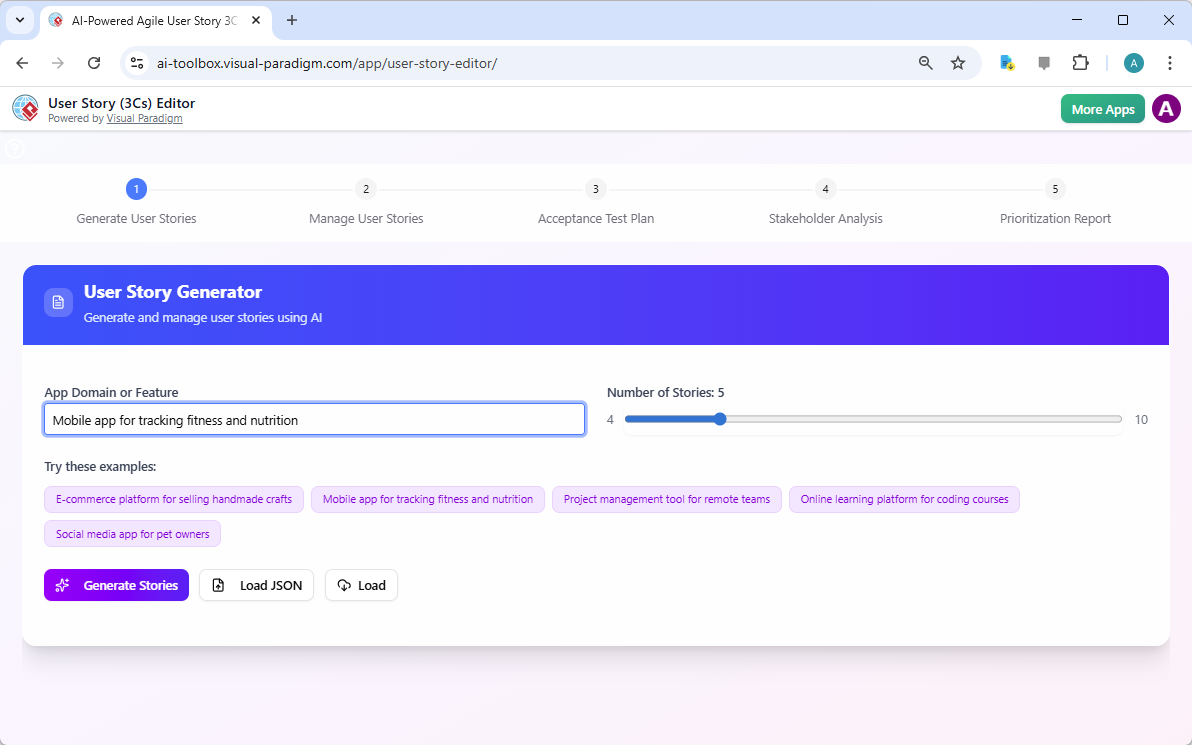
In the following exploration, we observe the tool in action as it navigates the creation of a “Mobile app for tracking fitness and nutrition.” The process begins with a simple prompt within the easy-to-use user story editor interface. The user specifies the app domain and the desired number of stories, initiating a sequence that will eventually produce a full suite of project artifacts, including test plans and stakeholder analyses. This automated approach ensures that the foundational elements of the project—the stories themselves—are grounded in the industry-standard 3Cs framework: Card, Conversation, and Confirmation.
Refining Requirements with the Professional User Story Table
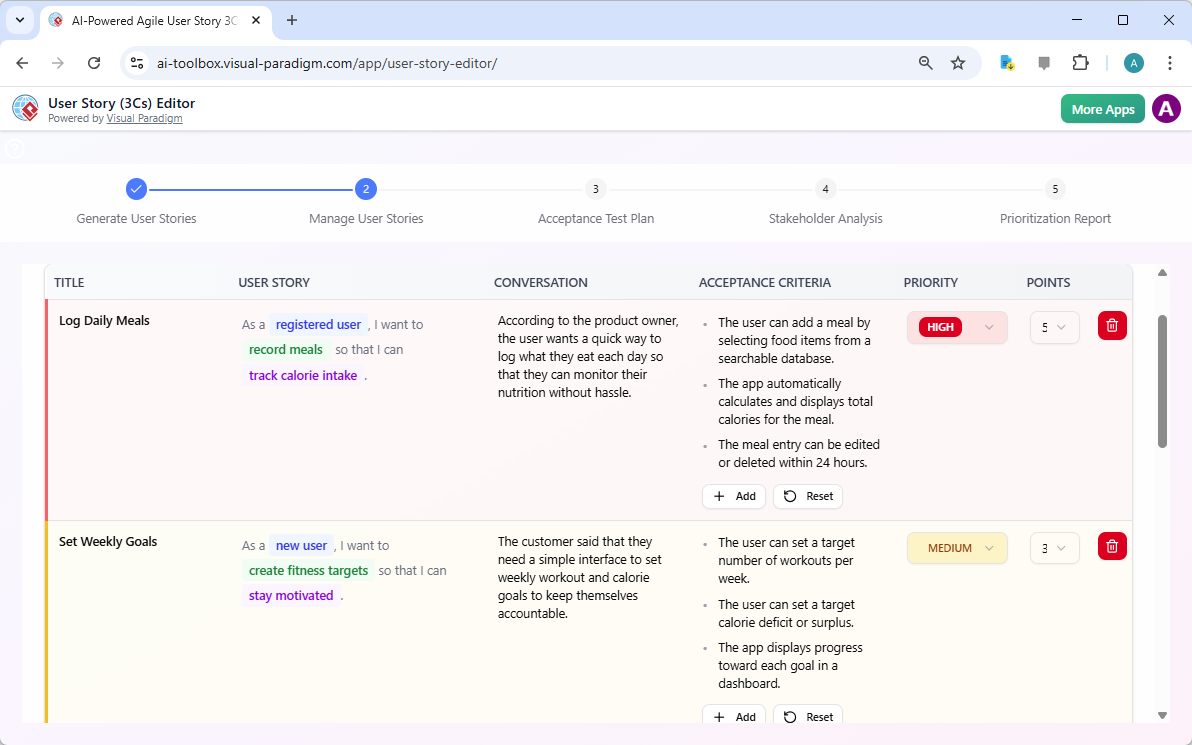
Once the initial generation phase is complete, the best online user story tool transitions into a management phase where the AI-generated suggestions are presented in an interactive, editable table. This interface is designed for high-density information management, allowing users to scrutinize the “Card” (the story statement), the “Conversation” (supporting context), and the “Confirmation” (the acceptance criteria). For our fitness app example, we see the AI has generated critical stories such as “Log Daily Meals,” which focuses on the registered user’s need to track calorie intake. Each row is fully customizable, enabling the product owner to adjust the narrative to fit specific business logic or technical constraints.
The AI-powered user story editor does not merely provide text; it integrates agile metadata directly into the workflow. Within this table, team members can assign “Priority” levels (High, Medium, Low) and estimate “Story Points” to reflect the complexity and effort required for implementation. This structured data becomes the backbone of the project, ensuring that the backlog is not just a list of ideas, but a prioritized roadmap. The ability to manually add new stories or delete redundant ones ensures that the human element of product management remains central to the process while the AI handles the heavy lifting of initial drafting.
Quick Summary of Key Benefits
-
Accelerated Backlog Creation: Transition from a concept to a robust set of user stories in minutes rather than hours.
-
Methodological Consistency: Strict adherence to the 3Cs framework (Card, Conversation, Confirmation) across all project documentation.
-
Automated Documentation: Instant generation of acceptance test plans, stakeholder personas, and prioritization reports.
-
Enhanced Collaboration: Provides a centralized, cloud-accessible platform for agile teams to align on deliverables.
-
Data-Driven Decisions: Utilization of normalized priority scores to objectively rank feature development.
Automating Quality Assurance through Acceptance Test Plans
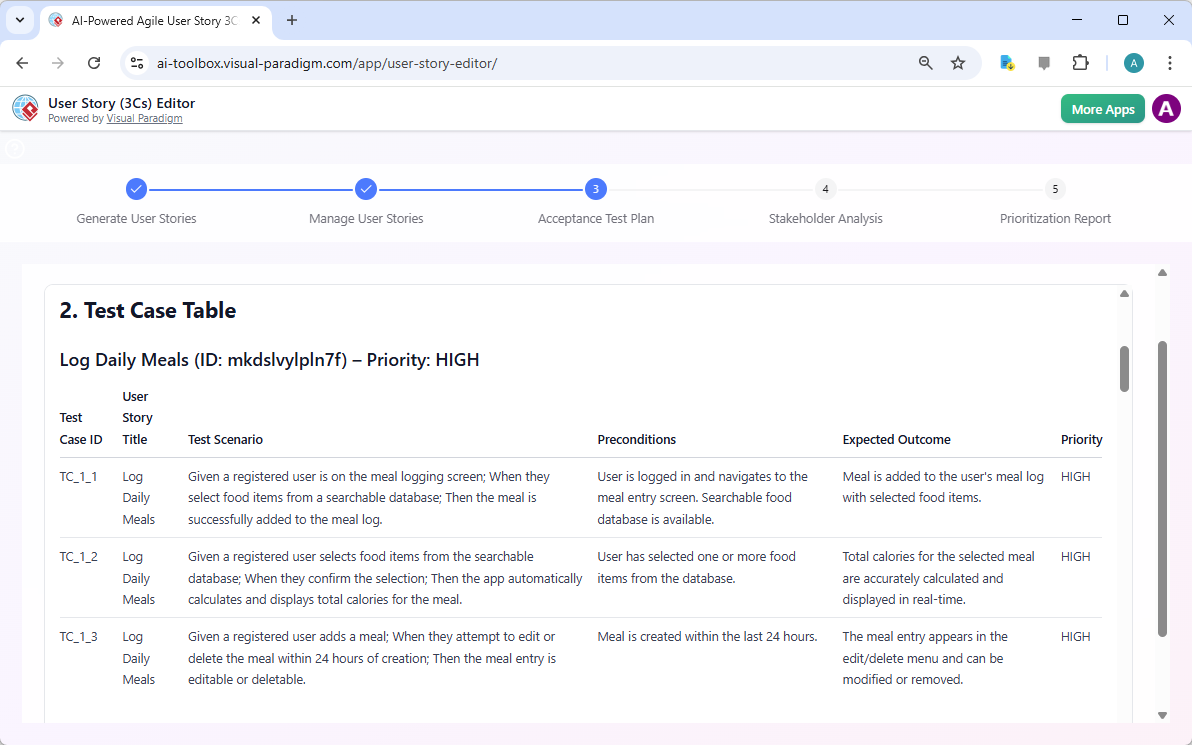
A significant bottleneck in the development lifecycle is the manual creation of test cases. Traditionally, QA engineers must parse individual user stories to extract scenarios and expected outcomes. The User Story (3Cs) Editor eliminates this friction by automatically deriving an Acceptance Test Plan from the defined acceptance criteria. In the fitness app scenario, for the story “Log Daily Meals,” the AI generates a “Test Case Table” that outlines specific scenarios, such as a user selecting food items from a searchable database. Each test case includes preconditions, the test scenario itself, and the expected outcome, ensuring that the development team knows exactly what constitutes a “done” feature.
This level of automation ensures that the “Confirmation” aspect of the 3Cs is robust and verifiable. By generating these plans early in the cycle, teams can adopt a more proactive approach to quality, identifying potential edge cases before a single line of code is written. The reports can be exported as Markdown, allowing for easy integration into other documentation systems or for use during sprint demonstrations. This systematic approach to testing reduces the likelihood of requirements being misinterpreted and improves the overall reliability of the final software product.
Deepening Project Insight with AI Stakeholder Analysis
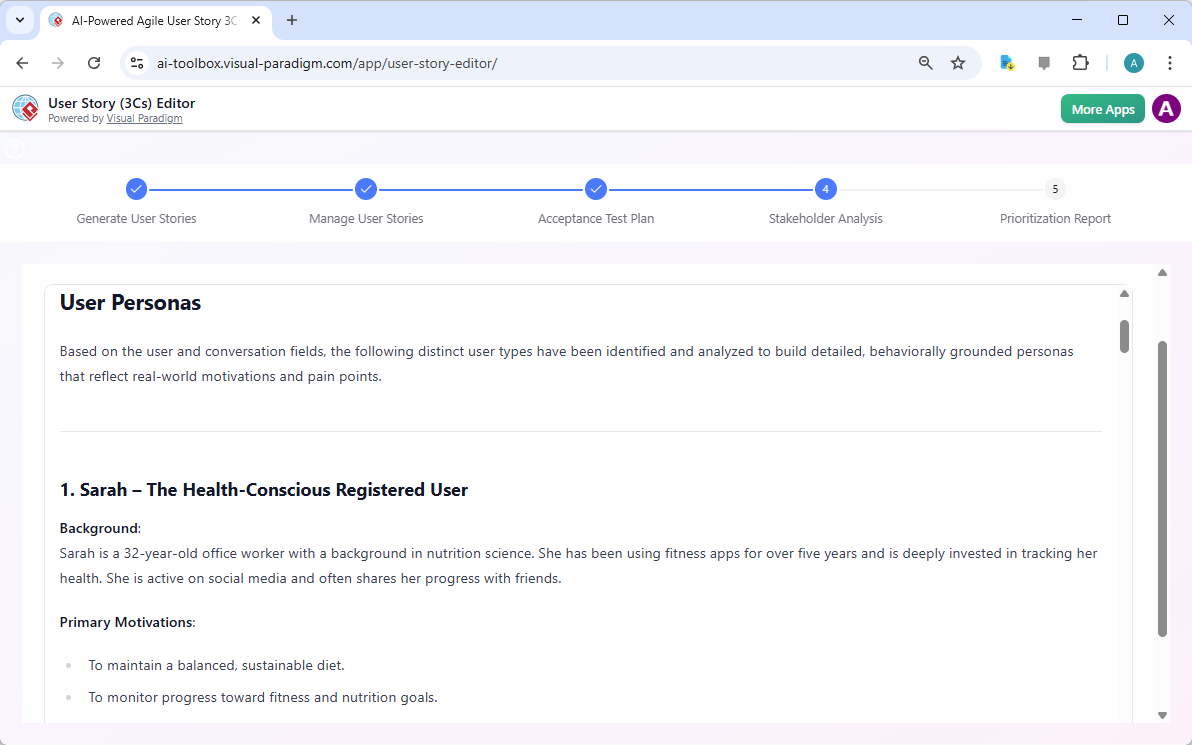
Understanding the human landscape of a project is as critical as the technical requirements. The AI-powered User Story (3Cs) Editor goes beyond simple story points by analyzing the backlog to identify key stakeholders and user personas. This feature provides an automated Stakeholder Analysis, creating detailed profiles of the individuals who will interact with the system. For our fitness and nutrition tracking app, the tool identifies “Sarah – The Health-Conscious Registered User.” The analysis details her background as a nutrition-savvy office worker and outlines her primary motivations, such as maintaining a balanced diet and monitoring progress toward fitness goals.
These behaviorally grounded personas help the development team maintain empathy for the end-user throughout the build process. By identifying pain points and motivations automatically, the online agile project management tool ensures that features are built with a specific purpose in mind. This analysis is particularly useful for product owners when communicating with business executives, as it provides a clear rationale for why certain features are being prioritized based on the needs of the target audience. It transforms a list of technical tasks into a user-centric mission.
Strategic Roadmap Planning via the Prioritization Matrix
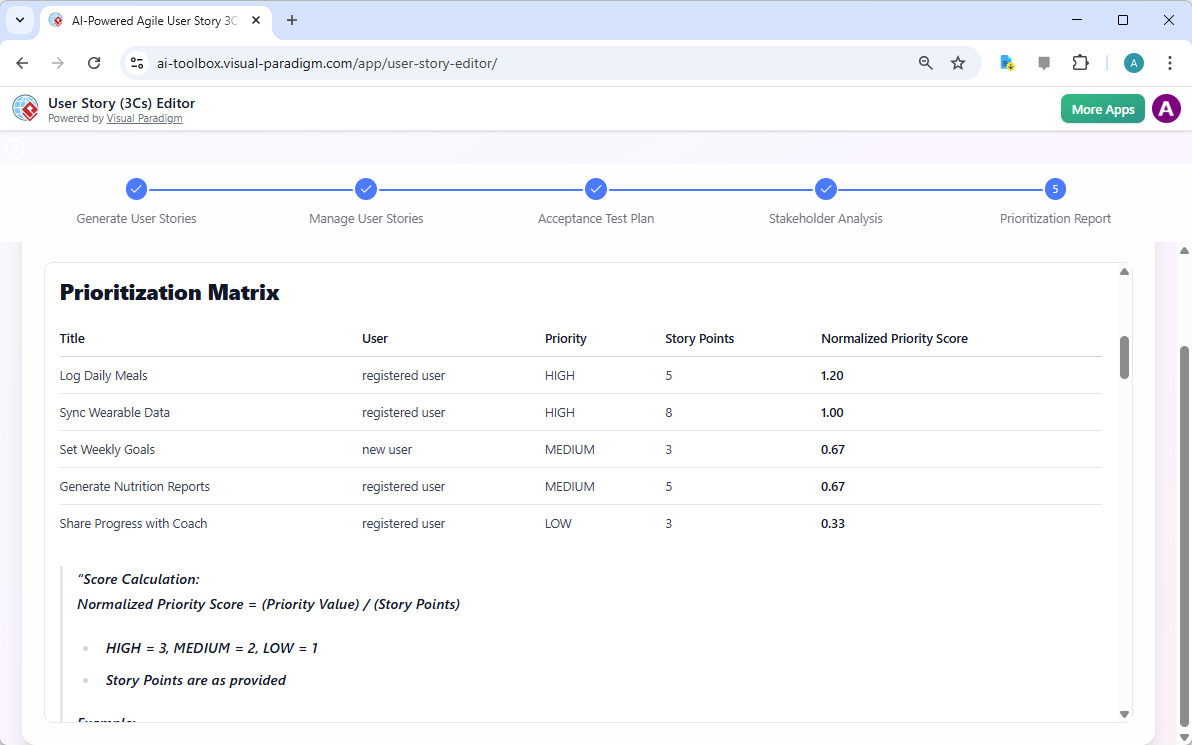
The final stage in organizing a successful project involves objective prioritization. The User Story (3Cs) Editor provides a sophisticated “Prioritization Report” that synthesizes all the data points gathered in previous steps. This report features a “Prioritization Matrix” that calculates a “Normalized Priority Score” for each story. The formula—(Priority Value) / (Story Points)—allows teams to see which features offer the highest value relative to the effort required. For instance, high-priority items with low story points will naturally rise to the top of the roadmap, identifying “quick wins” for the upcoming sprints.
In our fitness app project, we can see how items like “Log Daily Meals” and “Sync Wearable Data” are ranked. This data-driven approach removes much of the subjectivity and internal politics often associated with backlog grooming. By presenting a clear, mathematical justification for the development order, the AI-powered user story generator fosters transparency and trust within the team and with external stakeholders. This ensures that the team’s energy is focused on the most impactful features, maximizing the return on investment for the product development effort.
Successfully navigating the complexities of agile development requires tools that are both sophisticated and accessible. The User Story (3Cs) Editor from Visual Paradigm represents a significant leap forward in AI-powered agile documentation. By automating the transition from a simple idea to a fully documented, tested, and prioritized backlog, it allows teams to spend less time on administrative tasks and more time on actual innovation. Whether you are building a fitness app or a complex enterprise system, this professional user story tool provides the structure and insight necessary for success in the modern software landscape.
Start Building Your Product Backlog Today
Ready to revolutionize your agile workflow and eliminate the manual grind of story writing? You can experience the power of AI-driven project management right now. Use the AI-powered User Story (3Cs) Editor to generate your first set of stories and see how quickly your project takes shape.
Experience the tool for yourself: Try the AI User Story Editor Now
Learn more about the features: Visual Paradigm AI User Story Guide
Related Links
-
Agilien AI-Powered Jira Backlog Planner – Visual Paradigm: Automate and enhance your Jira backlog planning with Agilien AI, which intelligently structures user stories and epics for efficient sprint planning.
-
Creating Storyboards from User Stories in Visual Paradigm: Tutorial on transforming user stories into visual storyboards to improve understanding and alignment in product development.
-
Visual Paradigm – Story Estimation & Spike Investigation for Agile: Learn how to use Visual Paradigm’s agile development tools to estimate user stories and conduct spike investigations to reduce uncertainty in sprint planning.
-
How to Manage User Stories with Story Maps in Scrum: A practical guide on using user story maps to organize, prioritize, and manage user stories within a Scrum framework.
-
From Business Processes to User Stories: A Mapping Tutorial: Learn how to transform business processes into user stories using Visual Paradigm, enabling better alignment between business goals and development.
-
What Is a User Story? A Complete Guide to Agile Requirements: This comprehensive guide explains the concept of user stories in Agile software development, highlighting their purpose, structure, and importance in capturing user needs effectively.
-
Writing Effective User Stories: A Practical Guide for Agile Teams: A hands-on guide that walks Agile teams through the process of crafting high-quality user stories using real-world examples and proven techniques.