
In the complex landscape of modern enterprise architecture, clarity is not just a luxury; it is a necessity. Organizations often struggle with disconnects between high-level vision and daily execution. This gap frequently leads to wasted resources, misaligned teams, and strategic drift. To bridge this divide, professionals turn to structured frameworks that translate abstract ambitions into actionable plans. The Business Motivation Model (BMM) stands out as a robust standard for organizing these elements. It provides a disciplined approach to defining clear objectives, ensuring that every action ties back to a fundamental purpose.
By adopting this framework, businesses can move beyond vague aspirations and establish a coherent system of goals, strategies, and tactics. This guide explores the mechanics of the BMM, offering a deep dive into how it facilitates objective definition. We will examine the core components, the relationships between them, and practical steps for implementation. The goal is to equip you with the knowledge to build a sustainable model of motivation and direction within your organization.
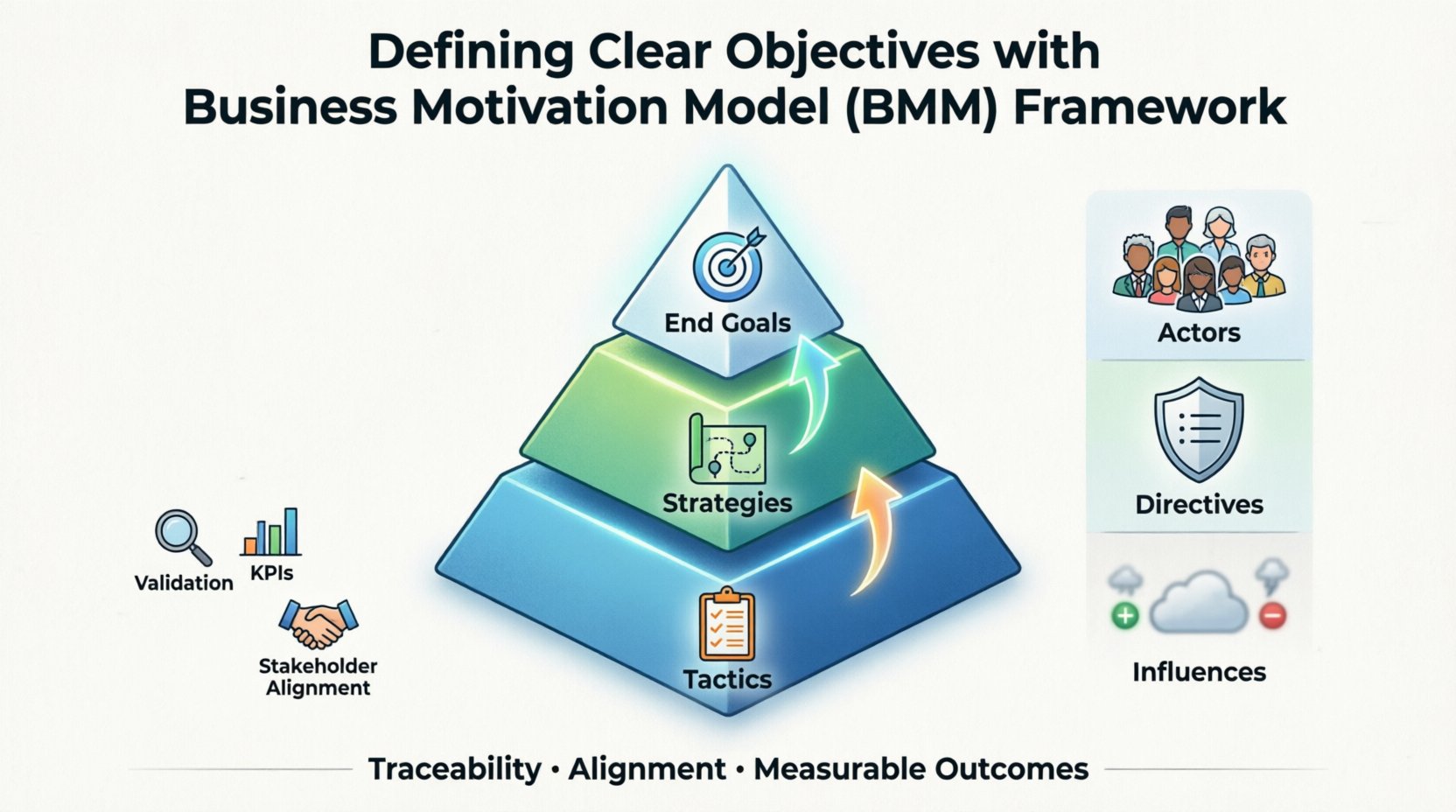
Understanding the Business Motivation Model 🏗️
The Business Motivation Model is an open standard maintained by the Object Management Group (OMG). It is designed to model the “why” behind business actions. Unlike traditional process modeling, which focuses on “how” tasks are performed, BMM focuses on the drivers and intentions. It creates a unified view of the business environment, connecting the motivation for change with the means to achieve it.
When defining objectives, the BMM offers a vocabulary that eliminates ambiguity. It distinguishes between what an organization wants to achieve and the specific actions taken to get there. This distinction is critical. Without it, teams may focus on activity rather than outcome. The model ensures that every tactic can be traced back to a specific goal, and every goal aligns with an overarching enterprise objective.
Key Components of the BMM Framework 🧩
To define objectives effectively, one must understand the building blocks of the framework. These components interact to form a complete picture of business intent. Below is a breakdown of the essential elements used within the model.
| Component | Description | Role in Objective Definition |
|---|---|---|
| Actors | Entities that take action or have a role in the business. | Identifies who is responsible for achieving the objectives. |
| End Goals | Desired states that are valuable to the organization. | Defines the ultimate targets or outcomes. |
| Directives | Rules or policies that must be followed. | Sets constraints and boundaries for actions. |
| Strategies | Plans or approaches to achieve goals. | Outlines the method or path to the destination. |
| Tactics | Specific actions or resources used to execute strategies. | Details the concrete steps taken daily. |
| Influences | Factors that affect the business positively or negatively. | Highlights external and internal drivers. |
Understanding these definitions allows stakeholders to map their intentions accurately. For instance, an End Goal might be “Increase Market Share,” while a Strategy could be “Expand into New Regions.” The Tactics would then include specific marketing campaigns or hiring plans. This hierarchy ensures that the daily work supports the long-term vision.
The Hierarchy of Objectives 📊
One of the most powerful aspects of the Business Motivation Model is its ability to handle hierarchy. Objectives are rarely isolated; they exist in layers. A clear objective at the top influences every objective at the bottom. This creates a chain of accountability and alignment.
When establishing this hierarchy, consider the following relationships:
- Means-Ends Relationships: This is the core logic. A strategy is a “means” to achieve a “goal.” A tactic is a means to achieve a strategy. If you cannot link a tactic to a goal, it may be unnecessary activity.
- Delegation: Goals are often broken down. A corporate goal becomes a departmental objective, which then becomes a team target. BMM supports this decomposition clearly.
- Consistency: Lower-level objectives must never contradict higher-level ones. The framework helps identify conflicts early.
For example, if the top-level goal is “Sustainability,” a department goal might be “Reduce Energy Consumption.” A team tactic could be “Install LED Lighting.” Each step is a logical progression toward the main end. If a team decides to “Increase Production Speed” without considering energy, it might conflict with the sustainability goal. The model flags this tension.
Step-by-Step Guide to Defining Objectives 🛠️
Implementing the BMM to define objectives requires a structured approach. It is not enough to simply list goals; they must be integrated into the model. Follow these steps to build a solid foundation.
1. Identify the Actors 🤝
Begin by listing who is involved in the business. This includes internal departments, external partners, customers, and regulators. Each actor has specific interests and capabilities. Knowing who the actors are helps in assigning ownership to objectives. For example, the Marketing Department might own brand awareness goals, while Operations owns efficiency goals.
2. Define End Goals and Directives 🎯
Articulate the desired states. These should be specific and measurable where possible. Distinguish between End Goals (the outcomes) and Directives (the rules). End Goals drive the business forward, while Directives keep it within legal and ethical boundaries. A directive might be “Comply with Data Privacy Laws,” while an end goal is “Enhance Customer Trust.” Both are vital for stability.
3. Develop Strategies and Tactics 🗺️
Once the goals are set, determine how to reach them. Strategies are high-level approaches. Tactics are the specific resources and actions. Avoid jumping to tactics without a strategy. A common error is starting with “Buy new software” (tactic) without defining the strategic problem it solves. Ensure every tactic links back to a strategy, and every strategy links to a goal.
4. Map Influences ⚖️
Identify factors that will help or hinder progress. These can be internal, like employee morale, or external, like market trends. Classify them as positive or negative influences. For instance, a new technology might be a positive influence on innovation. Economic downturn might be a negative influence on sales. Acknowledging these allows for better risk management.
5. Validate and Refine 🔍
Review the model with stakeholders. Check for gaps and overlaps. Does every actor have a clear role? Are all goals supported by strategies? Is there a clear line of sight from the bottom up? Refine the definitions based on feedback. This iterative process ensures the model reflects reality.
Aligning Stakeholders and Influences 🤝
Objectives are not defined in a vacuum. They exist within a web of stakeholder interests. The BMM framework explicitly accounts for these relationships through the concept of Stakeholders and Influences.
Stakeholders can have different motivations. Investors may prioritize profit, while employees may prioritize job security. The framework helps reconcile these differences. By mapping goals to stakeholders, you can see which objectives satisfy which groups. This transparency reduces conflict.
Influences play a crucial role in alignment. A positive influence might be a strong brand reputation. A negative influence might be supply chain instability. When defining objectives, you must account for these variables. If a goal relies on a factor that is negatively influenced, the objective may need adjustment.
Communication Benefits
- Shared Vocabulary: Everyone uses the same terms for goals and strategies.
- Visual Clarity: The model can be visualized, making complex relationships easier to understand.
- Traceability: You can trace any decision back to a strategic goal.
Measuring and Tracking Progress 📈
Defining objectives is only half the battle. The other half is measuring success. The BMM framework supports this by linking goals to metrics. However, the model itself is about intent, not just measurement. It provides the context for why measurement matters.
When setting up tracking, consider the following:
- Key Performance Indicators (KPIs): Select metrics that directly reflect the End Goals. If the goal is “Customer Satisfaction,” measure satisfaction scores, not just ticket volume.
- Leading vs. Lagging Indicators: Lagging indicators show past performance (e.g., revenue). Leading indicators predict future performance (e.g., pipeline value). Use both to manage objectives effectively.
- Feedback Loops: Regularly review the model. If a tactic is not moving the needle, adjust it. If an external influence changes, update the strategies.
It is important to note that the Business Motivation Model does not replace performance management systems. Instead, it provides the strategic context for those systems. It answers the question, “Why are we measuring this?” This context makes the data more meaningful to the organization.
Common Challenges in Implementation ⚠️
While the framework is powerful, applying it in real-world scenarios presents challenges. Recognizing these pitfalls helps in avoiding them.
1. Vague Objectives
Goals must be concrete. “Improve performance” is too broad. “Increase system uptime to 99.9%” is specific. The BMM encourages specificity. Ambiguity leads to misalignment and wasted effort.
2. Siloed Thinking
Departments often define their own goals without considering the broader picture. This creates conflict. The BMM requires a holistic view. Ensure that departmental goals roll up to enterprise goals.
3. Over-Complexity
It is easy to create a model that is too detailed. If the model becomes too complex to manage, it loses value. Start with the high-level objectives and expand as needed. Keep the hierarchy clean.
4. Static Models
Business environments change. A model created today may be obsolete in six months. Treat the BMM as a living document. Schedule regular reviews to update goals, strategies, and influences.
Best Practices for Sustainability 🌱
To ensure the Business Motivation Model remains effective over time, adopt these best practices.
- Integrate with Planning Cycles: Link the model to annual planning or quarterly reviews. This ensures it is not an exercise done once a year.
- Train Stakeholders: Ensure that everyone understands the terminology. Actors, Goals, Strategies, and Tactics should be common language.
- Use Visual Tools: Diagramming tools help visualize the connections. A text-based list is often insufficient for complex organizations.
- Focus on Value: Regularly ask if an objective adds value. If not, remove it. Keep the model lean and focused.
Frequently Asked Questions ❓
Addressing common questions can clarify the application of this framework.
Q: How is BMM different from SWOT Analysis?
SWOT focuses on Strengths, Weaknesses, Opportunities, and Threats at a specific point in time. BMM is a structural model that defines the relationships between goals, strategies, and actors over time. SWOT is an input that can inform the BMM, but BMM provides the ongoing structure.
Q: Can this be used for small businesses?
Yes. While often associated with large enterprises, the principles of clarity and alignment benefit any size organization. Small businesses can use a simplified version of the model to ensure resources are used effectively.
Q: Does BMM require specific software?
No. The BMM is a conceptual framework. It can be implemented using spreadsheets, whiteboards, or specialized modeling tools. The value lies in the thinking process, not the tool used.
Q: How do I handle conflicting goals?
Conflicts are normal. Use the model to visualize the trade-offs. You may need to prioritize one goal over another or find a third strategy that satisfies both. The framework helps make these decisions transparent.
Q: How often should the model be updated?
This depends on the volatility of your industry. In stable markets, annual updates may suffice. In fast-moving sectors, quarterly reviews are recommended. The key is to ensure the model reflects current reality.
Summary of Benefits 🌟
Adopting the Business Motivation Model to define clear objectives offers significant advantages. It transforms abstract ideas into structured plans. It aligns stakeholders around a common vision. It provides a mechanism for tracking progress against intent. Most importantly, it ensures that the organization is not just busy, but effective.
By understanding the relationships between actors, goals, strategies, and tactics, leaders can make informed decisions. They can allocate resources where they matter most. They can navigate changes with confidence. The framework serves as a compass, guiding the organization through complexity toward its defined ends.
Implementing this approach takes effort and discipline. It requires breaking down silos and engaging stakeholders in honest dialogue. However, the payoff is a cohesive, motivated, and strategically aligned business unit. In an environment where clarity is rare, the Business Motivation Model provides a clear path forward.